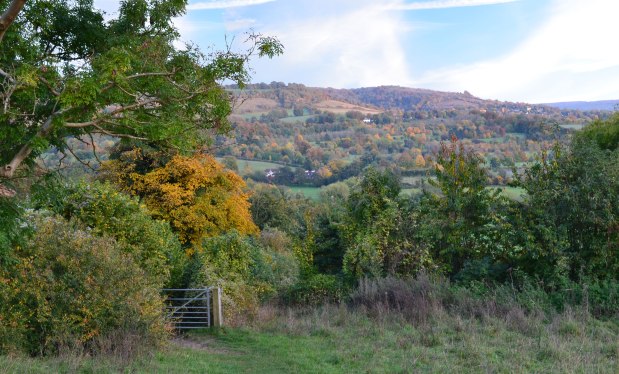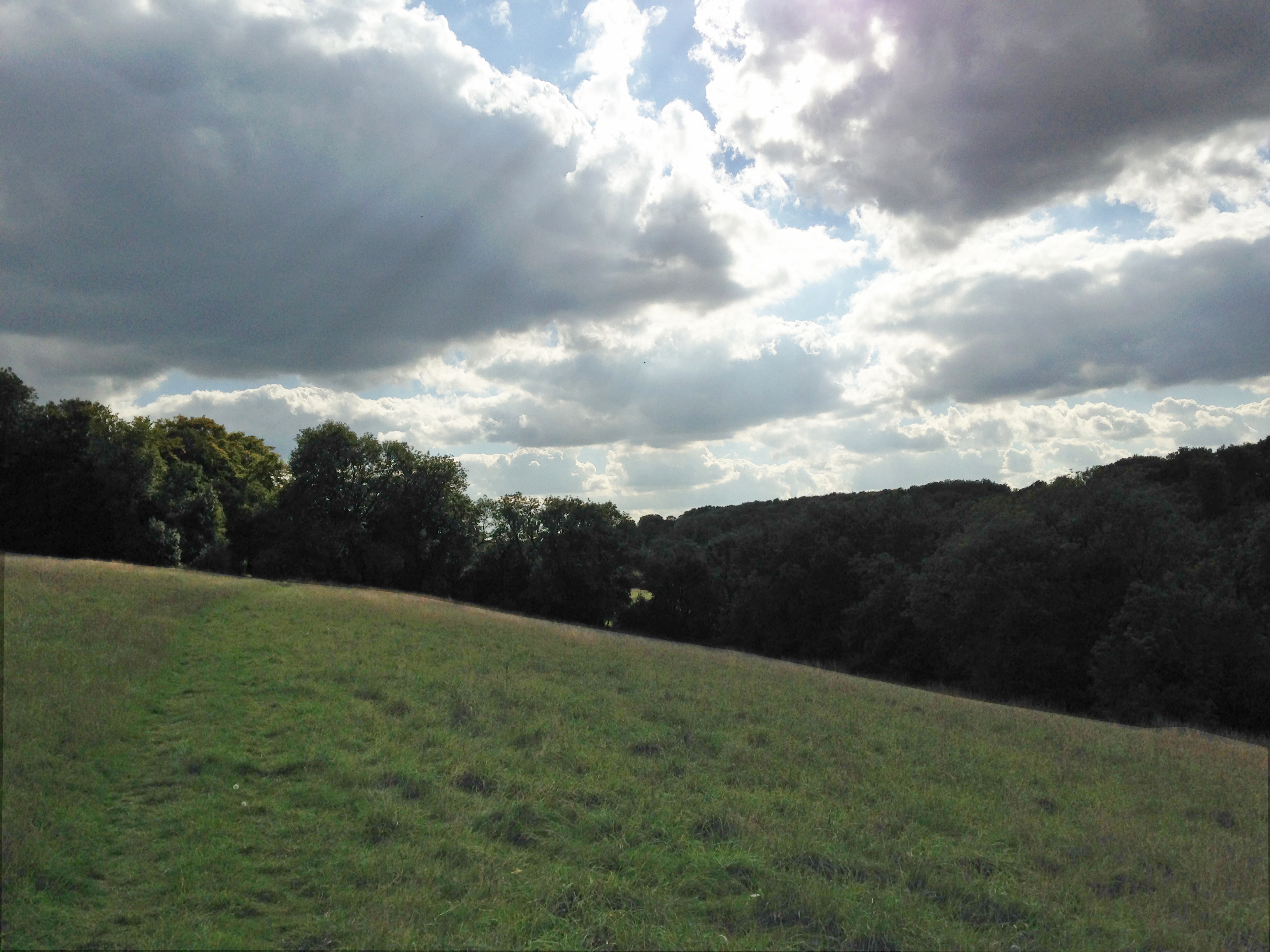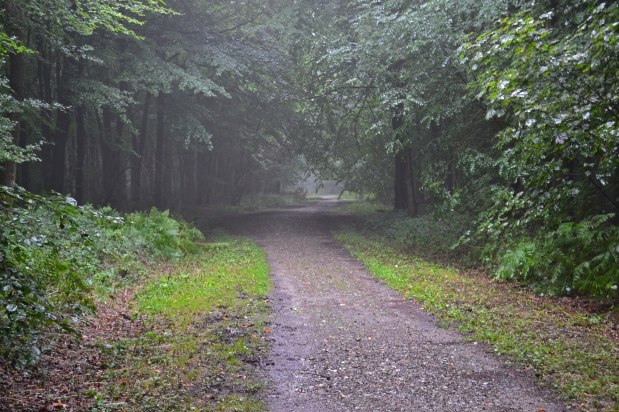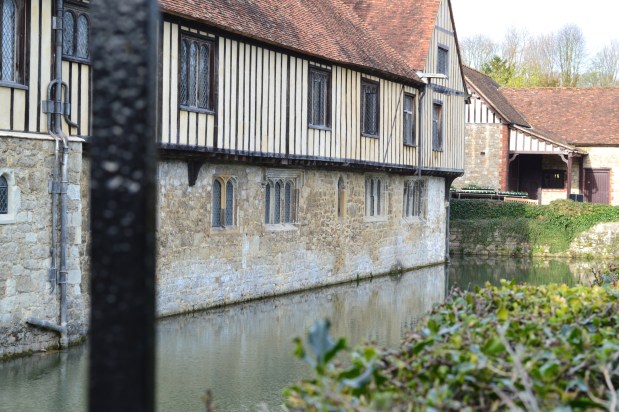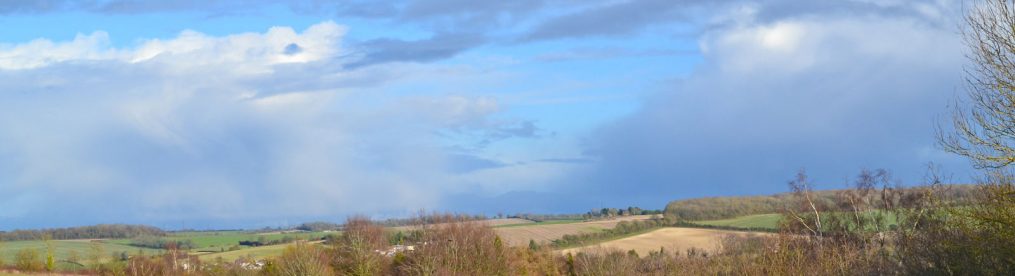
What an appalling bank holiday weekend for weather. I can’t remember one like it; only Saturday morning was up to scratch. And this on top of a week of heavy rain. In need of exercise though, we drove over towards Shoreham and walked for five miles on various paths in the the western Darent Valley above the village to Andrew’s Wood, then through Pilot’s Wood and Meenfield Wood back to where we’d parked (where Shacklands Rd meets Castle Farm Rd and the High St). With the humid, steamy, very damp conditions the woods had the feel of a tropical cloud forest. At the highest points we were in the clouds, draped over the tops of the North Downs. The wildlife consisted of wrens, pigeons and a robin, however; not quite up there with howler monkeys and the three-toed sloth.
Author: ammcculloch49
Ashdown Forest – great even on rainy days
Just a one-hour drive from south-east London or train journey from London to Tunbridge Wells, Crowborough (nearest station), Uckfield or East Grinstead then bus/taxi/cycle. More info on public transport options here
Further afield than the walks on this site, but not inaccessible from London by train/bus/taxi/bike, is the extraordinary Ashdown Forest (map here) in East Sussex. ‘Forest’ is a misnomer; the word did not originally mean just woodland, it referred to areas where deer were kept for hunting – often in a mixed habitat.
The Ashdown Forest lies on the high weald of sandstone between the chalk of the North and South Downs. It’s a great place for walking – you can wander anywhere, there are few fences and loads of paths. There is scots pine, heather, gorse, rare birds like the dartford warbler, lizards and snakes, many varieties of butterfly, moth and dragonflies. There’s also a lot of history – the area was a favourite hunting ground for Henry VIII (useful for nipping into Hever Castle on the way back too or, if Anne wasn’t in, Bolebrooke Castle), and there was a medieval iron industry in the forest too. On a misty, drizzly, murky day like Monday this week it really resembles parts of Scotland (you wouldn’t be able to see any mountains on such a day anyway).
The pictures here were taken around Gills Lap – a place immortalised by AA Milne in Winnie the Pooh – and Wren’s Warren Valley (Eeyore’s gloomy place in Milne’s stories).
Where to go: Parking is easy in the Ashdown Forest. There are many little car parks from which paths meander off. My favourites are King Standing, Gills Lap, (both off the B2026 from Hartfield and great for high level walks between the clumps of pines), Hollies (off the Nutley Rd near Duddeswell), Lintons (ideal for the Tabell Ghyl walk), and Broadstone (close to the excellent visitors’ centre).
• Mapped walks in the Ashdown Forest from the Ashdown Forest Centre
• Guided walks
• Map of walking routes and carparks
• Forest Row bike hire
Near the Ashdown Forest is a flat off-road cycle route called the Forest Way running 6 miles from Groombridge to Forest Row (bikes for hire in Forest Row). Groombridge (home of the superb manor house, gardens and woodland, Groombridge Place) is on a steam train line – the Spa Valley Railway – between Tunbridge Wells and Eridge, on the edge of the Forest.
Ightam Mote walk added
What a beautiful house Ightam Mote is. A real treasure kept open by the National Trust dating from the 14th century set in lovely gardens and surrounded by woods and hedgerows, oast houses and old stone barns. It’s also at the junction of several excellent walks along the greensand ridge of the North Downs. My newly added walk 6 is one of these. Nearby pubs and villages offer a lot too – Stone Street, Underriver, Plaxtol and West Peckham are all great places to stop off in.
Summer dusk walks
The extra hours of daylight means you can even get out into the countryside from south London after work if so inclined. Worth the effort I’d say. Pictured is Darwin’s house from the adjacent field, June 2015 at about 8.20pm; the others are of various fields on Walk 1.
Ide Hill’s Cock Inn open again. Hooray!
It’s bad news for Romney Street’s Fox and Hounds (see below) which seems a long way from reopening, but good news for walkers finishing up in or passing through Ide Hill – the Cock Inn has been superbly revamped and is now open after a short period of uncertainty. Here’s the slightly convoluted story of its refurb which sounds like a bit of a planning mix up. Anyway, the end result is good; the place looks excellent and its original character is alive and well. Pictures above from the Ide Hill circular walk.
Here’s the gorgeous Otford circular walk … but the Fox and Hounds is closed. Noooooo…

Thunderstorm approaching – seen after leaving point 7. April 2012. This storm ended a long warm spell from March to April and ushered in the rain that went on for all of May and much of June that year (spoiling the queen’s regatta among other things)
I’ve finally got around to adding the Otford circular walk. At six miles it’s the longest on this site so far and the most hilly, but it’s worth it. But it’s a crying shame that the halfway-point pub, The Fox and Hounds, has shut down. It had a really good, large beer garden and giant fairytale shoe for kids to play in with a slide on top. I guess it was a bit isolated to survive the rural pub blight – especially in the winter months – not being in a village. Also newly shut is the Austin Lodge golf course, which clearly was suffering from the downturn in golf. There are also quite a number of courses in the area and competition must be tough. Presumably the valley it was in will now go back to farmland, but for now it’s got a rather wistful, wild look to it. The walk, like the others on this site, is within the Kent Downs Area of Outstanding Natural Beauty.
The walk is best in April-October – after that it gets too muddy at some points. The first time I did it, in 2005, I got home just in time to see Steve Harmison bowl Michael Clarke in the amazing 2nd Test of that momentous ashes series. A big moment (for some of us anyway), and a great ending to a great day.
Aerial shenanigans
So I took my own advice and walked with friends and family around Downe while the airshow was on. Here are a couple of the resulting pictures.
Buzzards, aeroplanes and wild flowers
The bluebells are well and truly finished now we’re into June, but the meadows in this little pocket of near-idyll from Westerham to Eynsford are alive with wild flowers. The field adjacent to Down House is particularly spectacular as are the open grass sweeps of Lullingstone. I’m no expert on variety identification but there’s more to see than just daisies and buttercups – there’s pyramidal orchids, abundant cow parsley, cowslips, chalk milkwort, speedwell…
Cycling near Cudham recently I disturbed a large buzzard. Close up, the scale of this bird of prey is decidedly impressive, but what suddenly occurred to me is that, when growing up, it was unheard of to see buzzards so close to London. They were definitely considered birds of the upland wilds, not the suburban fringe. There’s clearly been a sharp rise in their population in recent years in these parts … I wonder if there’s a breeding programme nearby, or perhaps it’s that their persecution by landowners has stopped. Soon after this I saw two buzzards soaring over the valley between Downe and Cudham, closely followed by a red kite gliding at height from north to south. Again, sightings that would have been almost unthinkable up until 10 years ago.
At Downe Bank, on another cycle on a recent coldish evening, I saw my first ever badger in the wild, hurrying across Cudham Road ahead of me as I laboriously ascended that steep hill.
On June 13 walkers in the area will be treated to the sights and sounds of Spitfires, Hurricanes and the Red Arrows, all flying at the Biggin Hill Festival of Flight. The air show marks the 75th anniversary of the Battle of Britain, and while a more modest affair than the airfield’s major International Air Fairs (until 2010), the event should prove a fitting tribute to those who fought against the Nazis from Biggin Hill. And walkers and cyclists in the area that day will get some unusual and exciting views of the planes as they manoeuvre for passes over the airfield.
Bluebells 2015
(Read latest bluebell piece for 2020, here) The bluebells, as I write on April 26, are in full swing. They generally love moist, even swampy ground in sun-dappled woodland (so coppiced trees are very good) and south-facing slopes where the drainage isn’t great. The best places for walking amid bluebells – of the walks on this website – are:
1 Ide Hill-Toy’s Hill circular walk via Emmett’s Gardens. Here, bluebells are everywhere. Especially brilliant on the south-facing slope of Emmett’s Gardens.
2 Shoreham circular – extend the walk into the woods above Shoreham to the west, as far as Andrews Wood for great bluebell vistas.
3 Downe circular – at Point 3, instead of turning right towards Downe House, turn left on the path that heads down into woods (in to the valley between Downe and Cudham – an area called Downe Bank, which also contains some orchid varieties). The bluebells here are amazing. In fact every little copse around Downe, Biggin Hill and Cudham has spectacular seas of blue.
Other superb displays can be seen at One Tree Hill (1km south east of Knole Park), near Sevenoaks. Then, and closest to SE London, there is Petts Wood/Hawkwood. For the latter, enter the wood from the entrance under the railway line at the intersection of Towncourt Crescent and Birchwood Road and take the second path on the left and you’ll soon be in the realm of the bluebells (in Edlmann Memorial wood) after passing through a grove of chestnuts.
Big trouble (sort of) in little Downe
Downe is a quiet village with a big history but it’s home to Nigel Farage’s two local pubs, both of which are pretty decent places for a drop. So, the Ukip leader was ousted from his Sunday lunch in the Queen’s Head last Sunday (22 March) by the Beyond Ukip Cabaret Group who had originally hired the George and Dragon‘s function room (without revealing the nature of their booking).
Having been tipped off that Farage was eating 200 metres down the road at the Queen’s Head, the group speedily headed there. No one likes deserting a family Sunday lunch so I guess what started off as a good humoured affair might have turned a bit ugly. Usually Downe is full of cyclists and walkers at that time, many no doubt enjoying the bonus entertainment provided by the cabaret group, whose desire to represent diversity led them to appear like extras from some under-resourced global disaster movie.
Anyway, let me just reassure you, dear readers, that EU flag-burning nights and torchlit processions behind smouldering Jean-Claude Juncker effigies remain unknown in Downe; it’s just a village dragged reluctantly into the limelight, for a few days only (hopefully).
Read accounts of the protest by a Guardian journalist who joined the cabaret group, and the riposte to his report from the Guardian-reading landlord of the Queen’s Head. Interestingly, many of the protestors have realised that the events were a bit of an own goal, given that Farage’s children and those of other diners in the pub were apparently terrified. To avoid deep depression about the future of the country, don’t read the comments.