Yellowhammers and Spitfires

Yellowhammers and Spitfires

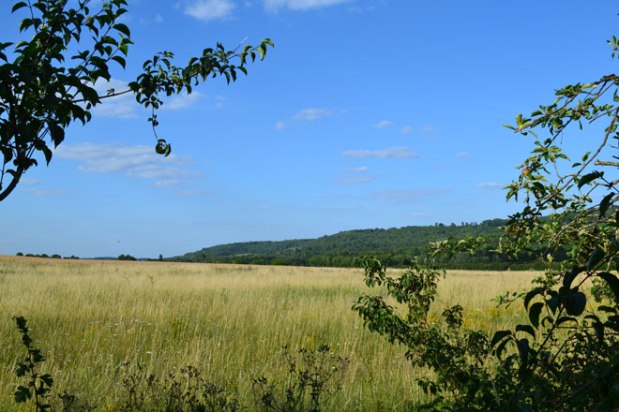
An idyllic new route: walking down Polhill Bank then past Sepham Farm towards Otford takes you into a summery wonderland of wild marjoram, myriad butterflies, hedgerow birds while, in the (hopefully) azure sky, two-seat Spitfires purposefully head off to deep Kent on joyriding trips.

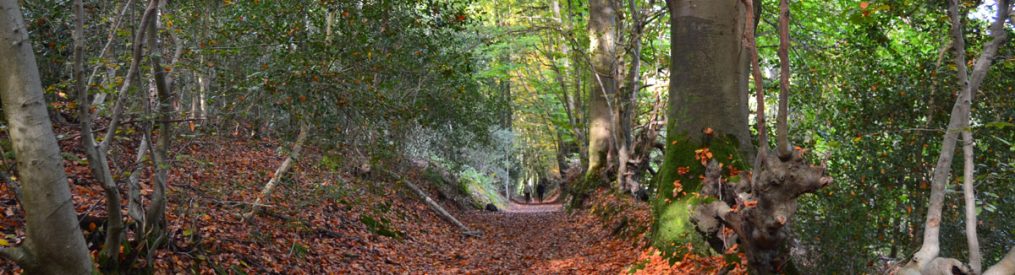
There are loads of paths to take from the car park off Shacklands Rd by Badgers Mount; it’s easy to customise walks from there. But you need to stroll a mile or so before you can rid yourself of the M25 noise. But even close to the motorway there are compensations: Andrews Wood, Meenfield Wood and Pilots Wood are beautiful and each has its own character. Visit late in the day and the shadows and sunbeams among the beeches form a light art installation on a scale the Tate could only dream of. Kent Wildlife Trust is taking care of some of Pilots Wood these days, and of Polhill Bank which it leads on to, a south-facing slope full of wildflowers and a perfectly framed window of the vale between the North Downs and Greensand Ridge.

This slideshow requires JavaScript.

Continue down the steep slope and enter a world resonant with birdsong – yellowhammers in particularly (de-de-de-de-de-de-deeeeeee) – and the growl of Merlin engines overhead from time to time.

There are views over rich meadows, cereal fields, apple trees and ancient hedgerows. In the haze oasthouses stand out black and white against the darkly wooded valleysides. Right now, in July, butterflies abound – peacocks, commas, red admirals, gatekeepers, meadow browns and more. Buzzards drop by for the views (and carrion). At one point you come across Pluto, the furthest point of the to-scale Otford solar system model (the sun is in the recreation field in the village somewhere). At four miles, the route is doable for the kids with a couple of tough slopes thrown in to test out the oldies’ knees. Check it out.

• GPX map of route, click here
• PDF, click here

Google map

Let’s hear it for foxgloves (and rosebay willow)

Let’s hear it for foxgloves (and rosebay willow)

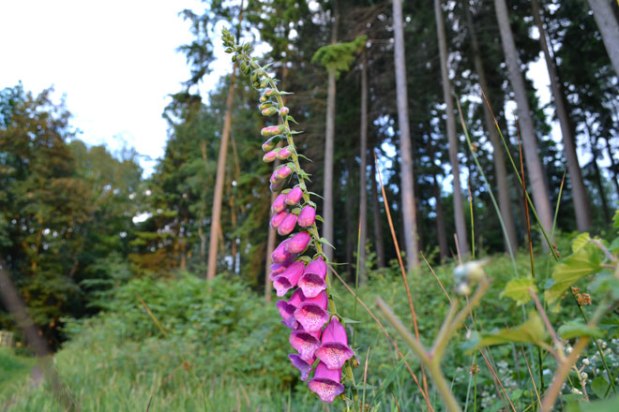
People (like me) go on about orchids but undeniably our most spectacular native flower is the foxglove. Agreed? They’re flowering now and bees love ’em. Maybe it’s because they’re not rare they don’t get quite the attention all the little more obscure ones receive. So what are the best walks on this site for foxgloves? Ide Hill, Chiddingstone, One Tree Hill, Hever, Hosey Common/Westerham. Most will have stopped flowering by mid-July I’d guess. It’s a beautiful flower but highly toxic – and our distant ancestors associated it with evil because of this toxicity, calling places where it appeared ‘Witches’ Grove’ and the like. It really can cause harm, including heartbeat fluctuations, vomiting, blurred vision and collapse. However, its digitalin chemical, which gives it these qualities, is also used to treat heart conditions. Besides, it’s very pretty – if you like pink – so let’s move on from all that.

It particularly likes lighter acidic soils and seems to thrive in woodland gaps, glades and recently cleared land. I’d say it’s more a flower of the Greensand Ridge than the North Downs chalk though you can find it in the woods and hedgerows of the latter.

Also spectacular from now until August is rosebay willow herb. Just as tall as foxgloves this beautiful flower grows even more abundantly on the walks than foxgloves. There’s one particularly impressive ‘forest’ of rosebay willow on One Tree Hill, just behind the famous viewpoint, in a glade.

This slideshow requires JavaScript.

Meadow mystery magic and a forgotten aviator

Meadow mystery magic and a forgotten aviator

I’d only ever done Walk 14 (Shoreham’s ‘mysterious’ eastern valleys) in winter and autumn prior to today. It then had a lonely, almost eerie quality. I’d assumed it would be busier but my friend and I were alone as we traversed fantastic woodland and wildflower meadows, and yes, it still had that timeless feeling of loneliness. Dark green fritillary butterflies and commas were seen as were bee orchids, fragrant orchids and fields of poppies and thistle.

After the hamlet at Austin Lodge we made it up the hill to the Percy Pilcher memorial; a beautiful spot overlooking a typical North Downs dry valley. Pilcher was a 19th-century glider designer and pilot who tested many of his designs right here, a couple of miles south of Eynsford. He was poised to become the first man in the world to achieve powered heavier than air flight but crashed and died in the south Midlands flying his Hawk glider before he could get his powered machine – a revolutionary triplane – in the air. Pilcher would have beaten the Wright Brothers by four years had he succeeded. A more impressive monument to the great man was put up at Stanford Hall, Leicestershire, scene of his last crash, but the one near Eynsford (pictured below) felt perfect in the hush of this breezy, warm day.

One day in 1897 Pilcher let his cousin Dorothy Rose Pilcher take the controls of his Hawk glider – probably the first time a woman had flown a heavier-than-air-aircraft. She flew down the hill and collided with a man operating a cinematograph camera. I reckon it was his fault but no one was hurt thankfully.

This slideshow requires JavaScript.

A great thing about this walk is that it starts right by Shoreham (Kent) station (obviously an even better thing once the pandemic is over, whatever that means). Please don’t try to get to the Pilcher memorial by car; there’s no parking at Austin Lodge and the whole essence of this remarkable place is its tranquility. You can park the car by Shoreham station (please avoid driving through the village which can get snarled up and spoilt by traffic) for free if you feel the train service is unsafe for Covid-19 reasons.

Learn more about Percy Pilcher.