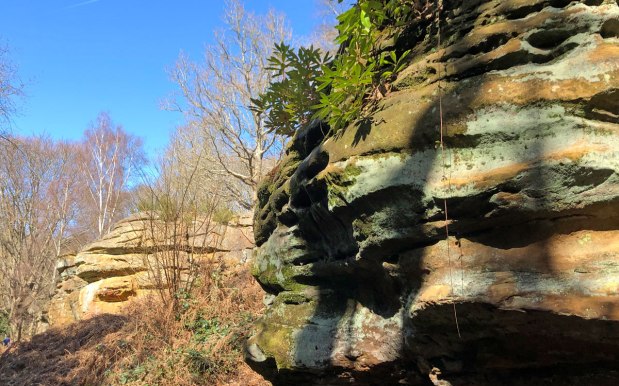
The sandstone outcrops in and around Tunbridge Wells on the Kent High Weald are little remarked on yet are the most climbed rock formations in the country, given their proximity to London. A great walk can be done from Tunbridge Wells station out past Wellington Rocks on the common, through Happy Valley as far as High Rocks, taking in all of these wonderful, alien-looking formations that appear strangely out of place within the smooth contours of south-east England. Perhaps come back via Rusthall Common, and its Toad Rock. A bit further away, at Groombridge are Harrison’s Rocks, perhaps the most striking of all and easily reached from Tunbridge Wells by taking the Spa Valley railway.

The sandstone here is Ardingly sandstone – a different type of rock to the greensand (glaucite) further north on the ridge south of Sevenoaks (see Ide Hill, Underriver, Oldbury and One Tree Hill walks). There are also outcrops, though much smaller, on the Hever and Chiddingstone walks. Our walk last week, in delightful weather (sadly not available this weekend) took in the Cheesewring rocks south of Rusthall Common.
The origins of these rocks, which gained their characteristic cracks during the ice ages, lie in sediment of the Wealden Lake. This covered much of what is now SE England and northern France 145 million years ago. I’ll add a walk at some point to cover these superb spots.

Meanwhile, grey clouds returned this Sunday but it was great to see the fantastic magnolias in full bloom in Scords Wood, as it melds into Emmetts Garden on the Ide Hill walk. The distant fields and even Bough Beech reservoir appeared white in the odd light. I’ve never seen that effect before. It was unsettling. But still, a lovely walk.
(Photographs: Cheeswringer, Tunbridge Wells; magnolia at Emmetts Garden. Adam McCulloch, iphone images so not the best!)


 Kent walks near London