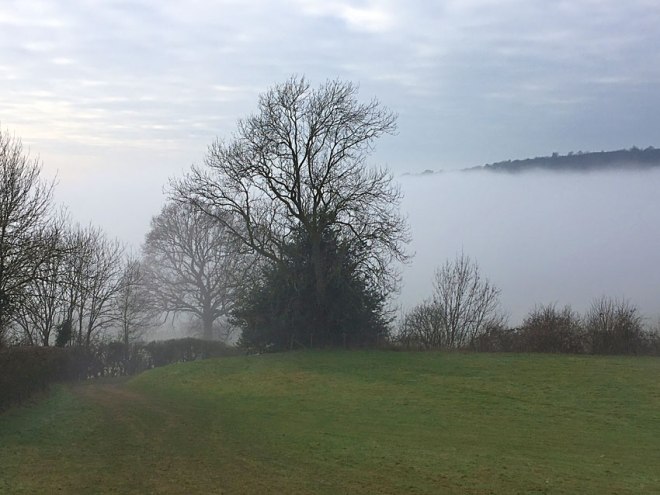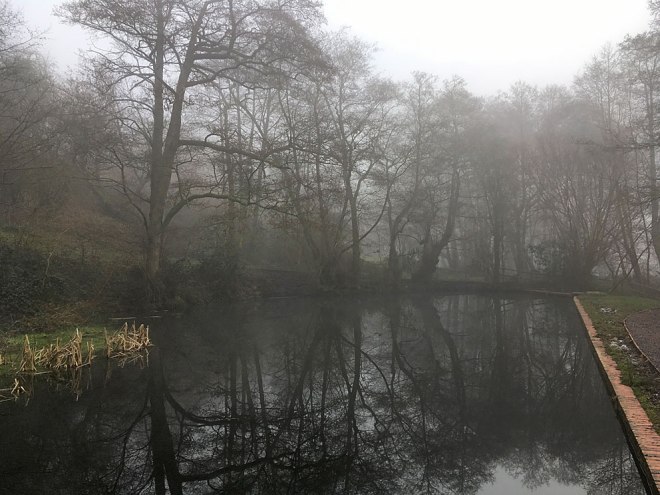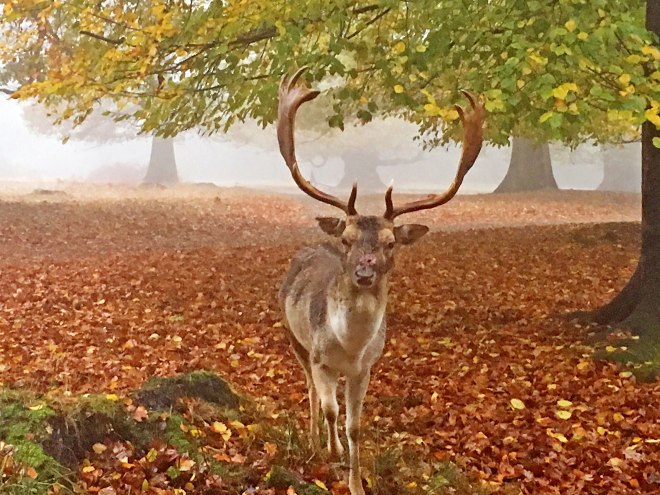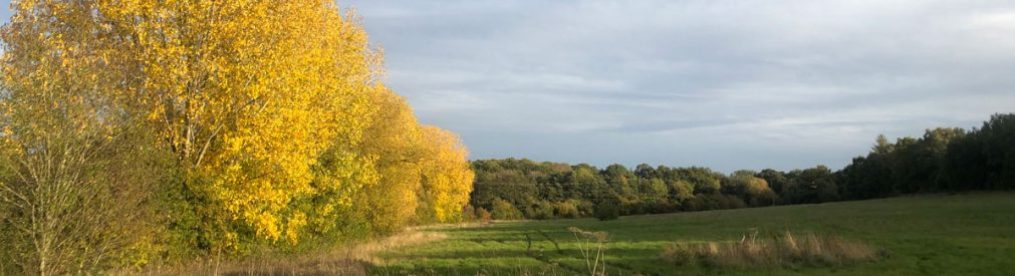
Two weeks ago I walked at Downe in snow (see pictures below) – a reminder that villages near the leading edge of the North Downs (Ide Hill is another) are just enough metres higher than SE London to convert rain into snow. Since then there have been signs of spring; no sightings of ridiculously early bluebells so far, unlike this time last year, but a milder feel despite Doris rushing through. This past weekend a drizzly Knole Park walk was hugely enjoyable. Although the park was surprisingly busy there was a lovely wild atmosphere about the place and the removal of scaffolding from the side of Knole House restores the Tudor integrity of that fantastic structure. Busy green woodpeckers and flitting small mixed groups of finches provided the evidence that change is in the air. No owls though, even as dusk came on.
Kent
New walk: Shoreham’s mystery eastern valleys
Beyond the steep, thickly wooded eastern wall of the Darent Valley is a quiet chalk upland area of dry valleys, meadows and plateaus. There’s a disused golf course, now overgrown and becoming a bit of an unofficial wildlife reserve, lovely north-south views, a discreet private airstrip behind a strip of woods from which vintage light aircraft are regularly flown, and, well… that’s it really. It’s a very atmospheric area and, for me, quite different in nature from the western valley wall. My new, ‘eastern valleys’ walk (number 14, 4.5 miles, pix below) really digs into this tranquil, timeless landscape via the little hamlet close to the defunct Austin Lodge clubhouse. Also the Otford/Shoreham/Romney St walk (5) takes in some of it. Walkers can combine the two routes to make a 10-miler or combine them with the Shoreham Circular strolls (8.5 miles). The starting point for the new walk is Shoreham railway station, which is well connected to south-east London, by Thameslink trains (not the most reliable line but so handy for the countryside). It can also be started from the church with an alternative route up to the plateau. There are some steep sections so you’ll feel this one afterwards. Enjoy. (Download a pdf of this walk.)
The joy of bad weather walks
The weekend has started abysmally, with heavy rain, low temperatures and general murk. Great for walking! Yes, there’s a real frisson in donning hat, gloves and coat and striding off on a ridge amid horizontal precipitation. Failure to remember hat or gloves, however, is detrimental to the cause. Some places take on a whole new atmosphere of wilderness when you walk in poor conditions. Knole Park suddenly seems like a Scottish glen, the Ashdown Forest becomes Dartmoor, Lullingstone the Cheviot hills (bit of a stretch that). Anyway, whatever, my point is that waiting for perfect conditions is just not good form if you want to enjoy the local countryside. I can see from my exalted position as webmaster that the number of views on this website fall dramatically as the clouds gather. So don’t delay, ignore the moisture, get out there. I’ll be watching.


Ide Hil walk, Ram Pump Pond
A great walk on a grey day is my latest offering here… Eynsford/Lullingstone (4 miles; 90 mins). It’s mostly mud-free, has two good pubs waiting for you, and up on the hill by Eagle Heights you’ll feel the elements alright. It’s also a great choice of walk if car-less; it starts from Eynsford station.
I won’t bother with a picture; grey, rainy days aren’t very photogenic. They’re all about feeling it.
A few hours later… went to Knole Park in awful conditions, but got an OK shot with the iphone
– had to brighten it a bit so a bit pixelly but still…

Stag at Knole, November 2016 (Point 1 on the Knole Walk)
Knole Park’s wild side (3.5 mile walk)
Knole Park is great for an autumn walk. Fantastic beeches and oaks, with the odd yew and pine plantations, make for a colourful spectacle. Encounters with deer, interesting birdlife such as green woodpeckers, redstarts, and weird fungi and so on, add to the interest. Oh, and a great National Trust maintained tudor mansion (Knole House). A lot of the park counts as rare lowland dry acid grassland, if you’re in to topographic categories.
My walk takes in the more remote-feeling eastern side of the park, starting in woodland on the park’s southern perimeter. I’m afraid that’s not the most convenient place to start the walk if you’re travelling to Sevenoaks on the train, but you can still do the walk by starting closer to the station at the park gate behind the leisure centre (half a mile walk from the station) – and then joining the route by Knole House (ie point 4 to 5 when you see the map – click link below).
Read about the route here
Download and print off a pdf of the walk
Slow worm and autumn colours
Enjoyed an excellent walk on the western ridge above Shoreham to Polhill today. Autumn colours were beginning to kick in, lit up by the slanting late afternoon sun low in a sky that looked to be in a state of flux. High cirrus, ragged grow low broken cumulus, patches of blue and squally showers on the horizon.
I love coming across unexpected wildlife so was delighted when my son spotted a large slow worm by the path. They are legless lizards apparently, not snakes and not worms. This one was a real beauty, more than 20cm long, and I think a female (males aren’t so stripy apparently). In one of the photos you can see its little black tongue flickering out. They eat slugs and worms apparently – the only creatures that aren’t quick enough to get away – and can live to, amazingly, 50-odd years.
Just finished reading Beryl Bainbridge’s Birthday Boys novel about the expedition to the Antarctic led by Captain Scott that finished in tragedy in 1912. An incredible book that gets inside the heads of some of the main protagonists on the trip and leaves the reader staggered all over again at the risks and appalling hardship those men gladly signed up for: recommended.
Places on these Kent walks where you might go the wrong way

Hidden valley path on way to Ightam Mote
I don’t think there’s too many places on these walks where you can get lost but it’s very easy when writing instructions to mislead inadvertently. The word ‘track’, for example, does not mean the same thing for everyone; ‘pass a large pine tree’ won’t be too clear to someone who doesn’t think it is a large pine tree. And it’s very easy to miss out stiles and kissing gates in the instructions as I have done quite a lot. Then there are farmers who plough up paths (that’s happened at Shipbourne and Downe in the past). Here are the points where people have contacted me to ask for clarification (I’ve altered the instructions in all cases but it may not be enough…)
1 Downe walk: some people have gone wrong at the very start by missing the path just next to Christmas Tree Farm and setting off to Cudham on the footpath a few metres further on. My fault, because I didn’t mention initially that the correct path is slightly hidden by vegetation whereas the Cudham one is clearly visible.
2 One Tree Hill walks: the woods to the rear of the hill, if walking from OTH to Wilmot’s Hill on the way to Ightam, are easy to get lost in. You have to keep your bearings in relation to a couple of houses and an orchard. I’ve tried to make it easy but it’s quite hard to describe (I’ve gone wrong myself in there). However, once you hit the country lane you’ll be able to pick up the Wilmot’s Hill path OK.
3 Ide Hill: Near the beginning, people have told me my instructions are unclear and they almost set off on the Greensand Way to the east, towards Sevenoaks. The answer is to walk down the hill, ignoring all detail I’ve stated, then turn right when you hit another path, thus keeping Ide Hill village (at the top of the hill) to your right. Then you cross the valley towards Scord Wood and Emmett’s Garden with Ide Hill at your back. Not my fault that one, I feel.
4 Hever. Ah. Luckily for me perhaps, not the most popular of these walks, though I love it personally. There are four points where you can go wrong. I’ve covered them all in the instruction but, hey, you’ve got enough to read. First, turning right at the ‘second house’. This path angles off the lane in front of a house called ‘Bothy Cottage’, at the entrance to the house’s drive. Secondly, immediately on leaving the sandstone outcrop at Hill Hoath, turn right and go through a kissing gate next to a long strip of meadow (some walkers have been known to go straight on – fine if you want to go all the way to Penshurst). Third, in Stock Wood, ignore the major-looking path off to the right and narrow one angling left – keep on the centre path even though it doesn’t look very ‘major’. Fourth, turning off Uckfield Road it’s quite easy to miss the footpath, though it does have a sign. The kissing gate is a bit buried in hedge.
There are bound to be other spots that left walkers in a quandary… please let me know in the comments section, or by email, so I can update my instructions accordingly.
Cities of mauve spires
Rosebay willowherb is now in full bloom in glades, on verges, and by railway tracks throughout Kent. One of the factors causing the plant to spread so much in the past 70 odd years was the second world war when clearings were made in woods, aerodromes were built all over the south east and bombs were dropped across the region. Why this should be I don’t know… anyway honey bees love ’em and when you see clusters it’s quite a spectacular sight. One such spectacle is in the clearing in the woods at the top of One Tree Hill. Keep quiet here and just listen to the hum of the bees. On Sunday we did the ‘hidden valley’ walk from One Tree Hill; I haven’t put it on this site yet, but will do. The walk ends up as another Ightam Mote circular but takes in a fabulous secluded valley behind Wilmots Hill which brings you out at the Mote after passing somewhat sinister-looking accommodation for early 20th century hop pickers. I’ll write up the walk soon… can’t believe I haven’t done it before.
A taste of summer

Lullingstone and castle, summer 2014
Summer has suddenly broken out for the first time in weeks. Today is looking good, tomorrow also after a dull start. The heat truly comes on for Monday though there may be some cloud around, so expect humidity, but a good time to take kids paddling in the river or down to the coast. However, there are thunderstorms up ahead. What I’d love to get on this site is a good pic of lightning from one of the walks; a sort of north-west Kent storm-chasing scenario on foot. There haven’t been many occasions when I’ve done one of the walks in hot summer weather… just hasn’t happened much lately, but here’s a pic of Lullingstone Castle from the Shoreham to Eynsford walk on a hot day in July two years ago.
A few Downe images
I really like the meadows around Downe, especially on the hillside between points 4 and 8 on the second half of the walk. Right now the buttercups have largely gone and have been replaced by a mix of scabious, daisies, clover etc amid the long grass. The colours are not so obvious as a few weeks ago when the grassy fields were ablaze with yellow but they are more varied and seem to attract a wider variety of insect life. The Downe circular is particularly useful for south east London dwellers, being the closest and shortest of the walks on this site. I can do the whole journey in under two hours if I get a move on.
Airshow at Biggin Hill – as seen from a detour from the Downe walk
Original post: Today, Saturday June 11, there’s a small airshow at Biggin Hill airfield, so it’s a good day to do the Downe circular walk. There’ll be aerobatic teams, Spitfires, a Hurricane and Mustangs and, at 15.30, the Red Arrows who are arriving at the airport directly from the Queen’s birthday flypast. Adds a bit of spectacle to the walk if the usual birdsong, trees and wildflowers aren’t enough for you!
Update: Today, Sunday June 12: A pretty poor weekend of weather though there were a couple of windows of brightness: Saturday morning and late afternoon, and late Sunday afternoon. We set off to do the Downe walk in pouring rain on Saturday, assuming the airshow had been called off. But incredibly, the rain stopped on our arrival, the clouds lifted and we were treated to the Battle of Britain Memorial Flight, the Red Arrows, a Mustang, stunt planes and a Spitfire/Hurricane finale. I’ve supported the event for many years so not feeling too guilty about walking around it, though I certainly recommend paying to enter to get the full experience. Photographically you get some interesting shots of the aircraft from public footpaths near the airfield and to hear and see Spitfires and Hurricanes in this setting, their natural domain considering the airfield was a principal fighter base in 1940, is a wonderful thing.