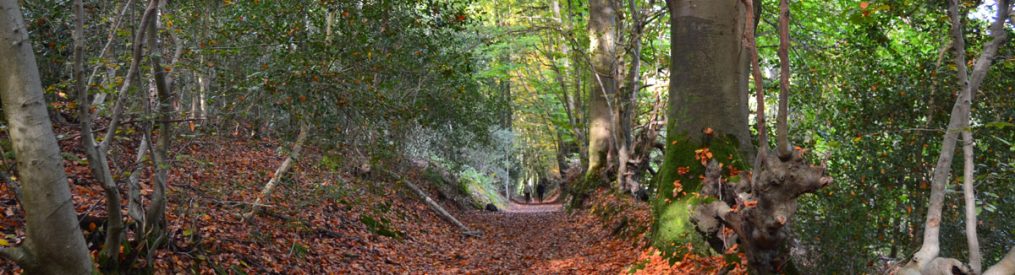
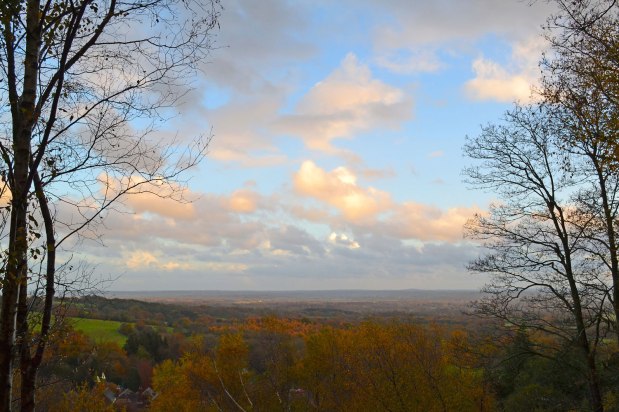
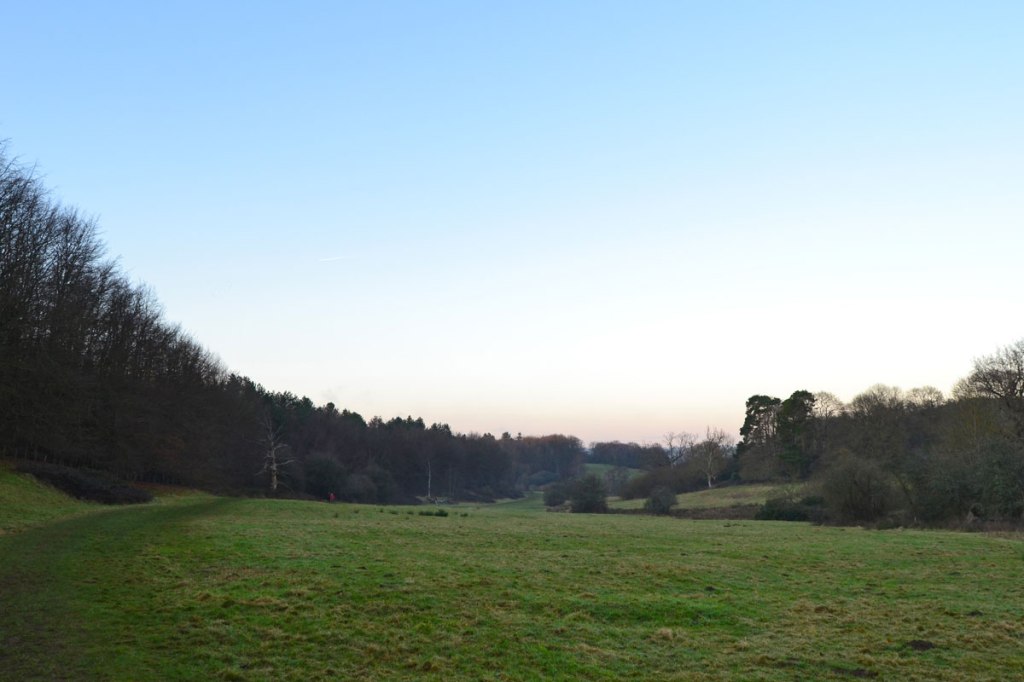
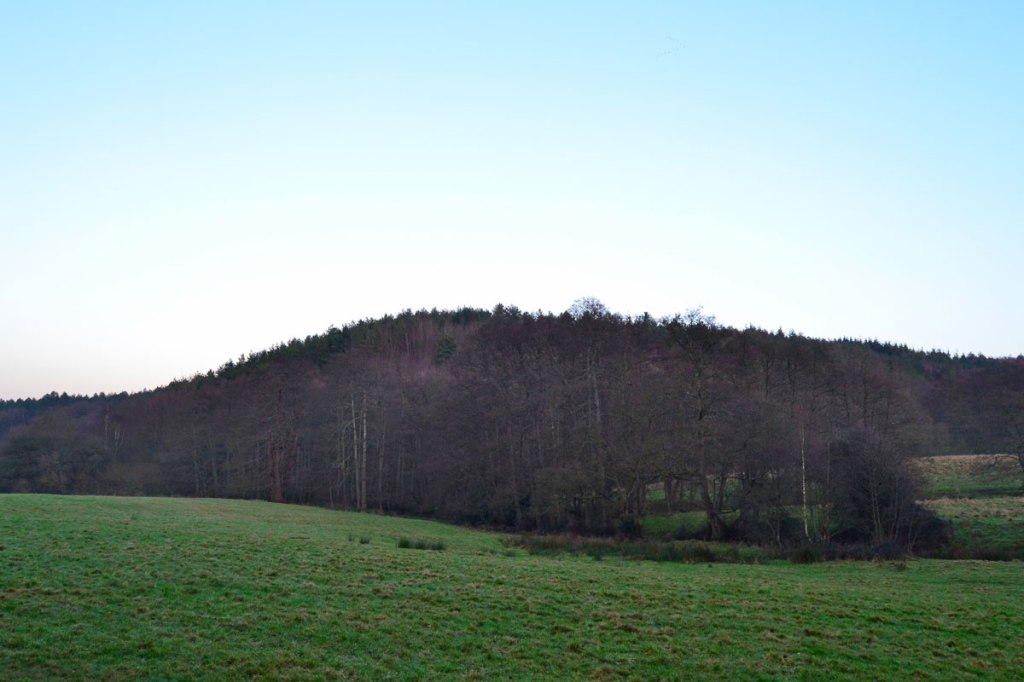
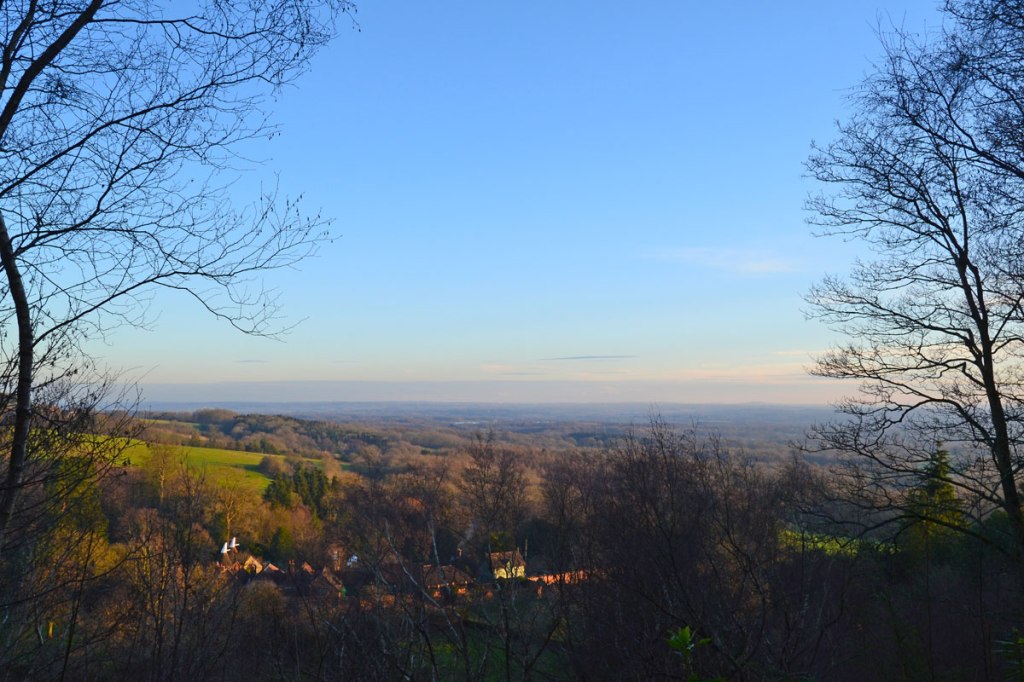
The final throws of autumn are upon us – possibly my favourite bit of the season as the deepest colours emerge and birdlife quickens among the spectrum of greens, reds, yellows etc. The Kent countryside views turn into tableaus of timeless atmosphere with woodsmoke drifting and a constant melding and shifting of seasonal tones. Timing a walk correctly is suddenly an issue. Leaving the Sydenham area at 2.20pm we got to Hosey Hill car park just after 3pm. The journey flew by as we listened to the first half of Wales v All Blacks on the radio. We were after the golden light of late afternoon but, as I feared, we were a bit late. Walking the route in reverse – so crossing the road and making for the infant river Darent first – we got some beautiful sunshine on the upper parts of the trees on the early stretches of the walk. But by 4pm those wonderful Mariners Hill views lacked colour – the sun had slipped sideways (as it does at this time of year) leaving a hazy grey and mauve world in its wake. Still nice and atmospheric of course but not as photogenic. Walking at a decent lick we got back to the car park by 4.30pm in plenty of dusky light; there was no need for iphone torches and little risk of tripping on a root.
Walking at this time of year is deceptive; when indoors you feel there is no light at all after 4pm, but if you are already out on a walk your eyes adjust naturally to the dimming light and you can keep going until 5pm I reckon.
I’ll add some photographs from the walk soon. The top photo is actually from a previous November when I set off a bit earlier.
“When spring came, even the false spring, there were no problems except where to be happiest. The only thing that could spoil a day was people and if you could keep from making engagements, each day had no limits.”
That’s a fun quote from Hemingway. I take it to mean prioritise walks above socialising, now it’s a bit warmer (I reserve the right to be wrong about that) and to get out in the woods and downs, witness the transformation from grey and brown to green, blue and yellow. I say “witness” but it happens suddenly, overnight perhaps, when you’re not looking. Suddenly the air is soft, the countryside hues have changed and spirits have lifted.
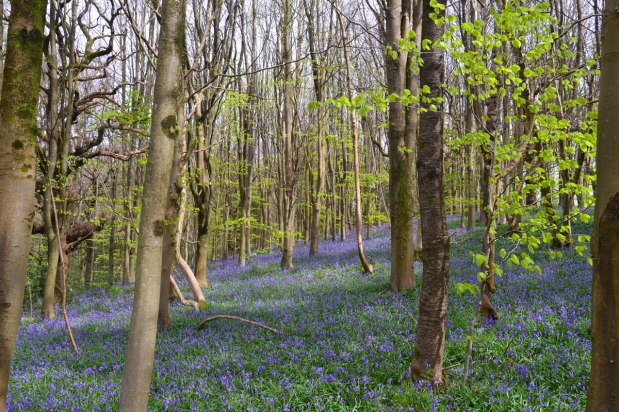
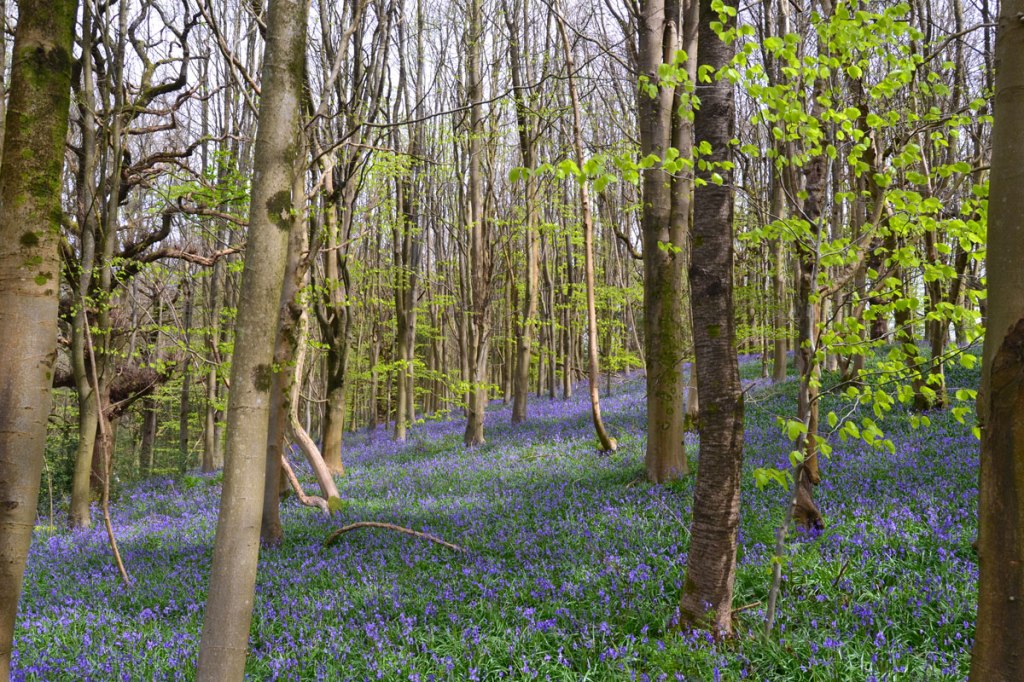
We chose the 3.5-mile Knockholt/Chevening North Downs route for late Saturday afternoon and a 4.5-mile stroll on the Greensand Ridge at Hosey for the following morning. On the Hosey route bluebells were two-thirds in bloom and were mixed beautifully with stitchwort and anemone. We heard coal tit, nuthatch, song thrush, chaffinch joining in the merry burble of song from great and blue tits, robins and wrens. A delightful pint of Westerham Brewery’s Light Ale ensued after the walk at Squerry’s Winery.
At Knockholt, along the escarpment, three red kites drifted overhead throughout the walk and a pair of buzzards hung in the air. These raptors love the updraft along the ridge and I think this walk is the most reliable route for seeing them on of all the walks here, though they can pop up on any. Please don’t think me callous but I rather hope the birds of prey feast on pheasants; there are too many of the latter human-introduced birds in these parts and they kill a large number of reptiles and amphibians.
Redwood tree above Chartwell, at Mariner’s Hill on the Hosey/Westerham route
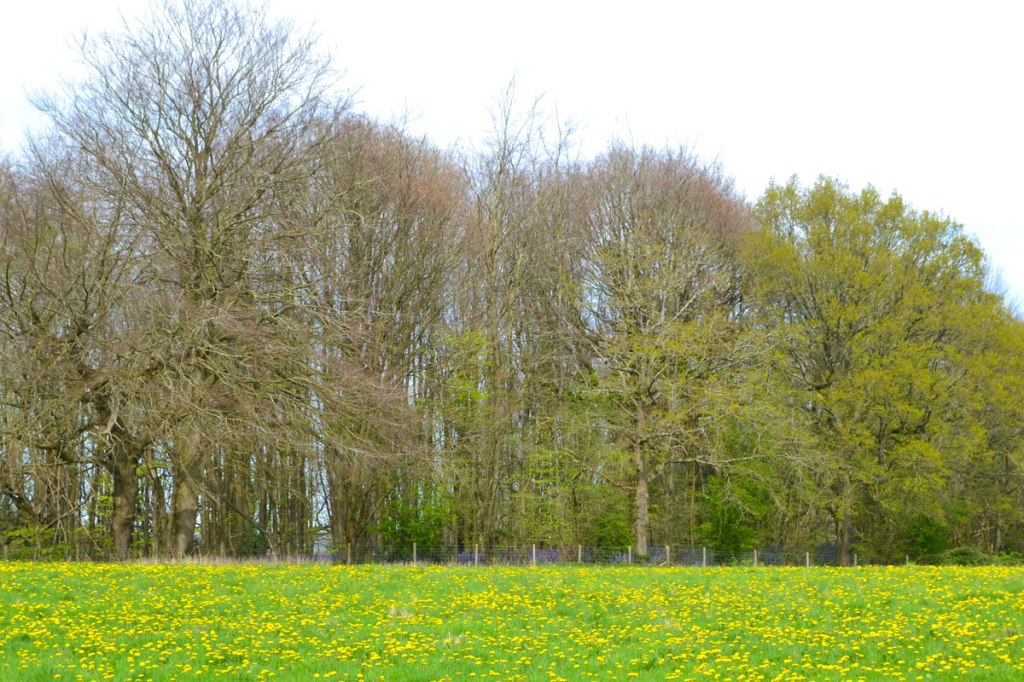
Dandelions on Mariner’s Hill, mid-April.
Bluebells on Mariner’s Hill on the Hosey/Westerham walk
A view of Chevening House and the Vale of Holmesdale from the chalk escarpment near Knockholt Pound. The Hosey and Westerham walks are the Greensand Ridge in the distance
The cleft in the Downs on the Knockholt/Chevening shorter version
Marsh marigold by the infant Darent river, on the Hosey/Westerham routes
The chalk Knockholt/Chevening walk on the North Downs ridge is separated from the Hosey walk on the Greensand Ridge by the clay Vale of Holmesdale, an east to west valley that runs in parallel to the two lines of hills and which contains the M25 and M20 motorways. Holmesdale clay runs between the chalk and sandstone yet despite the starkly different geology in such a small distance the plants and tree species don’t superficially appear to differ that much – presumably the plants have adjusted to the contrasting soils over the millennia. But there are some differences – there are more likely to be orchids and expanses of grassland on the less densely wooded chalk hills; while on the greensand the woods seem a tad more extensive and are more likely to include stands of pine, which like the sandier soils. I’m no expert so I won’t go on. Bluebells like both; that’s the main thing and this week they are reaching their peak at sites like Meenfield Wood, Scords Wood, and Mariners Hill. Enjoy them, they’ll be gone within about four weeks.
A beautiful dusk walk around Chartwell and Mariners Hill on the Hosey route, accompanied by a stunning full moon and the mew of a buzzard, hit the spot last Sunday afternoon. It’s not always the early bird that catches the worm, you know. The mud just before point 8, the ‘dramatic’ crossing of the infant River Darent, is hilariously sloshy and treacherous enough to defeat any footwear bar stilts fitted with spikes but can be avoided by walking parallel in the grassy field alongside and rejoining just before the log bridge. A satisfying hose down of boots after returning home was called for.
Just a few miles from London … latest walks at One Tree Hill and Westerham. Of course, the weather in these shots is not fully representative of how it’s been of late!