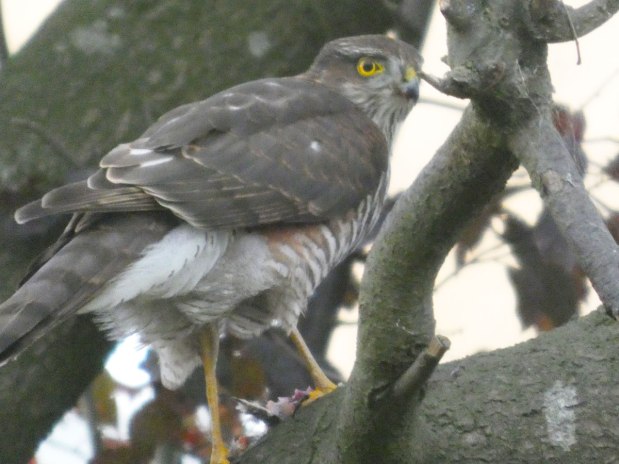
Working from home has its benefits. A glance out of the kitchen window one grey Thursday recently brought rich dividends. There in the cherry plum tree was a bird. Usually it would be a pigeon, a robin, a great tit or goldfinch. This was larger and was clearly eating something it had pinned to a branch. It was a sight I’ve never seen before – almost a bucketlist scenario in fact, a sparrowhawk in my garden. I’ve had the odd sparrowhawk encounter in my pocket of south-east London before – soaring over Cator park, racing down Perry Vale, zipping low through Mayow Park and most vividly nearly taking my ear off while chasing sparrows in Bell Green. Yes, Bell Green, that hitherto unnoticed wildlife haven. I’ve seen one try to eat a pigeon at Beckenham Cricket Club while out running. It was chased away by crows and the pigeon flew off unimpressed by its brief ordeal.
Male sparrowhawk notices a crow eyeballing it from across the garden. Not bothered.
Don’t look too closely if you’re squeamish. Nature is red in claw …
What a privilege to receive a visit from this superb bird
But this was new to me. A sparrowhawk having lunch (a poor little long-tailed tit I believe) for about 10 minutes, unhindered, just a few feet from me. I had to take photos through the kitchen window so as not to disturb him (it was def a male) so the quality isn’t great but beggars can’t be choosers. I’m still rather excited by the whole thing truth be told.
There are plenty of smartphone apps for this purpose but without knowing what you’re likely to see or hear software such as Merlin or Birdnet can mislead if used in isolation. I’m not an expert but birder and fellow Kent walker Dave most definitely is. I’ve never seen him use an app. He just stands in the middle of the path for ages building up an aural picture from the space around us. “Chaffinches somewhere in that oak 30 metres to the right; greenfinch behind us, maybe 200 metres, nuthatch flying to those conifers… look, there it is, mistle thrush down low …” I find it quite annoying to be honest. But it’s a remarkable display of skill, patience and knowledge built up over years.
What doing the odd walk with Dave has taught me is that it’s best to learn a few calls of birds you are likely to see/hear and then, once you are familiar with them, start adding other likely species. Some, robin, blue and great tits, blackbird, you can learn from the garden or park. Cuckoo is obvious and one you can hear this month and in June on the Ide Hill, Chiddingstone and Hever walks in particular. Greenfinch is very distinctive too and dead easy to pick up once you know its chatter and “wheeze” – similar but different enough to more common goldfinch. You hear it more in parks and gardens though than on the KWNL walks.
Wren – one of our smallest, but loudest birds. Photo: Wikimedia Commons
It took me ages to realise that wrens were incredibly loud and identifiable; I’ve got that one down now, along with song thrush, greenfinch, chaffinch, long tailed tits, chiff chaff, blackcap, coal tit, goldcrest, and most recently, nuthatch. I’ve no idea what dunnocks sound like, so I better give that a listen, and treecreeper too. Bullfinch is a toughie because you really have to listen out for their weird “rusty gate”-like whistle and toots. Yellowhammer is easy. To see one of these I recommend the hedgerows on the Polhill route, once down on the valley floor; Fackenden Down hedges; the Eastern Valley walk and the Chevening walk. A great one to listen for now is common whitethroat. These have arrived from Africa now and are filling our hedgerows with song; they sound a bit like their cousins the blackcap but less rich and burbling. There are loads of other, less common, summer visitors to tick off, which all may be encountered on a walk at KWNL – willow warbler has a lovely song, nightingale obviously, garden warbler… Cetti’s warbler is startlingly loud and a bird that sings disconcertingly close to you but from deep inside a thorny dense bush, so you can’t see it.
So, I’d say use a combination of memory and app to recognise birdsong. Use the RSPB site and British Birdsongs to learn two or three bird species at a time, then use one of the smartphone apps to record and analyse what you hear – having listened out for the birds you’ve tried to memorise. It doesn’t seem easy at first but pretty soon you’ll start recognising the patterns. After all, it’s just music in another form and the difference between a chiffchaff and a wren will soon be as obvious as between Dua Lipa and, say, Raye. Or Chaka Khan and Whitney Houston. Or Teena Marie and Cindy Lauper. Or George Benson and Philip Bailey; Luther Vandross and Maurice White. I could go on, and would quite like to.
Two weekends of truly muddy conditions have passed; both have been very mild and reasonably bright (well, the Sundays anyway) but with heavy rain overnight only the most hardy, dedicated walkers have taken to the squidgy, squelchy paths. Last week we splashed around the 3.5-mile version of the Knockholt Pound/Chevening route; today, with a bit less time available we took to that old staple the Downe walk, with a couple of variations. The final field once heading back to the village was a glutinous saturated sea of clay, as it usually is after heavy rain. Oh for the days when this was a wildflower and hawthorn meadow left to its own devices, alive with the calls of yellowhammer and skylark. The Downe walk has lost two delightful wildflower meadows in recent years – one to a scraggy looking crop rotation, the other to grazing by a non-existent sheep flock.
Red kite, Downe, February
Approaching final woods, Downe, February
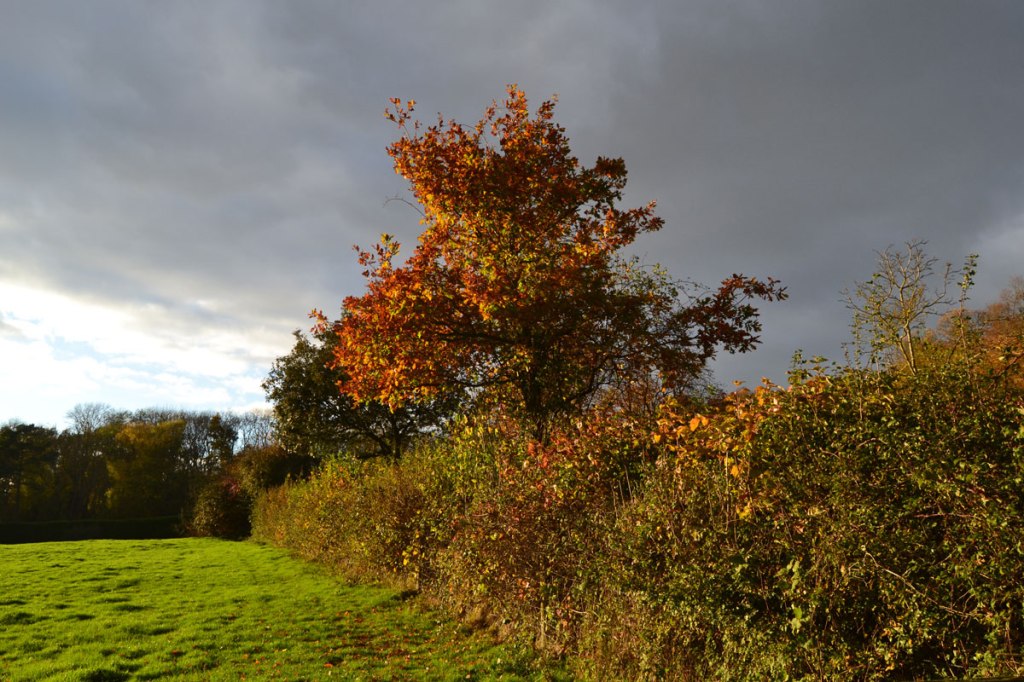
Hedgerow and approaching shower, Chevening
Approaching shower, from below the North Downs scarp, Chevening
Beech trees, Downe, February
Bare field on the North Downs ridge, Knockholt Pound
Anyhow, never mind, there we go. Let’s focus on the positives: bright skies, great colours, a sudden crescendo of bird song including skylarks after a silent winter, a Spitfire taking off from Biggin Hill – what a brill din! – and a few snowdrops to admire. Best of all there was some wonderful bird of prey sightings. On the Knockholt route we were checked out by a low flying red kite and were given a private buzzard show. At Downe this Sunday I’ve rarely seen so many buzzards gliding and soaring. A hovering kestrel joined the party at one point, while on the return leg of the walk, on the hillside above the golf course, a red kite seemed to follow me along, drifting, sideslipping and wheeling on the breeze. These incredible birds have only been regularly seen on these walks in the past 10 years or so. They are a most welcome addition – along with the buzzards, themselves a relatively new bird to this part of Kent in these numbers. On entering the final beech woods I heard a tawny owl call, despite it being only 2.30pm.
Mysterious birder Dave has emerged once again from his Kent weald lair! This was great news on this gusty, mild, cloudy day with a walk at Knole planned. Dave’s presence would ensure that I would observe or hear (rarely both) species I wouldn’t usually encounter when walking alone. Arriving at Knole late thanks to an unforeseen ambush cunningly laid by temporary traffic lights on the A21, I spotted Dave already staking out the territory in Knole’s south eastern corner. “There’s nothing here,” he said, greeting me with breezy optimism. But it wasn’t entirely true. By standing still amid the beeches and oaks in the open woodland of that area of the park it seemed the birds started to come to us. First a troop of chaffinches (but not as far as we could tell the hoped for brambling), then coal tit, song thrush, nuthatch, greater spotted woodpecker and goldcrest. As we entered the south eastern conifer plantation we heard siskin (pictured header) – or rather Dave did.
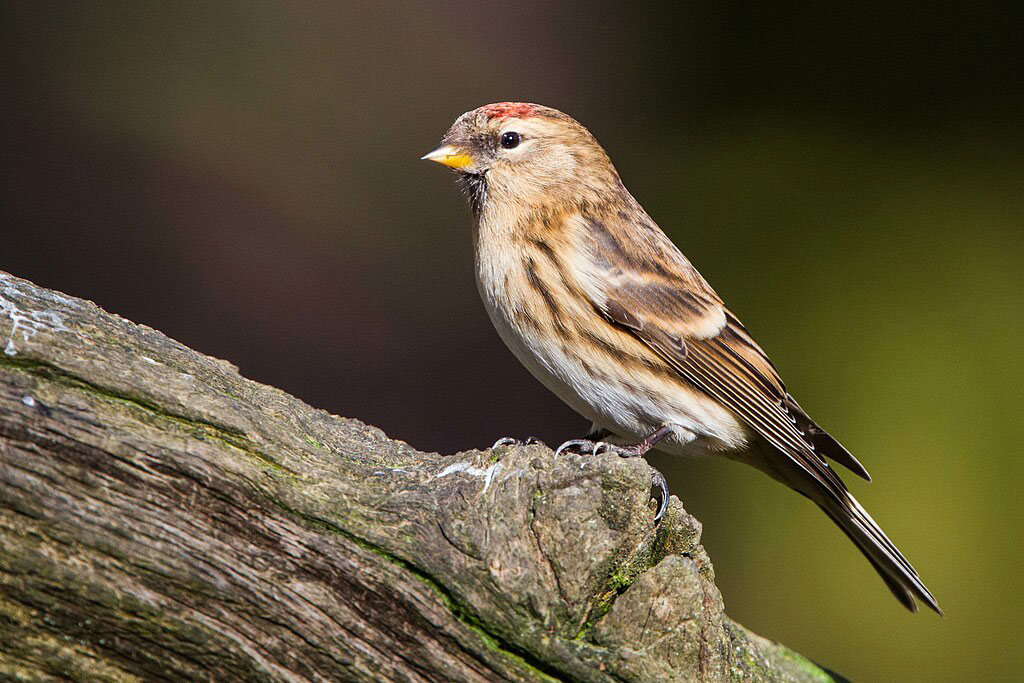
Lesser redpoll. Photo by Ron Knight/Wikimedia Commons
Later a lesser redpoll (pictured above) flew over, a very delicate little finch type thing. Two greenfinches – not at all common these days – were spotted at the top of a tree, while more predictably, a buzzard wheeled above. Mistle thrush was then heard and a flock of redwings streamed across the field on the Godden Green side of the wall on the eastern fringe, where there’s a lovely view of Fackenden to Kemsing downs and of the Darent Valley opening. Finally, a fetching pair of stonechat, a male and a female, alighted in grass just ahead of us as we started to walk up to the house. As we got close they hopped into the bracken tops, disturbing a roosting wren.
It’s definitely worth walking with Dave – you become aware of far more birds than you would normally see. I had to bite my lip though when checking the football scores – West Ham were playing at Man Utd and it wasn’t going well … sorry Dave.
Of all the seasons-within-seasons, the end of winter, or springter, is one of the least enjoyable for walking I find. That doesn’t mean I don’t enjoy getting out into the countryside; it just means that when I do, I look around and think “meh” quite a bit. There’s still a lot to look out for in early March: old man’s beard (clematis vitalba), hazel and alder catkins, blossoming blackthorn, the vigorous growth of bluebell shoots, redwings and fieldfares flocking to migrate east, small birds breaking into song, the passage of gulls at high level etc, but the predominant colours are grey and brown, the air is still harsh and raw, mud clings to your boots and you slip on steep paths.
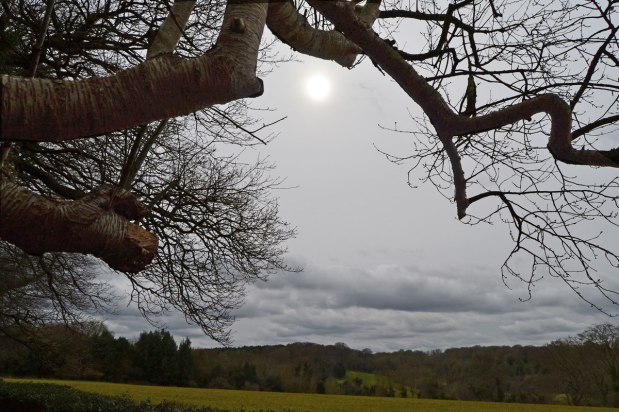
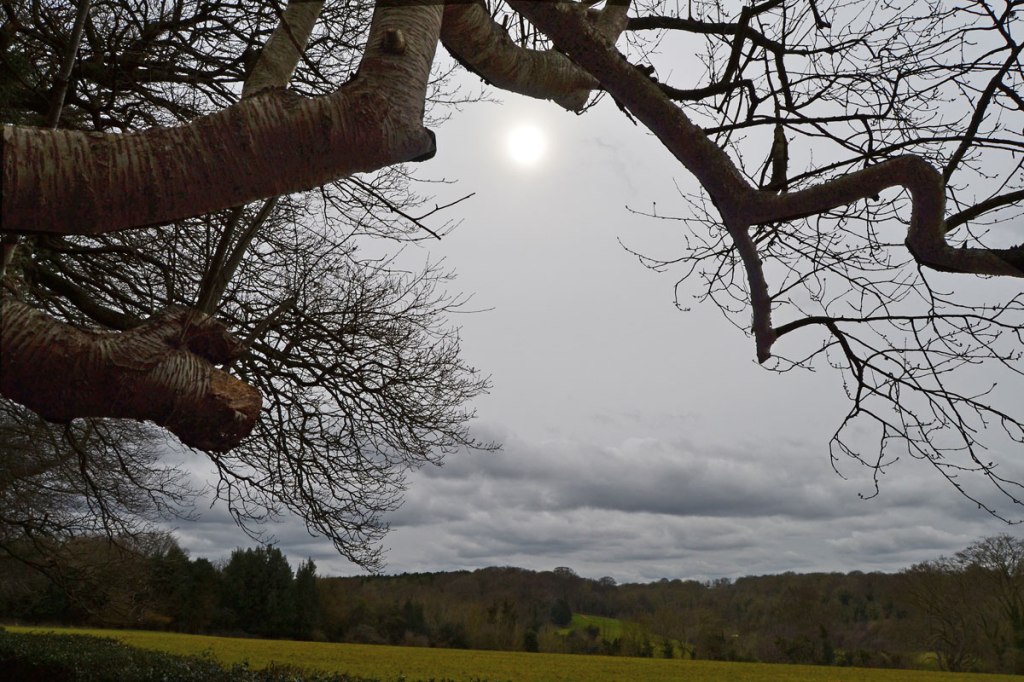
On recent walks to Hosey, Fackenden Down, Bough Beechand Downe, I found plenty to like but not much to inspire. This was partly because, apart from at Fackenden where there was an eyecatching sunset, the sky was unyielding and grey. Drama is needed in the sky at times like these, and springter often provides it as great air masses come into conflict, showering us with rain, hail, snow and sleet and producing fascinating aerial vistas. But at Hosey, all was monotone, at Bough Beech a thin Sunday drizzle dampened down any sense of vitality and at Downe, the morning brightness was consumed by a blanket of altostratus – the precursor to an approaching front – which had stealthily taken over the day as I was en route. But everyday is different if you look closely enough and the sun, a white ball behind the veil, did its best to make the stroll memorable.
View over Chartwell, Hosey walk
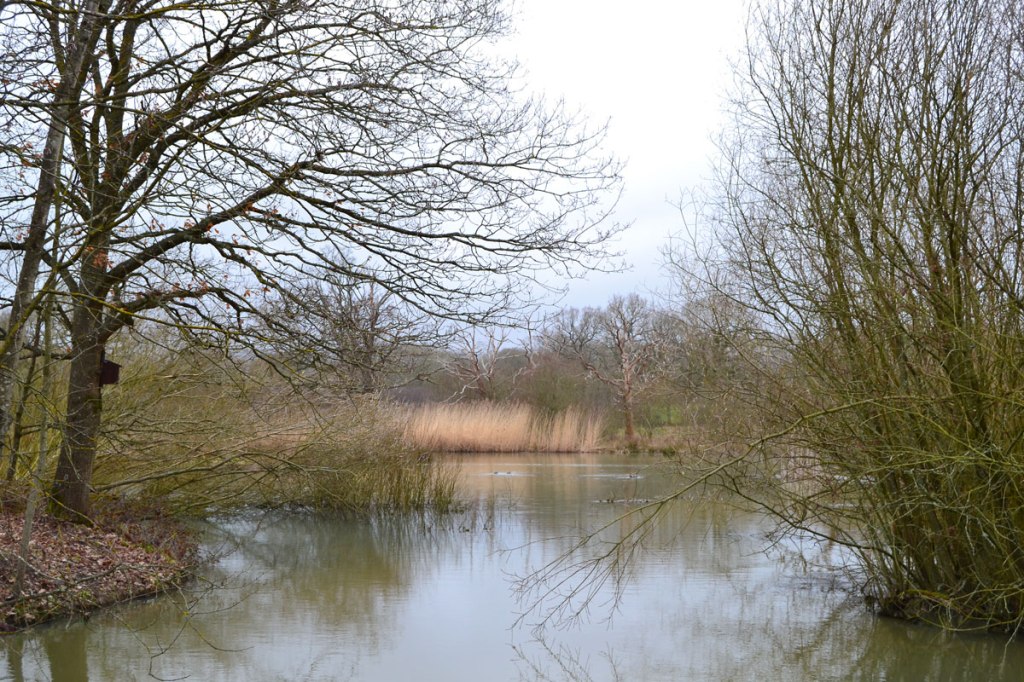
Bough Beech nature reserve
View over Bough Beech reservoir from the Bore Place chair
Downe walk under altostratus cloud
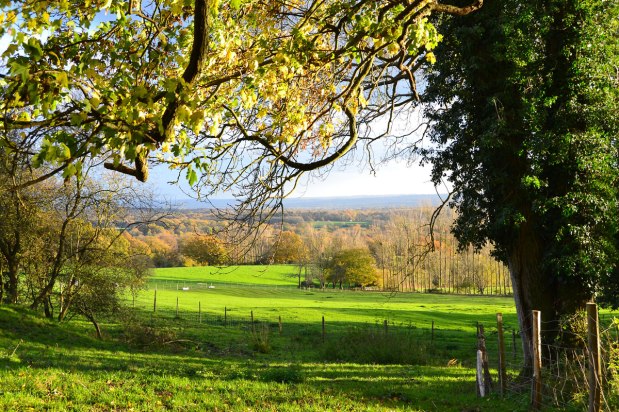
View from Fackenden Down, March 2023
That terrific birder Dave accompanied me at Bough Beech, educating me as we went on the courtships of goldcrests, the behaviour of gadwall – a much underappreciated duck, he said – West Ham’s unsatisfactory season, the calls of marsh tit and treecreeper (I’d forgotten, again), and the distribution of local chaffinch populations. Although we made it to 39 species we saw no snipe, barn owl, brambling, kestrel or even buzzard as we hoped. The bird of prey fraternity was represented only by a solo red kite who lazily loitered above the low weald landscape for nearly half the walk, sometimes close, sometimes distant – an almost spectral presence so unfettered was it by the subdued, squelchy land below.
Thinking back to that red kite (which by the way would have been an extraordinarily rare sight in this part of the world until about 10 years ago) my springter moans and groans appear misplaced; these grey walks were brilliant.
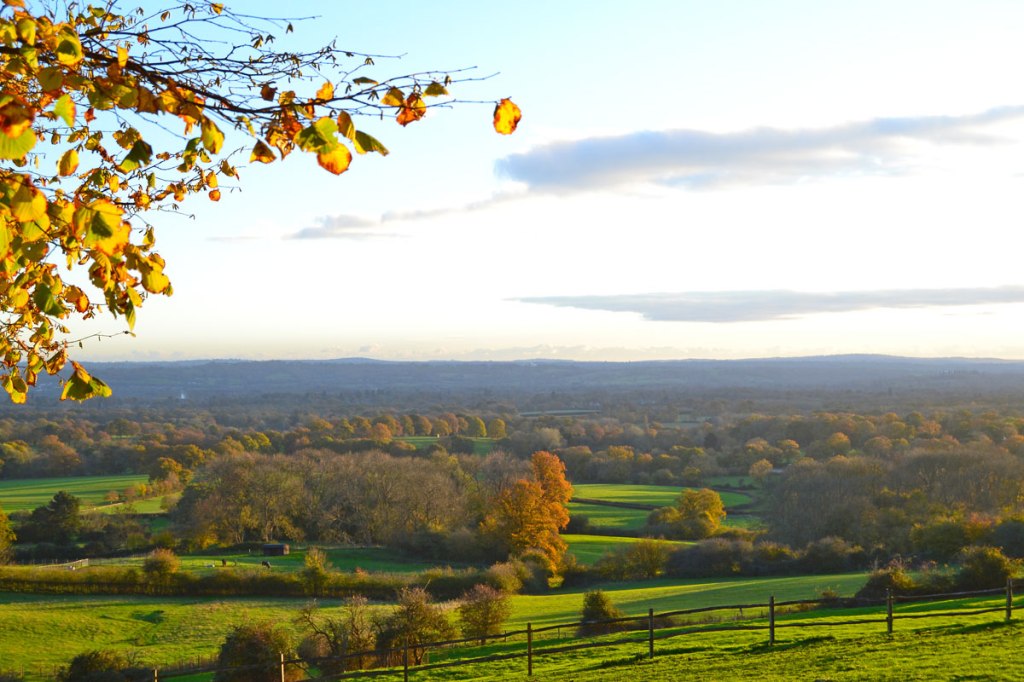
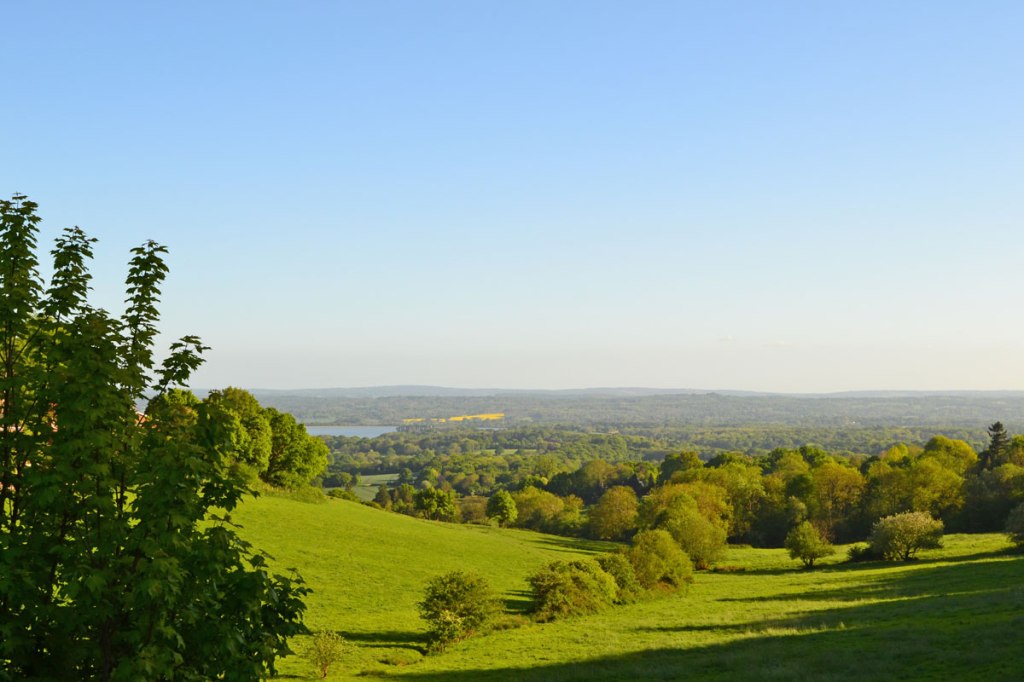
The Underriver walk – short and long version – was the focus this weekend. Just south of Sevenoaks this lovely walk, part of the One Tree Hill“suite” of routes, offers great views across the Kent weald and superb woods and hedgerows. There’s a lot of interesting geology too, as you encounter greensand (sandstone) boulders, a greensand cliff, and plenty of springs as the sandstone hits the weald clay.
I was joined by birder Dave on Saturday which as usual led to an exponential increase in sightings and bird calls identified. Within a few paces of entering the first horrendously muddy field we heard and saw a flock of newly arrived fieldfares some 50 strong, a troop of long-tailed tits, goldcrests flitting in the bordering trees and overflying redwings. You can see birds like that in your local park if you’re lucky – these sightings aren’t exclusive to the countryside at all. Later on a marsh tit flew past us, which was probably the most noteworthy bird of the day and another feather in Dave’s cap as he recognised the fleeting call just as the bird, in silhouette, zoomed past us. Dave reckons the area’s bird life would perk up with a bit more arable land and fewer livestock pastures. Scrubby unkempt arable fields are a big favourite for les oiseaux it’s true.
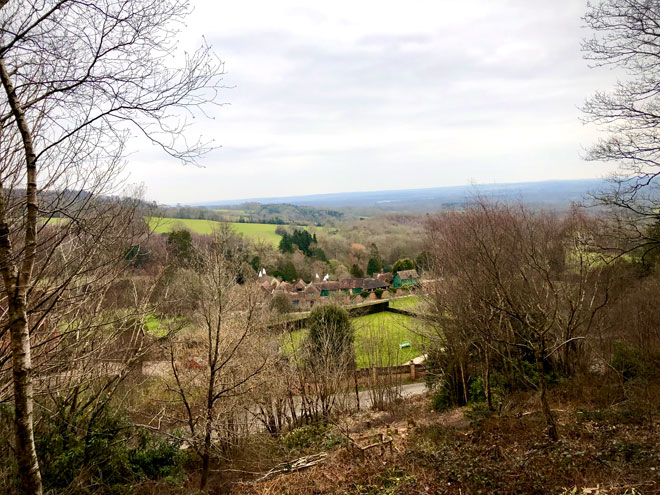
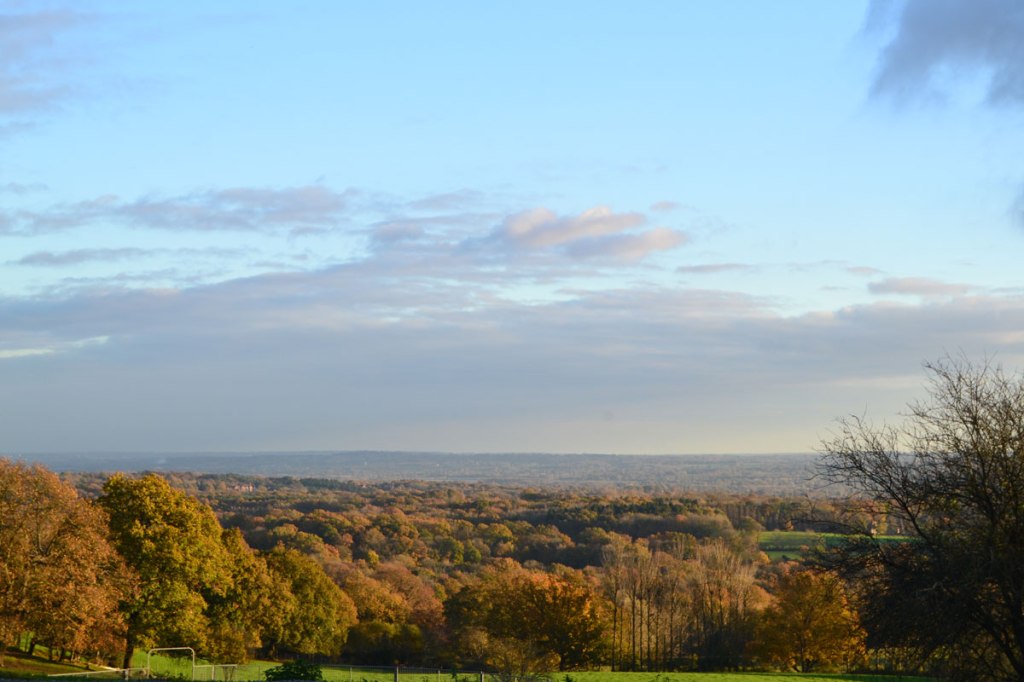
View of the Weald all the way to Ashdown Forest, from above Kettleshill Farm, Underriver
I had been hoping for bullfinch, siskin and most of all, brambling. But it was not to be. Barely a chaffinch as it happened but quite a few goldfinches. Later on there was a kingfisher at the lovely pond on the path below St Julian’s Club and tawny owls calling at Rooks Hill, Wilmotts and Underriver itself. The truth is that there are fewer birds around these days, just as there are fewer insects. I guess it’s farming methods, climate change, all that stuff. But anyway, it was good fun just to be out there listening and watching.
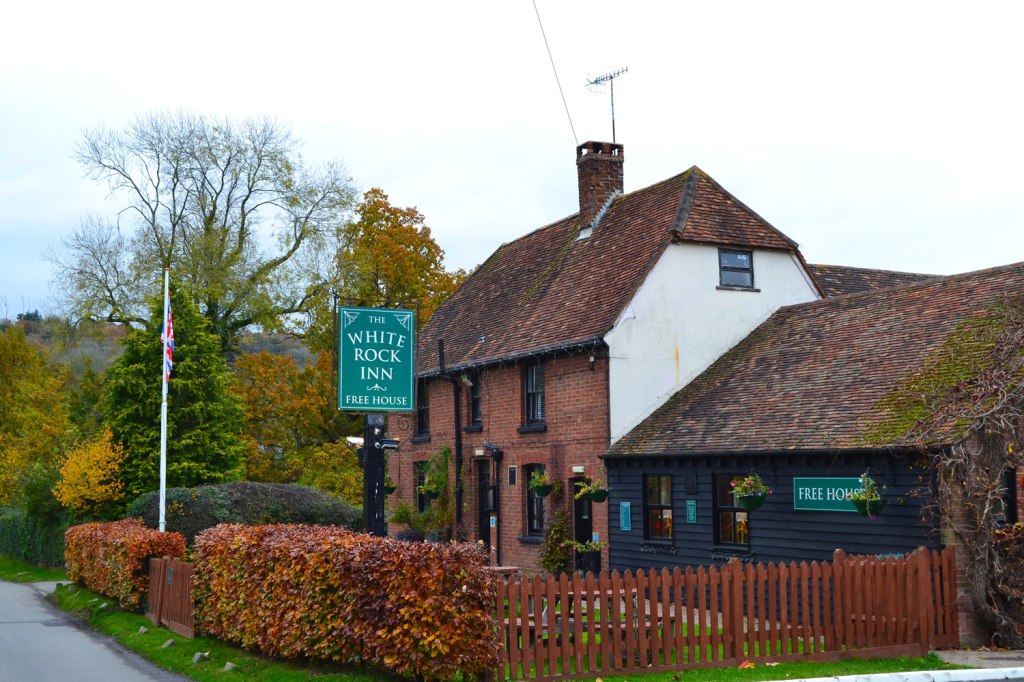
We went again on Sunday. Conditions were gloomier in the afternoon than they had been on Saturday, with quite a large shower making birding more difficult. But it mattered not, the views were still great and the excellent White Rock Inn was open and offered a friendly welcome.
Continuing the theme of overlooked walks at Kent Walks Near London, the Polhill Pluto route yesterday proved the perfect choice on a bright, breezy summer’s day. There were plentiful orchids in the Andrews Wood-Meenfield Wood gap and fantastic ox-eye daisies, scabious and poppies in the fields below Polhill. It’s a great walk to do if you are a fan of the yellowhammer – the colourful, chirpy bunting (we’re talking about a bird by the way!) that adorns hedgerows in these parts and is particularly common for some reason between Shoreham and Otford. It’s repetitive and unworldy song is one of my favourites – it’s commonly described as sounding like ‘a little bit of bread and no cheese’ because of its rhythms but to me it’s simply the sound of summer. Listen out for it on the Darent Valley floor; around Sepham Farm it’s nearly always heard, and sometimes present in the lower parts of the Fackenden and Eastern Valleys route (such as around the Percy Pilcher memorial). The Pluto route (so called because you pass the final ‘planet’ on the Otford solar system scale model) can be combined with the Shoreham circular and even the Fackenden, Otford and Eastern Valley routes for a walk of up to 11 miles or so as all these routes intersect, or almost intersect, at various points. For some reason, I only think of this stroll as a summer walk – not entirely rationally, but it just feels right on a warm day.
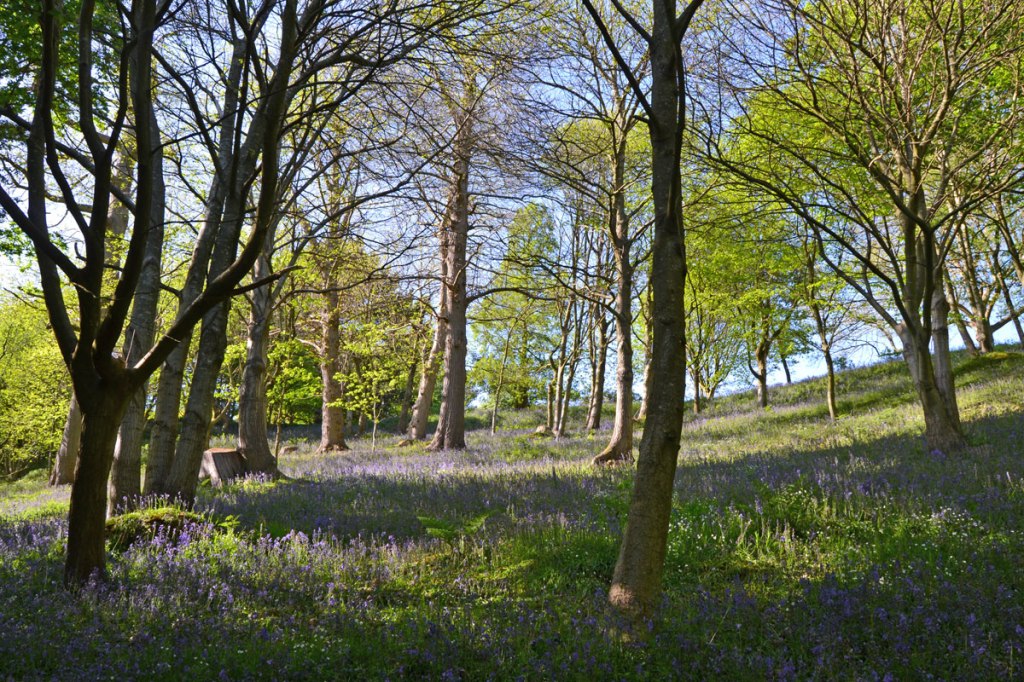
The bluebells have faded a little earlier than usual this year. It seemed to me on the Ide Hill walk today that the south-facing slopes may be drier than normal for spring, which has affected bluebells’ longevity while those in more sheltered parts of the woods were still full of colour. There’s certainly been a marked lack of rain this year – last month just 18mm fell in north-west Kent, about one-third of the usual April total.
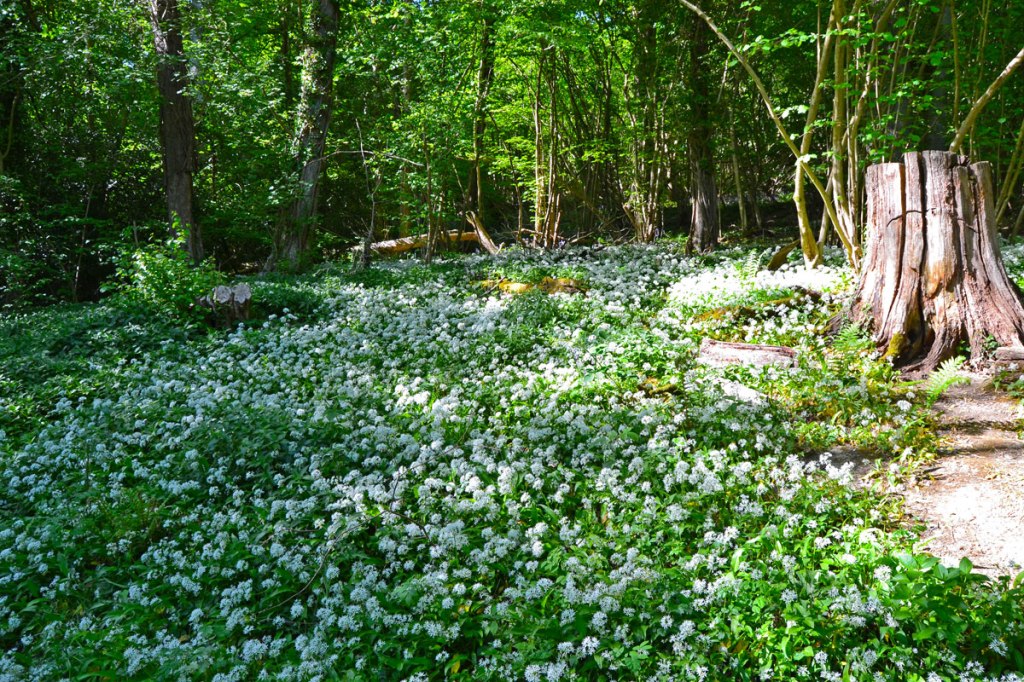
In Meenfield woods, on the Shoreham and Polhill walks, the bluebells, while fading, were still hanging on last weekend – perhaps those woods have retained a little more moisture. I’m no expert. Anyway, instead of bluebells, look out now for wild garlic (or ransoms) growing in profusion in woods on Kent Walks near London. Their brilliant white/cream flowers (pictured above at Rook’s Hill on the One Tree Hill walk) are a sight for sore eyes where there are damp woods and subterranean water close to the surface. The Ide Hill walk is quite unusual for KWNL in having plenty of gorse (near the walk’s start) which is looking brilliant in the spring sunshine, too.
As for birds, things still seem a little quiet with few swallows, martins and swifts making it to the region so far, but I was delighted to see my first whitethroat of the year in one of the many superb country lane hedgerows between Shoreham and Well Hill, a great bird to watch for when on a country cycle. (Pictured in slideshow: whitethroat, Darent Valley view, faded bluebells, Ide Hill view, Scord’s wood, wild garlic in Scord’s wood, azalea in Emmett’s and faded bluebells of Meenfield Wood).
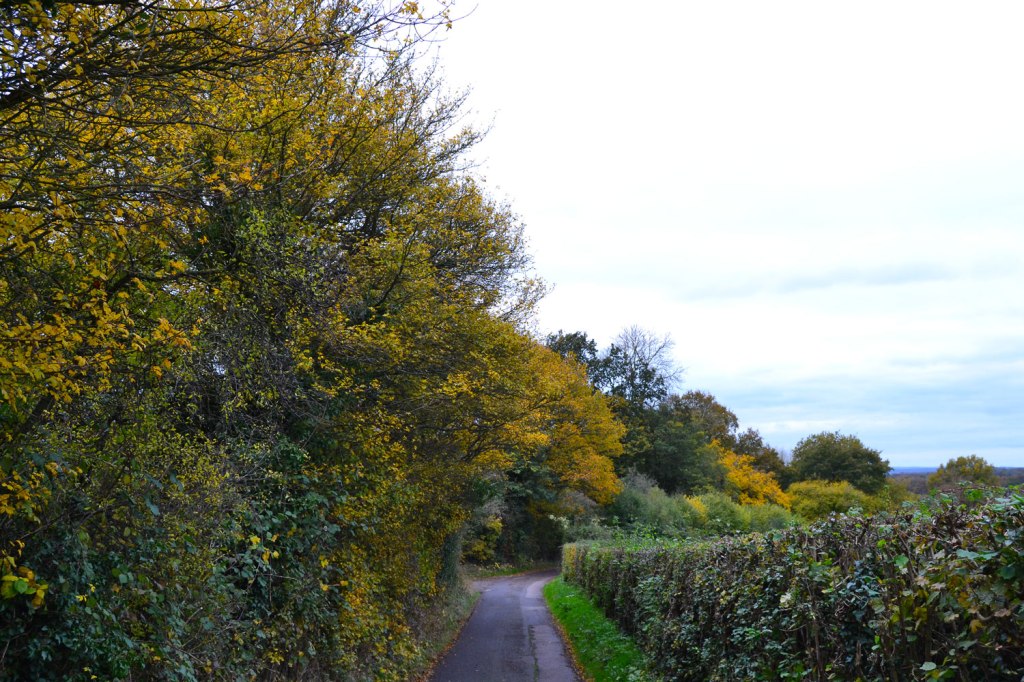
The mud on these walks is still in the mild-moderate category. Wellies useful but not essential… mostly. But if things get really boggy, which they are bound to do by midwinter, it’s easily possible to devise routes that take in tiny wandering lanes rather than swampy paths – of which there are more than few in these parts. Many such lanes were once paths… others service dispersed houses around villages and become footpaths or bridlepaths. It would be difficult to devise a proper circular walk of decent length using only these trackways – although I intend to give it a shot over the coming months. Two such lanes which intersect with a walk at KWNL are at Underriver. Take a look at the map; you’ll see two lanes roughly north to south acting as shortcut links between points 4, 5 and 8. These are lovely to explore, especially at the moment with the unfurling of the autumn wardrobe. They also intersect with footpaths so you can devise your own bespoke routes. With bird expert Dave I walked them yesterday, stopping often to admire berries and views, and to scan for les oiseaux. We didn’t see a lot (bird numbers have been in decline for years): a few siskins, a gorgeous flock of bullfinches flitting the hedgerows, and newly arrived redwings in threes and fours was about it. Oh, and a fantastic female kestrel which eyed us from a small scarlet tree close to the (excellent) White Rock Inn. We managed about 3.5 miles, half on tarmac, before resuming the Underriver route at point 4, but doing it anticlockwise. A pint of Harvey’s at the aforementioned pub in the autumnal twilight was a splendid bookend to a most satisfactory KWNL afternoon.
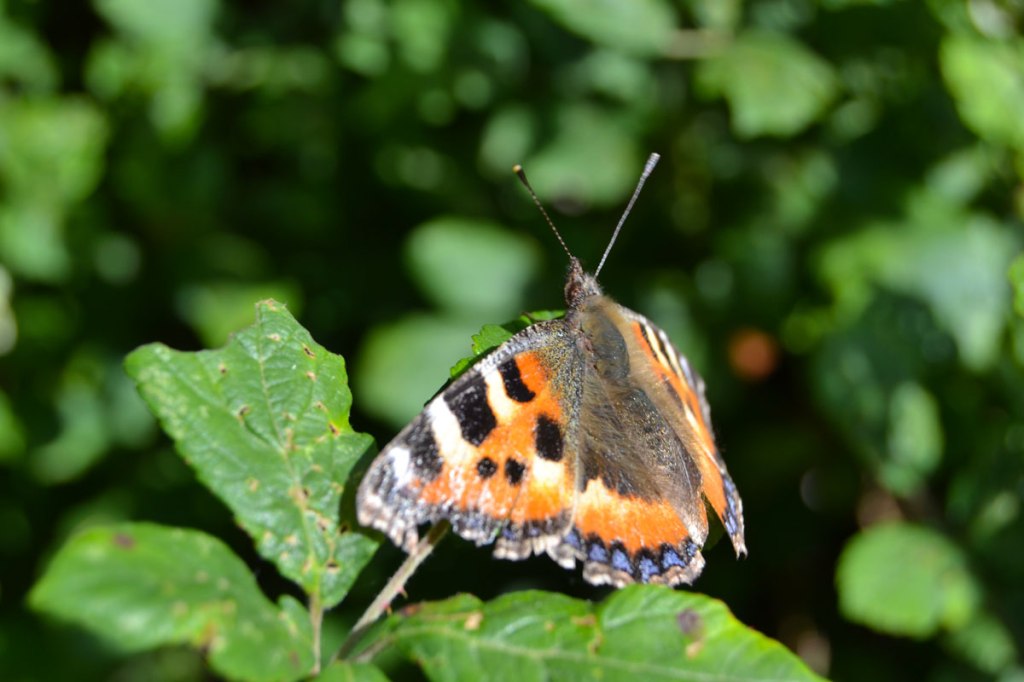
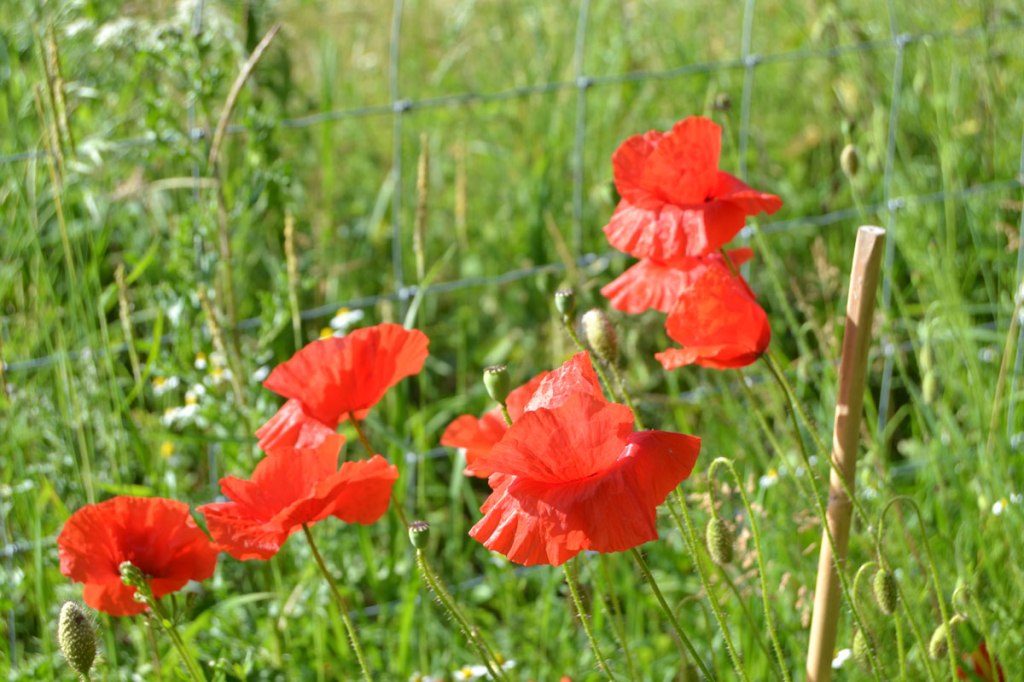
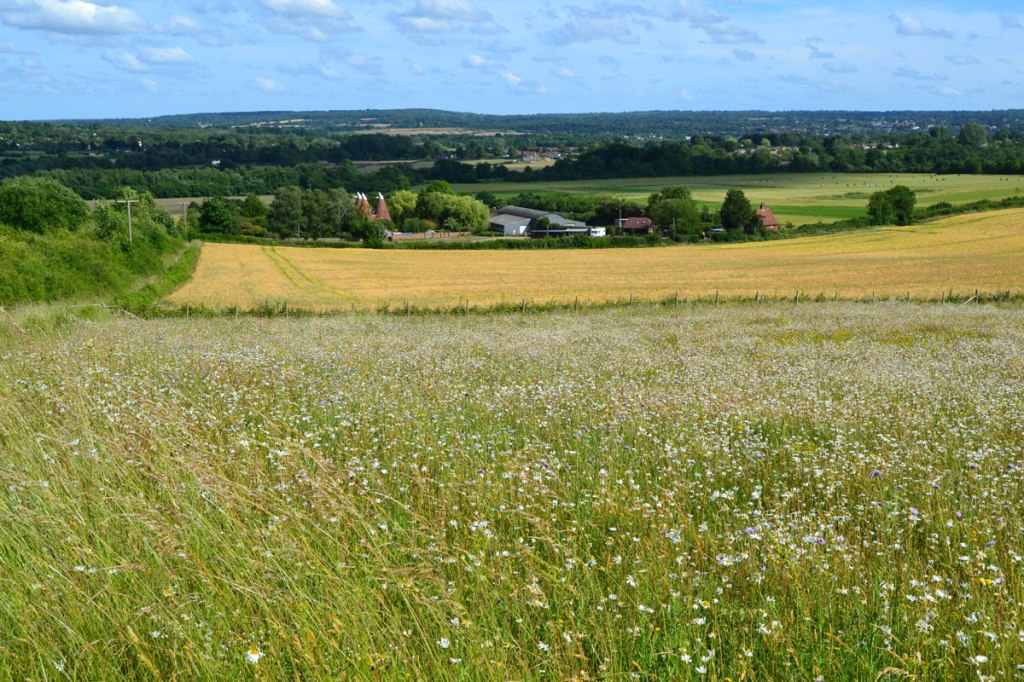
The word ‘meadow’ is synonymous with summer and June and July are the very best months to enjoy them. There are so many brilliant summer meadows on these walks now alive with oxeye daisies, orchids, vetch, poppies, buttercups, and lush grasses rippling in the breeze. They are alive with butterflies and other insects while swallows swoop above them forming brief gaggles before separating to make single passes. High above, buzzards are often seen soaring while spectacular red kites – now much common in Kent than at any time in the modern era – float into view closer to the ground. Of course there are issues, swallow and martin numbers are much lower than back in the day and there ought to be more butterflies and bees. Still, meadows are hubs for wildlife and we are lucky the North Downs, Weald and Greensand Ridge areas possess so many.
Meadow bordering Scord wood on the Ide Hill walk, June 2021. Sheep have munched this one a fair bit, and that in the lead photo, but there are still plenty of wildflowers and bees

















 Kent walks near London