The North Sea comes to the North Downs

South-east London’s first April weekend was a dullard; very disappointing at a time of year when colour is returning to parks, gardens and countryside. A breeze from the North Sea – not a particularly cold one – brought thick stratus, drizzly outbreaks and, on Saturday, a gloom that made it hard to distinguish 3pm from 7pm. Headlights were on, people hurried past, huddled, on the pavements. On the North Downs escarpment the cloud barely scraped over the hills and the drizzle intensified; but there was a snug softness in the air and sudden increases in brightness as the sun attempted to break through before being smothered by the North Sea murk once again.

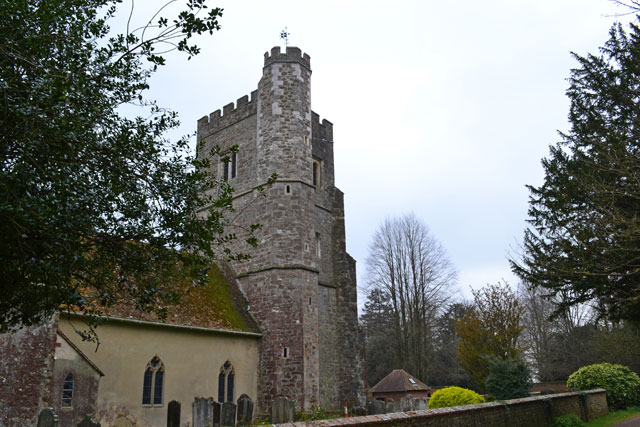
Chevening church, Kent

Chevening church, St Botolph’s © Adam McCulloch

Chevening

Near Chevening, beneath the scarp, on a murky day in spring © Adam McCulloch

Sunday was marginally better, but the Spitfires and light aircraft of Biggin Hill were still well and truly grounded – so none of the flybys accompanied by the growl of piston aero engines you usually get in these parts. We did two walks at Knockholt Pound, taking in Chevening hamlet: one to the west that loops back on to the North Downs Way via Sundridge Hill; the other to the east, heading down by Star Hill Lane then swinging right past messy farmyards to Chevening’s ancient St Botolph’s Church. The first bluebells are out and other wildflowers punctuated the grey proceedings along with myriad ultra-busy birds. A bullfinch was spotted, a buzzard (always a buzzard or two at Chevening) and more pheasants than I’ve ever seen.

I may well add the combined walk to this site next week, but I’m not totally satisfied with it; some good views and points of interest but there’s one bit where there’s too many farm tracks and rubbish heaps and I’m not even sure if you’re allowed to walk there. Also, the woods seem a bit too managed – logging, and probably something to do with all the pheasants.

Wakey wakey woodland

The countryside has truly woken up. I saw my first peacock butterfly of the year at Ide Hill on Sunday (the more observant among you will be wondering what took me so long I’m sure, they’ve been around for a couple of weeks now) although oddly I haven’t seen a brimstone yet. Maybe I’m just walking along, daydreaming, not really taking stuff in. Anyway, I have noticed the woods developing a healthy green sheen, patches of primroses, and even the odd impatient bluebell bursting into flower. In Scord’s Wood, below Emmetts Garden, I came across clusters of cardamine pratensis – cuckoo flower, a somewhat overlooked spring flower (it’s pretty but not vividly colourful). My camera ran out of juice though, so no pix.

Birdsong has gone up several notches, with chiff chaffs arriving from African and great tits getting particularly busy, blackbirds clearing their throats and robins getting very territorial about everything. Out running recently I surprised a couple of fieldfare picking out worms at Beckenham Cricket Club, no doubt soon to head east to their breeding grounds in continental Europe and further afield. They might have been mistle thrushes, when I come to think of it. Up close very beautiful.

This slideshow requires JavaScript.


Knockholt Pound on woods

I tried to find a new walk today and decided that the Chevening area round the corner from the Darent Valley looked good. It’s got a lovely old church, a secluded 17th-century grand mansion used by the government for dignitaries (are there any still?) and the North Downs chalk escarpment. The house was probably designed by Inigo Jones (trendy name you’ve got to say).

It’s an area I often cycle around out of winter, using the Pilgrims’ Way road at the foot of the scarp and climbing steeply on the likes of Sundridge and Brasted hills. A lovely area in summer.

This slideshow requires JavaScript.


My route started at the end of Chevening Lane, Knockholt Pound, where I parked up. I followed the path down the slope through woods toward Chevening, then swung a right across farm/park land with great views of the mansion. Eventually you enter more woods and emerge on Sundridge Hill by a house with the most extraordinary number of bird feeders. With tits and finches all a flutter around me I strode up the hill on the narrow lane then took the North Downs Way back to Chevening Lane with more woods to the south, blocking the view. All in all about 3.5 miles.

This slideshow requires JavaScript.

It was boring. And muddy.

I passed very few people; there was an angry woman shouting at her dog. The woods seemed lifeless and over-managed. The agricultural land was dull. I saw a buzzard. Great. And some violets flowering. I was pleased with the views of Chevening House, but then I remembered Boris Johnson stayed there sometimes when he was (a useless) foreign secretary. And that was it.

I’ll need to add something, a diversion of some sort, before I can include it on this site. I’ll think of something. But all the paths around Knockholt are a bit stop start. It’s a better area for cycling perhaps.
Ah, the warming winds of … February?

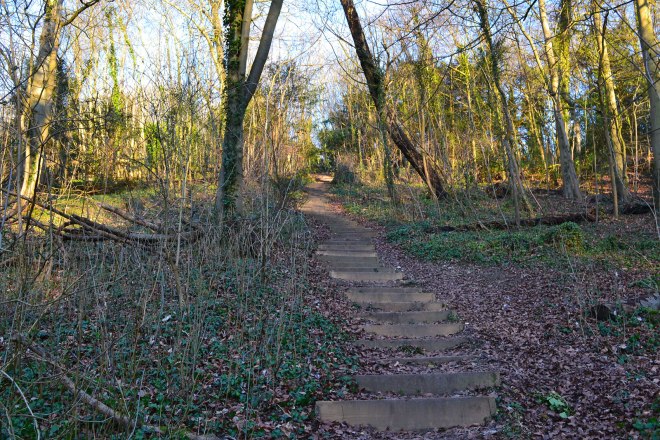
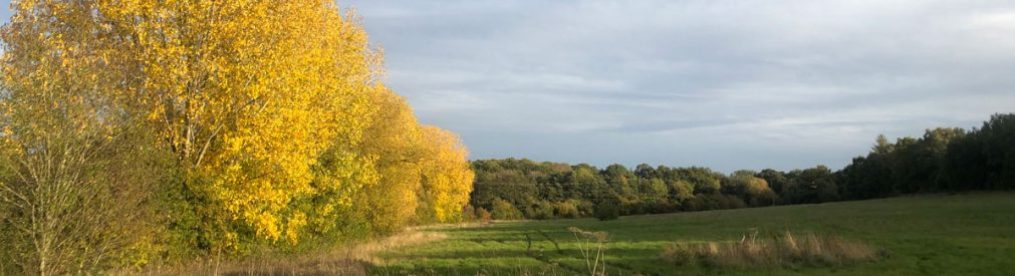
What a strange, beautiful day. Golden light flooding in from a cloudless sky and a startling clarity in the warm air produced scenes as colourful as anything I’ve seen in an English winter. February? We toiled up the steps ascending the steep hillside of Dunstall Wood amid hectic birdsong; the trees were silent only two weeks ago. I half expected humming birds to zip by and howler monkeys to playfully crash through the canopy.

Dunstall Wood steps

Dunstall Wood steps – quite a climb on a warm day

At Austin Spring (this was, again, the Fackenden walk) a huge flock of finches rose from the unkempt fringe and flitted into that row of oaks that strides through the fields there. Without binoculars I couldn’t be sure of all the species but among them were goldfinches, chaffinches, greenfinches and siskins. There must have been 100-plus; quite a surprise.

On Walk 19, steps up White Hill; Dunstall Farm, Austin Spring

Austin Spring – trees full of finches that had been feeding below

Later, in the twilight at White Hill, a tawny owl flew past us – my younger son saw it first as a silhouette on the path ahead of us, and I’m ashamed to say my first reaction was to think ‘pigeon’.

No butterflies though, not a single brimstone, the first to fly most years. You’d think on such a warm day they’d be present. All in all an excellent way to exorcise an away defeat at Burnley.

Dunstall farm house

18th-century Grade-II listed Dunstall Farm House – an attractive building, with a hint of Normandy

Fackenden Down above Otford Mount

Fackenden Down dusk: end of an amazingly mild February day, looking south-west towards Brasted

A proper crisp winter’s day

It’s been cloudy and mild on the whole; dull really, but the past two days have been crisp limpid classics, with a giant full moon thrown in for good measure. Some pictures from yesterday’s stroll at Meenfield Wood/Polhill Bank: walk 18. And, here’s a batch from Cliffe on the Hoo Peninsula from a trip there in mid-January, quite a haunting place in the right light.

This slideshow requires JavaScript.

Lullingstone country park – perfect for a winter walk in fading light

The open spaces and long valley views of Lullingstone make for a very atmospheric walk at this time of year in clear conditions. The Shoreham-Eynsford stations walk takes in an area of the park, as does Walk 12 but its easy to devise your own stroll from the Visitor’s Centre or from Eynsford’s Roman Villa car park (not free) or train station. There is also parking in Eynsford village or in laybys along the road to the Villa. It’s a bit cloudy as I write but on Thursday the sky was fantastic, though there was no moon.

This slideshow requires JavaScript.

The austere beauty of the Kent Downs in winter

Winter has arrived but it remains mild; with more rainfall the mud has churned up on the most of the walks so it’s time for wellies. But take care: the chalky Darent Valley hillside paths can be a bit slippery at this time of year, particularly where the paths are worn and the chalk is close to the surface. But the austere beauty of the North Downs in winter is now evident, especially on the eastern side of the valley – walks 5, 14 and 19 – and on the Eynsford routes: walks 3 and 12. If the temperature drops a bit take a flask out with some hot chocolate and maybe a shot of something stronger – really works out here in an easterly wind!

Each of the walks on this site have their own character. There’s definitely a split between the southern routes, such as Chiddingstone, Ide Hill and at Hever, which are more wooded and somehow bucolic, and the more hilly, more grassy northern routes of the Darent Valley where the ridgelines are the highest points for an easterly winds for hundreds of miles. It’s all very atmospheric; when walking I often imagine what life was like for Saxons, Romans, Britons and Vikings who settled these parts and picture them on their long, painstaking journeys.

So, here’s a useful way of choosing a walk near SE London … enlarge the map, then just click on the labels and lines to find a walk that suits you. You’ll see there’s quite a spaghetti junction of walks around Shoreham, you can combine them all and stay out all week if you like! My tip this week is Walk 19: Fackenden Down. It’s on the eastern side of the Darent Valley – straight out of Shoreham train station and the views are terrific. The walks are also on the menu at the top. Enjoy…

My walks

Download Walk 1: Downe circular (near Bromley, 2.6 miles) View on your phone/desktop
Download Walk 2: Shoreham circular (3.5 miles) View
Download Walk 3: Shoreham to Eynsford (4.2 miles) View

Download Walk 4: Ide Hill circular (3 miles) View
Download Walk 5: Otford circular via Romney St (5.5 miles) View

Download Walk 6: One Tree Hill circular (near Sevenoaks, 5.5 miles) View
Download Walk 7: One Tree Hill figure of eight (near Sevenoaks, 5 miles) View
Download Walk 8: Shoreham/Otford circular (5 miles) View
Download Walk 9: Hever circular (4.5 miles) View
 Download Walk 10: Chiddingstone/Penshurst circular (4 miles) View
Download Walk 11: Knole Park’s Wild Side (3.5 miles) View
 Download Walk 12: Eynsford/Lullingstone circular (4 miles) View
 Download Walk 13: Chislehurst station to Petts Wood station (3.7 miles) View
Download Walk 14: Shorehams mystery eastern valleys (5 miles) View
Download Walk 15: Westerham/Chartwell (5.5 miles)
View
Download Walk 16: Shoreham circular mk2 (3.5 miles) View
• Download Walk 17: Bough Beech/Bore Place (2.5 miles) View
Download Walk 18: Shoreham/Polhill Bank (4 miles) View
Downland Walk 19: Fackenden Down (4 miles) View
Download Walk 20: Downe circular mk2 (4 miles) View

An online version of the Ordnance Survey map 147 can be found here but strangely some public footpaths are not included. I’m gradually working on making GPX files for the walks so they can be followed ‘live’ on smartphone, but, ahem, slow progress is being made!

Shoreham, Kent – a perfect village for a stroll

Nine of the walks on this site involve the Shoreham neighbourhood, in the Darent Valley. This is good, because Shoreham is a decent little place with its four fine pubs, vineyard, Battle of Britain museum, river walk and houses from down the centuries. And it has a station, served by trains from London Blackfriars (sometimes Victoria too) via Peckham Rye and Bromley South, and Sevenoaks. Otford down the road is alright too. My walks use the valley rims, east and west; the valley floor along the river and the ‘dry’ valleys (geographical feature – not a reference to any shortage of pubs!) that flank the main one. The Darent river itself rises south of Westerham, on the shallow slope of the Greensand ridge and its early stretches can be seen on walks 15 and 21. Try not to drive through the village itself. On the east side of the village there’s a car park by the station and a huge layby almost opposite the station. On the west side there’s a free car park at Filston Lane. Best of all though, arrive by train if possible. There’s only one (tiny) shop in the place, so don’t expect to do your shopping there.

This slideshow requires JavaScript.

It’s a great village to stroll around, explore the ancient church and paths that skirt the northern side, around the back of the vineyard. Full details can be found on each Shoreham walk page. The Darent Valley path itself, which the walks here take in stretches of, is 19 miles long, starts by Sevenoaks station and ends at Dartford, as the river enters the Thames. So that’ll take awhile.

The sublime nine Shoreham walks

Shoreham station is most convenient for the eastern walks but it’s only a half-mile walk down Station Rd to connect with the western valley ones, too. Each of the walks can be adapted into something much longer by joining them together. 

Walking at Fackenden Down and Magpie Bottom, Shoreham, Kent

The diversion to Fackenden Down is a great variation to the Shoreham circular walks. If you walk over the top of the hill and continue to Magpie Bottom you join the Romney Street walk, shortening it slightly. Fackenden Down and Magpie Bottom are both sites of special scientific interest and are examples of chalk upland being rewilded. Both have great biodiversity with rare plants, insects, birds and reptiles. See details (Walk 19). The other walk that can be altered to take in Fackenden Down is the ‘eastern valleys’ walk. Here are some pictures:

This slideshow requires JavaScript.

Here’s a map of the near-four-mile route; description here

One Tree Hill, Sevenoaks – good place to catch a winter sunset

The Greensand Way route between Ightham Mote, One Tree Hill and its Wilmot Hill derivatives are great for winter light after about 2.30pm at the moment. Picture below is from yesterday about 3.45pm. Love how the sheep reflect the light. It looks darker in the picture than it actually was… trying to get the exposure right for land and sky always a challenge.

This slideshow requires JavaScript.