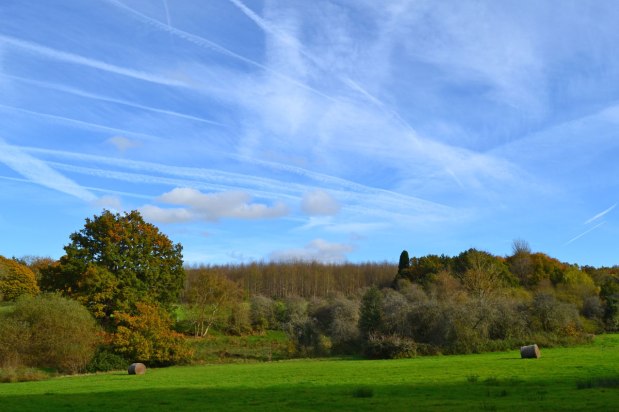
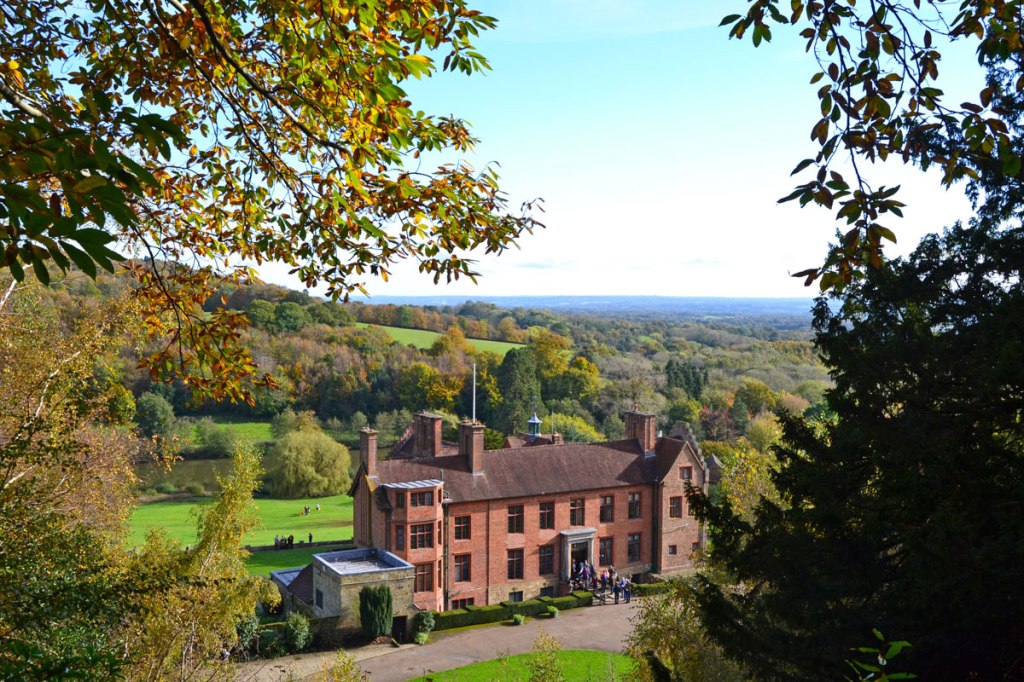
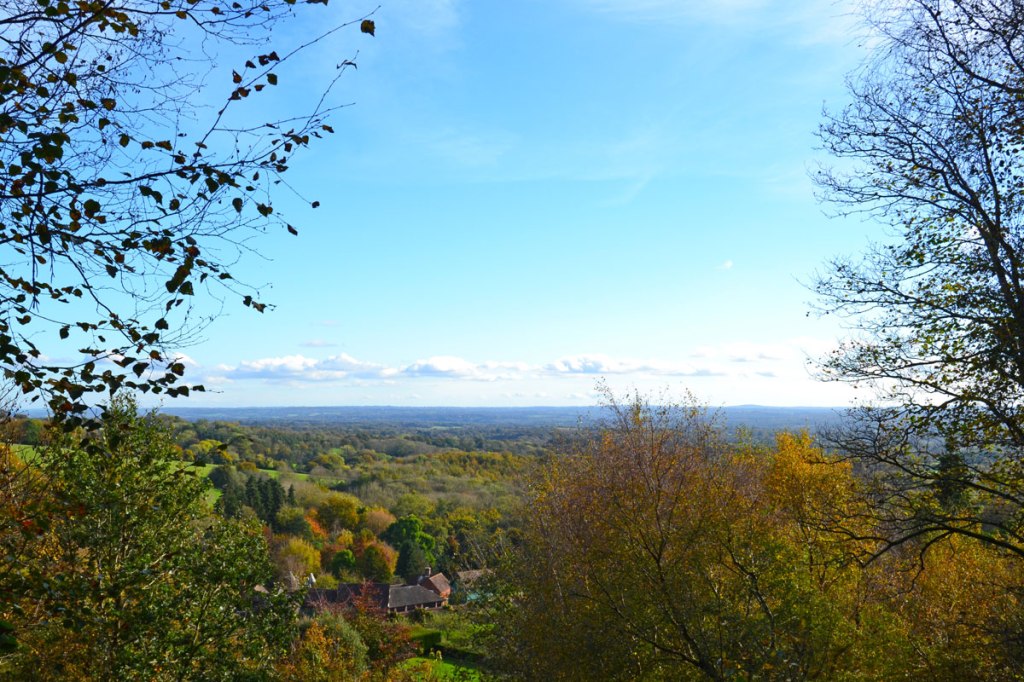
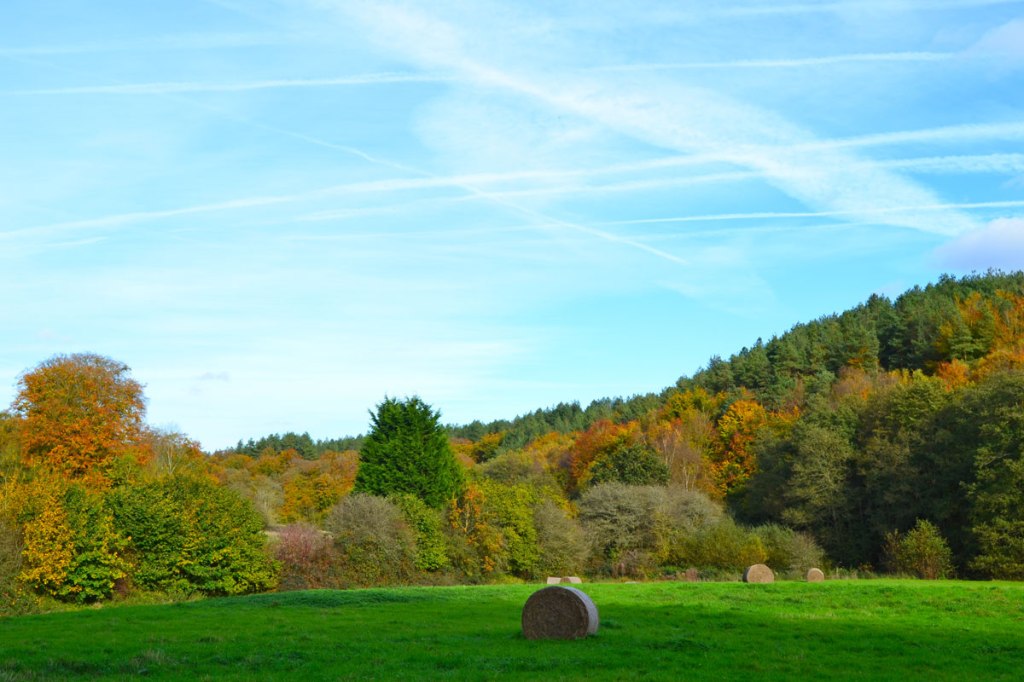
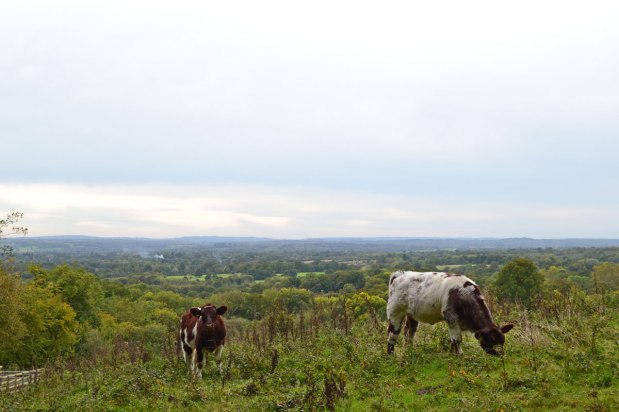
An El Classico of an autumn day. And about time too. We decided that the Hosey walk on the Greensand ridge route at Westerham was the one for us, given the foliage, and views of the Weald from Mariner’s Hill. This time last year the Heaverham circular walk at Kemsing provided something very similar but the warmth of that late October 2023 day seemed freakish at the time. Today was more normal, just a lovely day – neither warm nor cool. The leaf colours, especially in the little valley of the infant River Darent, were superb as hopefully the photos below show, and the vista across the roof of Churchill’s Chartwell gaff as magnificent as ever. I was expecting to see redwings recently arrived from the Netherlands and generally more birds flocking together. But nothing much happened on that front, although mistle thrush were heard and a large buzzard lifted off close to us in one meadow. A pint at the Westerham Brewery place on the way back was an outstanding finale. However, the effect wore off as my football team lost.
Reading around this subject recently it seems to me that to be safe it’s best not to do this at all with dogs. Cows can charge at people with dogs. The advice is that people should let go of the dogs but recent stories suggest that even this isn’t enough to prevent an attack. On most of the walks you can divert around the edges of fields or spot an alternative path. You’re almost certain to be fine if the herd is far away on the other side of the field; the problems seem to come if they are grazing around the path. Of course 99% of the time they just ignore you, or glare impolitely. But I suggest stay well clear even if without dogs. If with a dog, divert. On the walks at KWNL paths only cross fields with cows in them on the Chiddingstone walk (often but usually very far away on the other side of the field), Underriver walk (sometimes), and very occasionally on the Fackenden Down walk at Magpie Bottom and the top of the Down.
October, along with June, July and January (all the J’s) is a ‘classic’ walking month. We all know about the turning leaves so I won’t bother describing the colour changes that occur! What I like best are the migrating, busy birds, the every changing cloudscapes, the sudden showers, the unpredictable temperature changes (‘wow it’s warm’, ‘wow it’s like Iceland!’) and, best of all, the light. It’s a real shame when the clocks go back at the end of the month because it denies us hikers of another hour of daylight. Why we continue with this bizarre clock policy defeats me; I guess it’s as British as the mythical replacement rail bus or surprise roadworks. It is what it is … sigh. Rant over.
Polhill view October
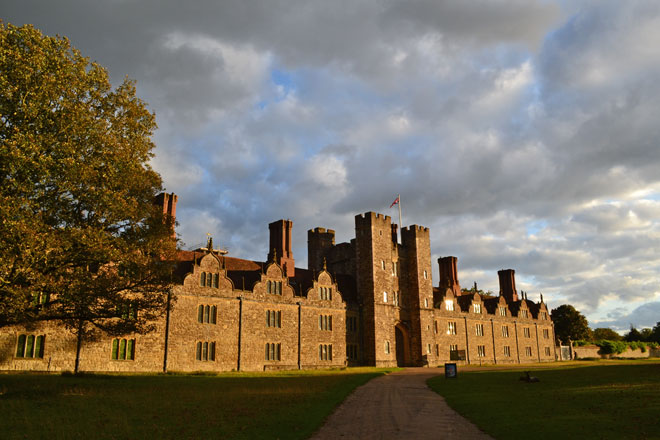
Knole, early October.
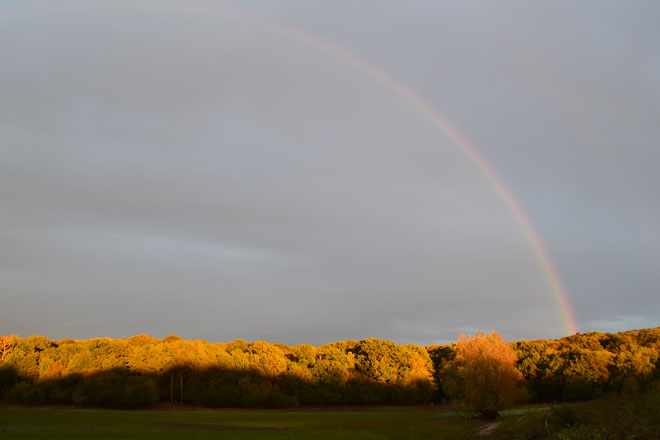
Rainbow, October
Emmett’s view over Weald in early October 2015
Downe near point 3, autumn
Downe
Darent valley autumn
Now, Camber Sands – that’s where we went last week to fully mark the end of summer. A fish flatbread with chilli jam, salad and sour cream at Dungeness’s brilliant Snack Shack* set us up for a late afternoon swim in the luckily non-sewagey waters at Camber. We followed this with a drink at the delightful Ypres Castle Arms in Rye, a tucked-away pub with a great beer garden and view of the salt marsh and Channel. As dusk began a little thunderstorm was flickering away somewhere near France but gradually crept closer. On the way home the ‘little’ storm suddenly became very large and caught up with us: spectacular fork lightning and bursts of torrential rain and hail propelled us past Northiam, Bodiam, Hawkhurst and even Tunbridge Wells – where of course the A21 was shut, necessitating an abysmally long diversion. But then the closure of major roads mid-evening, like mythical rail replacement buses and the clocks going back is something us Brits seem to just have to tolerate. * I recommend the Snack Shack but go before 2pm if poss, it gets very busy and perhaps has become a bit too popular. An alternative is the superb Britannia Pub just up the road.
My wellies came in useful on the Hever walk on Saturday. I’ve never worn them in early summer before. But my hunch was right… there are still a few quagmires out there. Watching a young couple ahead of me try to negotiate the mud in lightweight trainers made me wince. There’s not really the same problem on the North Downs chalk walks, where the drainage is much better thanks to the geology. Except where there’s clay (Andrew’s Wood hillside I’m looking at you).
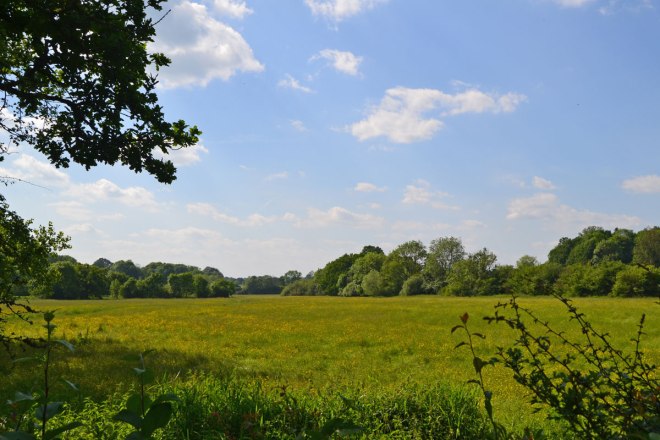
Meadow, Penshurst
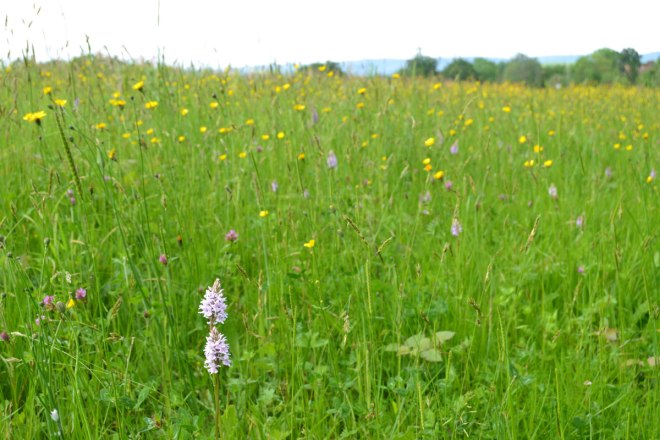
Common spotted orchids, Hever
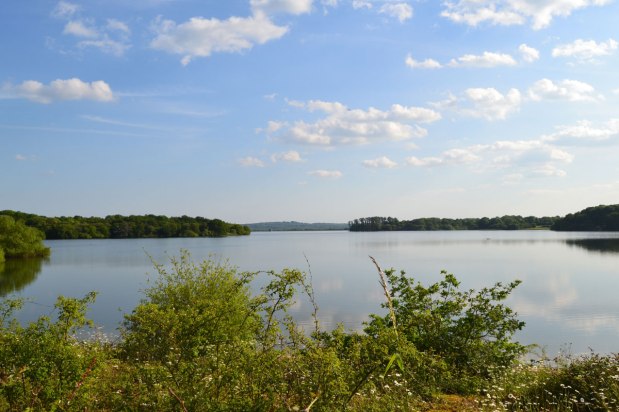
Northern lake at Bough Beech
In June it’s generally a good idea to stick a pair of secateurs or tough old scissors in your rucksack if you’re doing a Kent walk. It seems odd I know. One or two of the less well used paths become entangled in brambles, nettles etc this month and next. This is particularly the case this year because rain has kept hikers away and some of the paths have been left unused. The Eastern Valleys walk east of Shoreham definitely requires a bit of snipping as you walk along the fields on the Darent Valley rim. The diversion to the Percy Pilcher memorial viewpoint is in need of a trim at the best of times. And at Chiddingstone, near the start, the path leading into the swampy woods is nearly impassable. If you prefer, you can divert to walk along the field edge – it joins the main path as you enter the woods. The same thing happens later as you near the River Eden on the return leg. There are parts of the Hever walk, in Stock Wood and Newtye Hurst Wood where you might need to divert off the main path and it‘s easier to do a little judicious snipping than try to battle your way through. Especially if you’re wearing shorts!
Overall the Weald of Kent is obviously wetter than normal for the time of year. Bough Beech reservoir is brimful for once and the mires and ponds in the woods of Hever and Chiddingstone are well topped up.
The inaugural KWNL bluebell award results are in, now that the bluebell season is drawing to a close. The judge (that’s me) has visited a number of sites renowned for their bluebells at this time of year and come to his decision, without seeking the opinions of others (I prefer it that way, for clarity of thought). First, let’s be honest, it’s been a slightly underwhelming field this year compared with previous years, when this competition wasn’t held. It’s pissed down with rain largely, the sun has generally refused to appear, and it’s been so windy that lots of branches have fallen in the woods disrupting the shimmering fields of azure and making the place look untidy generally.
4th PLACE – EMMETTS/SCORDS WOOD on the IDE HILL ROUTE
Emmetts Garden/Scord Wood was the strong favourite to be the winner given their popularity and reputation so it is something of a shock to see it down in fourth in 2024. The position of the flowers on the slope and the widely space trees help makes them easy to photograph nicely, especially with late afternoon sun casting long shadows – the perfect bluebell shot. However, it was grey and cold during my visit and there were a few too many bare patches – unlucky, but rather like an Ofsted inspection on the way day the usually impeccably behaved pupils have nicked the headmaster’s car and left it upside down on the cricket pitch. Beautiful of course, but somehow not quite up to usual levels of greatness. No trophy but Champions League nonetheless.
Meenfield Wood on the various Shoreham/Polhill western Darent Valley routes was also expected to make the top two, but just fell short. The full inspection took place on a Saturday again heavy with cloud with approaching rain from the south. The lime green of the beeches coming into leaf contrasted with the blue flowers to make for a colourful sight despite the conditions. Splotches of stitchwort added to the jollity at times. Many might argue it was a worthy contender to win; and in another year it may have.
Doing much better than expected this year was New Years Wood, on the Cudham circular route. A lovely, quiet woods without many paths to interrupt the swathes of blue. More mysterious feeling even than Meenfield and it was easier to imagine the bluebells somehow continuing for miles into the distance – you couldn’t see where they ended.
1st PLACE – BLUEBERRY LANE MEADOW, KNOCKHOLT POUND
Close to the Cudham circular and Chevening walks, this magical spot (view from the gate: no entry into field) was not considered a contender until the judge happened to cycle past it on Sunday 5 May. This grassy field dotted with outstanding oaks, one of which appears damaged by lightning or storm, had never previously attracted the judge’s attention. The flowers appeared a very dense dark blue instead of rather milky blue of the previous two entrants, perhaps because of some trick of the light. There was some consideration that it should not qualify because it’s not strictly speaking on one of the walks, but this was overruled eventually, as cycle routes at KWNL also count.
Submissions from One Tree Hill, Lullingstone, Ide Hill, Hever and Oldbury were received too late to be considered unfortunately. They also breached the judge’s criteria of “not too much mud”.
I think there’s good bluebell viewing until around 13 May, but the beginnings of the end are already visible, so good luck! See my cycle routes at Plot A Route
Mysterious birder Dave has emerged once again from his Kent weald lair! This was great news on this gusty, mild, cloudy day with a walk at Knole planned. Dave’s presence would ensure that I would observe or hear (rarely both) species I wouldn’t usually encounter when walking alone. Arriving at Knole late thanks to an unforeseen ambush cunningly laid by temporary traffic lights on the A21, I spotted Dave already staking out the territory in Knole’s south eastern corner. “There’s nothing here,” he said, greeting me with breezy optimism. But it wasn’t entirely true. By standing still amid the beeches and oaks in the open woodland of that area of the park it seemed the birds started to come to us. First a troop of chaffinches (but not as far as we could tell the hoped for brambling), then coal tit, song thrush, nuthatch, greater spotted woodpecker and goldcrest. As we entered the south eastern conifer plantation we heard siskin (pictured header) – or rather Dave did.
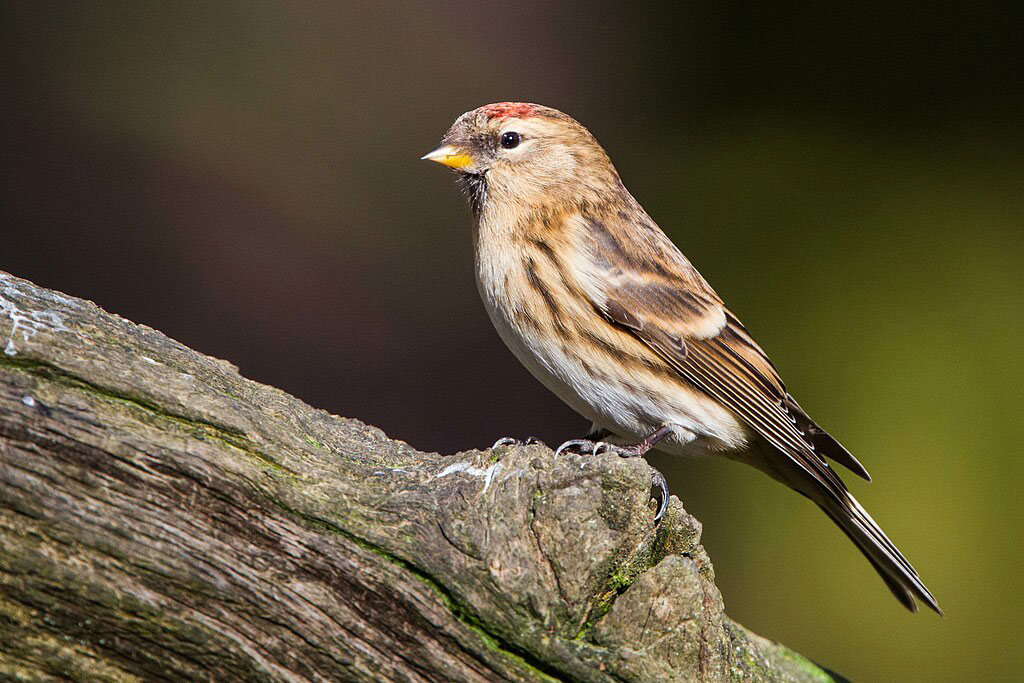
Lesser redpoll. Photo by Ron Knight/Wikimedia Commons
Later a lesser redpoll (pictured above) flew over, a very delicate little finch type thing. Two greenfinches – not at all common these days – were spotted at the top of a tree, while more predictably, a buzzard wheeled above. Mistle thrush was then heard and a flock of redwings streamed across the field on the Godden Green side of the wall on the eastern fringe, where there’s a lovely view of Fackenden to Kemsing downs and of the Darent Valley opening. Finally, a fetching pair of stonechat, a male and a female, alighted in grass just ahead of us as we started to walk up to the house. As we got close they hopped into the bracken tops, disturbing a roosting wren.
It’s definitely worth walking with Dave – you become aware of far more birds than you would normally see. I had to bite my lip though when checking the football scores – West Ham were playing at Man Utd and it wasn’t going well … sorry Dave.
Thought it worth mentioning. The heavy rains this winter (until recently) have damaged the chalk path between points 2 and 3 and displaced a lot of stones on the Cudham route. There’s now a mini ravine for some of the path and a lot of bits of rock. Only a minor inconvenience really but worth knowing. I don’t see how it gets ‘fixed’ in the short term and will probably get worse as we’re not out of the woods yet (pun intended).
Erosion on Cudham chalk path
Even more worth knowing is that soon after Point 4, the stile leading into the wood adjoining Newyears Wood, where a lot of chopping goes on, has gone missing. Now you have to climb over the low wooden fence to use the public footpath there. The yellow waymarker sign for the public footpath remains in position. No sign has been erected saying that this stretch of path is temporarily out of bounds has so I say you are totally entitled to carry on using the path. I hate it when landowners don’t take care of path access – it’s just disrespectful and careless.
Cudham short version (3.3 miles)
There is a short cut version to avoid this hopefully temporary missing stile bore. It takes just a mile off the route but misses out on the nicest bit of woodland at Birches Croft, on the edge of New Years Wood.
Still, the stile issue is not as serious a problem as the idiots who have literally cut down the traffic lights on the Hayes to Keston road at the junction of the A232 – yes, it looks to me as though an angle grinder has been used to cleanly chop all four traffic lights at this now dangerous crossing point. I guess it’ll be quickly remedied.
Here’s a ‘new’, pleasant two-hour, four-mile stroll that fits in to the Downe/Cudham/Knockholt suite of walks; ie, it’s on the chalk North Downs and not too far from Bromley – in fact it’s still within Bromley borough (about 30 mins’ drive from Forest Hill, 15 mins bus from Orpington Station, 20 mins from Bromley South). It’s quite a similar walk to the High Elms Estate route described in this informative leaflet but there are differences – my route is a mile and a half longer, goes further to the west initially and stays deeper in the woods in the long stretch to the High Elms visitor centre (Beeche).
I’ll write it up and devote a page to it this week at some point but meanwhile here’s an Ordnance Survey GPX map for the route, and, below, a Google map of it. We started from close to the church in Farnborough village (Kent) but you could also start from the High Elms visitor centre car park (free, the last time I checked). If you’re not driving, you can take the 358 bus to Farnborough village from Bromley South, Orpington, Crystal Palace, Shortlands, Kent House, Eden Park, Anerley, Clock House stations etc (it’s a long and twisting route from Crystal Palace though!). The closest railway station is Orpington, just a mile or so from Farnborough village.
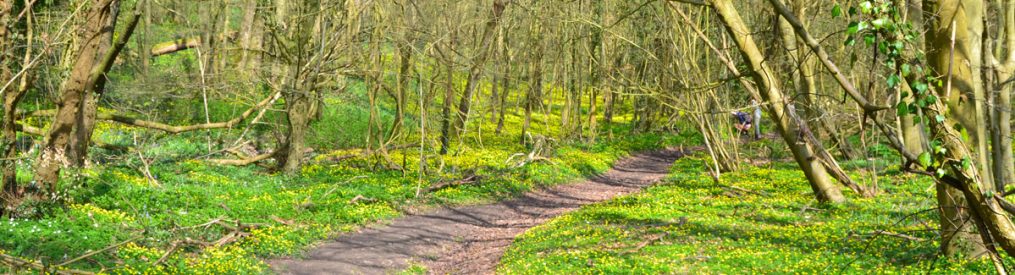
It’s not a spectacular walk with awe-inspiring vistas, unlike say the One Tree Hill, Ide Hill or Fackenden routes, but there’s some lovely woodland, views over shallow valleys, amazing conifers in the Lubbock estate next to Shire Lane at High Elms and lots of bluebells, orchids (pictured in Cuckoo Wood, lead image) and birds at various times of the year. Right now it’s a bit bleak of course but there’s still much to enjoy. The ‘home stretch’ as you reach Cuckoo Wood then get nearer the cafe and nature centre (called Beeche) at High Elms is quite busy with dog walkers, as are the initial fields after starting the walk in Tye Lane. In between though, it’s very quiet. There are no stiles so suitable for a hardy push chair (I think!). There are three roads to cross; the first – Shire Lane – is a notorious rat run where for some reason cars are often driven recklessly fast, so take care.
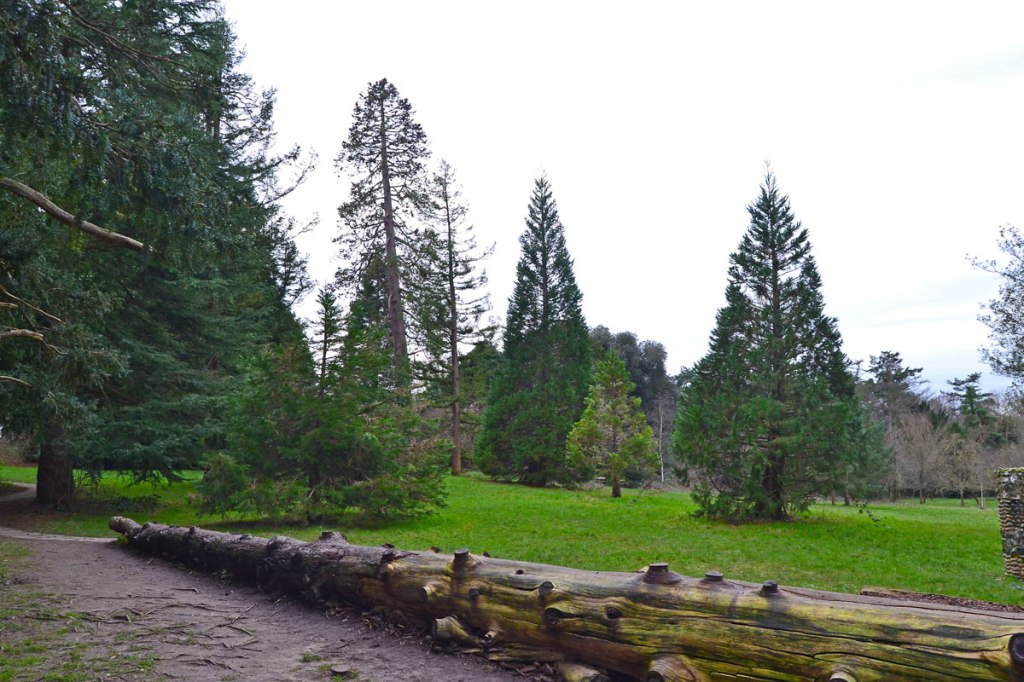
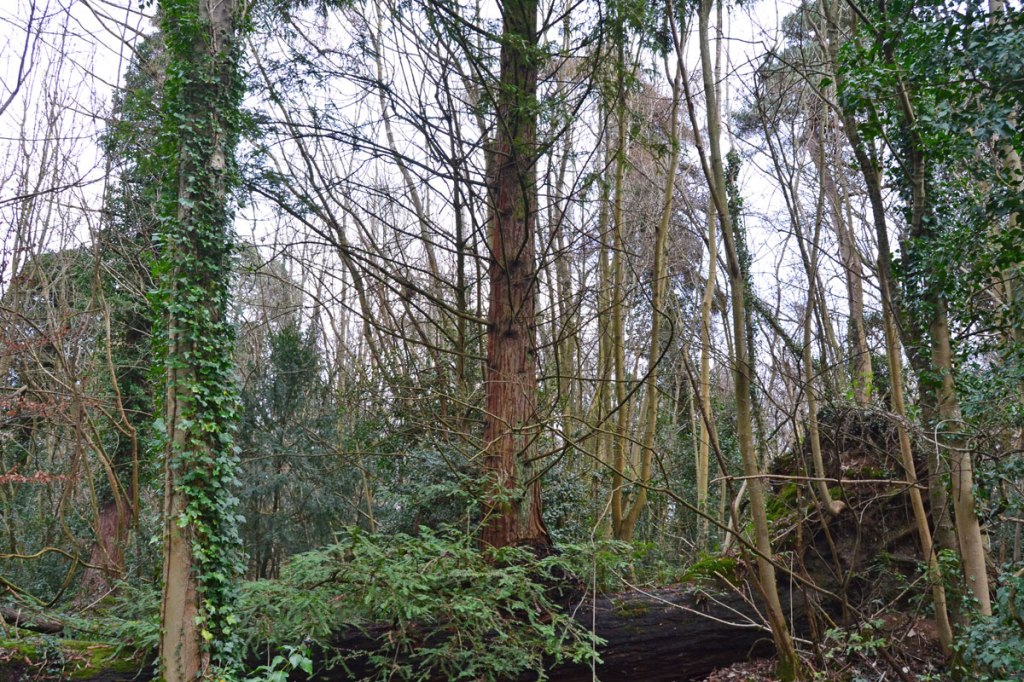
Pictured above in dull winter conditions: 1 Lubbock’s conifer plantation dating from mid-19th century; 2 the High Elms area near the cafe is popular with dog walkers; 3 A holm oak, an evergreen oak from southern Europe, offers winter cover in High Elms’s western woods; 4 New growth shoots from a fallen giant sequoia in the western woods close to the High Elms ‘nature field’; 5 Looking bleak in winter, this field close to the start of our walk is excellent for small mammals and their predators such as kestrel, owls and buzzards; 6 Church of St Giles the Abbot, Farnborough, has a nave dating from the 12th century; 7 Woodland meadow in High Elms woods – from April this patch is alive with wildflowers; 8 pine trees near the church at Farnborough
This walk was first tried on 7 January 2024 after weeks of rain. We revisited the following week in slightly better weather hence the appearance of blue sky in a couple of photos. The mud wasn’t too terrible by 14 January. The chalk beneath the thin soil has done its job well draining the water so it’s probably a safer bet for having less mud than the nearby Cudham walk.
If you have children it‘d probably be better to start and finish the walk at the High Elms car park so they can enjoy hide and seek and a picnic in the beautifully decayed old gardens of the Lubbock manor house (burned down in 1967 possibly by a discarded cigarette).
We chose Lullingstone for our Christmas morning walk. Well, I didn’t actually. It was the family choice, and a surprise one because I was, for once in my life, all for staying in and wrongly assumed my partner would be. I’m glad we did though: staying in all day and not walking anywhere is hardly ever the right choice, even with a turkey to roast and fudge to finish.
There’s no denying that in the mild, grey, mizzly, boring weather the Darent Valley landscape seemed to have lost a bit of its lustre. It felt as if we’d taken it by surprise – it’s usually ready for us and induces an inward gasp of delight as we get our first view of it. On Christmas Day it looked a bit bleak, a bit ‘meh’. It seemed to be saying, “oh it’s just them again – I can’t be bothered frankly.”
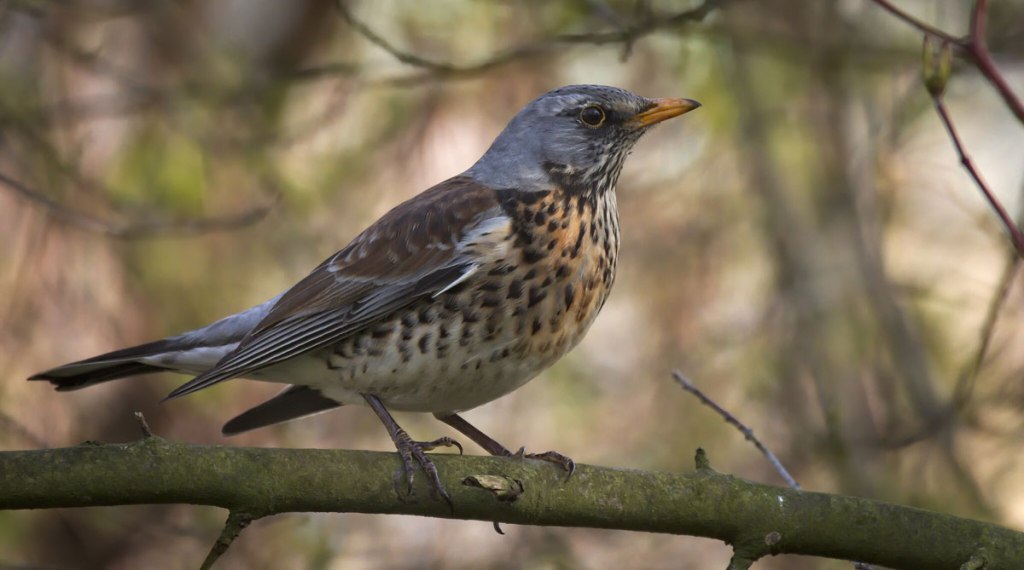
Fieldfare profusion
But on closer examination there was a lot to enjoy: huge groups of fieldfare (a winter thrush visitor from north-east Europe); a few chaffinch (relatively scarce nowadays in these parts) in brilliant winter plumage; loads of berries – haws, rosehips, elderberry in the main – and long-tailed tits flitting through open woodland. The profusion of berries was the attraction for the fieldfares. My regular Lullingstone kestrel did not appear, nor did the almost tame goldcrest I’ve encountered previously in Upper Beechen Wood. (Fieldfare photo: hedera.baltica/Wikimedia Commons)
Oh, that tree!
I’m often astonished at myself for not noticing things – I’ve been known to sit on sofas at home without realising they are brand new, turn on TVs that someone has just delivered and installed, and fail to remark on a room‘s entire renovation. I exaggerate, but it amazes me that I’ve walked past the extraordinary old oak at Lullingstone pictured below at least 200 times without really clocking it; a memory of it must have been lodged in my brain somewhere since childhood, but in the subliminal part. In a similar vein there’s an elegant art deco building opposite Brixton station that’s very familiar to me but it was only last week, on returning from the Ritzy, that I actually looked at it and saw it for what it was. I’ll never ignore it again, and the same goes for this incredible oak.
To be fair, there are several of these oaks at Lullingstone, mostly up towards the golf clubhouse in the west of the park (unlike this one). With some I’m not quite sure if they’re dead or alive. There’s one that you could actually hide inside. This one, which is maybe 300 years old, has a kind of elephant’s face embedded, is indicated on the map below. I’m going to try to keep eyes and brain a bit more joined up from now on. Probably means less daydreaming – let’s see!
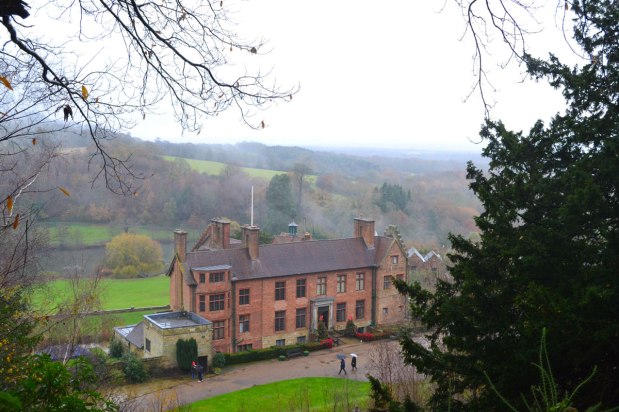
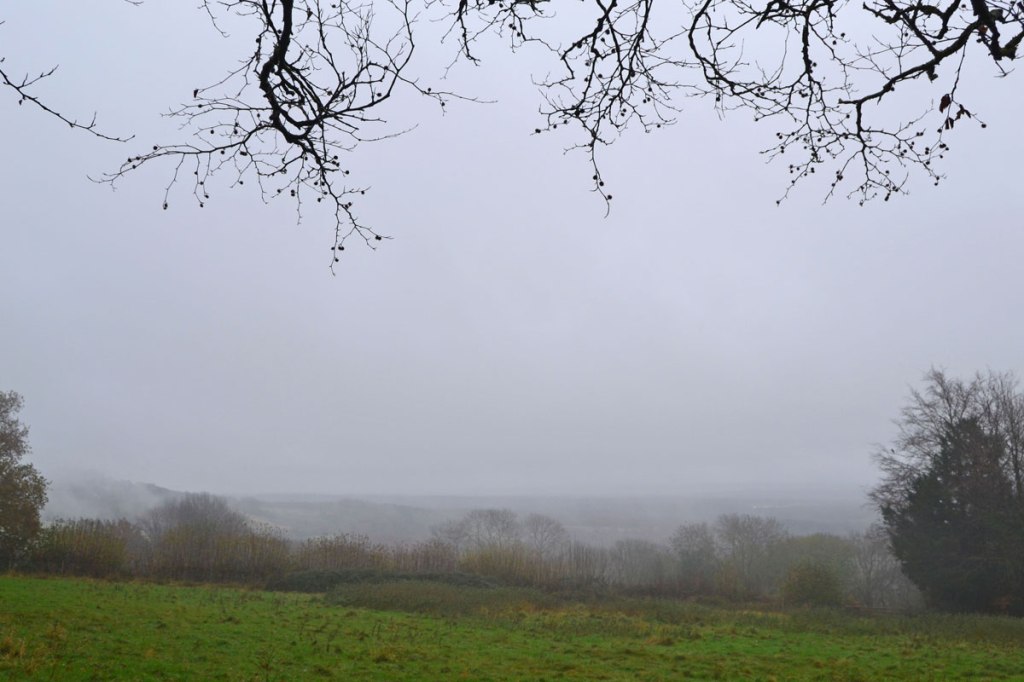
I love to walk the Hosey and Westerham routes in late autumn because of the views of the Low Weald woods from Mariner’s Hill and the hues of the trees on the lower slopes of Tower Hill along the infant River Darent. I missed out on those treats this year but last Sunday we took the Hosey route despite persistent rain and cloud so low it scudded into the hollows of the Greensand Ridge and draped itself over NT attractions such as Chartwell and nearby Emmett’s Garden. We did the walk in reverse, which made life a little less predictable but also disoriented us on a couple of occasions. Even the familiar can confuse when approached from a different direction (wise words indeed ha ha). Despite the rain and mud it was a lovely atmospheric stroll and further proof that, as the great walker Alfred Wainwright said, “there is no such thing as bad weather only the wrong clothing”. I can’t say I had the right clothing, given the fact that my jeans were covered in mud by halfway through and the skin on my bare hands had shrivelled, but these minor discomforts were dwarfed by the pleasure of being out in the countryside. Small birds, including three bullfinch – a rare sight – flittered in many of the hedgerows, a sign that recent frosts have softened and sweetened the berries enough to be gulped down. (Pictured below: Mariner’s Hill views in cloud and rain; water meadow of infant River Darent – a good spot for bullfinch. Above: Chartwell)


















 Kent walks near London