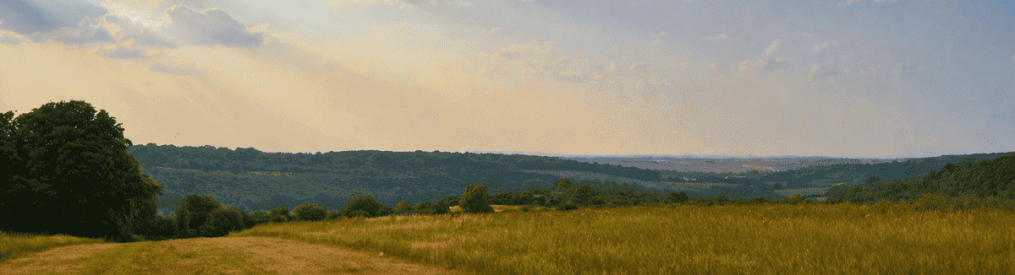
Bluebells around Shoreham, Ide Hill, Downe, Chislehurst, Kent

It’s that astonishing time of year when woods turn blue. I think from Easter to early May the bluebells will be great – there are some patches already in full bloom. The best of my walks for bluebells are Ide Hill and One Tree Hill (see below). Read 2020 bluebell piece here

Bluebells on the Ide Hill walk, April 25, 2015

Bluebells on the Ide Hill walk

Here are the best places on my walks:

  • Shoreham circular: take the high path through Meenfield woods, the one that goes along the top of the hill. It’s marked on my digital map with a blue line. It just means continuing to the top of the hill after point 7 and turning right (north) at the top rather than two-thirds of the way up. The parallel paths meet later, by Shacklands Rd. There are not many bluebells on the regular route, so as I say, take the high Meenfield woods path.
  • Ide Hill: the best walk for continuous bluebells. There are great bluebells straightaway once you enter the Ide Hill NT woods behind the church, and even better in Scords wood just below Emmetts Garden. (Picture.) Amazing bluebells at Emmetts of course, but it’s best to pay the fee (or at least buy some cake!) if you linger in the gardens.
  • One Tree Hill walks: Good bluebells throughout these NT woods and also at the top of Wilmots Hill (on the ‘figure of eight‘ walk). Some lovely pockets of mixed bluebells and wild garlic (picture) off to the side of the path as you near Ightam Mote too (including a kind of garlic ‘jungle’ at one point). Some in the woodland between Shipbourne and Underriver too.
  • Downe: like the Shoreham circular you just have to make a small diversion to get the best bluebells, which are to be found in the hillside woods between Downe and Cudham (picture). Just turn left instead of right at point 3 and walk down to the woods. The hillside is called Downe Bank – a favourite place of study for Charles Darwin and John Lubbock (these great scientists’ names still make infuse this area with greatness and give it a special atmosphere). There aren’t many bluebells to be seen without the diversion.
  • There are good stretches of the blue stuff on the Hever walk, but perhaps less so on the Chiddingstone walk except in the woods above the river Eden (picture) on the return leg of the walk. There are excellent areas of the flowers on the Chislehurst/Petts Wood walk in the lower part of the wood, amid the chestnut groves just east of point 7 close to the railway tracks, stretching north towards the central fields. Knole Park is not great for bluebells compared with the other walks – but then One Tree Hill is just round the corner to sate your blues. However, back to Shoreham, the two Romney St/Shoreham eastern valley walks (5 and 14) have fantastic patches of bluebells in most of the woods the paths pass through.

Find a north-west Kent walk that suits you


Here’s a map of all the walks on this site so far. Click on the pointers to take you to descriptions of the walks online or in printable pdf format. Alternatively, use the walk tabs at the top of this page.

The best walks on this site for public transport, if you live in SE London are:

Best for public transport: Chislehurst/Petts Wood walk (13): direct train to Chislehurst/Petts Wood/Bickley stations from Brixton/Hither Green/Catford/Herne Hill/West Dulwich/Peckham Rye/Nunhead. For the Shoreham/Eynsford and Otford routes (walks 2, 3, 5, 8, 12, 14, 16) there are trains direct to the starts of the walks on Thameslink services between London Blackfriars and Sevenoaks (stopping at Peckham Rye, Nunhead, Catford, Bellingham, Bromley South etc). Trains are relatively frequent and take about 30 minutes from, say, Catford to Otford. Pubs in Shoreham and Eynsford well placed for any delays or cancellations!
So-so for transport: Downe (walk 1): closest route to SE London but involves a (fairly frequent) 25-min bus ride – 146 from Bromley South station
OK for transport: Knole Park (walk 11) – you’ll have to walk from Sevenoaks station (good rail services to Sevenoaks station on Thameslink – see above – or Charing Cross line (Hither Green etc) for nearly a mile to the leisure centre and enter Knole from there, joining the walk as per instructions and map.
Bit of a stretch but do-able: Hever (walk 9) actually has a station, on the London Bridge line via East Croydon, so quite easy from Forest Hill, Brockley etc if you plan ahead. The walk starts at Hever Castle, 1 mile from the station but there’s a path that will take you there from the station.
Not so accessible: Sevenoaks routes (walks 4, 6, 7): can take train to Sevenoaks station on Thameslink or Charing Cross line (Hither Green etc), but then a taxi ride – Ide Hill is about 4 miles from the station; One Tree Hill about 3 miles (also quite close to Hildenborough station).
Car only, although…: I think Chiddingstone is definitely best by car. But, you can take the train to Hildenborough or Edenbridge and get a taxi (more details on walk’s page). Westerham/Chartwell is best with a car, though again bus from Bromley is possible (246), as is taxi from Sevenoaks station.

Always check ‘live departures’ online for trains – service disruption is quite the thing these days you know.

Best for views

One Tree Hill, Ide Hill, Otford circular via Romney St, Fackenden Down, Westerham/Chartwell, Shoreham’s mystery eastern valleys, Polhill, Eynsford/Lullingstone. Oh… actually all of ’em.

Best pubs on the walks – click here

See menu at top of page for full list of walks

Which of these walks are best for public transport links?


Here’s a map of all the walks on this site so far. Click on the pointers to take you to descriptions of the walks online or in printable pdf format. Alternatively, use the walk tabs at the top of this page. No one likes standing for ages at bus stops or on railway platforms but I will say the bus to Downe is relatively reliable and frequent and the train to Eynsford, Shoreham and Otford is pretty good too (and there are pubs to dip in to if you have to wait for ages anyway) – although watch out for engineering work on Sundays. More details below. Tell me if you have any tips I’ve left out.

The best walks on this site for public transport, if you live in SE London are:

Best for public transport: Chislehurst/Petts Wood walk (13): direct train to Chislehurst/Petts Wood/Bickley stations from Brixton/Hither Green/Catford/Herne Hill/West Dulwich/Peckham Rye/Nunhead. For the Shoreham/Eynsford and Otford routes (walks 2, 3, 5, 8, 12, 14) there are trains direct to the starts of the walks on Thameslink services between London Blackfriars and Sevenoaks (stopping at Peckham Rye, Nunhead, Catford, Bellingham, Bromley South etc). Trains are relatively frequent and take about 30 minutes from, say, Catford to Otford. Pubs in Shoreham and Eynsford well placed for any delays or cancellations!
So-so for transport: Downe (walk 1): closest route to SE London but involves a (fairly frequent) 25-min bus ride – 146 from Bromley South station
OK for transport: Knole Park (walk 11) – you’ll have to walk from Sevenoaks station (good rail services to Sevenoaks station on Thameslink – see above – or Charing Cross line (Hither Green etc) for nearly a mile to the leisure centre and enter Knole from there, joining the walk as per instructions and map.
Bit of a stretch but do-able: Hever (walk 9) actually has a station, on the London Bridge line via East Croydon, so quite easy from Forest Hill, Brockley etc if you plan ahead. The walk starts at Hever Castle, 1 mile from the station but there’s a path that will take you there from the station.
Not so accessible: Sevenoaks routes (walks 4, 6, 7): can take train to Sevenoaks station on Thameslink or Charing Cross line (Hither Green etc), but then a taxi ride – Ide Hill is about 4 miles from the station; One Tree Hill about 3 miles (also quite close to Hildenborough station).
Car only, although…: I think Chiddingstone is definitely best by car. But, you can take the train to Hildenborough or Edenbridge and get a taxi (more details on walk’s page).

My walks

• Download Walk 1Downe circular (near Bromley, 2.6 miles) View on your phone/PC
• Download Walk 2Shoreham circular (3.5 miles) View
• Download Walk 3Shoreham to Eynsford (4.2 miles) View
• Download Walk 4Ide Hill circular (3 miles) View
• Download Walk 5Otford circular via Romney St (5.5 miles) View
• Download Walk 6One Tree Hill circular (near Sevenoaks, 5.5 miles) View
• Download Walk 7One Tree Hill figure of eight (near Sevenoaks, 5 miles) View
• Download Walk 8Shoreham/Otford circular (5 miles) View
• Download Walk 9Hever circular (4.5 miles) View
 Download Walk 10: Chiddingstone/Penshurst circular (4 miles) View
• Download Walk 11: Knole Park’s Wild Side (3.5 miles) View
 Download Walk 12: Eynsford/Lullingstone circular (4 miles) View
 Download Walk 13: Chislehurst station to Petts Wood station (3.7 miles) View
• Download Walk 14: Shorehams mystery eastern valleys (4.5 miles) View

Spring in the air?

Two weeks ago I walked at Downe in snow (see pictures below) – a reminder that villages near the leading edge of the North Downs (Ide Hill is another) are just enough metres higher than SE London to convert rain into snow. Since then there have been signs of spring; no sightings of ridiculously early bluebells so far, unlike this time last year, but a milder feel despite Doris rushing through. This past weekend a drizzly Knole Park walk was hugely enjoyable. Although the park was surprisingly busy there was a lovely wild atmosphere about the place and the removal of scaffolding from the side of Knole House restores the Tudor integrity of that fantastic structure. Busy green woodpeckers and flitting small mixed groups of finches provided the evidence that change is in the air. No owls though, even as dusk came on.

Downe in winter snow

Awful weather this week – overcast, cold – but at least there was some snow today to enliven proceedings. I decided to get some fresh air on the Downe walk. In south-east London the snowfall didn’t stick whatsoever but by the time I reached Keston there were extensive patches. Below are some iPhone images of the Downe circular walk taken sequentially. I nipped off-piste down to the golf course after point 5 – the unblemished snow on the fairway made me feel as if I were walking on goose feathers; the powder had a strangely translucent appearance I’d never seen in snow before. Popped into the Queen’s Head where a half of Westerham Ales’ Grasshopper by the fire, with Italy v Ireland rugby on the telly, was a splendid ‘warm down’. Once again, a rotten day for weather comes up trumps (whoops, sorry, banned word there).

This slideshow requires JavaScript.


New walk: Shoreham’s mystery eastern valleys

Beyond the steep, thickly wooded eastern wall of the Darent Valley is a quiet chalk upland area of dry valleys, meadows and plateaus. There’s a disused golf course, now overgrown and becoming a bit of an unofficial wildlife reserve, lovely north-south views, a discreet private airstrip behind a strip of woods from which vintage light aircraft are regularly flown, and, well… that’s it really. It’s a very atmospheric area and, for me, quite different in nature from the western valley wall. My new, ‘eastern valleys’ walk (number 14, 4.5 miles, pix below) really digs into this tranquil, timeless landscape via the little hamlet close to the defunct Austin Lodge clubhouse. Also the Otford/Shoreham/Romney St walk (5) takes in some of it. Walkers can combine the two routes to make a 10-miler or combine them with the Shoreham Circular strolls (8.5 miles). The starting point for the new walk is Shoreham railway station, which is well connected to south-east London, by Thameslink trains (not the most reliable line but so handy for the countryside). It can also be started from the church with an alternative route up to the plateau. There are some steep sections so you’ll feel this one afterwards. Enjoy. (Download a pdf of this walk.)

This slideshow requires JavaScript.

Eynsford, Darent Valley, Downe winter photographs

Blowing my own trumpet rather (an odd expression for a saxophonist to use of course), I’m rather pleased with these two photos, particularly the top one, taken at about 3.45pm on the Eynsford walk (shoreham-to-eynsford and lullingstone). I was struck by the sky colours, the shapes of the trees and how the flint stones in the field stood out white, seeming almost luminescent. The second one was pointing further towards the recently set sun, hence the orange hues. Anyway, enough pretentious twaddle from me… hope you like them.

Eynsford Lullingstone flinty field, winter

Eynsford Lullingstone flinty field, winter

Eynsford, Lullingstone, Kent. Flinty field.

Eynsford, Lullingstone, Kent. Flinty field.

Update, January 10, 2017: I did some major tweaking in Photoshop on the first of the pictures below to improve detail in the foreground. Cheating, some would call it. It was taken near Downe House at about 3.45pm in early January 2017, as were the pictures beneath it (even though they appear lighter, they were actually taken a few minutes later).

Downe near point 3 in winter

Downe near point 3 in winter

Downe, Kent, England

Frosty hillside fields, Downe

Field next to Downe House

Field adjacent to Darwin’s house, Downe, January

The joy of bad weather walks

The weekend has started abysmally, with heavy rain, low temperatures and general murk. Great for walking! Yes, there’s a real frisson in donning hat, gloves and coat and striding off on a ridge amid horizontal precipitation. Failure to remember hat or gloves, however, is detrimental to the cause. Some places take on a whole new atmosphere of wilderness when you walk in poor conditions. Knole Park suddenly seems like a Scottish glen, the Ashdown Forest becomes Dartmoor, Lullingstone the Cheviot hills (bit of a stretch that). Anyway, whatever, my point is that waiting for perfect conditions is just not good form if you want to enjoy the local countryside. I can see from my exalted position as webmaster that the number of views on this website fall dramatically as the clouds gather. So don’t delay, ignore the moisture, get out there. I’ll be watching.

fog-at-ide-hill-2017

Ide Hil walk, Ram Pump Pond

Ide Hil walk, Ram Pump Pond

A great walk on a grey day is my latest offering here… Eynsford/Lullingstone (4 miles; 90 mins). It’s mostly mud-free, has two good pubs waiting for you, and up on the hill by Eagle Heights you’ll feel the elements alright. It’s also a great choice of walk if car-less; it starts from Eynsford station.

I won’t bother with a picture; grey, rainy days aren’t very photogenic. They’re all about feeling it.

A few hours later… went to Knole Park in awful conditions, but got an OK shot with the iphone
– had to brighten it a bit so a bit pixelly but still…

Stag at Knole

Stag at Knole, November 2016 (Point 1 on the Knole Walk)

Knole Park’s wild side (3.5 mile walk)

Knole Park is great for an autumn walk. Fantastic beeches and oaks, with the odd yew and pine plantations, make for a colourful spectacle. Encounters with deer, interesting birdlife such as green woodpeckers, redstarts, and weird fungi and so on, add to the interest. Oh, and a great National Trust maintained tudor mansion (Knole House). A lot of the park counts as rare lowland dry acid grassland, if you’re in to topographic categories.
My walk takes in the more remote-feeling eastern side of the park, starting in woodland on the park’s southern perimeter. I’m afraid that’s not the most convenient place to start the walk if you’re travelling to Sevenoaks on the train, but you can still do the walk by starting closer to the station at the park gate behind the leisure centre (half a mile walk from the station) – and then joining the route by Knole House (ie point 4 to 5 when you see the map – click link below).

Read about the route here
Download and print off a pdf of the walk

This slideshow requires JavaScript.