Come along and enjoy top quality live jazz, Monday 10 April 8.20pm
If big band jazz is your thing, or even if it isn’t, come along to Sundridge Park WMC at 134 Burnt Ash Lane, BR1 5AF on Easter Monday. I will be playing in the saxophone section on alto sax. The band is called the Mick Collins Legacy Band, recognising its founder. It’s £10 to get in and the band starts at 8.30pm and finishes at 10.30 with a short break. There’s no need to book (you can’t anyway!) but there’s a bar at hand and lots of seating in a large room with good acoustics. The music we play is by arrangers and composers such as Thad Jones, Bob Florence, Gil Evans, Wayne Shorter, Kenny Wheeler and Mike Gibbs. What else can you do on a Monday night that’ll be as uplifting? Don’t answer that!
It seems that financial pressures brought on by the Covid lockdown and reduced footfall in winter has led to the closure of this beautiful, historic, and challenging public course and its owner Sencio’s other leisure facilities in Sevenoaks and Edenbridge. It’s very sad news not just because I’ve enjoyed the odd round at Lullingstone for many years, but because the course is a key component of the country park; the wild grasses, woods and scrub in between fairways is highly biodiverse and is home to a decent array of flora and fauna. I should know, I’ve tentatively had to search for my ball in these wild fringes often enough. Without the course you wonder what might happen to the rest of it what with the pressure for new housing. Let’s not worry about it too much for now; Sevenoaks District Council says it is confident that a new operator can be found for the course and the other Sencio facilities so let’s hope for the best. My main Lullingstone walk starts from Eynsford station but, if you’re driving, you can park just outside the golf course entrance (presumably shut now) and do a complete 5-mile orbit of the country park.
In the meantime it’d be good if people enjoying the new freedom in the park stay off the greens; I’m sure it’s fine to cross the fairways if you want but please leave the wildlife-rich rough well alone.
River Darent
Bench, Lullingstone
Lullingstone horse chestnut in flower
Skylarks nesting and wildflowers: put dogs on the lead
Skylarks provide us with the soundtrack of the countryside in southern England as they mark out their territories from around 100ft in the air. There are quite a few of them at Lullingstone, whereas birds that used to be seen in the park such as lapwings and yellowhammers have largely disappeared. I’m a bit worried that without the golf, people and their dogs will range all over the grassy slopes and will inadvertently destroy skylark nests. The birds nest in hollow scrapes in reasonably grass between 20 and 50cm high. I noticed last Sunday that quite a few dogs were bounding around in areas they wouldn’t normally be because of the golf closure. It’d be a shame to lose the skylarks and other flora and fauna that was protected by being in “islands” of grasses and meadow in between fairways.
Of all the seasons-within-seasons, the end of winter, or springter, is one of the least enjoyable for walking I find. That doesn’t mean I don’t enjoy getting out into the countryside; it just means that when I do, I look around and think “meh” quite a bit. There’s still a lot to look out for in early March: old man’s beard (clematis vitalba), hazel and alder catkins, blossoming blackthorn, the vigorous growth of bluebell shoots, redwings and fieldfares flocking to migrate east, small birds breaking into song, the passage of gulls at high level etc, but the predominant colours are grey and brown, the air is still harsh and raw, mud clings to your boots and you slip on steep paths.
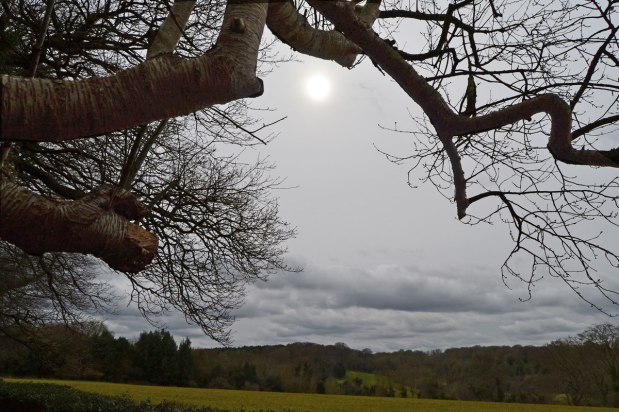
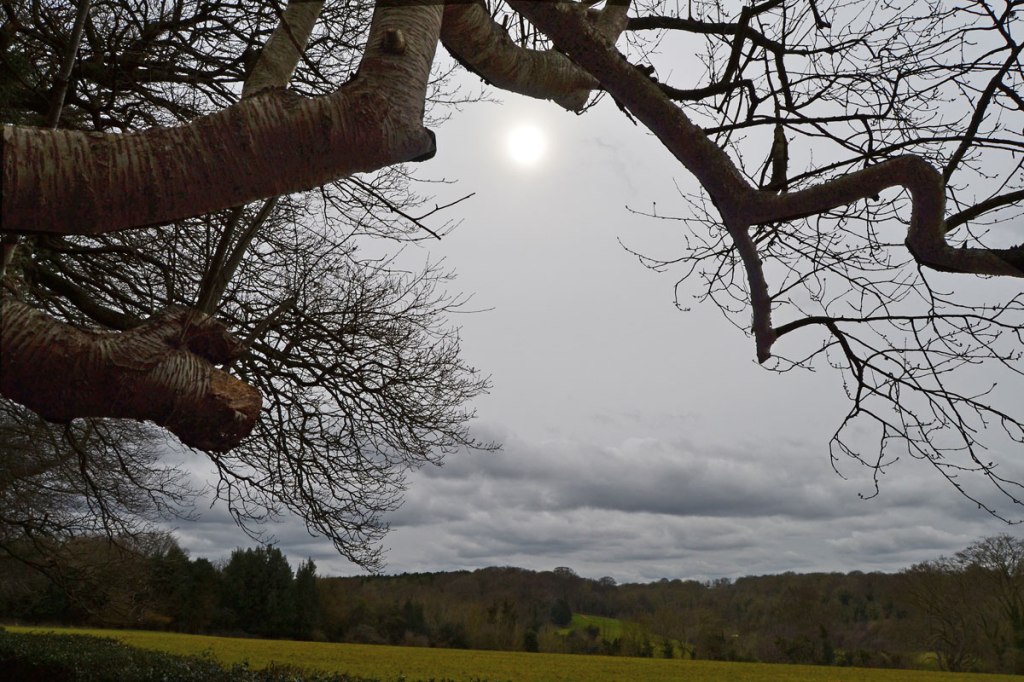
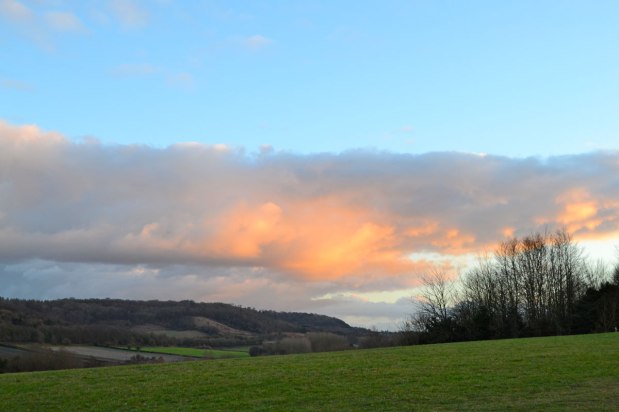
On recent walks to Hosey, Fackenden Down, Bough Beechand Downe, I found plenty to like but not much to inspire. This was partly because, apart from at Fackenden where there was an eyecatching sunset, the sky was unyielding and grey. Drama is needed in the sky at times like these, and springter often provides it as great air masses come into conflict, showering us with rain, hail, snow and sleet and producing fascinating aerial vistas. But at Hosey, all was monotone, at Bough Beech a thin Sunday drizzle dampened down any sense of vitality and at Downe, the morning brightness was consumed by a blanket of altostratus – the precursor to an approaching front – which had stealthily taken over the day as I was en route. But everyday is different if you look closely enough and the sun, a white ball behind the veil, did its best to make the stroll memorable.
View over Chartwell, Hosey walk
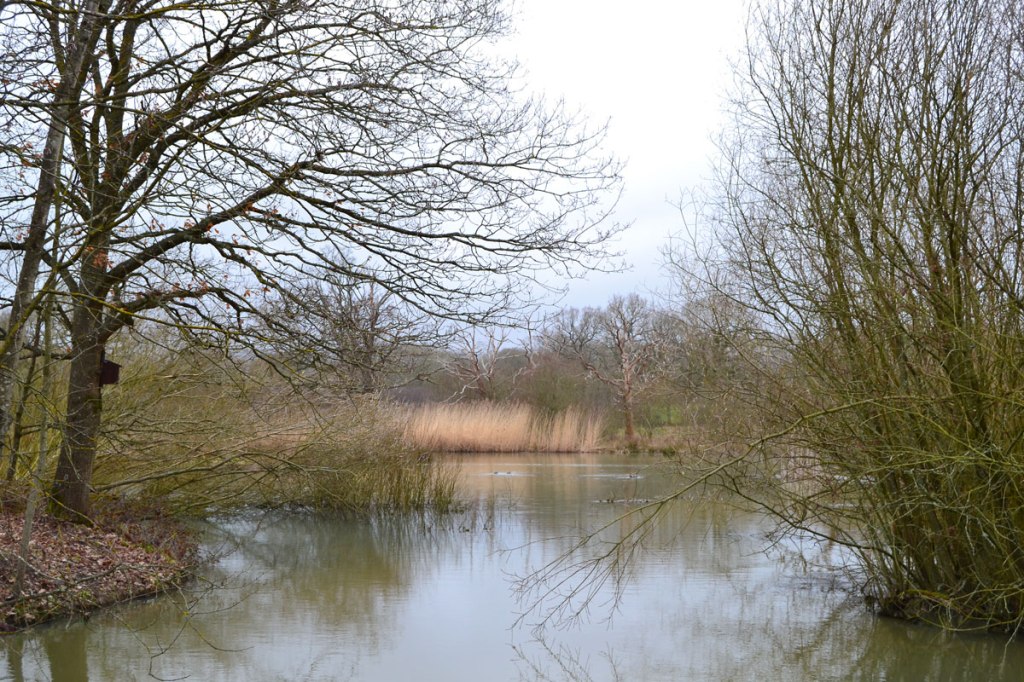
Bough Beech nature reserve
View over Bough Beech reservoir from the Bore Place chair
Downe walk under altostratus cloud
View from Fackenden Down, March 2023
That terrific birder Dave accompanied me at Bough Beech, educating me as we went on the courtships of goldcrests, the behaviour of gadwall – a much underappreciated duck, he said – West Ham’s unsatisfactory season, the calls of marsh tit and treecreeper (I’d forgotten, again), and the distribution of local chaffinch populations. Although we made it to 39 species we saw no snipe, barn owl, brambling, kestrel or even buzzard as we hoped. The bird of prey fraternity was represented only by a solo red kite who lazily loitered above the low weald landscape for nearly half the walk, sometimes close, sometimes distant – an almost spectral presence so unfettered was it by the subdued, squelchy land below.
Thinking back to that red kite (which by the way would have been an extraordinarily rare sight in this part of the world until about 10 years ago) my springter moans and groans appear misplaced; these grey walks were brilliant.
It’s proved an unexpectedly dry month, which has meant less mud when walking at this time of year than in any February I can remember (I don’t take measurements to be fair). There have been some gloomy weekends but some bright ones too leading to loose talk of spring having sprung. It hasn’t. Appreciating the longer daylight hours, we headed off in late afternoon for a circuit of Lullingstone yesterday, taking in the superb Beechen woods, the views down the Darent Valley and the blackthorn/hawthorn-dotted grassy high chalk hillsides on the return (we’d started the walk from the golf club car park, not the visitor’s centre). The cloud-shrouded sunset was magnificent with glimpses of Jupiter and Venus in the twilight. Very few birds around apart from a few fieldfare feeding late on the eighth hole fairway in the gloom. The last golfers had gone and with few people around it was all very tranquil, leaving a lovely imprint on the memory that will last me through the week.
Last week, the Cudham walk was terrific with sunshine and wisps of high cirrus stippling the sky. The medieval flint church (pictured), shaded by ancient yews was beautifully lit as was the wonderful New Year’s Wood. There was little in the way of mud, but also few birds for some reason, even among the hedgerows. This drop off in the numbers of birds is something I’ve seen right across the walks lately. It seems to me that rich, well kept woodland areas such as Scords Wood and Petts Wood aren’t doing quite as badly as farming and pasture areas. This is what worries me about those new fences at Downe – does it mean more grazing and less space for wildflowers? Steve Gale’s blog North Downs and Beyond has some more on the drop off in bird populations. Steve is an expert observer of fauna and flora and has the experience to observe and record changes in numbers.
Unlike that sparkling Sunday in Cudham, the weekend just past was so gloomy that I only managed a brief cycle to Beckenham Place Park and back. I found little to inspire to be honest. Let’s hope for better in the weeks ahead.
Come along and enjoy top quality live jazz
Not venturing out at the weekend actually suited me as I needed to practise my saxophone (and watch some sport) in readiness for a gig tonight (Monday 13th). So if big band jazz is your thing come along to Sundridge Park WMC at 134 Burnt Ash Lane, BR1 5AF. It’s £6 to get in and the band starts at 8.30pm and finishes at 10.30 with a short break. There’s no need to book (you can’t anyway!) but there’s a decent bar at hand and lots of seating in a large room with good acoustics. The next performance after this is on 6 March at the same venue. The music we play is by arrangers and composers such as Thad Jones, Bob Florence, Gil Evans, Kenny Wheeler and Mike Gibbs, the sort of material performed by the Woody Herman, Stan Kenton, Count Basie bands etc. What else can you do on a bleak Monday night that’ll be as uplifting? Don’t answer that!
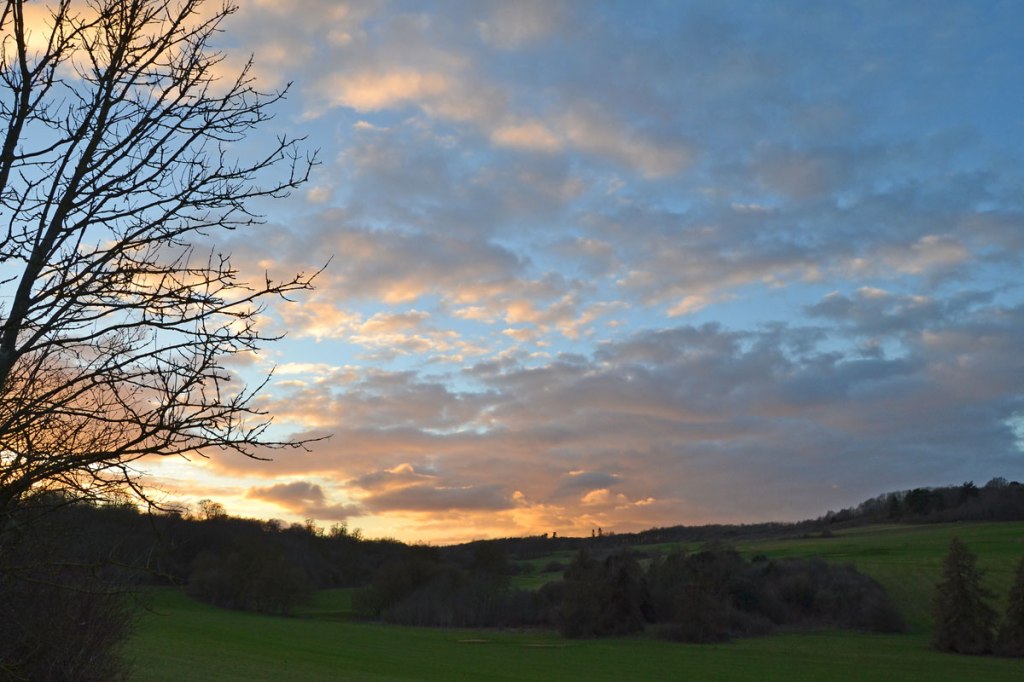
My previous post referred to getting lucky with the light on dark winter days. At Ide Hill last Friday, the cloud layers parted to reveal a magnificent dusk sky full of colour. Photos don’t really capture it, and my basic digital SLR Nikon isn’t really up to capturing the Moon properly, but I’d like to post a few just to remind myself of this wondrous early evening. It was another reminder that late afternoon can be a superb time to go out – there’s no need to postpone a winter hike just because you’ve been busy in the morning and didn’t manage to get away.
January walks are all about timing. Things can appear dreary, muddy, dank and generally unappealing but with the right weather conditions the quality of the light can make everything right. Clear, bright, frosty days are definitely the best for a Kent hike at this time of year and despite all the low cloud and rain this month, there have been quite a few such days falling at the weekend. Well, a couple anyway. We’ve tried to make the most of it and walks at Cudham, One Tree Hill, Ide Hill, Hosey, Downe (despite the new fences) and Petts Wood have come up trumps. With a hard frost, like the one we found at One Tree Hill last Sunday, a lot of the mud freezes, which helps considerably. Such days can be good for a spot of casual birdwatching too with small birds often so keen to feed that they care less for human presence – I’ve enjoyed up-close views of goldcrest, nuthatch, coal tit and brambling this winter. But it’s a mysterious affair; sometimes there are no birds at all.
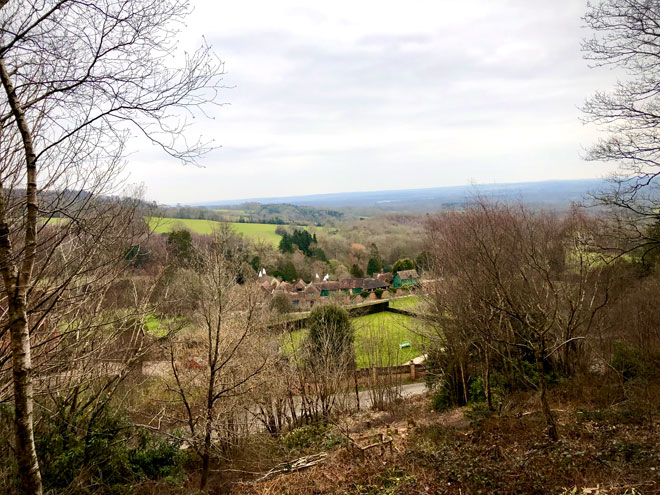
Beech trees catch the late afternoon sun, Downe
Sunbeam at Mariners Hill over the low weald of Kent.
Rooks Hill Lane on the One Tree Hill, Ightham Mote walk at Bitchet Green (iphone photo)
Sunshine on beech trees, Downe, January
Hidden valley, Ightham Mote in deep frost. iPhone photo.
To mark the year’s passing I’ve picked one photo from each month looking back over the year so will hope to show the passage of the seasons. In some months I took few photos … which is why September’s picture is a bit “meh”. One photo is a complete cheat because it’s not from the walks here, but from north-west Scotland! I think my favourites are the final two of the year: Underriver view and Lullingstone in the snow, although the sharpness of that Cudham shot in remarkably clear July air does a lot for me.
I don’t rate myself as any kind of photographer, and I’m sure a true pro could do a lot better, but I do enjoy capturing an atmosphere or certain aesthetic. If others like them too, even better!
Happy Christmas to all who visit and use this website and best wishes for 2023.
A cloud layer produces a false sunset at Ide Hill, January
Downe walk, February
Flooded woods, Bough Beech, March
Bluebells in Emmetts Garden/Scord’s Wood, April 2022
View over Summer Isles from Ben Mor Coigach, near Ullapool, May.
Pyramidal orchid in the Andrews Wood-Meenfield Wood gap, June
Cudham walk, July, between point 2 and 3, the field short cut
View from Romney Street, August, Fackenden Down walk
Lullingstone park is a great place to feel the winter vibes in the North Downs, with sweeping views of the Darent valley, big skies, mists swirling down by the river and a variety of terrain: from grassy expanses to rich beech and oak woods. Some walkers in Kent on Saturday saw a double sun – a trick of the light in which the sun seems to appear twice. It’s also called a sun dog, and is a type of halo. We weren’t so lucky, but the atmosphere was superb – wispy cloud, patches of cobalt sky, a low sun and a light mist. Small flocks of linnets were feeding in scrubby fields at the start of our route, up by the golf course entrance. It was the last day of this week of snow and freezing temperatures so we wanted to make the most of it, taking a 4-mile route around the park. A very deep frost had formed on top of the snow, producing some incredible branch-like crystal structures. It was a truly memorable stroll.
Two very cold but contrasting days at the weekend just gone. Bright sunshine and rich colour on Saturday, fog, frost and monochrome tones on Sunday after a largely clear night. We walked near Shoreham on the North Downs then, on Sunday, at Ide Hill near Sevenoaks on the Greensand Ridge. I tried to keep an eye open for birds and saw a yellowhammer flying away from along the line of hedgerows beneath Fackenden Down plus several fieldfare. At Ide Hill we saw a brambling among a mixed bunch of chaffinches and great and blue tits (there may have been a female bullfinch among them too) on the eastern edge of Emmett’s Garden and later some greenfinches popped out of a hedgerow. At Ide Hill, as we had hoped, we were ‘above the cloud’ with a layer of fog obscuring the low weald below and little pinnacles of ridges further south poking up through the murk. The best frost was seen en route around the woods and heaths of Hayes and Keston Common – very beautiful. And then came the snow …
Anyone with time free over the next couple of days should try to get out on the walks to experience the snow at places like Knole and on the hill tops at Fackenden and Polhill. It can be spectacular. (See photos from 2021.)
If you haven’t seen it, please check out my piece for The Guardian on a Darent Valley walk ending at the Samuel Palmer, one of Guardian Saturday’s pub walk series. And on 31 December the paper is running a piece I wrote about birding while walking – describing walks at Underriver and on Handa Island in NW Scotland.
Pictured: elderberry, rosehips and views in the winter sun on Fackenden Down; fog and murk on the Low Weald from Ide Hill