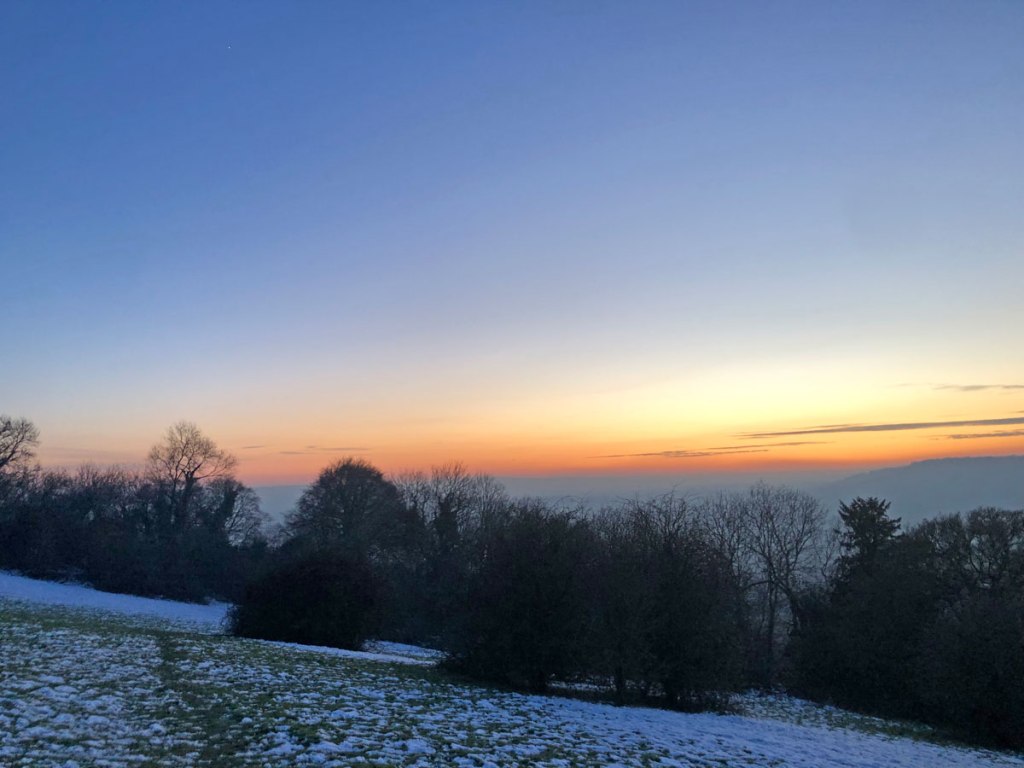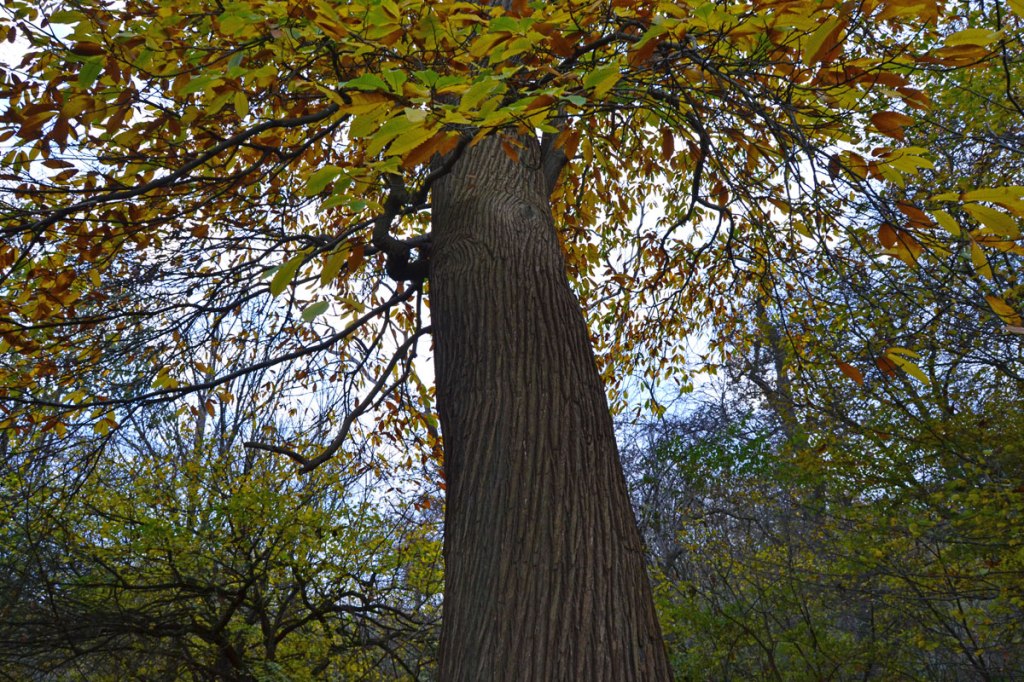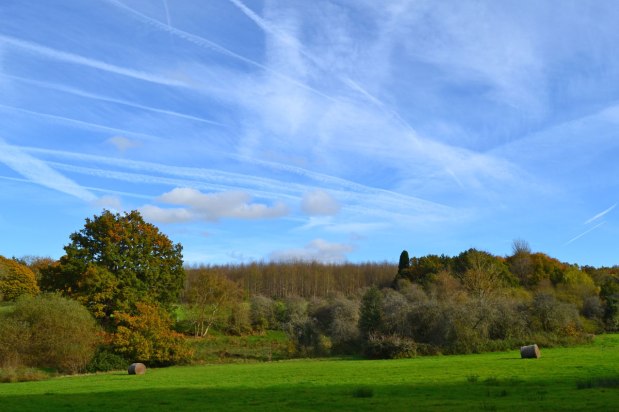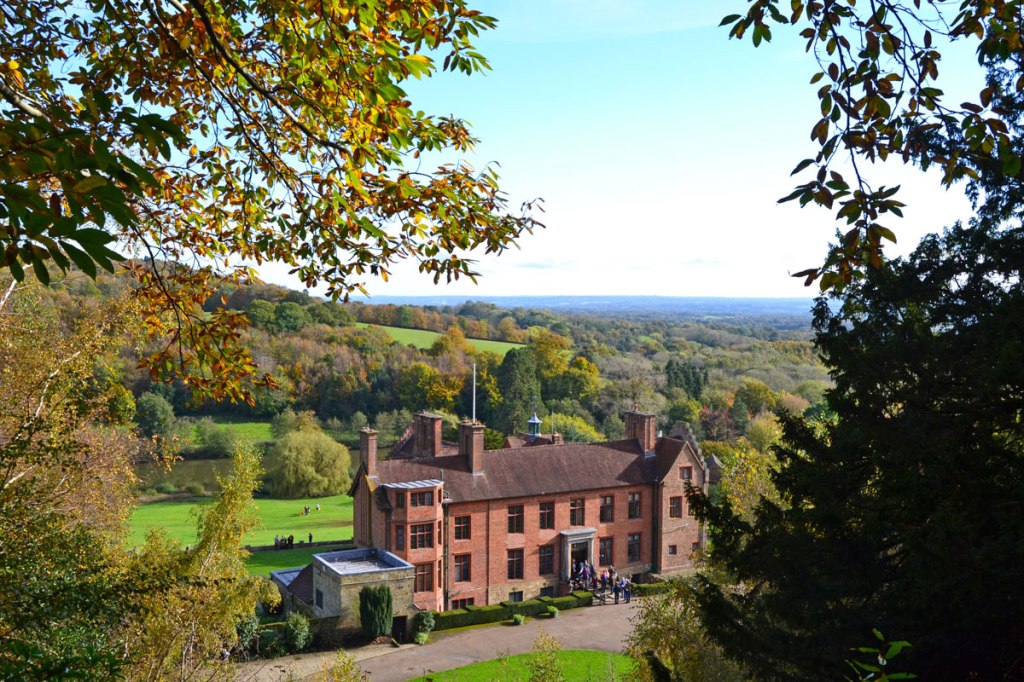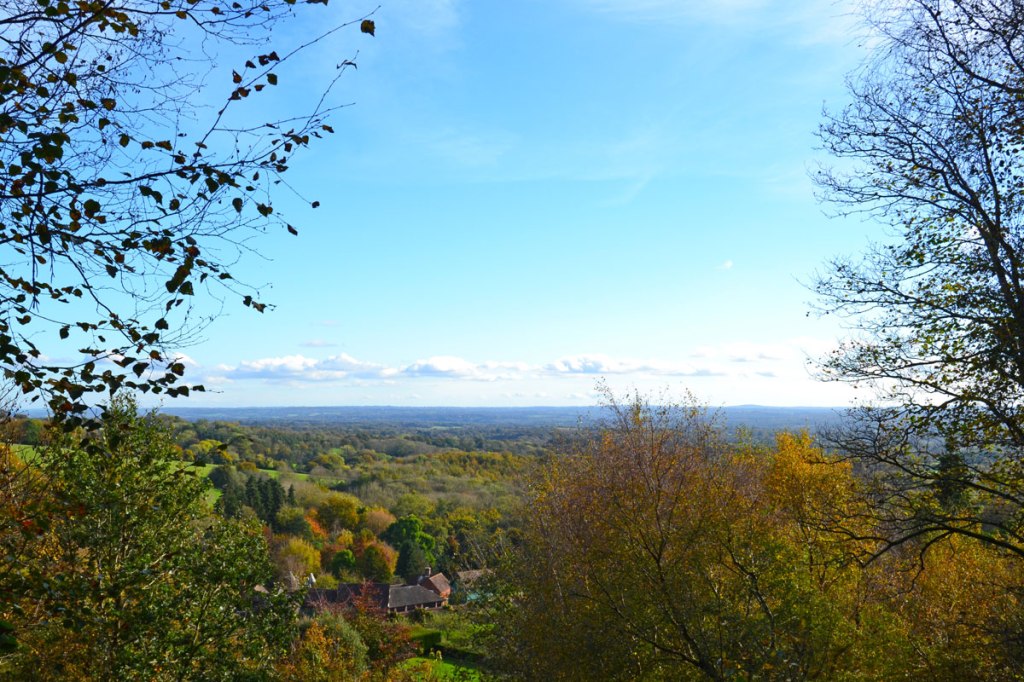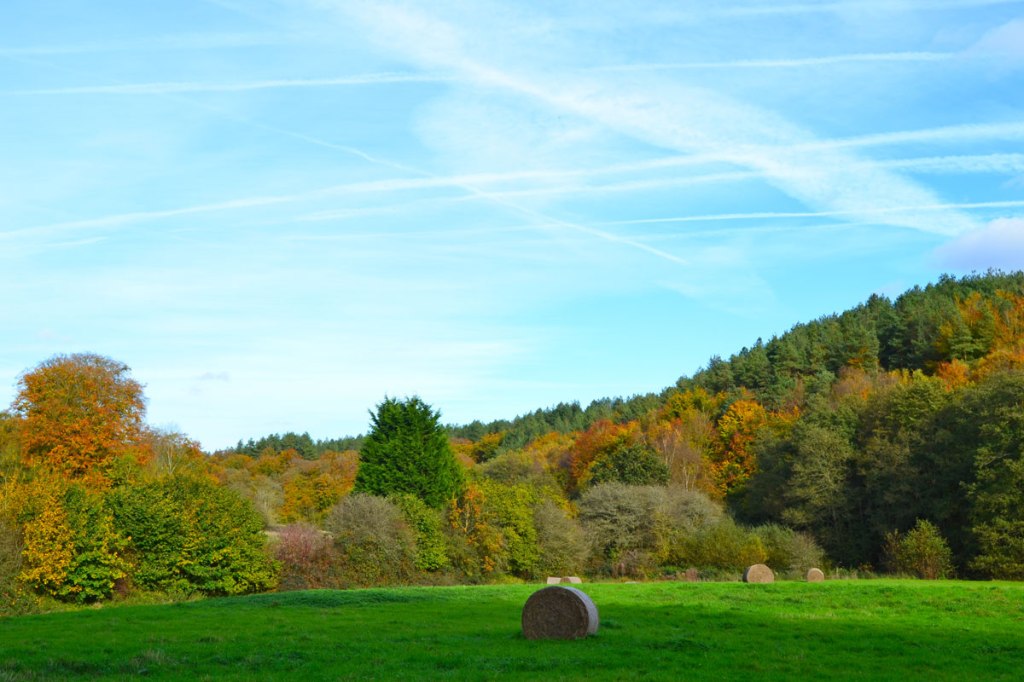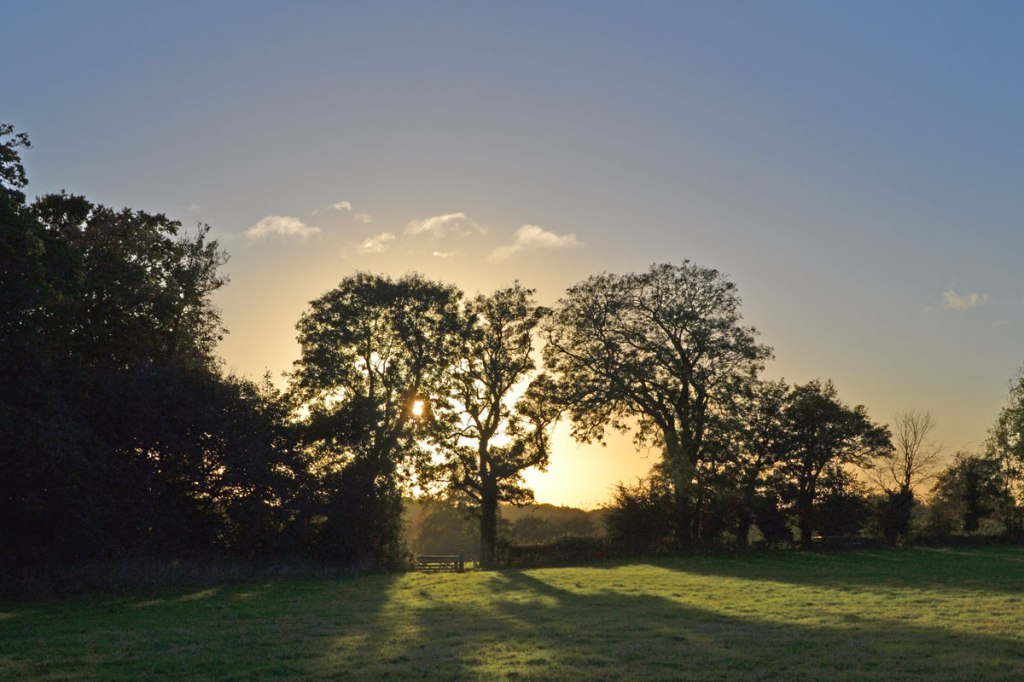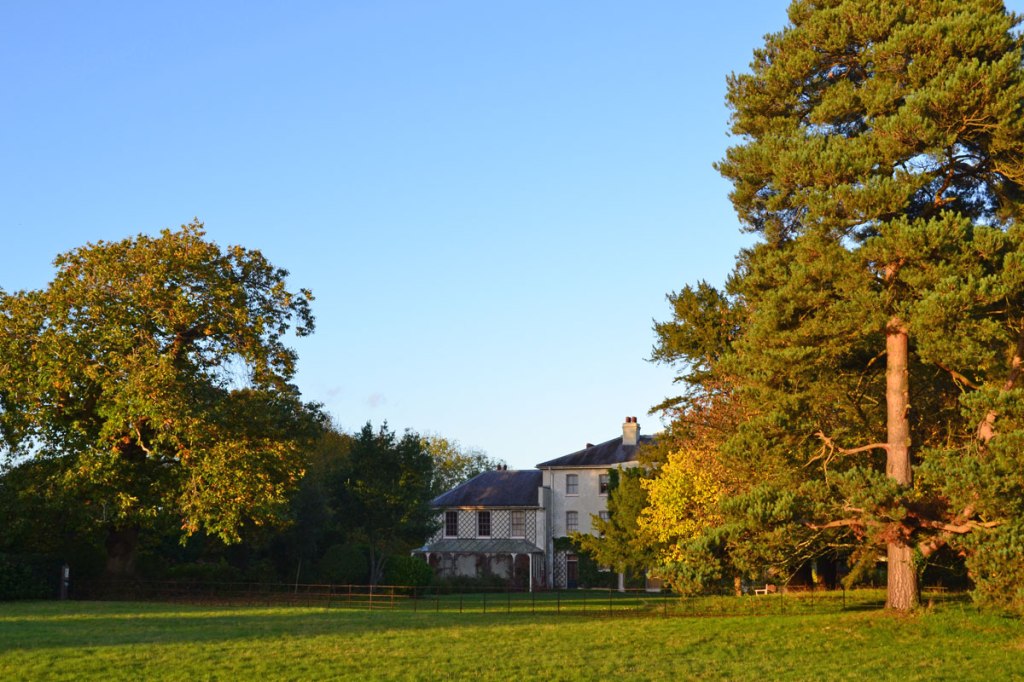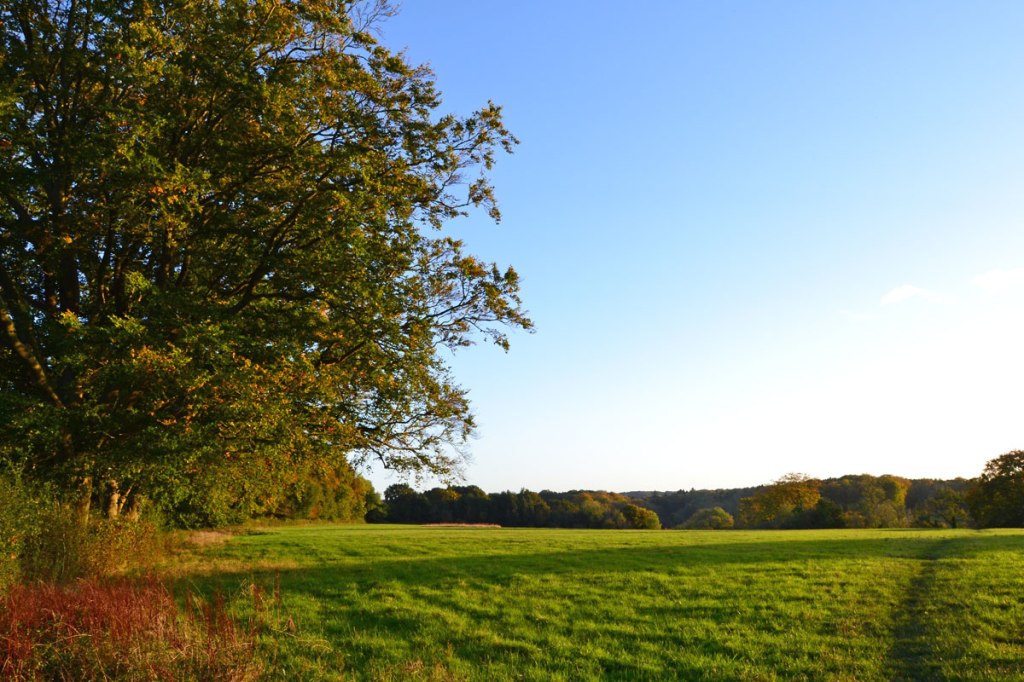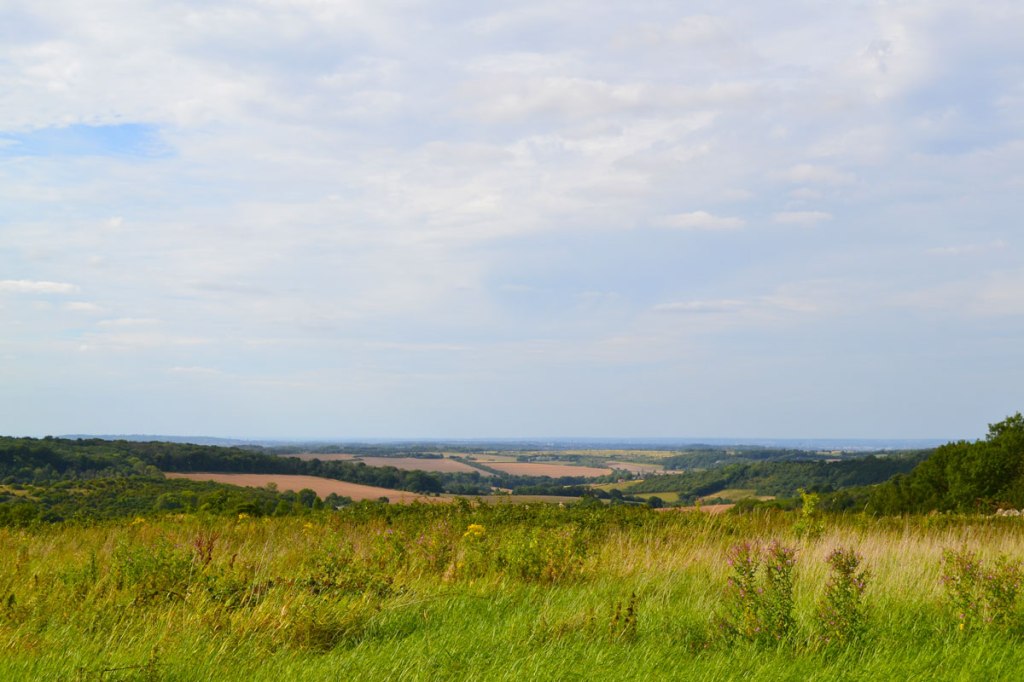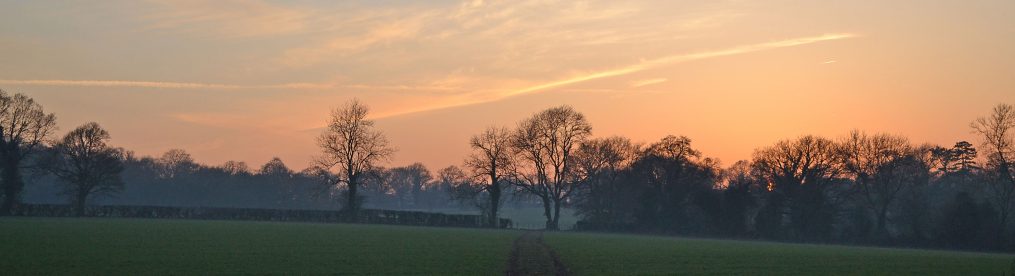
It’s been a bit of a classic autumn so far; lots of rain but also some great sunny windows of walking opportunity. If you’re keen on getting out for a walk but prefer to stay dry it means checking your weather apps and staying agile. Lately these windows have come at the end of the day and have rewarded those able to dash off on a Kent saunter late in the day with some brilliant light. On Saturday, the Downe walk at 5pm was a winner. As well as a beautiful sky, saturated colours and a sense of perfect tranquility, there were interesting birds around: kestrel, sparrowhawk, three yellowhammers, redwing and mistle thrush. Migrations are happening. Some of these birds may have travelled from Scandinavia, from eastern Europe, Yorkshire or a few miles over the border of Surrey. We’ll never know.
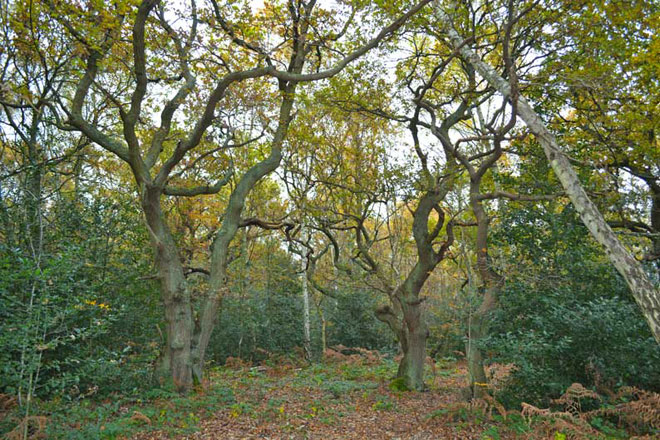
Rain set in overnight and for much of the next day. I’m drawn to wooded areas for walk in bad weather and few woodlands are better than Petts Wood, maintained by the National Trust. Scots pines, chestnut groves, heather glades, oak, ash, and sycamore surround a labyrinth of paths with a railway line and a couple of arable fields and streams helping navigation in the middle of the wood. A great place.
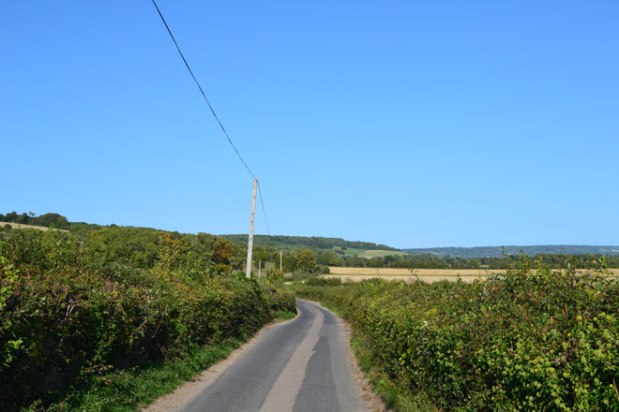
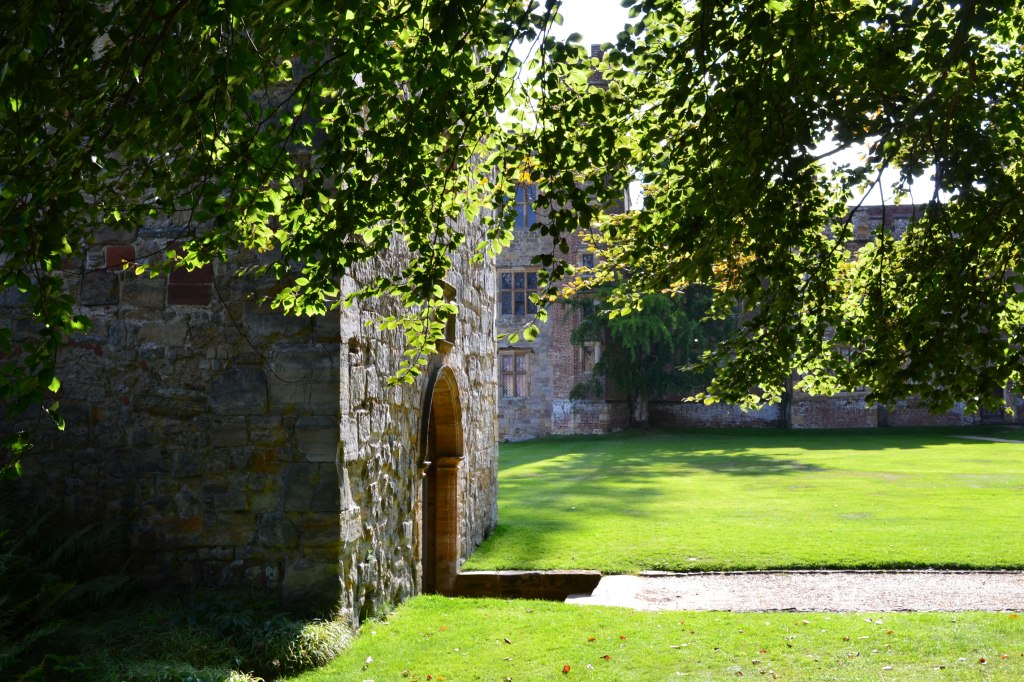
The dusty torpor of late August is upon us. Birdsong has dwindled and the countryside looks faded and a bit tired. The late afternoon sunlight on Sunday was filtered through a layer of dust and smoke particles from wildfires across the Atlantic giving an oddly melancholic tone to our cycle ride around Cudham, Brasted and Knockholt. The silence was only punctured by the breeze on the beautiful hedgerows, and dry, long grasses and wildflowers of the verges and fields left to fallow. Swallows seemed to be clustering together in a few places as they contemplate their epic journey south. We stopped to pick blackberries at Letts Green, having for once remembered to bring some tupperware with us. Later a ruddy moon rose to the south emphasising the odd atmospheric conditions. My cycle route takes in the Pilgrim’s Way and the daunting Sundridge Hill, having sped down Brasted Hill. We’ve done it so often now that our legs have acclimatised to the steep sections that we used to have to walk up. Another cycle, the next day, took us from Tonbridge to Penshurst Place, a beautiful medieval manor house with a wonderful walled garden, on a route close to the Medway and its offshoots that’s mostly off-road.
Penshurst gardens
Penshurst
Downhill on bike route toward Pilgrim’s Way from Cudham
Great to see so many people enjoying walks this weekend, a fair few using the KWNL routes and following the GPX from the look of the WordPress dashboard. I’ve helped a few out with directions from time to time – people are always tickled pink when they realise they’re talking to the actual bloke who wrote this site.
Today I walked the ‘mysterious eastern valleys of Shoreham‘ route. The path by the field is very overgrown. I was prepared for it so brought secateurs. Despite my snipping that path will still be daunting and slow going. I advise a diversion: check out the map on the route’s web page to see it – it involves walking down to Shoreham church from the station then taking the path heading north and eventually crossing the railway line and the A225 before heading east, steeply uphill and joining at Point 3. It’s not difficult, honest.
And it’s worth it. Right now this is a brilliant route. From the hamlet at Austin Lodge up to Romney Street the wildflowers are fantastic: wild marjoram and scabious; mauves, lilacs and purples with knapweed, devil’s bit scabious, the yellows of trefoil and ragwort, the deep pink of rosebay willow creating a sheen of vibrant colour. I walked with clouds of meadow brown and gatekeeper butterfiles with the odd brimstone and chalk hill blue thrown in. As ever in summer, the Magpie Bottom valley – between Knatt’s valley and the Darent valley – was humid, still and quiet. A little owl called, buzzards soared. I decided to extend the walk past Romney Street to Magpie Bottom and over Fackenden Down, bringing me out at Shoreham station just in time for the 5:38pm Blackfriars service. Perfecto.
It was great to hear that Kent Wildlife Trust made it to their £196k target to buy an extra 26 acres to extend their Polhill Bank reserve, which features on a couple of KWNL routes – Pluto and Meenfield Woods. I headed out there earlier today, sacrificing the first set of the French Open tennis final. I had a subsidiary mission – to buy a shrub. I was actually planning to go to Coolings for this purpose, near Knockholt, but the traffic was so horrendous on the pertinent routes past Bromley and Hayes that I diverted to Polhill Nursery so I could return to SE London via the Orpington bypass road, up through Chislehurst. I had a good look at Polhill Bank. The first pyramidal orchids were showing, along with loads of milkwort, speedwell and all the June usuals. My expertise does not extend to plants beyond the common species. There were few birds around: I heard a cuckoo briefly, which is something, a whitethroat and eventually a yellowhammer. Buzzards soared, a swift swooped around; there were no swallows or martins disappointingly. However, for the first time I saw a lizard at this reserve. I’ve long wanted to see one here because KWT’s website proclaims their presence on these sunny slopes. So I was delighted. I really had to look and just caught it in the corner of my eye in a gap between vegetation. I stayed on the path and was determined not to disturb it in any way as it was sunning itself on a piece of wood. As a result my photos are rubbish. But that is less important to me than the fact I documented it and didn’t tread on anything I shouldn’t have – and left it in peace.
Common lizard at Polhill
Heavy rainfall has formed pond just beyond Polhill
My wellies came in useful on the Hever walk on Saturday. I’ve never worn them in early summer before. But my hunch was right… there are still a few quagmires out there. Watching a young couple ahead of me try to negotiate the mud in lightweight trainers made me wince. There’s not really the same problem on the North Downs chalk walks, where the drainage is much better thanks to the geology. Except where there’s clay (Andrew’s Wood hillside I’m looking at you).
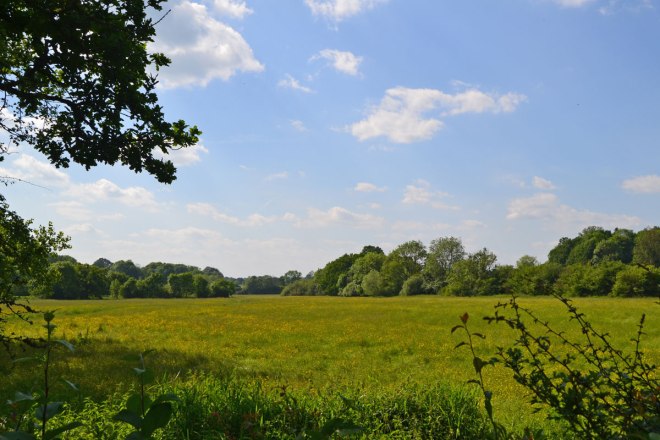
Meadow, Penshurst
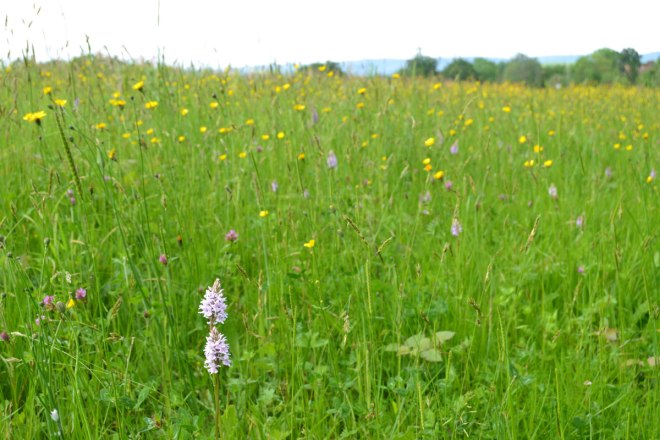
Common spotted orchids, Hever
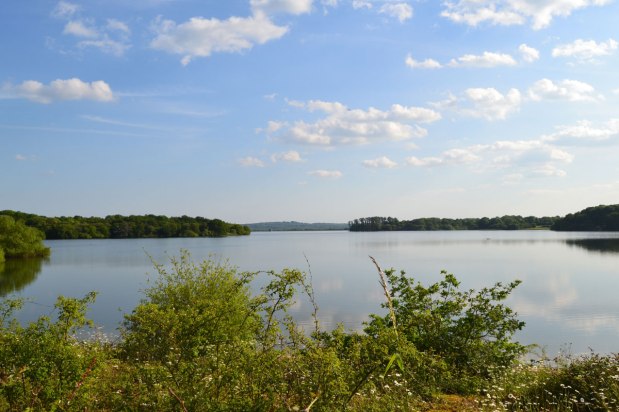
Northern lake at Bough Beech
In June it’s generally a good idea to stick a pair of secateurs or tough old scissors in your rucksack if you’re doing a Kent walk. It seems odd I know. One or two of the less well used paths become entangled in brambles, nettles etc this month and next. This is particularly the case this year because rain has kept hikers away and some of the paths have been left unused. The Eastern Valleys walk east of Shoreham definitely requires a bit of snipping as you walk along the fields on the Darent Valley rim. The diversion to the Percy Pilcher memorial viewpoint is in need of a trim at the best of times. And at Chiddingstone, near the start, the path leading into the swampy woods is nearly impassable. If you prefer, you can divert to walk along the field edge – it joins the main path as you enter the woods. The same thing happens later as you near the River Eden on the return leg. There are parts of the Hever walk, in Stock Wood and Newtye Hurst Wood where you might need to divert off the main path and it‘s easier to do a little judicious snipping than try to battle your way through. Especially if you’re wearing shorts!
Overall the Weald of Kent is obviously wetter than normal for the time of year. Bough Beech reservoir is brimful for once and the mires and ponds in the woods of Hever and Chiddingstone are well topped up.
There are plenty of smartphone apps for this purpose but without knowing what you’re likely to see or hear software such as Merlin or Birdnet can mislead if used in isolation. I’m not an expert but birder and fellow Kent walker Dave most definitely is. I’ve never seen him use an app. He just stands in the middle of the path for ages building up an aural picture from the space around us. “Chaffinches somewhere in that oak 30 metres to the right; greenfinch behind us, maybe 200 metres, nuthatch flying to those conifers… look, there it is, mistle thrush down low …” I find it quite annoying to be honest. But it’s a remarkable display of skill, patience and knowledge built up over years.
What doing the odd walk with Dave has taught me is that it’s best to learn a few calls of birds you are likely to see/hear and then, once you are familiar with them, start adding other likely species. Some, robin, blue and great tits, blackbird, you can learn from the garden or park. Cuckoo is obvious and one you can hear this month and in June on the Ide Hill, Chiddingstone and Hever walks in particular. Greenfinch is very distinctive too and dead easy to pick up once you know its chatter and “wheeze” – similar but different enough to more common goldfinch. You hear it more in parks and gardens though than on the KWNL walks.
Wren – one of our smallest, but loudest birds. Photo: Wikimedia Commons
It took me ages to realise that wrens were incredibly loud and identifiable; I’ve got that one down now, along with song thrush, greenfinch, chaffinch, long tailed tits, chiff chaff, blackcap, coal tit, goldcrest, and most recently, nuthatch. I’ve no idea what dunnocks sound like, so I better give that a listen, and treecreeper too. Bullfinch is a toughie because you really have to listen out for their weird “rusty gate”-like whistle and toots. Yellowhammer is easy. To see one of these I recommend the hedgerows on the Polhill route, once down on the valley floor; Fackenden Down hedges; the Eastern Valley walk and the Chevening walk. A great one to listen for now is common whitethroat. These have arrived from Africa now and are filling our hedgerows with song; they sound a bit like their cousins the blackcap but less rich and burbling. There are loads of other, less common, summer visitors to tick off, which all may be encountered on a walk at KWNL – willow warbler has a lovely song, nightingale obviously, garden warbler… Cetti’s warbler is startlingly loud and a bird that sings disconcertingly close to you but from deep inside a thorny dense bush, so you can’t see it.
So, I’d say use a combination of memory and app to recognise birdsong. Use the RSPB site and British Birdsongs to learn two or three bird species at a time, then use one of the smartphone apps to record and analyse what you hear – having listened out for the birds you’ve tried to memorise. It doesn’t seem easy at first but pretty soon you’ll start recognising the patterns. After all, it’s just music in another form and the difference between a chiffchaff and a wren will soon be as obvious as between Dua Lipa and, say, Raye. Or Chaka Khan and Whitney Houston. Or Teena Marie and Cindy Lauper. Or George Benson and Philip Bailey; Luther Vandross and Maurice White. I could go on, and would quite like to.
“When spring came, even the false spring, there were no problems except where to be happiest. The only thing that could spoil a day was people and if you could keep from making engagements, each day had no limits.”
That’s a fun quote from Hemingway. I take it to mean prioritise walks above socialising, now it’s a bit warmer (I reserve the right to be wrong about that) and to get out in the woods and downs, witness the transformation from grey and brown to green, blue and yellow. I say “witness” but it happens suddenly, overnight perhaps, when you’re not looking. Suddenly the air is soft, the countryside hues have changed and spirits have lifted.
We chose the 3.5-mile Knockholt/Chevening North Downs route for late Saturday afternoon and a 4.5-mile stroll on the Greensand Ridge at Hosey for the following morning. On the Hosey route bluebells were two-thirds in bloom and were mixed beautifully with stitchwort and anemone. We heard coal tit, nuthatch, song thrush, chaffinch joining in the merry burble of song from great and blue tits, robins and wrens. A delightful pint of Westerham Brewery’s Light Ale ensued after the walk at Squerry’s Winery.
At Knockholt, along the escarpment, three red kites drifted overhead throughout the walk and a pair of buzzards hung in the air. These raptors love the updraft along the ridge and I think this walk is the most reliable route for seeing them on of all the walks here, though they can pop up on any. Please don’t think me callous but I rather hope the birds of prey feast on pheasants; there are too many of the latter human-introduced birds in these parts and they kill a large number of reptiles and amphibians.
Redwood tree above Chartwell, at Mariner’s Hill on the Hosey/Westerham route
Dandelions on Mariner’s Hill, mid-April.
Bluebells on Mariner’s Hill on the Hosey/Westerham walk
A view of Chevening House and the Vale of Holmesdale from the chalk escarpment near Knockholt Pound. The Hosey and Westerham walks are the Greensand Ridge in the distance
The cleft in the Downs on the Knockholt/Chevening shorter version
Marsh marigold by the infant Darent river, on the Hosey/Westerham routes
The chalk Knockholt/Chevening walk on the North Downs ridge is separated from the Hosey walk on the Greensand Ridge by the clay Vale of Holmesdale, an east to west valley that runs in parallel to the two lines of hills and which contains the M25 and M20 motorways. Holmesdale clay runs between the chalk and sandstone yet despite the starkly different geology in such a small distance the plants and tree species don’t superficially appear to differ that much – presumably the plants have adjusted to the contrasting soils over the millennia. But there are some differences – there are more likely to be orchids and expanses of grassland on the less densely wooded chalk hills; while on the greensand the woods seem a tad more extensive and are more likely to include stands of pine, which like the sandier soils. I’m no expert so I won’t go on. Bluebells like both; that’s the main thing and this week they are reaching their peak at sites like Meenfield Wood, Scords Wood, and Mariners Hill. Enjoy them, they’ll be gone within about four weeks.
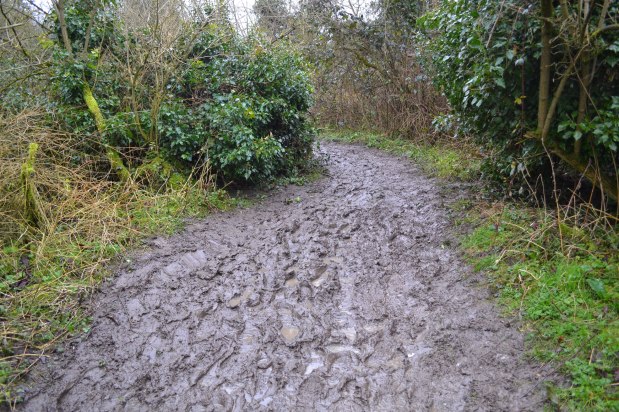
Two weekends of truly muddy conditions have passed; both have been very mild and reasonably bright (well, the Sundays anyway) but with heavy rain overnight only the most hardy, dedicated walkers have taken to the squidgy, squelchy paths. Last week we splashed around the 3.5-mile version of the Knockholt Pound/Chevening route; today, with a bit less time available we took to that old staple the Downe walk, with a couple of variations. The final field once heading back to the village was a glutinous saturated sea of clay, as it usually is after heavy rain. Oh for the days when this was a wildflower and hawthorn meadow left to its own devices, alive with the calls of yellowhammer and skylark. The Downe walk has lost two delightful wildflower meadows in recent years – one to a scraggy looking crop rotation, the other to grazing by a non-existent sheep flock.
Red kite, Downe, February
Approaching final woods, Downe, February
Hedgerow and approaching shower, Chevening
Approaching shower, from below the North Downs scarp, Chevening
Beech trees, Downe, February
Bare field on the North Downs ridge, Knockholt Pound
Anyhow, never mind, there we go. Let’s focus on the positives: bright skies, great colours, a sudden crescendo of bird song including skylarks after a silent winter, a Spitfire taking off from Biggin Hill – what a brill din! – and a few snowdrops to admire. Best of all there was some wonderful bird of prey sightings. On the Knockholt route we were checked out by a low flying red kite and were given a private buzzard show. At Downe this Sunday I’ve rarely seen so many buzzards gliding and soaring. A hovering kestrel joined the party at one point, while on the return leg of the walk, on the hillside above the golf course, a red kite seemed to follow me along, drifting, sideslipping and wheeling on the breeze. These incredible birds have only been regularly seen on these walks in the past 10 years or so. They are a most welcome addition – along with the buzzards, themselves a relatively new bird to this part of Kent in these numbers. On entering the final beech woods I heard a tawny owl call, despite it being only 2.30pm.
Mysterious birder Dave has emerged once again from his Kent weald lair! This was great news on this gusty, mild, cloudy day with a walk at Knole planned. Dave’s presence would ensure that I would observe or hear (rarely both) species I wouldn’t usually encounter when walking alone. Arriving at Knole late thanks to an unforeseen ambush cunningly laid by temporary traffic lights on the A21, I spotted Dave already staking out the territory in Knole’s south eastern corner. “There’s nothing here,” he said, greeting me with breezy optimism. But it wasn’t entirely true. By standing still amid the beeches and oaks in the open woodland of that area of the park it seemed the birds started to come to us. First a troop of chaffinches (but not as far as we could tell the hoped for brambling), then coal tit, song thrush, nuthatch, greater spotted woodpecker and goldcrest. As we entered the south eastern conifer plantation we heard siskin (pictured header) – or rather Dave did.
Lesser redpoll. Photo by Ron Knight/Wikimedia Commons
Later a lesser redpoll (pictured above) flew over, a very delicate little finch type thing. Two greenfinches – not at all common these days – were spotted at the top of a tree, while more predictably, a buzzard wheeled above. Mistle thrush was then heard and a flock of redwings streamed across the field on the Godden Green side of the wall on the eastern fringe, where there’s a lovely view of Fackenden to Kemsing downs and of the Darent Valley opening. Finally, a fetching pair of stonechat, a male and a female, alighted in grass just ahead of us as we started to walk up to the house. As we got close they hopped into the bracken tops, disturbing a roosting wren.
It’s definitely worth walking with Dave – you become aware of far more birds than you would normally see. I had to bite my lip though when checking the football scores – West Ham were playing at Man Utd and it wasn’t going well … sorry Dave.
Thought it worth mentioning. The heavy rains this winter (until recently) have damaged the chalk path between points 2 and 3 and displaced a lot of stones on the Cudham route. There’s now a mini ravine for some of the path and a lot of bits of rock. Only a minor inconvenience really but worth knowing. I don’t see how it gets ‘fixed’ in the short term and will probably get worse as we’re not out of the woods yet (pun intended).
Erosion on Cudham chalk path
Even more worth knowing is that soon after Point 4, the stile leading into the wood adjoining Newyears Wood, where a lot of chopping goes on, has gone missing. Now you have to climb over the low wooden fence to use the public footpath there. The yellow waymarker sign for the public footpath remains in position. No sign has been erected saying that this stretch of path is temporarily out of bounds has so I say you are totally entitled to carry on using the path. I hate it when landowners don’t take care of path access – it’s just disrespectful and careless.
Cudham short version (3.3 miles)
There is a short cut version to avoid this hopefully temporary missing stile bore. It takes just a mile off the route but misses out on the nicest bit of woodland at Birches Croft, on the edge of New Years Wood.
Still, the stile issue is not as serious a problem as the idiots who have literally cut down the traffic lights on the Hayes to Keston road at the junction of the A232 – yes, it looks to me as though an angle grinder has been used to cleanly chop all four traffic lights at this now dangerous crossing point. I guess it’ll be quickly remedied.