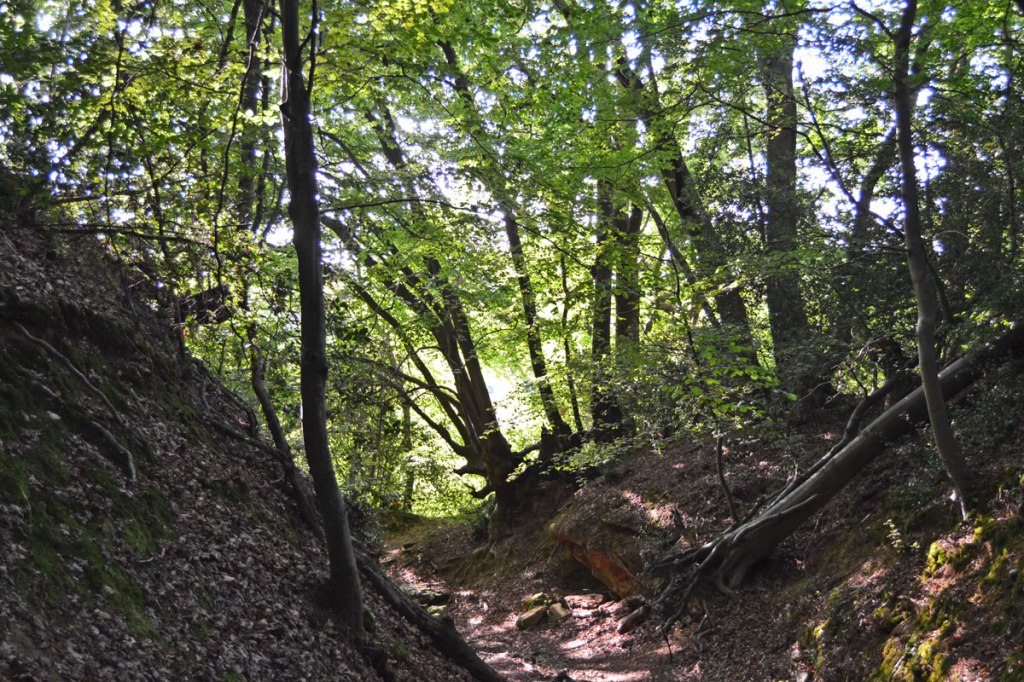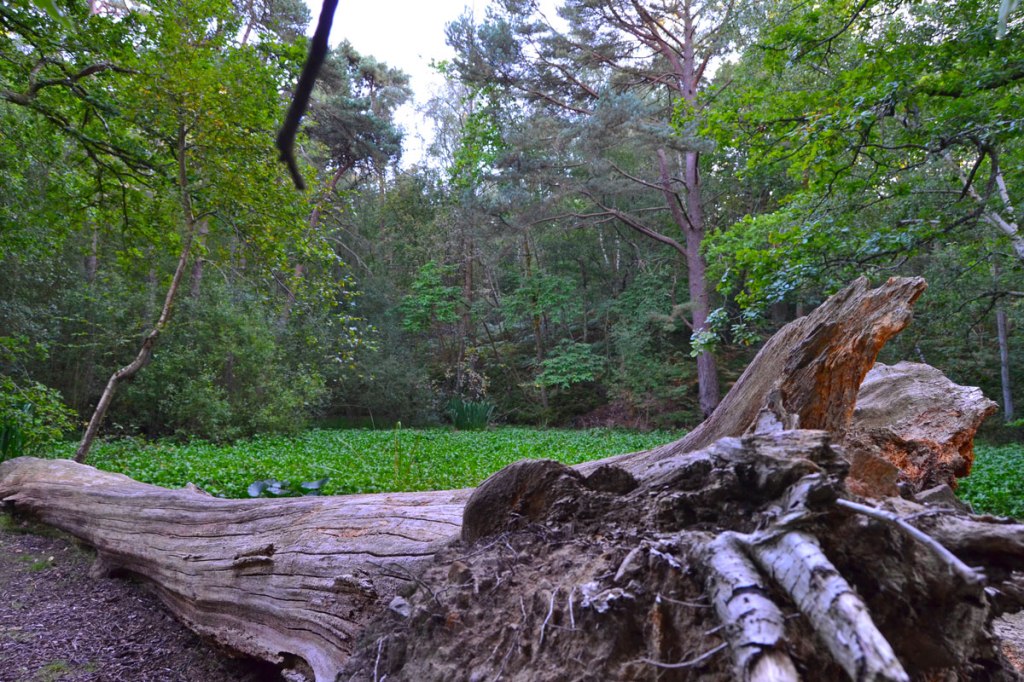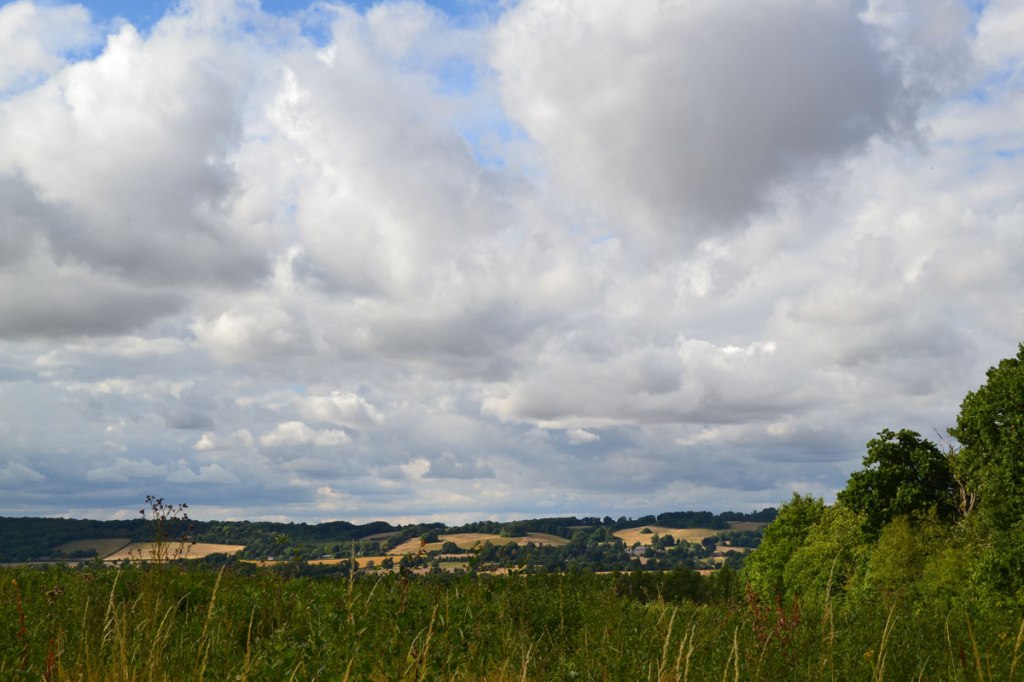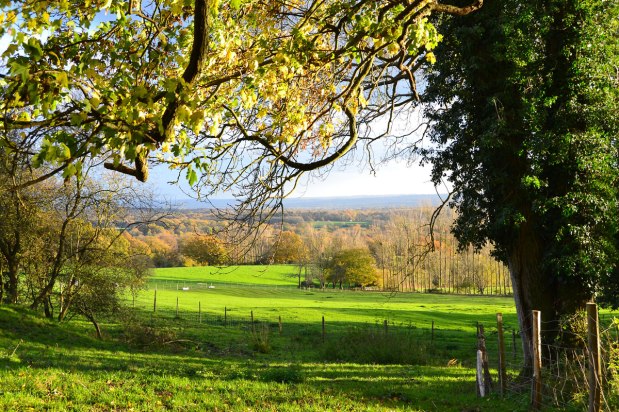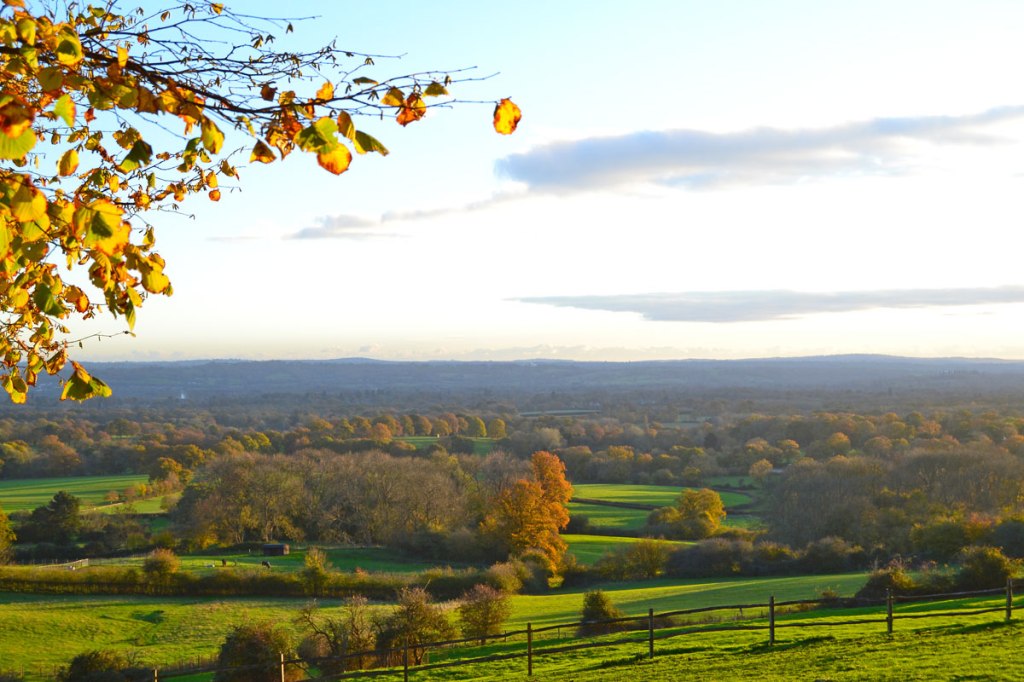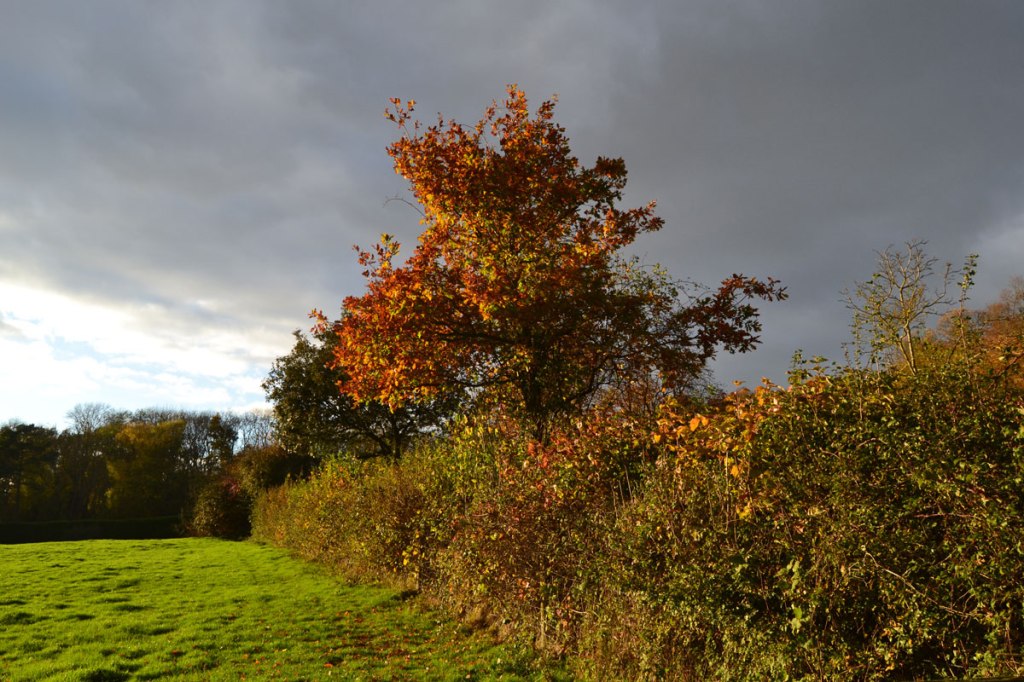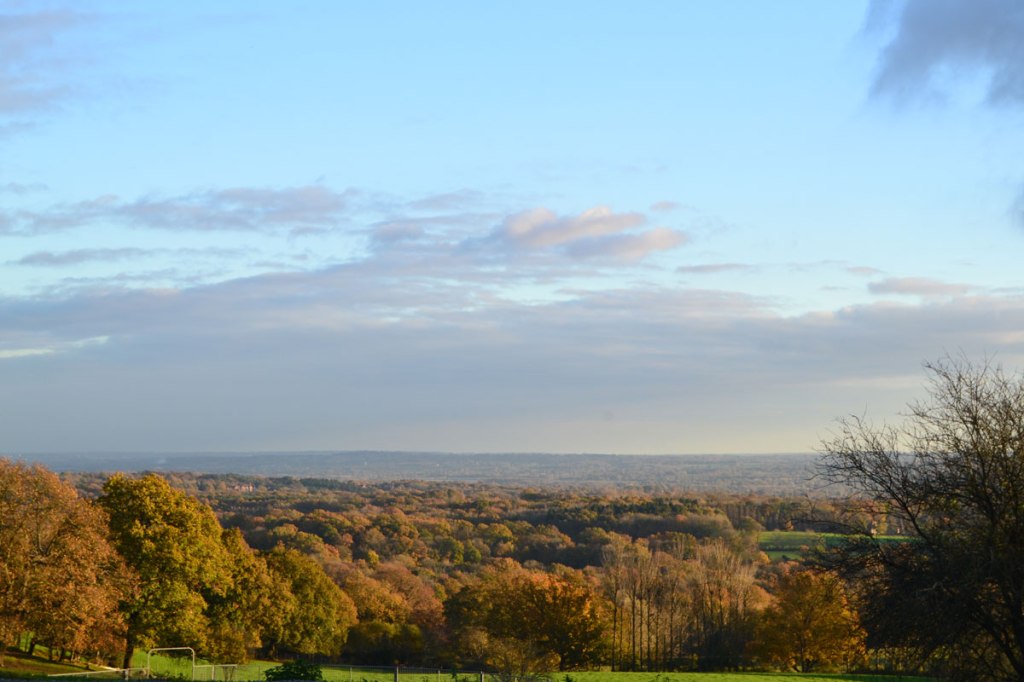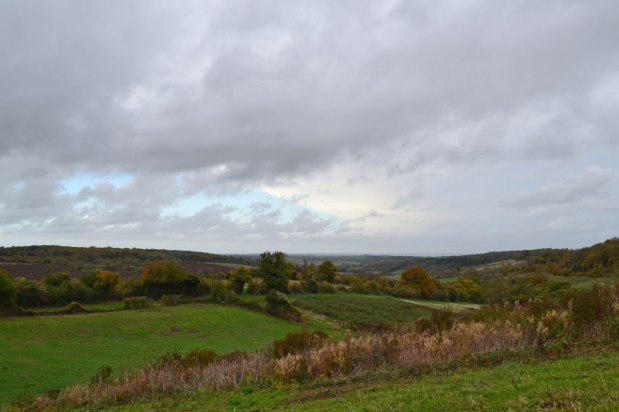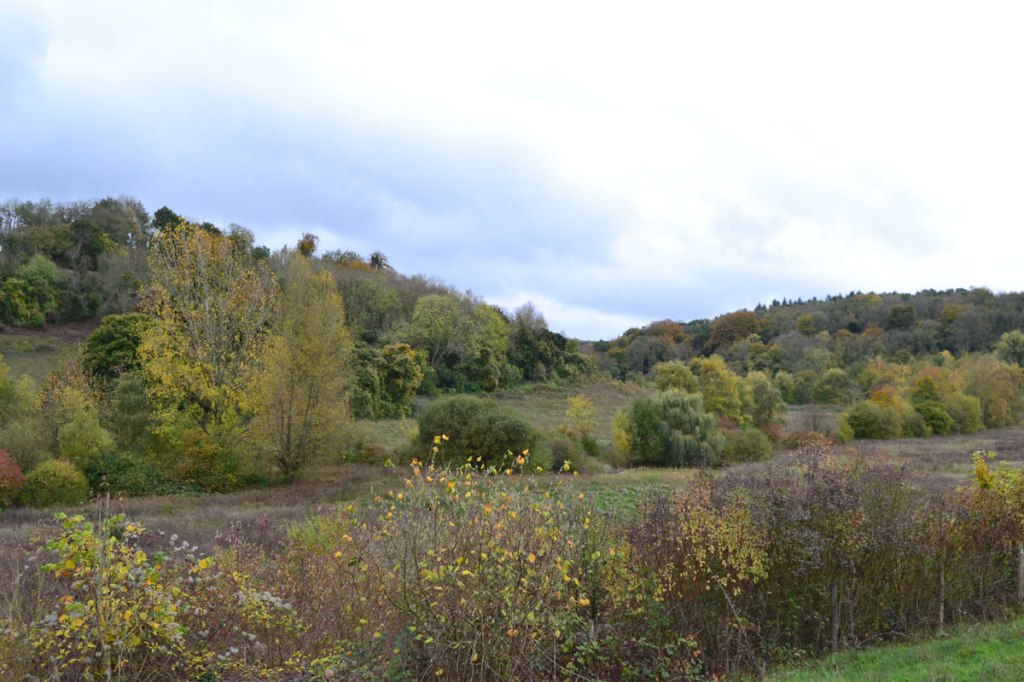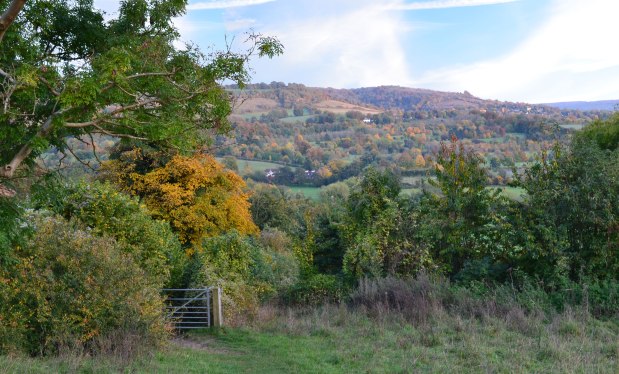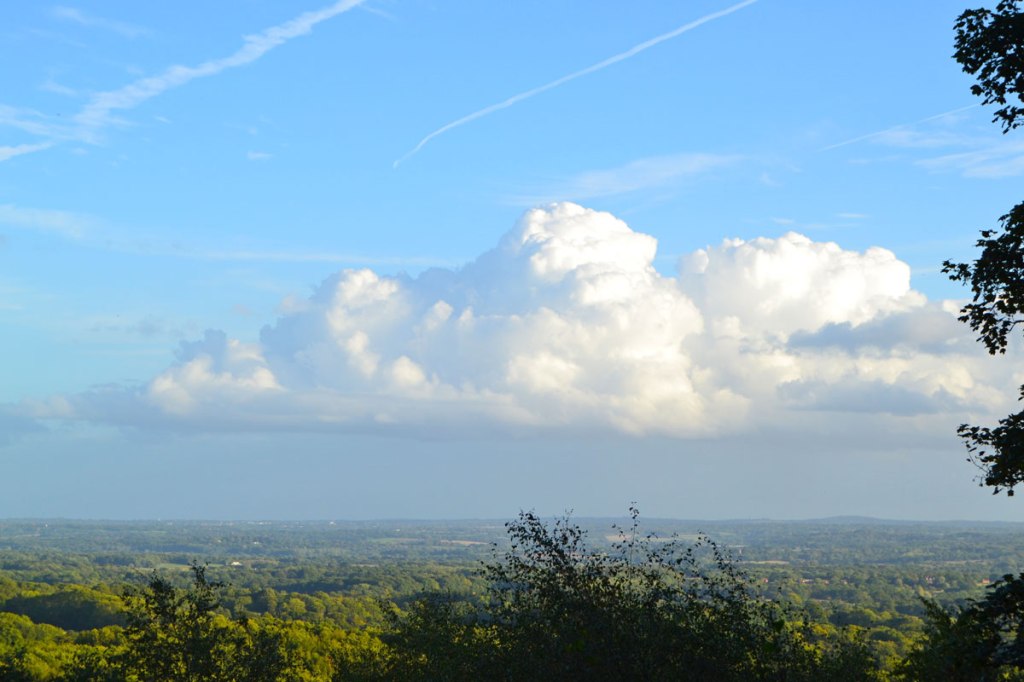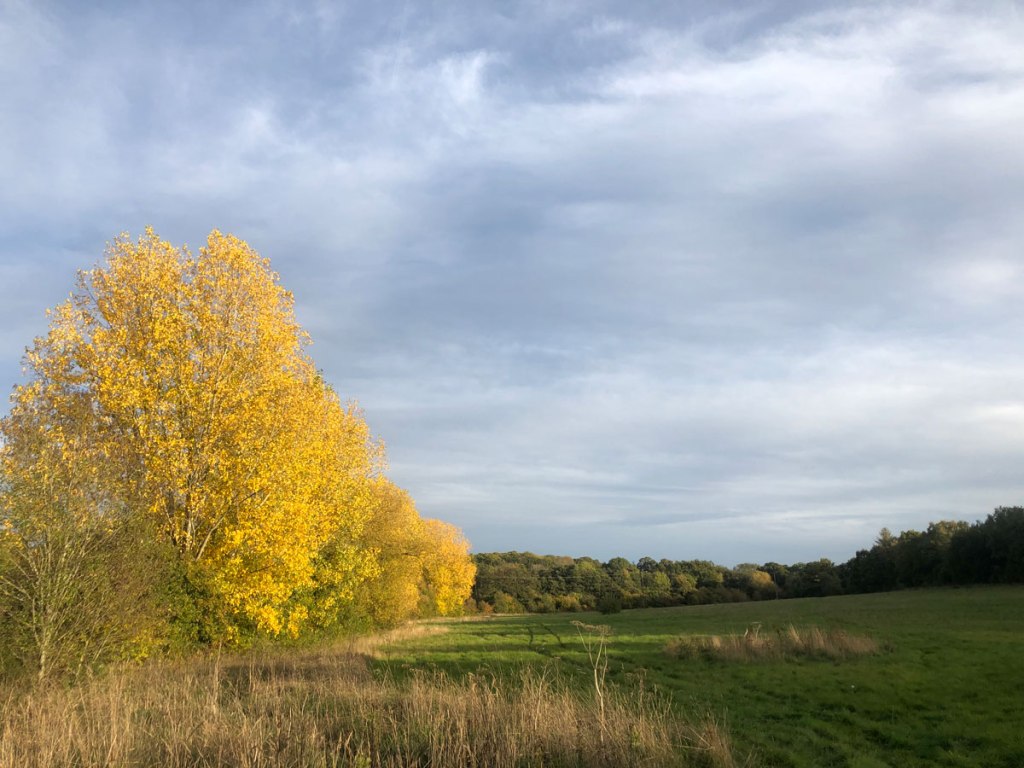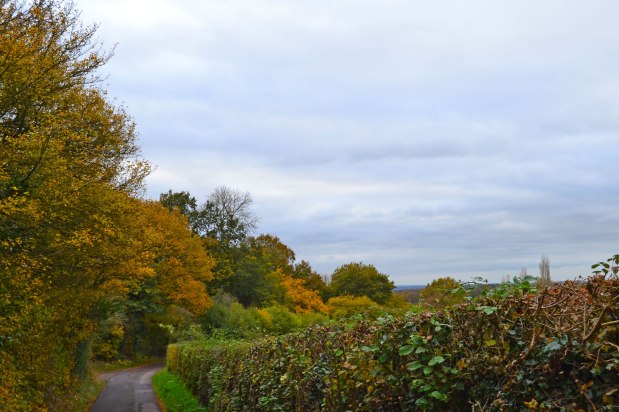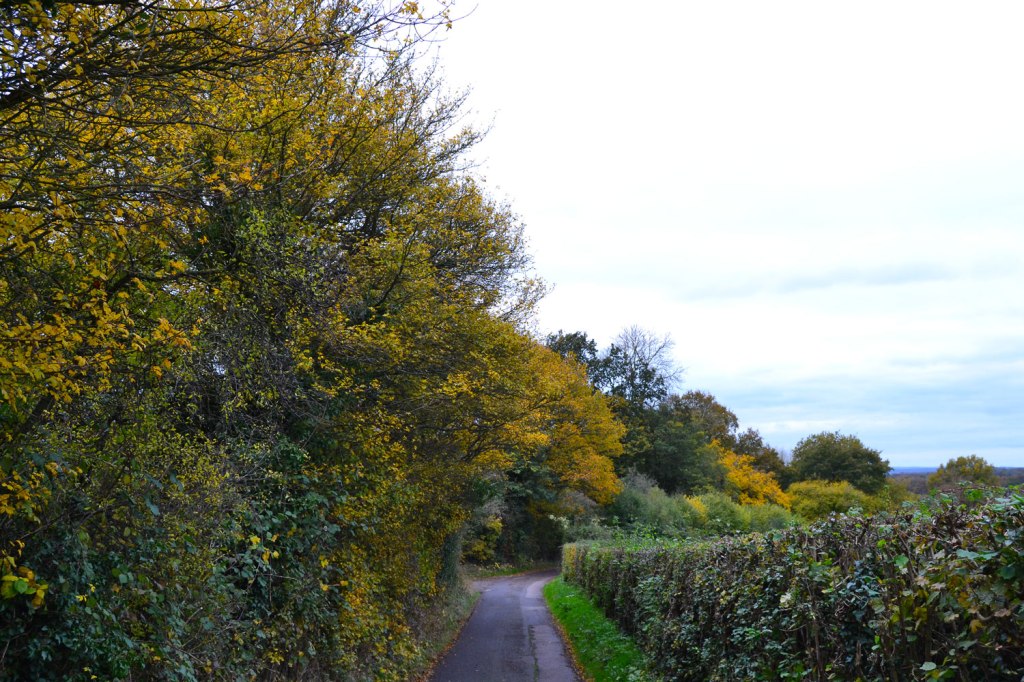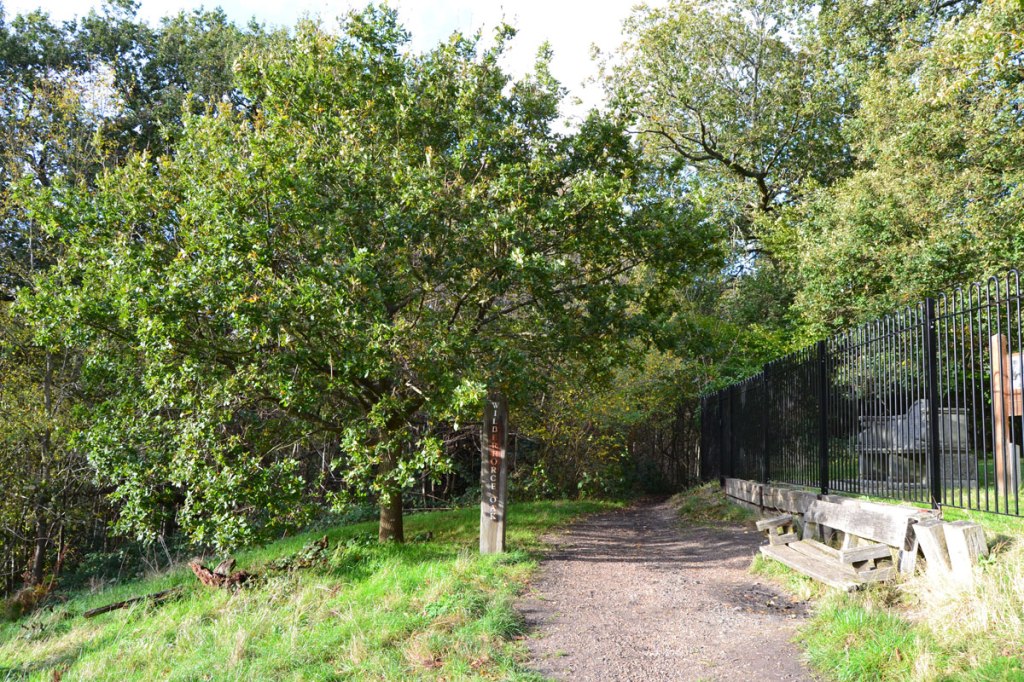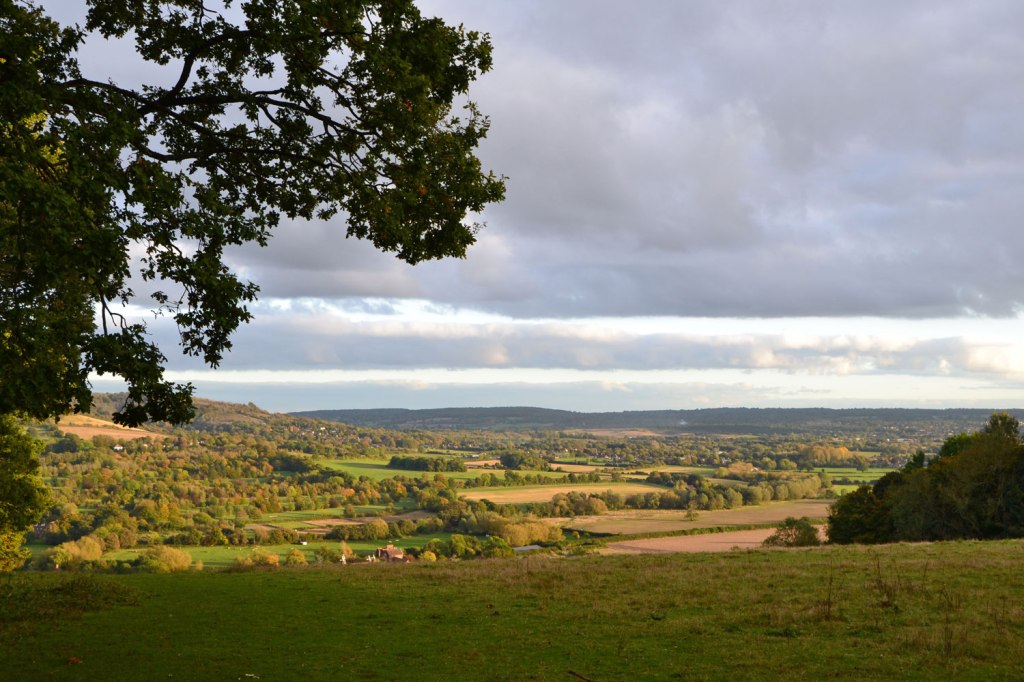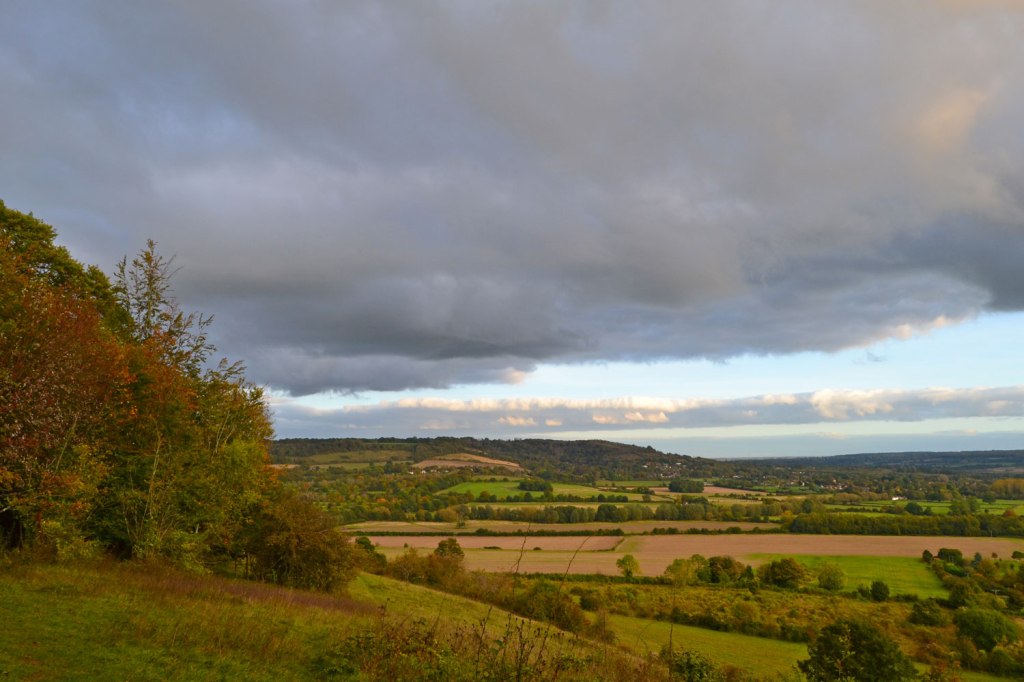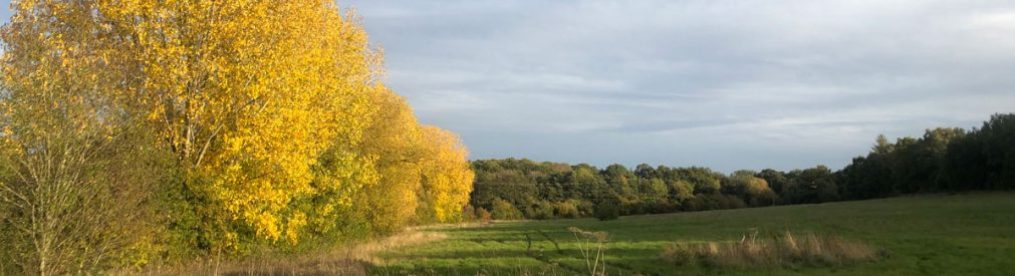
The Underriver walk was a picture last weekend, two unseasonably warm days that probably represented the last knockings of summer. It felt like summer and looked like summer with foliage mostly green and few birds flocking apart from some buzzards and jackdaws in a high altitude spiral. It’s another walk I now do in reverse to the sequence described on this site. One of the reasons for this is to avoid the sharp uphill section in the holloway by the “dancing beeches” just past the oasthouses at point 3. Coming downhill here then enjoying the route past Romshed farm seems a bit more civilised now I’ve done it a few times. At One Tree Hill the National Trust has trimmed the hedgerows and blackthorn clumps back to enlarge the panoramic view – and very effectively so. I’ve walked past that spot since childhood, though much more often these days, and that timeless view across the Low Weald to the Ashdown Forest and as far as the Surrey Hills in the west still grabs my attention. It’s a popular spot, as you can see in the picture below.
Walks this weekend will have a different flavour. The ground will be wetter with plenty of freshly fallen leaves. The temperature will be a lot crisper than last week, perhaps by nearly 10C, but with blue skies forecast it should be a beautiful couple of days for a stroll. And a first proper taste of autumn.
The Underriver walk – short and long version – was the focus this weekend. Just south of Sevenoaks this lovely walk, part of the One Tree Hill“suite” of routes, offers great views across the Kent weald and superb woods and hedgerows. There’s a lot of interesting geology too, as you encounter greensand (sandstone) boulders, a greensand cliff, and plenty of springs as the sandstone hits the weald clay.
I was joined by birder Dave on Saturday which as usual led to an exponential increase in sightings and bird calls identified. Within a few paces of entering the first horrendously muddy field we heard and saw a flock of newly arrived fieldfares some 50 strong, a troop of long-tailed tits, goldcrests flitting in the bordering trees and overflying redwings. You can see birds like that in your local park if you’re lucky – these sightings aren’t exclusive to the countryside at all. Later on a marsh tit flew past us, which was probably the most noteworthy bird of the day and another feather in Dave’s cap as he recognised the fleeting call just as the bird, in silhouette, zoomed past us. Dave reckons the area’s bird life would perk up with a bit more arable land and fewer livestock pastures. Scrubby unkempt arable fields are a big favourite for les oiseaux it’s true.
View of the Weald all the way to Ashdown Forest, from above Kettleshill Farm, Underriver
I had been hoping for bullfinch, siskin and most of all, brambling. But it was not to be. Barely a chaffinch as it happened but quite a few goldfinches. Later on there was a kingfisher at the lovely pond on the path below St Julian’s Club and tawny owls calling at Rooks Hill, Wilmotts and Underriver itself. The truth is that there are fewer birds around these days, just as there are fewer insects. I guess it’s farming methods, climate change, all that stuff. But anyway, it was good fun just to be out there listening and watching.
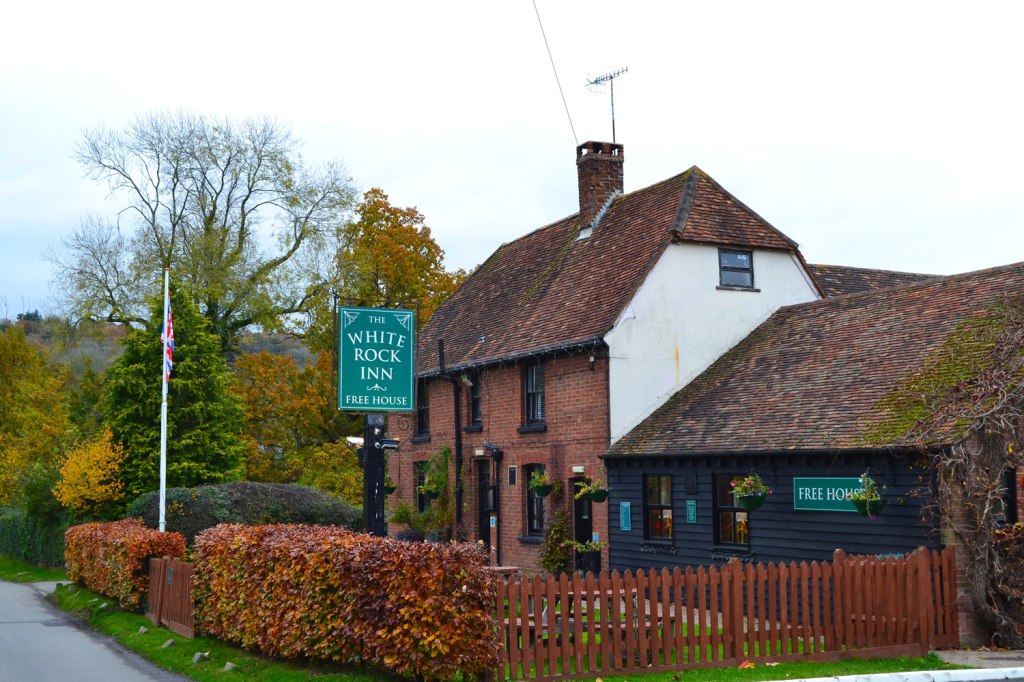
We went again on Sunday. Conditions were gloomier in the afternoon than they had been on Saturday, with quite a large shower making birding more difficult. But it mattered not, the views were still great and the excellent White Rock Inn was open and offered a friendly welcome.
Exceptionally mild temperatures have lured bats out into the autumnal gloaming to catch late flying insects. I love watching these animals swoop, flutter and flit around and it’s a bonus to see them so late in the year. Usually you can only pick them out against the sky but at Downe and Keston on last weekend’s strolls I was buzzed by bats so closely I sensed rather than saw them zooming past. Yesterday at Polhill one or two emerged from the mist to pass close over our heads before vanishing into the gloom.
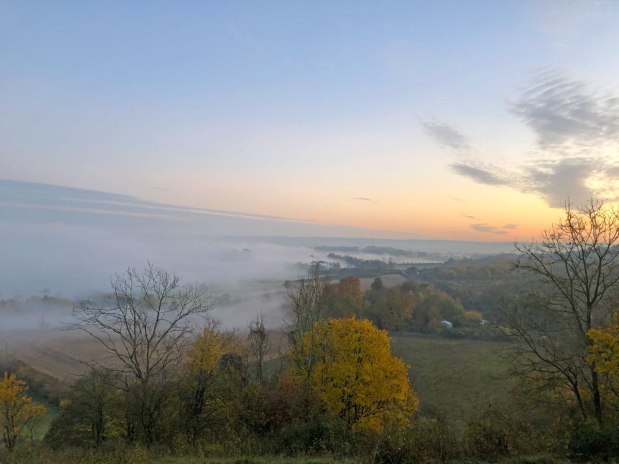
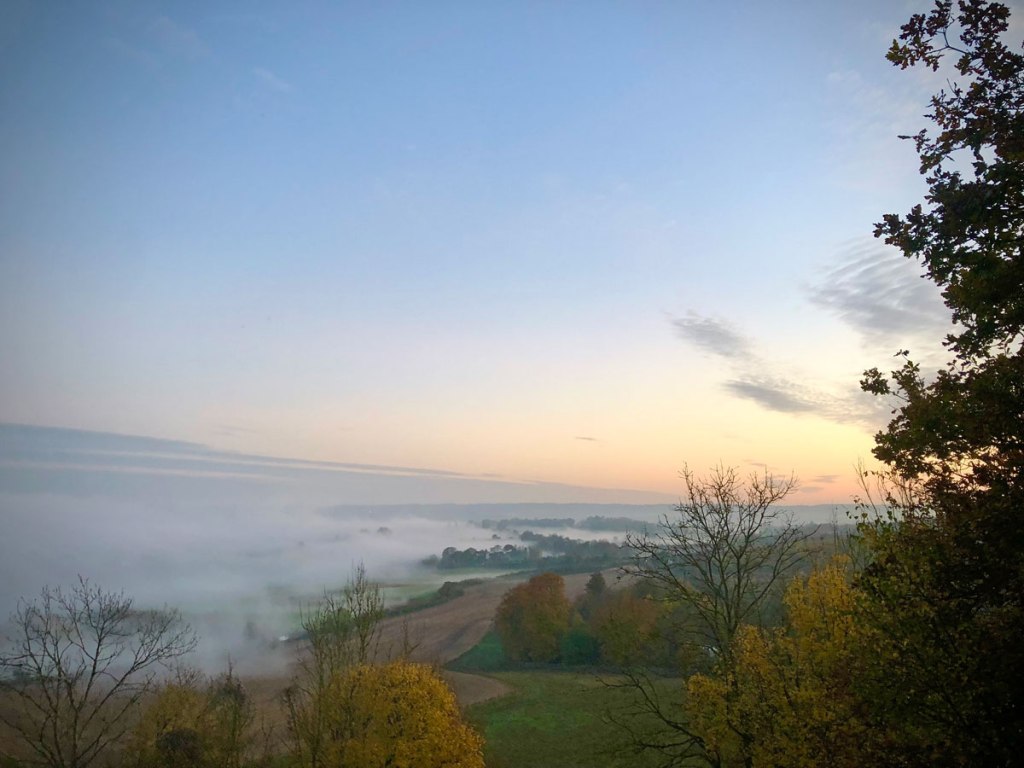
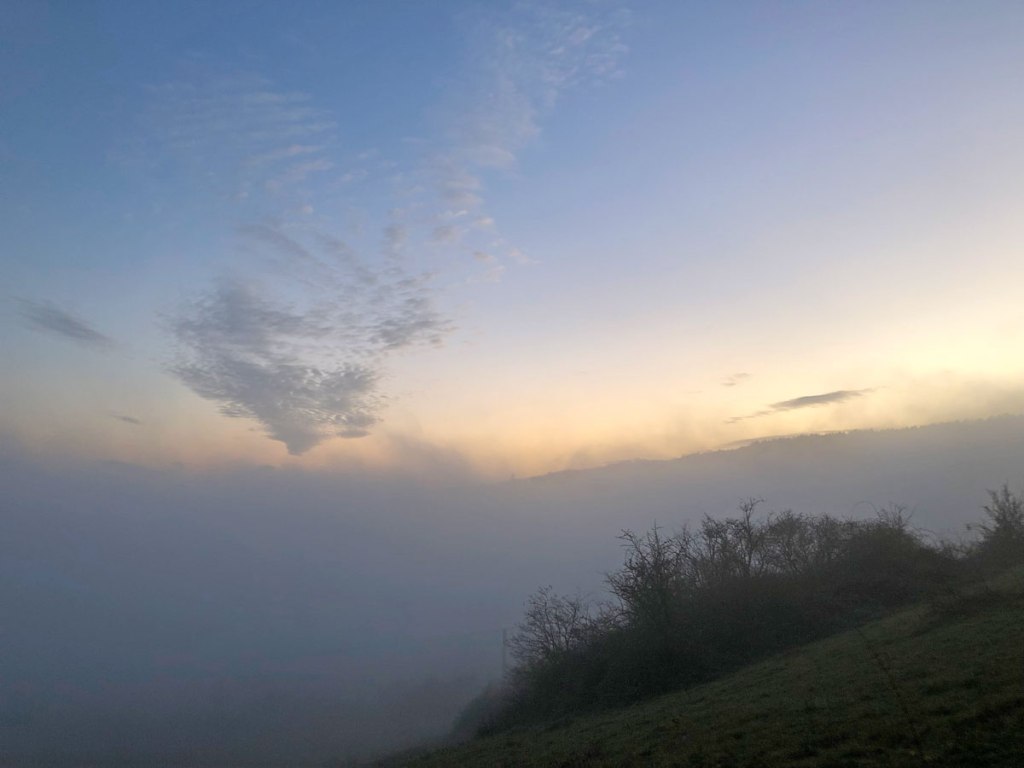
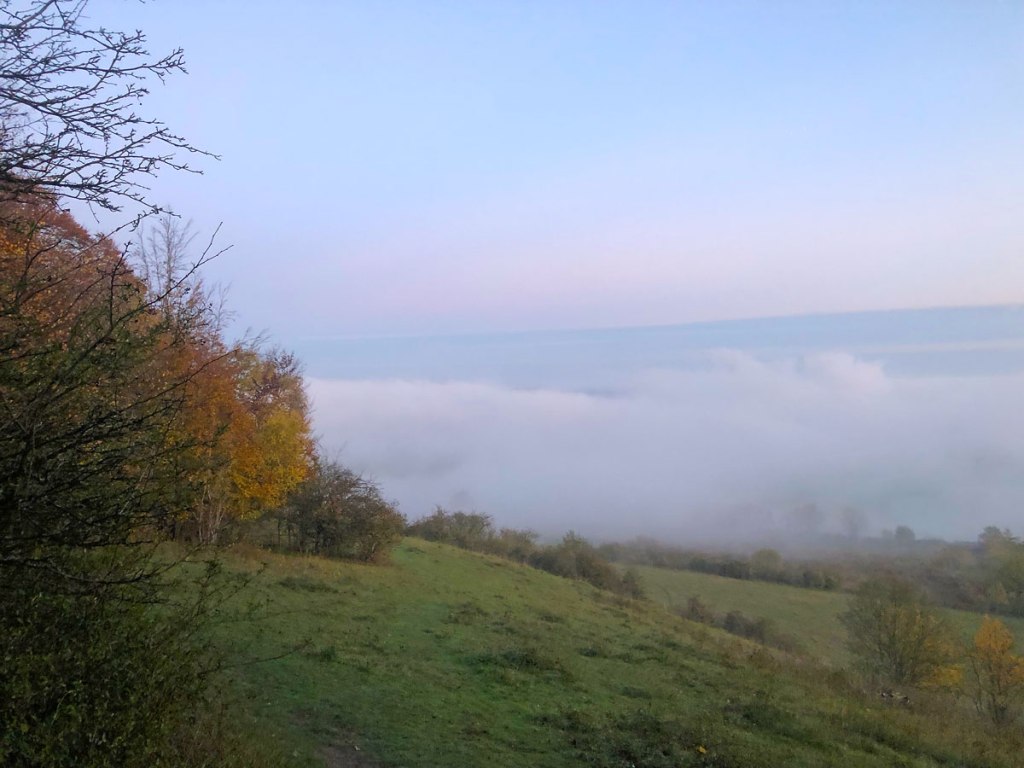
I’d thought we’d set off rather too late for a walk. Traffic was bad on the A21 slowing us further (the train is by far the best option for Shoreham walks) and low cloud had covered the sky. But by Locksbottom the skies cleared and we were bathed in a beautiful golden light. This was a false dawn: by the time we parked up by Meenfield Woods above Shoreham we were in quite dense fog. This magically cleared at Polhill, the walk’s halfway point, to give us unusual views before swirling back in as the sun set. With the mist below we had the feeling we were much higher above the valley than we were. I think this weather effect is called a temperature inversion, where warmer air passes over the relatively cold air on the valley floor, causing condensation.
By the time we finished the walk, visibility was down to about 50 metres and driving home the twisty, twiny country lanes needed total concentration if we were to avoid a close encounter with a hedgerow.
Mist obscures Sevenoaks, pictured from Polhill, November 2022
Mist at Polhill swirls in as the sun sets. Looking towards Knockholt and Chevening. November 2022
Mist at Polhill looking towards Otford, November 2022
I’m intrigued about how many of us look outside on a day like today – drab, cold, raining – and just think that curling up with a book or making a great meal or something would be a far better use of time than a walk. Who can blame those who decide such days are for doing stuff indoors? But judging by the views on this website there is a hardcore who come what may will not only brave the elements, they will relish them. I’m in this camp – although I do have a good book to read. Anyway, lovely autumn colour awaits those who make it out, all the more inspiring against the grey backdrop. Waterproof trousers and good boots will be handy though. Photos are from the Fackenden Down route last weekend on which the weather was actually fine as it turned out. Scroll through the photo gallery below right for autumn colour from all the walks.
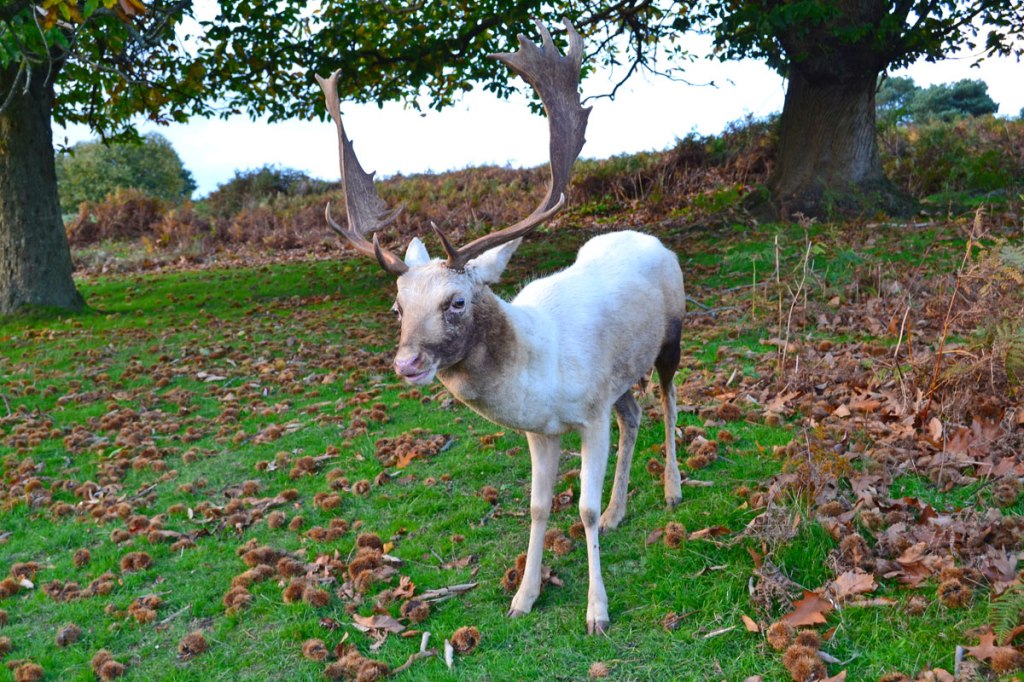
A walk in late afternoon around Knole was superb for autumn colour, acorn-munching deer and beautiful tints of pink and orange in the sky and reflected on the austere frontage of that superb medieval-Tudor house. We ventured off the main path as usual and veered through woods on minor trails discovering yellow and ochre fungi. The walk ended amid wafts of woodsmoke at One Tree Hill. Wonderful.
What a superb walk on the Polhill route recently. Superb weather and the trees in their best autumn finery. The views across the Darent valley were at their very best with every little detail sharply visible: the church tower, the oasts, the route of the river … It was a view that would have inspired Samuel Palmer, the brilliant mystical romantic artist inspired by William Blake and Turner who roamed this locale with his equally arty mates ‘The Ancients’ in the late 1820s and early 30s. He was mainly based in a rundown cottage nicknamed Rat Abbey before joining his dad at the lovely Water House – still standing of course. Repros of his beautiful art can be seen in the Samuel Palmer pub. He fell in love with and married 19-year-old Hannah Linnell when in his early thirties while in Shoreham and went on a two-year honeymoon in Italy where his art developed further. But it’s his Shoreham works that seem to attract the most attention. Strangely, his surviving son Alfred (another son had tragically died at 19) in 1909 burned loads of his pieces after his death saying that they were a humiliation because no one could understand them, or something. Odd that.
View across Darent Valley toward Fackenden Downon Shoreham circular and Polhill walks. iphone pic
It’s interesting to reflect when gazing across these lovely pastoral valley, and at Palmer’s beautiful paintings, that all was not well in the countryside in the 1830s. Mechanisation was putting farmhands out of work leading to disturbances and the destruction of agricultural equipment, incidents collectively known as the Swing Riots. In 1830 more than a thousand protesters were transported to Australia or imprisoned while 19 people in Kent were hung for their part in the fire-setting and destruction.
Incidentally, the Samuel Palmer pub, formerly Ye Olde George, received unexpected visitors on 15 September 1940 when two very shaken pilots from a shot down German bomber were taken there for a stiff drink by the Home Guard. For some reason I had thought the pub they were taken to was the now defunct Fox and Hounds in Romney St, but the very friendly Shoreham Aircraft Museum custodian, Geoff Nutkins, tells me it was almost certainly the George. Geoff himself is an excellent artist; although what the mystic Palmer would have made of his depictions of Spitfires and Hurricanes boggles the mind.
Scenery changes rapidly at this time of year as greens meld into yellows, browns, reds and golds. So many species of tree seem to go their own way, diverging increasingly in colour until they lose their leaves. Ash turns red, birch gold, chestnuts almost yellow.
Weald view from Mariners Hill on the Hosey walk, in early autumn
Other recent walks have included Hosey Hill, Petts Wood and Cudham. Autumn colours are really becoming apparent now – it really is a great time to get out into our local countryside. Petts Wood was wonderful on Monday 17 October; what a gem that area is for a walk within suburbia.
Hawkwood Estate, Petts Wood in mid autumn. Birches along the Kyd Brook. iphone pic
The Westerham and Hosey walks are brilliant in autumn too, with huge views of the Kent Weald from Mariners Hill (near Chartwell) and a wealth of woodland, at times tangled and impenetrable and others spaced and stately.
Tower Hill, behind the infant River Darent, in early autumn 2022, on the Hosey and Westerham walks
Conditions underfoot remain pretty dry considering we’re past October’s mid-point, as rain remains an unusual event. It also continues to be very mild, thankfully, considering the energy crisis and on several walks lately I’ve felt overdressed. My next sorties will hopefully be further south, to Hever – well overdue – and then the Ashdown Forest.
The mud on these walks is still in the mild-moderate category. Wellies useful but not essential… mostly. But if things get really boggy, which they are bound to do by midwinter, it’s easily possible to devise routes that take in tiny wandering lanes rather than swampy paths – of which there are more than few in these parts. Many such lanes were once paths… others service dispersed houses around villages and become footpaths or bridlepaths. It would be difficult to devise a proper circular walk of decent length using only these trackways – although I intend to give it a shot over the coming months. Two such lanes which intersect with a walk at KWNL are at Underriver. Take a look at the map; you’ll see two lanes roughly north to south acting as shortcut links between points 4, 5 and 8. These are lovely to explore, especially at the moment with the unfurling of the autumn wardrobe. They also intersect with footpaths so you can devise your own bespoke routes. With bird expert Dave I walked them yesterday, stopping often to admire berries and views, and to scan for les oiseaux. We didn’t see a lot (bird numbers have been in decline for years): a few siskins, a gorgeous flock of bullfinches flitting the hedgerows, and newly arrived redwings in threes and fours was about it. Oh, and a fantastic female kestrel which eyed us from a small scarlet tree close to the (excellent) White Rock Inn. We managed about 3.5 miles, half on tarmac, before resuming the Underriver route at point 4, but doing it anticlockwise. A pint of Harvey’s at the aforementioned pub in the autumnal twilight was a splendid bookend to a most satisfactory KWNL afternoon.
I’m trying to add more train/bus walks to the KWNL site; the traffic in SE London is a factor, as is the need to reduce car use and pollution. Then there’s the fact that lots of keen strollers don’t have cars anyway. I’ve got two new routes up my sleeve using public transport to access, but I haven’t quite got them finalised yet. One is Herne Bay to Whitstable (5 miles) which hardly needs a map… you just follow the coast path. Both stations are on the Ramsgate line from Bromley South. It’s quite expensive (£26 return) of course being a British train but definitely worth it. But I want to see if I can continue the walk to Faversham (doubling the length), which is also on the same line, using decent paths. I know you can but I haven’t done it yet. Also it means stretching the ‘Near London’ remit of this website somewhat, though the fastish train makes the trip fairly short in relation to distance and you arrive without feeling worn out by having to drive.
Closer to home would be a walk from Hayes station, the terminus of the London Bridge line via Catford Bridge, to Keston Ponds and then Downe (about 6 miles). From Hayes station you traverse Hayes Common, an attractive area of woods and heath to reach Keston. Behind the village is another woods from where you reach Keston Ponds. Looking at the OS map there is a ribbon of ponds from Keston and Hayes to Bromley Common. These are fed by springs and the Ravensbourne river, which rises at Keston Common.
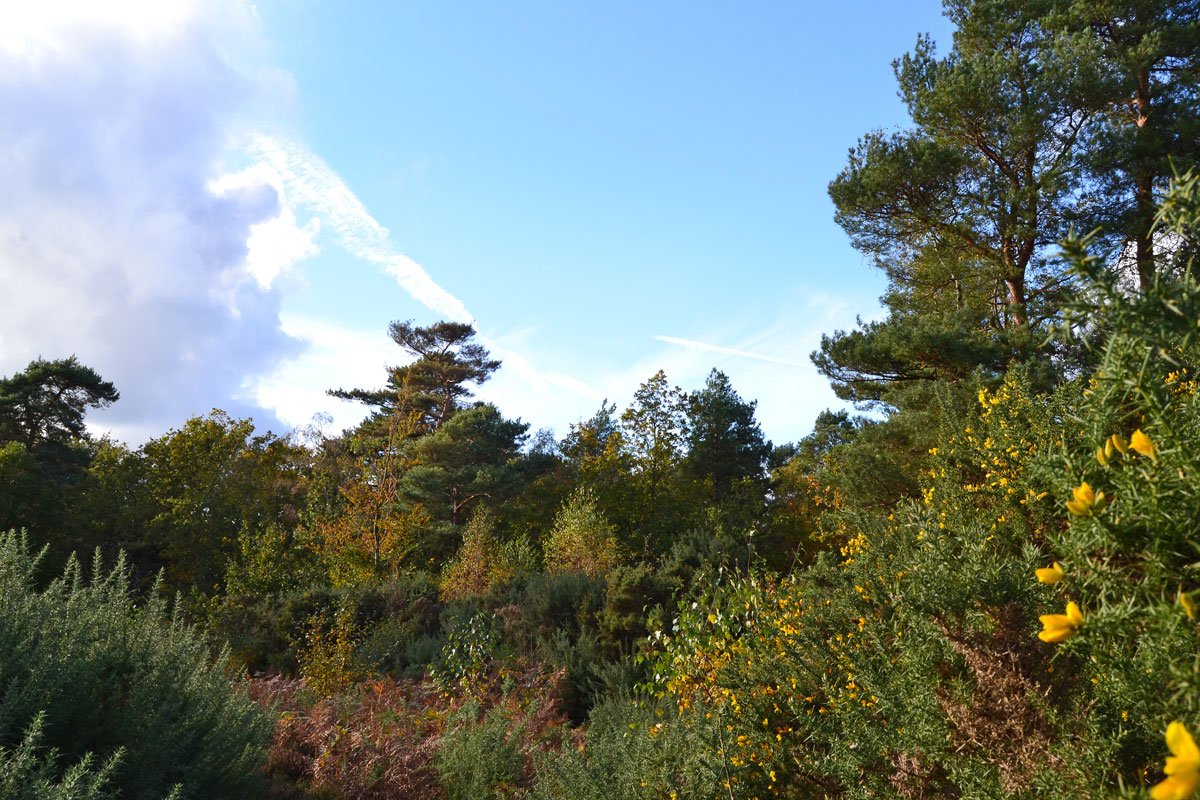
Keston Common heathland
Beyond the two main ponds is an important area of heath then, after crossing the A233 you head through woodland to the Wilberforce Oak, where in May 1787 William Wilberforce talked with prime minister William Pitt the Younger (who lived at adjacent Holwood House, the Chequers of its time), about abolishing the slave trade. The spot is marked with a stone bench plonked there in 1862 and now behind the Holwood perimeter fence and a sign. There’s a dead oak still standing but that isn’t the Wilberforce oak. There are also bits of old oak lying about… maybe some of that is from the original. But there’s a nice healthy young oak anyway, planted about 30 years ago. There are also echoes of Roman and prehistoric settlements around this spot.
From here it’s pretty easy to walk all the way to Downe; cross the somewhat hairy Shire Lane, walk past the Holwood Farm Shop then take the footpath on the right which joins up with the Downe circular walk to bring you into the village from where you can get the 146 bus back to Hayes/Bromley South/Bromley North. One further appalling fact about the slave trade that only recently came to light: the descendants of slave owners in the UK were paid compensation for the loss of their ‘property’ from 1835 to, wait for it, 2015. Hard to believe isn’t it?
Again we returned to Meenfield Woods and Shoreham to do the Polhill loop at the weekend. There was some lovely light in late afternoon on Saturday. Surprisingly there were few birds around given the migrations taking place. Clearly the route does not intersect particularly with the flightpaths of redwings, fieldfares and various other birds heading into the UK from the continent, although a red kite glided above us as we turned the corner to enter the ‘jungle zone’ beneath Polhill itself in the lower part of Pilots Wood. I’d like those redwings to know there are more than a few hawthorn bushes on Polhill with nice juicy scarlet berries right now. What are they waiting for? Maybe the frost, which makes certain berries more appealing to les oiseaux. Dark cloud combined with a lilac sky and soft sunlight to show off the autumnal Darent Valley at its best. My photography doesn’t quite capture it, but I tried.
As I write it’s pitch black outside and teeming with rain. After another year of somewhat unusual weather it’s quite reassuring to hunker down to the sounds and sights of North Atlantic storms swinging past. KWNL paths will be getting a lot muddier though, so it’s time for that wellies purchase. On the Polhill Bank/Shoreham and Fackenden Down routes recently I became really aware of the extent of ash dieback, a disease caused by the arrival (about 30 years ago) of a fungus that species of ash in Asia live happily with. Ash trees here have evolved no defences, however, and it is killing them by the thousand. The Woodland Trust estimates that 80% of our ashes – one of our most beautiful trees – will be destroyed. It’s sad to see the bare dead branches and the spots of dye marking the ailing trees facing the chop.
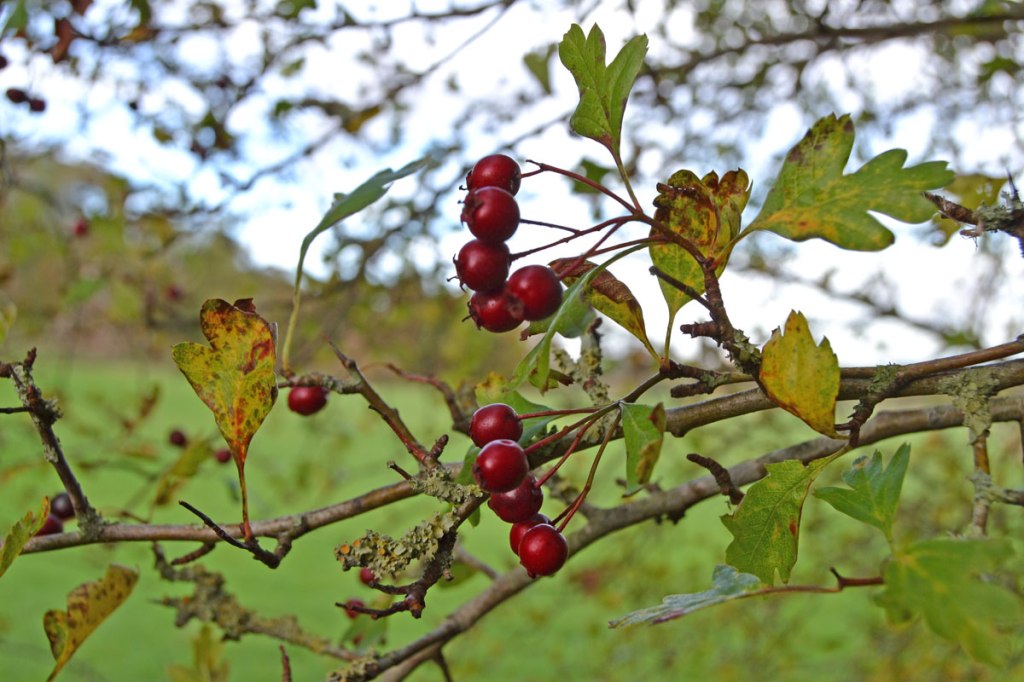
But among happier sights are the profusion of berries and fruits now dotting the hedgerows with scarlet, orange, purple and orange. Hawthorn, black bryony (don’t eat that one), spindle, sloes, crab apples, damsons, guelder rose, rowan berries and rose hips … they’re all knocking around on these walks, especially in the hedgerows on the Underiver/One Tree Hill strolls and at Fackenden Down. I’m trying to get better at identifying them but I’m not a natural forager or jam-maker; I’m happy to leave the berries to the winter migrants – redwings, fieldfare, waxwings and the like. If anyone could identify the berries pictured in the slideshow below at Polhill please tell me at amac49@hotmail.co.uk. I’m thinking hawthorn but I’m not sure.