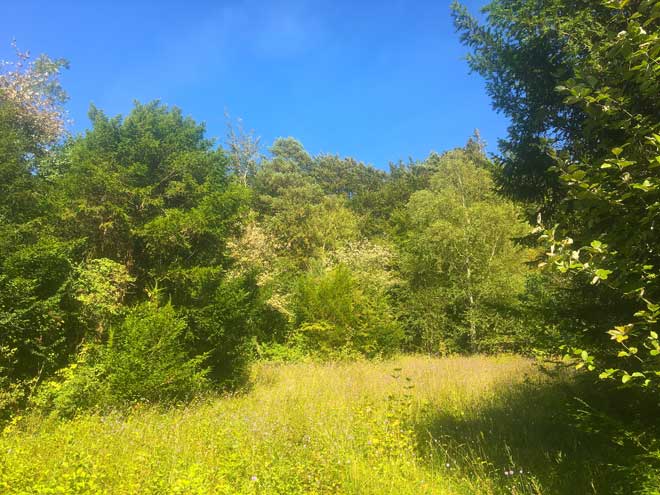
Petts Wood is brilliant for 2-3 mile walks combined with a cafe or restaurant visit to the town itself. The superb National Trust-maintained woodland has a multitude of paths, plenty of birdlife, some atmospheric heathery glades and a field with a nice view. There are little streams, a wonderful variety of trees from chestnut groves to scots pine, tulip trees, yew, holly and stout oaks, and lots of mud I’m afraid. I strongly advise travelling there by train if possible especially at the moment because the west side of town is gridlocked having been hit by petrol queues and major roadworks. It’s only a few minutes on the train out of Bromley South, on the Victoria-Orpington line; or 15 minutes from Hither Green/Lewisham on the Charing X-Sevenoaks route. The woods are a 10-minute walk to the north of the station, as is Jubilee Country Park. I’ve created a GPX map (revealing where you are on the route in real time) that ties in many of the more interesting parts of Petts Wood and its neighbour Hawkwood (see bottom of post for OS and All Trails versions).
Oh yes, by the way, there’s a major running event in the woods on Sunday October 10 so best avoid then.
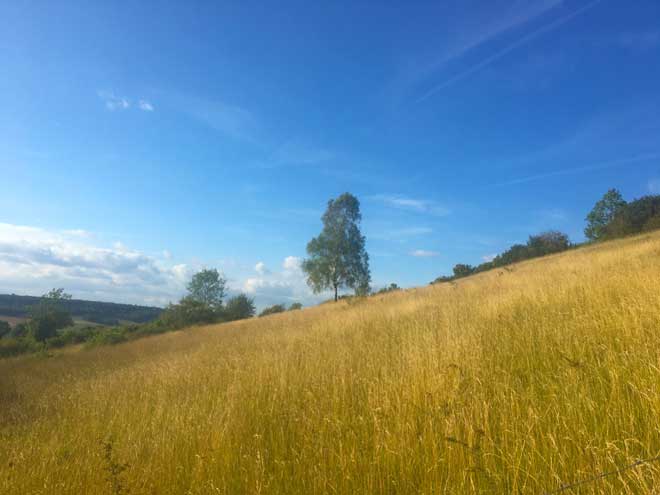
Devil’s-bit scabious (Succisa pratensis) is a flower from the honeysuckle family and it looks so cool right now. Maybe not for much longer but it’s currently fairly prominent on the chalky walks such as Fackenden, Polhill, Chevening and Kemsing. Where the grassy hilly slopes are looked after by naturalists, the Kent Wildlife Trust for example, the flower supplants regular scabious – another superb flower and particularly sweet smelling – by mid September. The marjoram is no longer flowering much, and thyme has died down somewhat too so for pollinators the devil’s-bit, which looks a bit like knapweed at first sight, is the main show in town. It is certainly being enjoyed by butterflies and bees on the wonderful ‘wild garden’ path – which in June is great for orchids – leading to Fackenden Down this week. But the star of the walk – apart from the landscape and sky – was a superb green common lizard in a sunny spot near the top of the down. Few birds were in evidence but chiffchaffs called from the hedgerows, a buzzard soared in the distance and being I’m optimistic I’d say I may have seen a pair of late-migrating turtle doves heading south. Apparently devil’s-bit scabious got its name from its ability to treat scabies, a property that the devil didn’t like much (the devil wants us all to be itchy you see). Slightly weird but there you go.
The accompanying photos were taken on my iphone and hence are poor quality – they certainly don’t do the blue-purple sparks of devil’s-bit any justice; my camera is once again defunct at the moment. (Close up of flower photo by Anne Burgess/Geograph creative commons.)
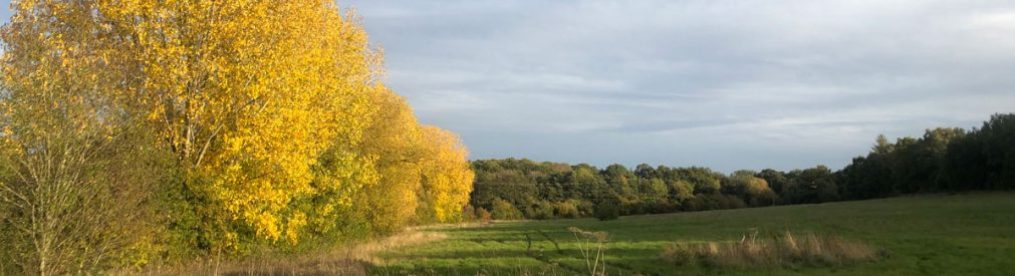
I’m having to change my banner photographs with every passing week to keep them current as we hurtle into winter. Autumn officially ends on 21 December but we all know that’s baloney. A few stormy days over the past week or so have stripped away the leaves and although temperatures are still fairly mild, it gets dark at 4.30pm and the ground is saturated. It looks like winter, it smells like winter, it feels like winter, it’s winter.
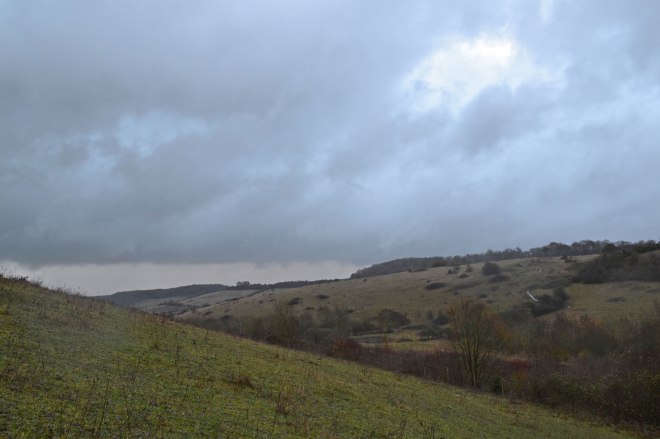
Last Sunday’s stroll at Cudham was beset by hefty squalls and paths are awash. Today I set out with a friend to walk between Otfordand Eynsfordvia Polhill, Pilot woods, Mill Lane, and Lullingstone. I continually slipped trying to ascend the steep sodden face of Polhill ending up on all fours sliding backward downhill, much to my friend’s mirth. We shared a cereal bar and discussed footwear. It was actually so wet that our boots never really got muddy despite regularly sinking ankle-deep into the mire.
The light seemed to go at about 3pm as the clouds sank ever lower so we abandoned the Eynsford leg and scoured the dank but still delightful streets of Shoreham for something to drink. We struck lucky and gratefully downed our Westerham ales under an awning outside the closed, deserted Ye Olde George (set for redecorating and reopening next year we hear).
Nr Romney Street, Round Hill, Austin Spring, near Shoreham, winter 2017
The conditions throughout the walk had been pretty ropey with low stratus scraping Fackenden Down opposite and a constant patter of precipitation slightly too heavy to be dismissed as drizzle. Darkness fell as we reached the railway station and faced a cold wait, which fortunately proved short as the Thameslink rolled in bang on time.
To add some perspective to the “inclement conditions” encountered on the walk we discussed a book I’m currently reading: The Worst Journey in the World, by a member of Scott’s team, which is about the ultimately horrific Antarctic expedition of 1911-13. Lots of things went wrong before the final tragedy, some before they’d even left Britain. None seemed insurmountable at the time but added together, like pieces in a jigsaw, they each played their part in the deaths of Scott and four of his fittest, doughtiest fellow explorers.
Underlying all of these mishaps were some truly horrendous meteorological experiences, which make walks in the Darent Valley even in murk, mud, darkness and constant rain, feel like a carefree saunter in the Shire. So, this winter, take a small leaf out of Scott’s book and say “to hell with the weather, let’s go for a walk”. There won’t be any crevasses after all; you will get back in one piece even if it rains or snows, and you might even be able to find an acceptable beverage. Just make sure you’ve got some decent boots.
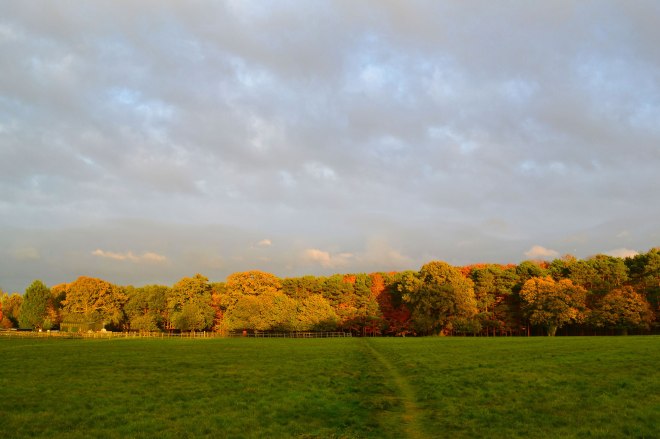
Late afternoons in the mid-autumn have their own lighting design with special colours, particularly on days like Sunday (25 October) when a clear sky was punctuated with decaying shower clouds reflecting the whole spectrum in the setting sun. So even though the clocks have gone back (for some reason I’ve never understood) if you can squeeze in a couple of hours’ walking late in the day you can be rewarded with amazing tree and sky hues. The Downe walk isn’t the most spectacular route on this site, but today it was beautifully lit, as pictured above.
I’ve always paid a lot of attention to sky. Since I was a kid I’ve always tried to work out what was likely to happen to the weather from reading cloud formations. I remember bugging my geography teacher about it: “So why did it rain for 40 minutes yesterday afternoon… was it a cold front or just a convection shower?” He’d study me with a bemused expression that said “yes, I know I gave a lesson on cloud identification yesterday but how the hell am I supposed to know?”, before giving me an answer in a tone of voice that suggested he was guessing.
I haven’t lost this childlike fascination with weather and hold in my memory particular freak weather moments from years ago.
I think an interest in clouds and meteorology (“I am a meteorologist not a weather man!” – sorry, Larry David reference there) adds something to the walks. The sky in the UK is ever-changing, constantly offers up clues and is often as beautiful as the countryside. It’s the greatest art gallery of them all; maybe Turner would have agreed. Here are some cloud photos from down the years from the walks and from south-east London.
I managed to squeeze in three walks between Friday and Sunday – Hosey Common, Knole Park and Underriver – and dropped by at Bough Beech. The weather was mostly grey on the first two days but a quick trip over to One Tree Hill late in the day on Saturday put us into pole position for enjoying a sliver of gold that marked the setting sun and some curious localised showers sweeping across the Weald, producing several rain shafts. Friday had burst into colour late on too, with a glorious rainbow at Bough Beech and ochre clouds layered above that sliver of gold and orange.
This slideshow requires JavaScript.
However, Sunday proved the best day of all with blue skies punctuated by dense cumulus once again depositing rain in sheets for 30 seconds at a time leaving the sunlit landscape shimmering. Very unusual weather. I met up with birdwatching guru Dave and walked on the Greensand Ridge at Underriver. He was in top form, picking up the calls of siskin, little owl, bullfinch and treecreeper in between explaining why West Ham were going to have a decent season (for them). We marvelled at the ‘dancing’ beech trees on the sunken path leading up the escarpment.
This slideshow requires JavaScript.
Later on, as the day turned red and mauve, we watched in awe as large flocks of redwings and fieldfares tracked west, arriving from Scandinavia or perhaps eastern Europe, no doubt heading for berry-laden hedgerows somewhere in the country. I think I’m getting into this birding lark but I think I’ll need expert guidance for some time yet.
But seeing those flocks on the move was something I felt privileged to witness – the kind of sight we can all see if we happen to look up at the right moment. But when you realise the significance and epic scale of these migratory movements you start to appreciate why some people wander around with binoculars and notebooks.
There’s no point pretending. It’s definitely autumn. It might even be winter. I’m not sure. But it’s not summer anymore. And it’s getting so dark so quickly after 6.30pm. I mean I’ve been through all this before – quite a lot actually – but this year it’s caught me out. The light just seems to go. There’s none of this ‘oh look there goes the sun but we can carry on getting jiggy with it’ malarky now. A nagging cold wind rubs salt in the wounds. Thoughts of a wander in the backyard to look at the tomato plants and their failed crop with a glass of sauvignon in hand seem so eccentric as to impinge on insanity.
Still, there are things worth getting out to see. Migrating birds for example. I was fortunate to be asked to write this piece on the subject for the Guardian last week. I learnt a lot writing it, especially from talking to the British Trust for Ornithology’s Paul Stancliffe; an expert who’s happy to talk to a layman and amaze them with stories and observations. It also gave me the opportunity to pick North Downs and Beyond blogger Steve Gale’s brains and discuss matters with the mysterious Dave of these pages. Who knew that until the 19th century many people believed swallows hibernated in mud in ponds during winter and that we only found proof of their migration in 1912? Well, I didn’t.
Meanwhile, there’s a pandemic going on. The infection rate is rising after a lull in which many of us had kidded ourselves into thinking it was kind of over. Of course it wasn’t. Without a vaccine it can’t be. But treatment of the disease is better now and most people ‘get’ social distancing and modified behaviour so I can’t believe we’re all for the chop quite yet. I don’t want to go on about politics here, so I won’t – there are enough opinions floating around. Let’s just say I’m not quite sure the virus outbreak has been handled too well and, on an unrelated matter, I don’t want Kent to be turned into a lorry or car park.
Anyway, walks are good! Very good for thinking, watching and reflecting and saying ‘hi’ to strangers. I recommend walks!
It might be an idea on walks to take hand sanitiser with you and use it after touching stiles and gates.
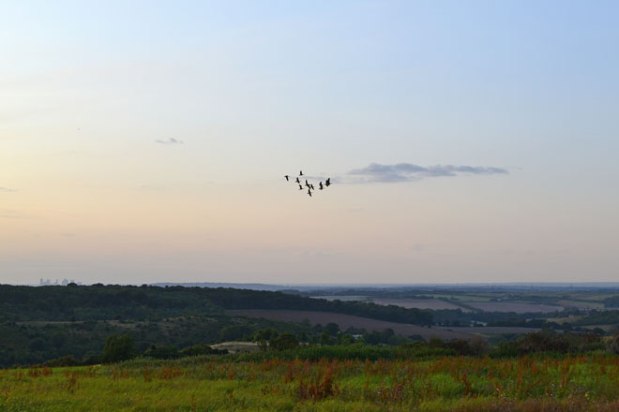
The picture above is of geese flying east of Shoreham at the end of August 2019 at the end of one of that year’s last hot days.
The weekend promises to dry and fairly sunny. This is highly novel and should not be ignored. I recommend a walk. For the mud averse I’d suggest a Lullingstone or Knole Parkexpedition. I regretfully add that One Tree Hill and Hever are quagmire-atic at present. Overtrousers, perhaps full body armour, would be required, along with thigh-length boots, which I doubt many Kent walkers possess. The other walks should be passable if distinctly squelchy.
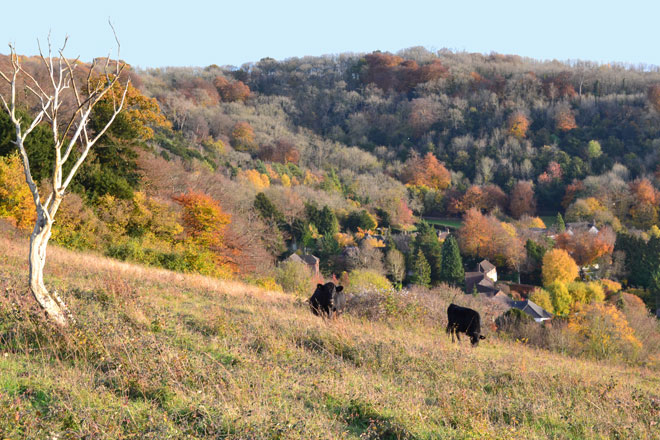
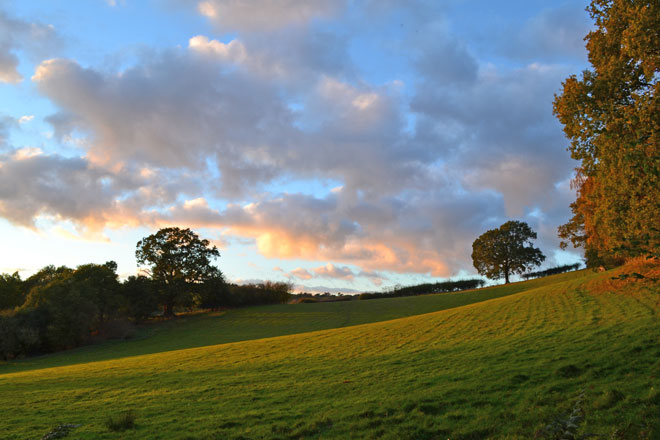
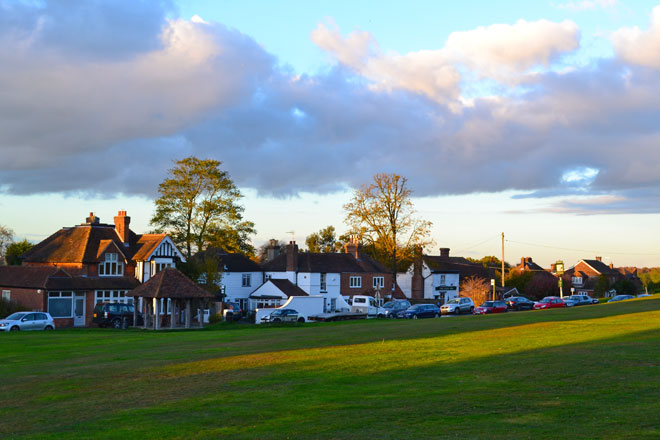
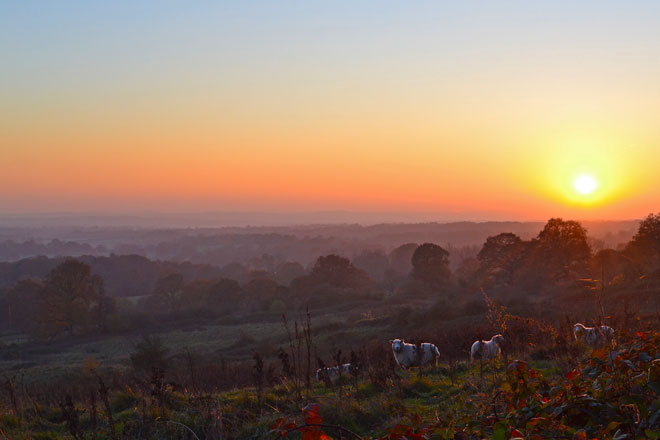
I have been walking in Suffolk today, in search of pastures new. And yes, the pastures are very large there. More of that later. In the meantime here are some pictures of sunny scenes in late autumn on Kent walks … scenes that many of us have almost forgotten ever happened.
The diversion to Fackenden Down is a great variation to the Shoreham circular walks. If you walk over the top of the hill and continue to Magpie Bottom you join the Romney Street walk, shortening it slightly. Fackenden Down and Magpie Bottom are both sites of special scientific interest and are examples of chalk upland being rewilded. Both have great biodiversity with rare plants, insects, birds and reptiles. See details (Walk 19). The other walk that can be altered to take in Fackenden Down is the ‘eastern valleys’ walk. Here are some pictures:
A walk with added poignancy today. Mariner’s Hill (Walk 15) has great views over Winston Churchill’s house at Chartwell to the Weald. The autumn colours here are particularly vibrant although I don’t think the hot summer and ridiculously mild autumn has led to more vibrancy than normal – as was advertised by some sources.
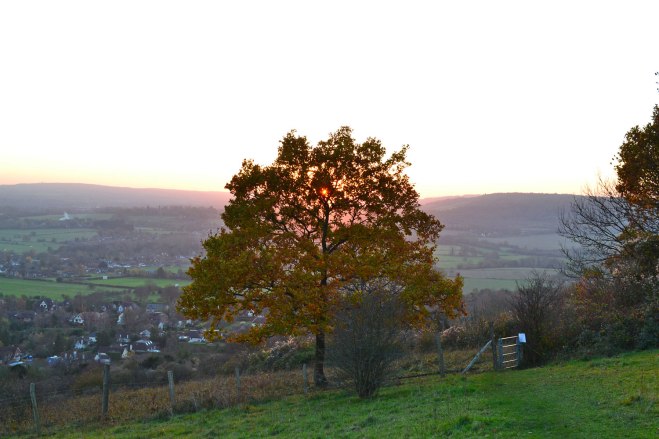
The clocks have gone back. For me that means rushed late afternoon walks as dusk gathers. Today’s speedy stroll was at Ide Hill, ending in complete darkness. Was hoping for an owl, but didn’t even see a bat. Some beautiful autumnal scenes though, across the Low Weald of Kent.