Most of the time the wildlife on these walks is pretty elusive, the small birds skulk in the undergrowth, lizards and amphibians dart away as you approach. Badgers are asleep. But every now and then something odd happens. They forget about us and say ‘I want to bask in the sunshine, I can’t be bothered with all this hiding’. Clearly, this grass snake spotted by the legend that is Birder Dave (and photo courtesy of Dave) near the River Medway at Tonbridge, wasn’t too bothered about the prospect of a bird of prey swooping down or a fox pouncing. But then it was rather big and may have learned not to worry so much – Kent’s very own anaconda.
Grass snakes often hang out close to water; they are good swimmers and have a liking for amphibians among other things. I’ve only seen them once; at Lullingstone where there were at least two similarly long ones slithering in and out of grass cuttings. Adders are all also present on the walks but are even more rarely seen. Lizards are a wee bit less elusive – I’ve seen them on the Knole, Ightham Mote and Fackenden walks.
What a wonderful walk today. The Oldbury-Ightham-Stone Street jaunt is a bit of an epic by KWNL standards at 6 miles, but every metre is worthwhile. I started badly, however, by telling a group of mountain bike riders they were wrongly cycling on a footpath. I was sure I was right but it turned out I was wrong. It was a bridlepath and they were fully entitled to ride on it. It wasn’t an unpleasant exchange and it was quite funny that I had to admit I was wrong after being shown the map. I ended up saying “Well I haven’t seen any horses, have you?” but I was trying not to laugh. I’m a country lane cyclist myself; I can’t understand cycling down paths and bumping over roots and being brushed by nettles. And I can’t understand cyclists steaming or wobbling down main roads with queues of nervous car drivers behind them. For me, the whole point is a bit of peace and quiet. But that’s me. Live and let live I say; each to their own.
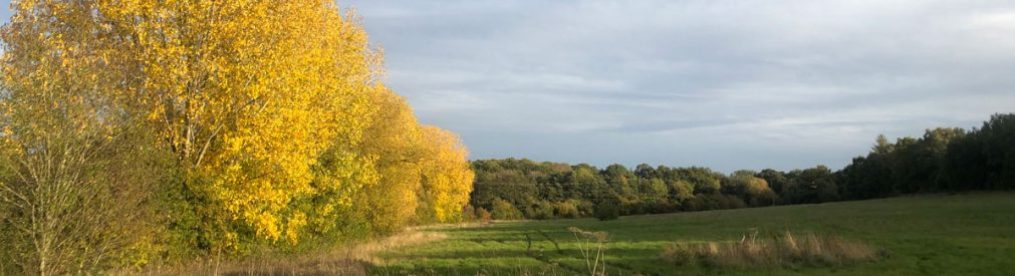
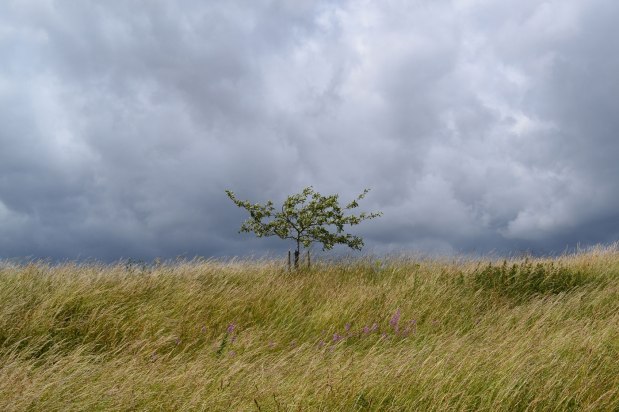
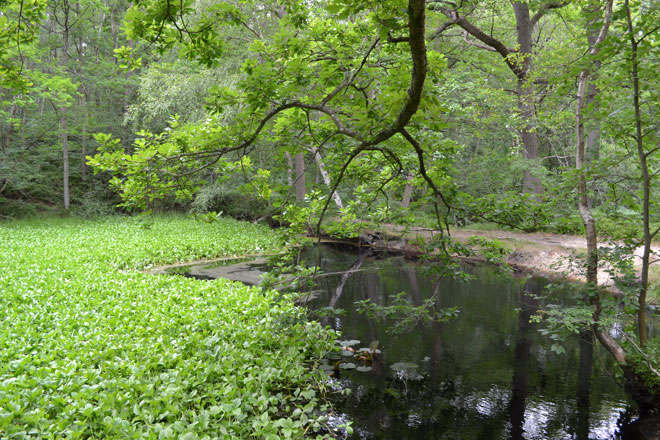
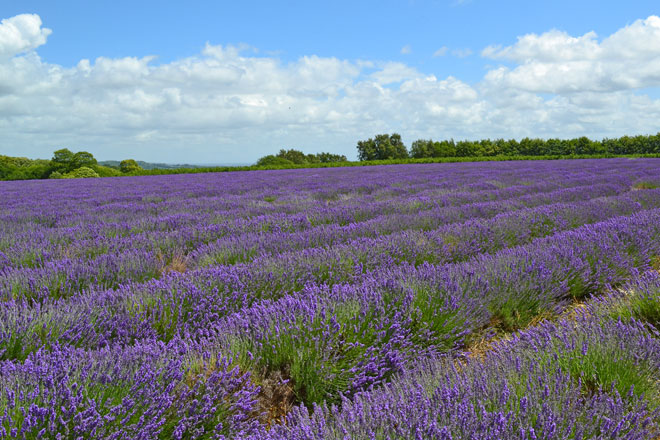
I hadn’t done this walk since Covid. My friend Steve introduced me to it in July 2020. The lavender has been largely harvested but as a result, on that section of the walk I didn’t pass a soul. Interestingly the springs of the Greensand Ridge seemed to be unaffected by the dry and hot weather, so ponds were looking healthy-ish, and the little streams near Ightham tinkled beautifully.
One of the oddities of the walk is that despite being on the Greensand Ridge you don’t get the same extensive Weald of Kent views that you do further west, at One Tree Hill and around Ide Hill. There are just too many trees in the way! But I did get great views of the Spitfires from Biggin Hill on their joyride flights; they seem to use this area to break away from the accompanying photo plane.
Pond at Point 1-2
Oldbury woods cover an iron age fort. It’s easy to see how this would have been a fortification in the centuries leading up to the Roman invasion but surely the Britons must have chopped down loads of trees to give themselves a field of view.
There is a similar feature at Keston, just south of the ponds. Navigation is not so straightforward at two points: between Stone Street hamlet and St Lawrence’s Church, and on Oldbury Hill itself, so check the GPX. Despite going slightly wrong twice (but quickly getting back on track thanks to the OS GPX) I was back home for the very enjoyable England v Germany football final – an excellent end to the afternoon. It’s a great walk, I really recommend it.
Mitchell and Peach lavender, point 3-4 pictured in early July 2020 – it’s harvested by August (earlier, if it’s been hot)
With temperatures peaking at 40C and no immediate prospect of rain it’s a good time to ask all Kent walkers to be particularly mindful of fire risk when out and about. I would also like to add that long walks in our nearby countryside is a great substitute for travel further afield; travel which we now know is immensely harmful to our environment. You can feel refreshed, in the same way you do by a short break, by immersing yourself in the valleys, meadows and woods of the North Downs and Greensand Ridge for an afternoon. Let’s hope the damage done by this arid summer is not profound on our verdant landscape, but in the long-term we must accept the rising temperatures will be.
Cycling home from London this week, in what felt like the inside of a convection oven, I could see the smoke of fires off to the east; in valuable wildlife habitats such as Dartford Heath and in east London – an apocalyptic scene. There are not even thunderstorms in the offing to bring relief. Things have to change; we must make better environmental decisions. But don’t expect our politicians to lead us – certainly not those in power at the moment – and don’t expect our media to treat it seriously enough. It’ll have to be us, the people, who act.
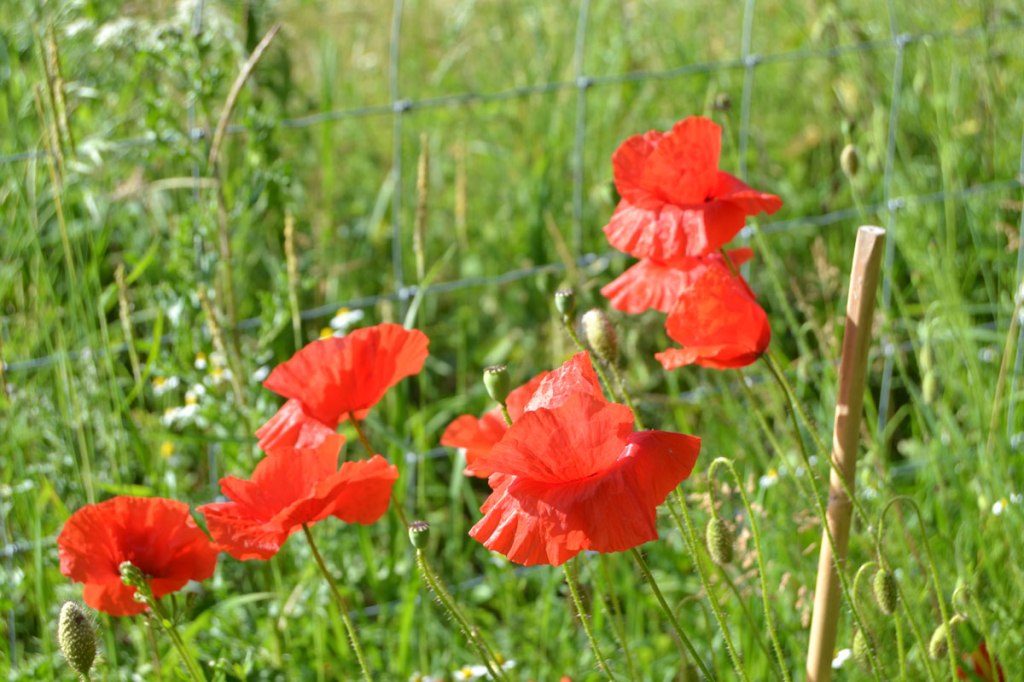
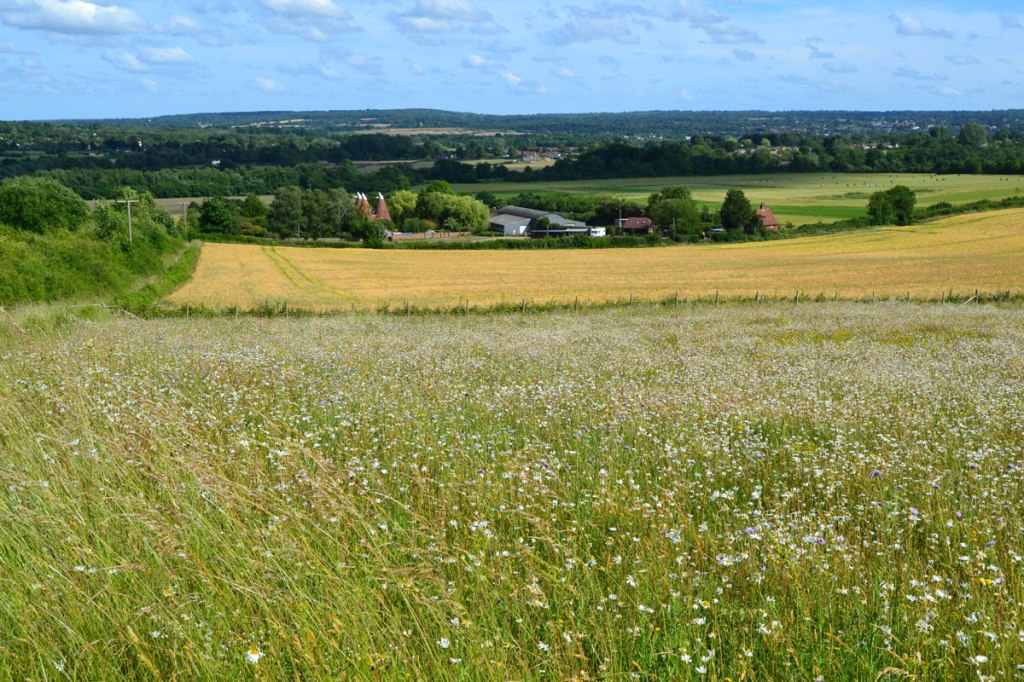
Continuing the theme of overlooked walks at Kent Walks Near London, the Polhill Pluto route yesterday proved the perfect choice on a bright, breezy summer’s day. There were plentiful orchids in the Andrews Wood-Meenfield Wood gap and fantastic ox-eye daisies, scabious and poppies in the fields below Polhill. It’s a great walk to do if you are a fan of the yellowhammer – the colourful, chirpy bunting (we’re talking about a bird by the way!) that adorns hedgerows in these parts and is particularly common for some reason between Shoreham and Otford. It’s repetitive and unworldy song is one of my favourites – it’s commonly described as sounding like ‘a little bit of bread and no cheese’ because of its rhythms but to me it’s simply the sound of summer. Listen out for it on the Darent Valley floor; around Sepham Farm it’s nearly always heard, and sometimes present in the lower parts of the Fackenden and Eastern Valleys route (such as around the Percy Pilcher memorial). The Pluto route (so called because you pass the final ‘planet’ on the Otford solar system scale model) can be combined with the Shoreham circular and even the Fackenden, Otford and Eastern Valley routes for a walk of up to 11 miles or so as all these routes intersect, or almost intersect, at various points. For some reason, I only think of this stroll as a summer walk – not entirely rationally, but it just feels right on a warm day.
I walked the Shoreham eastern valleys route (near Romney Street pictured) yesterday for the first time this year and much has changed! First off, the path along the field between points 2 and 3 were more overgrown than usual at this time of year… I’d actually brought secateurs with me to help matters and did some highly satisfactory bramble snipping. Next up and of more structural significance, the barn between points 4 and 5 at Austin Lodge has disappeared; apparently the land has been earmarked for a couple of houses. I’ve amended the route instructions. Later, I was disappointed to see that the steep hillside between points 6 and 7 has been munched by grazers and now there are no wildflowers. It used to be a sea of oxe-eye daisies and orchids at this time of year. What happened? Has the owner decided they don’t like rewilding after all? It’s probably complicated but I was a bit saddened by it. The next thing I saw on hitting Shoreham village was that Ye Olde George, having been refurbished for the past couple of years, has now reopened as The Samuel Palmer. Good name actually, but it stupidly hadn’t occurred to me that the Mount Vineyard people would also change the name of the pub. It looks excellent and I can’t wait to visit. I must have gone past it and not noticed it had reopened a couple of times because the refurb was complete by April 2022. But there’s also sad news; just across the bridge the King’s Arms remains shut after a damaging fire in March. I had no idea. Funny how quickly things can change.
Of all the walks on this site the one I’ve done the least is probably the Knockholt/Chevening circuit. I’ve not always been wildly effusive about it, even describing the early stages as dull. I was completely wrong it turns out. I strolled the route today and found it superb. The fields on the right of the North Downs Way in the early stages have been left fallow and look to be in a pretty advanced stage of rewilding – the flora is high enough to hide the odd lynx! As I hit Sundridge Hill the instantly recognisable and repetitive song of the yellowhammer burst from the hedgerows like some sort of alien morse code. A huge buzzard (what are they feeding them around here?) eyed me up from above. The views over Chevening House towards Ide Hill were delightful as I cleared the scarp face woodland. Chevening hamlet was as spooky as ever and the following climb back to Knockholt took in a broad vista of the Vale of Holmesdale under a moody sky with plenty of butterflies and wildflowers to admire. A red kite skidded and yawed above in the thermals and I startled a pair of greater spotted woodpeckers which suddenly took off from a fallen tree trunk a couple of metres ahead of me. I think my previous aversion to this walk was to do with the “private” signs around Chevening House, its association with some deeply unpleasant national figures, and the slightly creepy feel of the hamlet – it’s just so quiet, but it’s me, it’s not them – the road noise between points 4 and 5, and having to walk on the road for 100 metres by the farm at point 5. The truth is, there are great views, loads of wildflowers, wonderful trees and nothing much not to like.
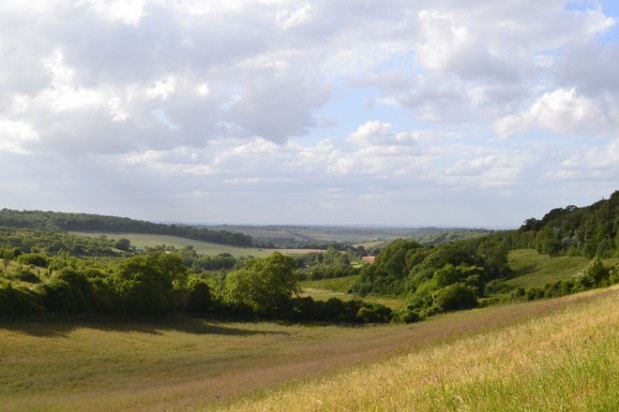
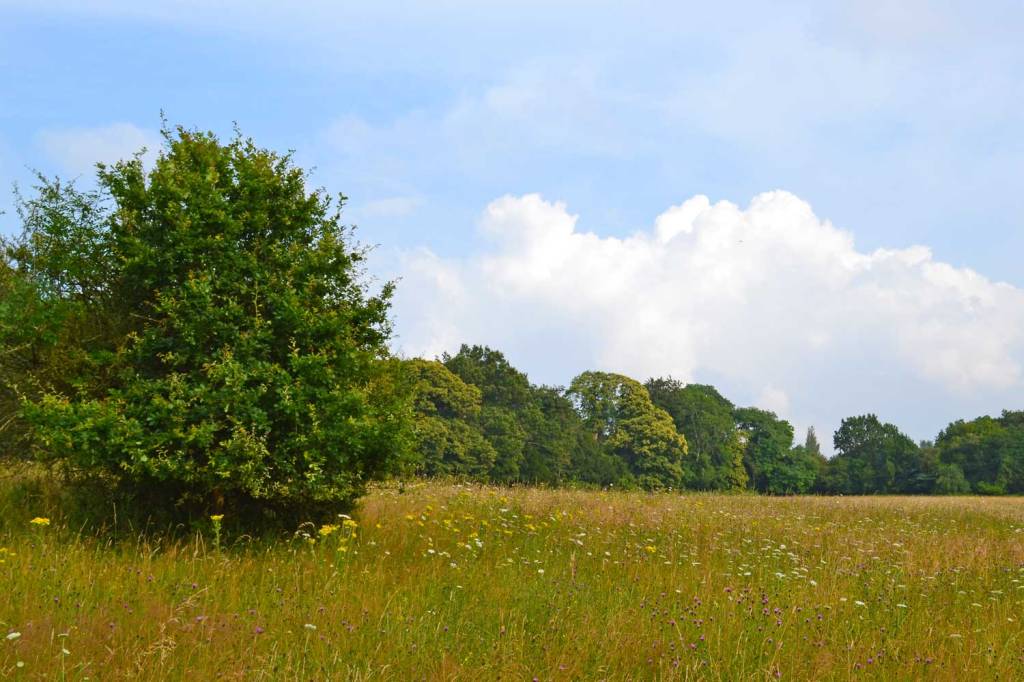
As quite often happens in these parts the camera doesn’t capture the walk; slopes are flattened out so the scenery looks blander than it really is.
To help you find suitable walks here’s a rather rough-looking interactive Google map. Just click on the lines and blobs to get more information about that walk. You can use the menu at the top of the page to print off pdfs and to look at more detailed directions. Each walk description has a GPX map attached so you can follow your progress in real time – if you have signal. Failing that please use an Ordnance Survey map to check the route (OS Explorer 147 has them all).
Best walks for travelling without a car are those in the Darent Valley – the ones starting from Shoreham, Eynsford and Otford/Kemsing stations. Knole Park can also be reached from Sevenoaks station.
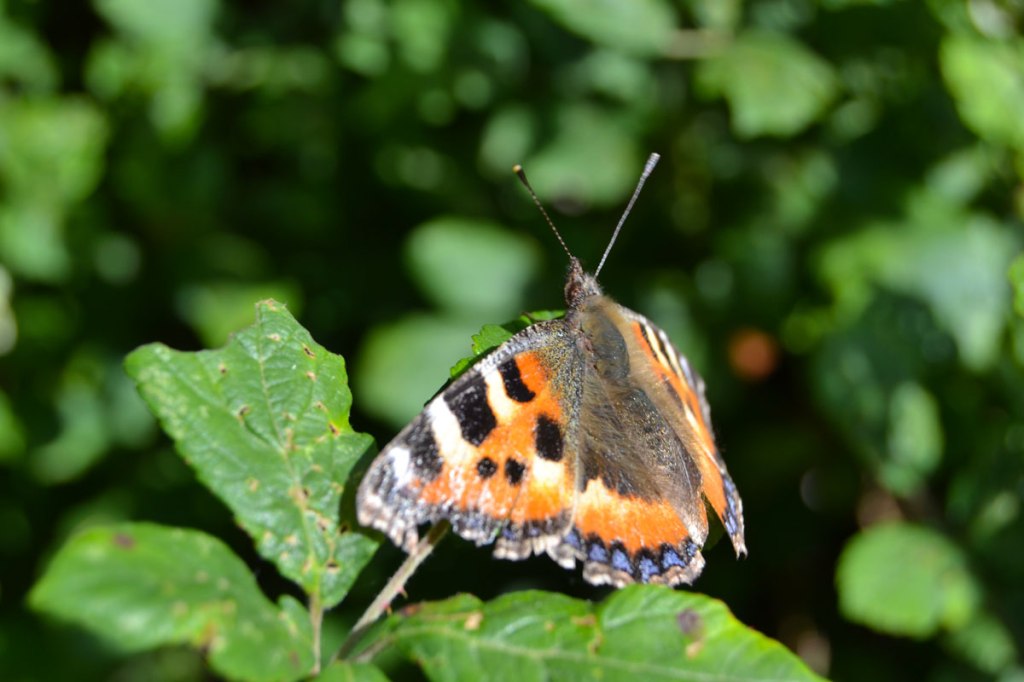
In a largely cloudy wet summer in these parts the sightings of butterflies are all the more precious. As an ‘ectotherm’ these insects need warmth to fly for any duration. So on cooler days they need to open their wings to sunlight and heat their bodies to about 29C before take off. Slopes with wildflowers on them facing the sun are particularly great places to see them.
Populations of these absurdly beautiful creatures are falling the world over because of climate swings and pesticide use – another reminder that apart from robins, goldfinches, magpies, deer and rats, etc, it’s quite hard to write about many facets of the natural world without doom and gloom encroaching, but that’s the reality. Take the small tortoiseshell butterfly: its numbers have declined because its larvae need to feed on wet leaves (mainly of nettle), so the increasing tendency toward drought has really hit its population over the past 40 years or so. The large tortoiseshell meanwhile has nearly completely vanished. Having said that, other species, such as silver washed fritillary, are said to be expanding if anything.
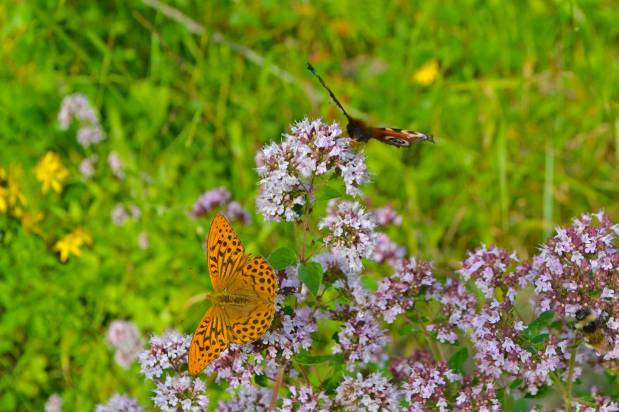
From top left clockwise: peacock in Downe feeding on marjoram; female silver washed fritillary; gatekeeper in Polhill; red admiral in Catford; marbled white in Downe; comma near Shoreham; male silver washed fritillary in Downe; chalk hill blue – photo by Steve Hart –Fackenden Down
However, Kent walks near London are graced at the moment by a variety of lovely species: on the chalk North Downs you’ll see silver washed fritillaries, the small but smart brown argus (actually classed as a blue), dark green fritillaries (if you’re very lucky), gatekeepers, marbled whites and meadow browns, plus many of the common names such as the incredible migratory painted lady, red admiral, brimstone, tortoiseshell large and small and a host of others. Chalk hill blue, the common blue and the adonis blue (very rare) are particular favourites. It might just be me but I tend to see more orange tips, peacocks, commas, brimstones and large whites on the Greensand Ridge walks around Sevenoaks, but I’m not being scientific here – they are widespread.
To see wonderful butterflies you might not have leave your garden or park as we all know – now the prolific south-east London buddleia is in flower, the migratory red admirals are often seen a-flutter in the suburban streets. Small species, like skippers, I don’t know much about. But I often see gem-like butterflies on the walks – I’d need to be with an expert to identify them.
It’s hard to photograph butterflies because they are rather skittish unless in the mood for a bit of showing off, or just super drunk on nectar (is that possible?) but I have managed to take a few shots over the past couple of years, which I’ve compiled in this montage above (the chalk hill blue centre right was taken by a friend though).
Not a butterfly but the very smart looking cinnabar moth, pictured at Romney Street while on the eastern valleys stroll
Sultry summer evenings are very much my thing. There’s been a promise of a storm in south-east London for some time without one materialising. We’ve even heard them from time to time, thunder rumbling around, sudden winds forming as if a tornado were nearby and, beyond London, huge puddles and mud show where the downpours have already struck. On Saturday the humidity is on the up, the atmosphere is murky, lofty cloud peaks emerge from the haze and you walk only 50 metres before the first drops of sweat form. I love it. I don’t love the idea of floods and unnaturally damaging weather of course – what happened in Germany is truly horrific – but I’ve always been up for a lightning display. Going off at a tangent here but talking of the growing likelihood of floods because of the climate crisis, I look around at the number of front gardens that have been paved over with inadequate drainage and I worry about what may be around the corner.
The Downe walk today, which occasionally feels a bit mundane, was a joy. Wildflowers spangled the grassy meadows, a song thrush serenaded walkers from a hedgerow and charms of goldfinches passed wittering in transit from field to woods. Spitfires growled through the moist air, seemingly busier than ever whisking people on joyride flights across the now customary airliner-free skies of Kent. Wild marjoram (basically the same as oregano) was flowering along with ragwort, knapweed, vetch, hawksbeard, the odd orchid and trefoil. Butterflies were having a fine old day: the pick of the bunch being peacocks and silver washed fritillaries among the marbled whites and meadow browns.
Sunday update: Another muggy day with storms nearby and another North Downs stroll with a route from Kemsing, courtesy of a good friend, Steve of Sydenham. Bird man Dave, of Tonbridge, was in line to join us but decided that the potential for lightning and thunder made it a risky undertaking. As it happened, the worst storm of the day had already passed once we arrived in Kemsing, and from then on the cloudbursts diverted to the north towards London – causing major flooding in parts, and south towards the High Weald. There were superb views, more Spitfires, and a fine pub at Heaverham – the Chequers. The wonderful meadow of Kemsing Down was a highlight – with plenty of marjoram, thyme, scabious and St John’s wort among the grasses. It’s not a walk we have on this site as yet but I’ll certainly try to conjure something similar – Kemsing station is nearby and could be a good starting point.
View from escarpment to the south from near Kemsing Down
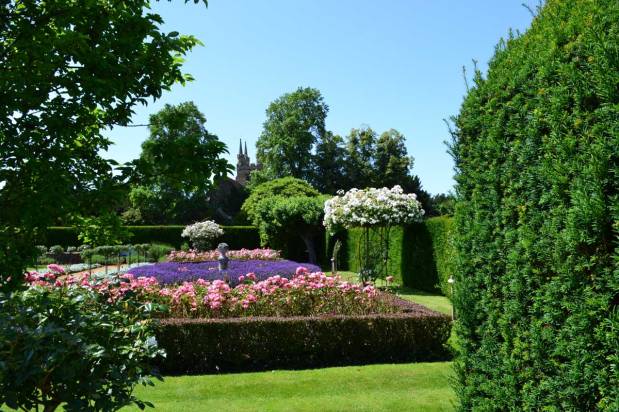
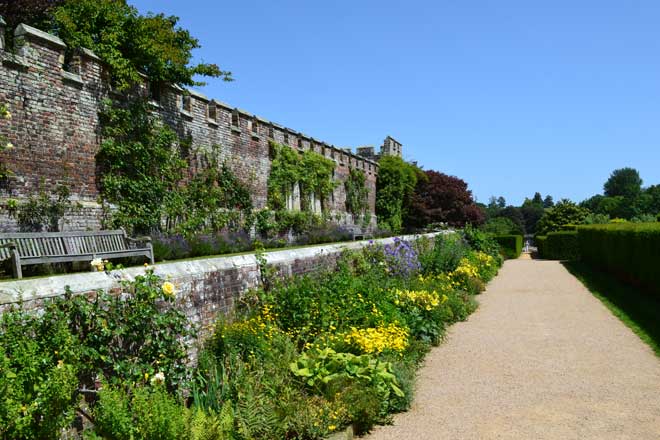
The planned long sultry walk at Oldbury failed to materialise on Sunday – like a mirage it shimmered but gradually receded from view as the unaccustomed warmth altered rhythms and weakened resolve. A midday family cycle from Tonbridge to Penshurst Place along the River Medway formed Saturday’s low weald excursion, coupled with a wander around the Tudor mansion’s sumptuous gardens. It was a gloriously warm day but not as energy-sapping as what was to come. On Sunday morning I did a bit of gardening at home in SE London – Penshurst’s vivid borders had inspired me to cut back some of the long grass and weeds to show off what flowers were growing in our sun-bleached south-facing front garden. But as the temperature roared past 30C by 11am it all felt like too much hard work; by noon I withdrew to a book and a cold drink, reflecting on how physical gardening actually is. I also pondered how sad it was that the once common municipal open air pool has largely disappeared from London apart from busy lidos at Tooting, Charlton and Brockwell Park. Nearby, the River Pool near Bellingham Play Park had become a paddling pool – I just hope its clean enough for that.
House martin. Photo by Av Thomas Landgren/Creative Commons
At Penshurst Place I saw more house martins than I’d seen anywhere this year; I’d seen some in the distance at Chartwell from the Westerham/Hosey walk a few weeks previously and a few on the Thames west of London. Among their merry throng, swallows and swifts also proliferated. Finches – green and gold – called and flitted from fruit trees and up at the house itself a very keen spotted flycatcher darted out from its vantage point on top of a wall to catch flying insects with elegant and accurate pirouetting manoeuvres. What an amazing bird that is; it seems so improbable that they make their way here every year from southern Africa to breed. What a journey for a small perhaps nondescript looking bird. At least the martins, swallows and swifts make their epic journey each year in huge clumps and look capable of incredible feats of airmanship, staying airborne for weeks on end. Birds like that perky flycatcher and its musical warbler fellow travellers look incapable of such a trip, but thankfully they make it every year. They clearly feel at home in the manicured grounds of Penshurst.
I’ve also seen notable birds also at Emmetts Garden, around Darwin’s garden at Downe, Hever and Chartwell, despite the heavy footfall. That seems counterintuitive. My guess is that despite the constant pruning and tidying, these birds find more nesting places in the medieval buildings than in neighbouring areas. They are also drawn by these historic plots’ long-established water features. Then there are the old fruit trees that are maintained out of respect for tradition. Certainly Penshurst does a good job of keeping some of its superb garden quite wild with an orchard and unkempt grasses. Its lovely ancient brick walls must also attract a lot of insects. Neighbouring farms may also use pesticides and over-trim hedges.
So perhaps the heritage gardens, despite their topiary and cultivated blooms, may actually be wildlife oases doing their bit for biodiversity alongside the rewilding projects. Maybe.
I haven’t described it yet but there’s an excellent walk between Tonbridge and Penshurst Place, on a separate path mainly to the bicycles. It would be easy to join with the Chiddingstone route. I must investigate further; there are some beautiful stretches.