The Darent Valley and its surrounding valleys near Otford, Romney Street and Austin Lodge to the east and Andrew’s Wood to the west seem to me to trap heat and moisture. Even on dull summer days the area feels more humid and sticky than the London suburbs for example. I love it. The area feels ‘different’ and somewhat mystical. It’s certainly very verdant and with rewilding projects, such as at Magpie Bottom, several SSSIs and Kent Wildlife Trust reserves, it’s worth having to change your shirt for. Just take a flask of water. Even on a mostly dull day like last Sunday, you might get a fleeting pool of sunshine to enjoy and the sight of cloud shadows racing across the rippling wildflower rich meadows towards you. (Dogowners are advised to keep their animals on the the lead though…. there’s apparently a threat of adder strikes on dogs in the area and occasionally livestock. Cases of dog theft have occurred too.)
Two walks around Shoreham at the weekend in subtly different conditions. On Saturday we went looking for orchids on the eastern valleys route. It was a mostly cloudy day but with good visibility. Towering cumulus held the promise of a storm in the evening – well, one did materialise even yielding a funnel cloud in a near-tornado touchdown in east London – and the humidity was something else, even in these chalk upland valleys which trap heat and moisture.
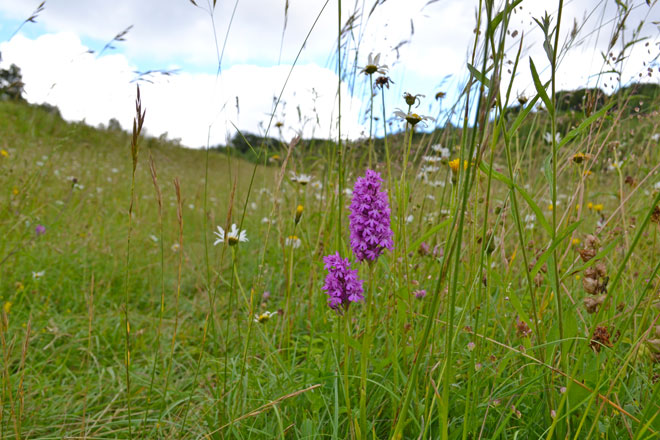
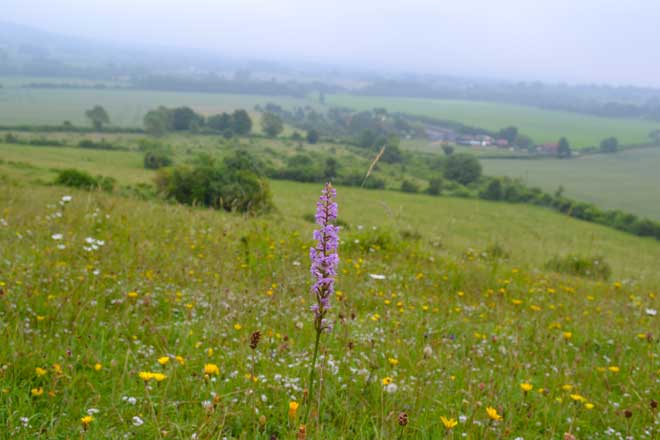
For Sunday, the cloud was almost at ground level, quite unusual for June I thought, again threatening heavy rain, which eventually arrived after dark. We kept our walk brief, venturing to Polhill from Andrew’s Wood but not heading down to ‘Pluto’ on the valley floor, instead hiking the hillside above Filston Lane, moving slowly, looking for flowers and birds (no luck there!). The chalk slopes were festooned with natural colour, the delicate pink of fragrant orchids, raspberry ripple of common spotted and rich pink/mauve of pyramidal orchids. Trefoil, ox-eye daisies, poppies, scabious, lucerne, foxgloves and others I don’t know the names of completed the scene.
Pyramidal orchid on Polhill Bank, managed by the Kent Wildlife Trust
There are bee orchids and more on these walks but I managed to miss them. Marbled white butterflies, commas and common blues were in abundance, plus a beautiful cinnabar moth, despite the lack of sun. It felt so rare to stroll on the flowering hillside in such dull conditions. Down at Headcorn, near Maidstone, the airshow had been cancelled through lack of visibility and nothing flew from Biggin Hill apart from one executive jet which made a beeline for the sunshine above the murk. Still no airliners.
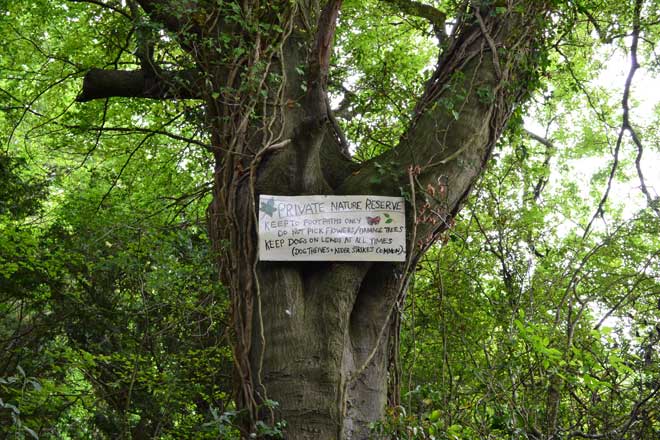
I was taken by the private nature reserve sign on the footpath into the hillside from Shoreham station… “keep dogs on the lead, adder strikes common” grabbed the attention.
Well here’s hoping the weather clears up a bit. I’m no expert but the orchids already looked to be on the wane just about, but there’s plenty more in the way of wildflowers yet to come on these thin chalk soils. Marjoram, thyme, wild carrot, more scabious, rosebay willow etc are all yet to explode into colour.
I should mention that Polhill is looked after very well by the Kent Wildlife Trust as is some of the land close to the Eastern Valley route, notably Fackenden Down. Apparently both sites support common lizards and adders (hence the warning sign), dark green fritillary butterflies, willow warblers and man orchids. I never see any of these species but it’s great to know they are present.
I liked the gloomy atmosphere. For a bit. But this is going on for far too long now. Still, there’s the football to enjoy.
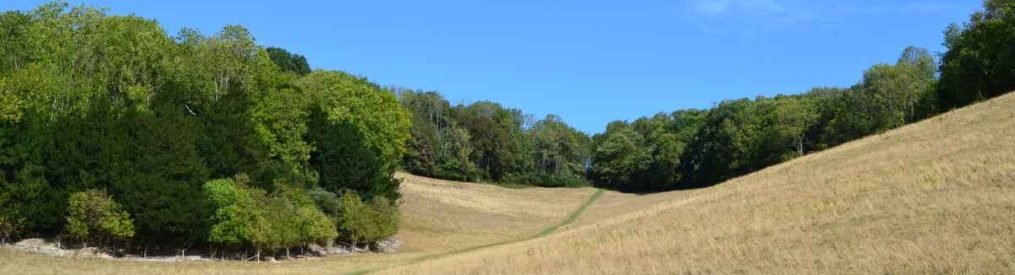
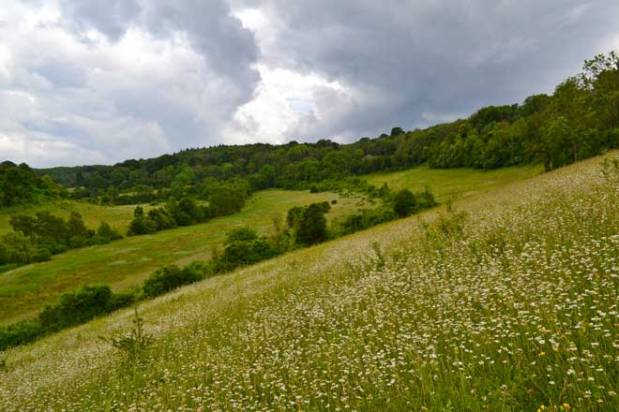
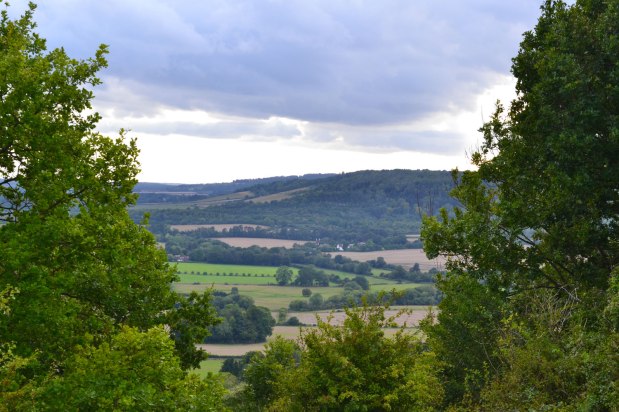
Top picture is the hillside opposite Romney Street, east of Shoreham. Below (in order of appearance): White Hill nature reserve sign; Magpie Bottom seen from Austin Spring; fragrant orchid White Hill; common spotted orchid White Hill; cinnabar moth near Austin Lodge hamlet; common spotted orchid Romney Street; fragrant orchid Polhill.All photographs by AMcC
The word ‘meadow’ is synonymous with summer and June and July are the very best months to enjoy them. There are so many brilliant summer meadows on these walks now alive with oxeye daisies, orchids, vetch, poppies, buttercups, and lush grasses rippling in the breeze. They are alive with butterflies and other insects while swallows swoop above them forming brief gaggles before separating to make single passes. High above, buzzards are often seen soaring while spectacular red kites – now much common in Kent than at any time in the modern era – float into view closer to the ground. Of course there are issues, swallow and martin numbers are much lower than back in the day and there ought to be more butterflies and bees. Still, meadows are hubs for wildlife and we are lucky the North Downs, Weald and Greensand Ridge areas possess so many.
Meadow bordering Scord wood on the Ide Hill walk, June 2021. Sheep have munched this one a fair bit, and that in the lead photo, but there are still plenty of wildflowers and bees
Any weather that isn’t warm and sunny feels like a major disappointment at the moment with autumn round the corner, Covid-19 issues and some fairly other horrendous news going on around the world. We need the compensation of mood-lifting sunlight. But even in these cold, cloudy conditions walks work wonders with wellbeing. Last week, with a few days off work I tried a new route starting from Underriver – in pouring rain as it turned out – that joins on with the One Tree Hill routes. It proved excellent and featured some really interesting farms with lovely old buildings as well as the familiar Greensand Ridge views. I’ll write it up soon but if you do Walk 6 in full (with the western extension past Romshed Farm) you’ll have done it anyway. But maybe I’ll work it into a shorter route too, so time won’t be such a pressure.
This slideshow requires JavaScript.
The next day proved equally splashy, so failing to find anyone who wanted to join me I set off down the A2 in teeming rain to the Hoo peninsula. I’ve done the walk there, starting at Cliffe, several times but this was probably the most spectacular occasion yet, with huge storm clouds to the north and south and slivers of sunlight illuminating the bleak marsh. I heard cetti’s warbler, saw a whitethroat, lapwings, avocet and various unidentified waders. A marsh harrier glided across the track at one point; very thrilling if you like that kind of thing. My luck ran out on the final mile, however, as the heavens opened. It’s an hour’s drive from Sydenham but Cliffe is a good place to visit, particularly for bird watching, picking blackberries, elderberries and sloe and gazing over the Thames estuary. You can park at the RSPB reserve or in the car park by the main village church and just wander the marsh paths and tracks. There is a train service to Higham (three miles away) or to Strood – a Thameslink service that can be picked up at London Bridge, Deptford, Greenwich, Maze Hill and Charlton. There are local buses (the 133) from Higham/Strood but a taxi might work better.
Over the weekend I returned for the second time in a week to one of my favourites: Fackenden Down, this time in good company – I love a social walk even more than a solitary one! I never tire of this route, one that always delivers in terms of views, rustic atmosphere and so on. It’s still pretty colourful too with ripening berries, scabious and trefoil flowers aplenty on Fackenden Down itself and many chalkhill blue butterflies lingering in the sheltered spots. Very few birds around, however, just a solitary buzzard and a kestrel with a few lingering swallows speeding over the meadows.
Yesterday I was lucky enough to emerge from the trees at the top of Fackenden Down just as eight – yes, eight – buzzards soared in the updraft together overhead, calling out and engaging in mock battles. I’ve never seen anything like it. Nearby Magpie Bottom was also a picture with mauve scabious flowers and purple knapweed giving the pollinators a real treat. On a small sandy lump, made by burrowing insects I guess, I spied a tiny, dark lizard which shot off as I reached for the camera inevitably.
Fackenden Down, near Shoreham and Otford stations, is a Kent Wildlife Trust reserve of rare and superb value. The trust is trying to encourage reptiles, butterflies and more varieties of wildflower to return to the spectacular site but needs money so please donate to them if you can.
I don’t use these pages to vent usually but something’s got me hot and bothered, and the beauty of running a website is that you are your own editor. Not always a good thing I suppose. Anyway, I’ve realised on my evening cycles that my street is actually hotter than surrounding areas. My one-hour route takes in Lower Sydenham, Beckenham, West Wickham and Hayes, taking in urban environments that lean on the lush side.
I’m a casual cyclist with an old bike and not much appetite for speed or lycra but this is beside the point. When I re-emerge onto my own street I feel a blast of heat. It’s because there’s far too much concrete in relation to greenery. Other streets have trees and front gardens, but here people – not necessarily current residents – have paved over their lawns, the council has removed anything arboreal (thanks guys, it looks like s*** now), and there is no strip of grass by the pavement. Just concrete mercilessly radiating heat. The water run off, if it ever rains again, will be pretty appalling and I imagine the street is now vulnerable to flooding thanks to the collective thoughtlessness. Doesn’t anyone care about aesthetics or the environment? You don’t have to be a keen gardener to have a patch of grass and a few plants. I think it’s pretty poor.
River Pool path with no litter – for a change.
Now for a rant that’ll echo what we’ve all heard on the news and elsewhere. Close to my road there is a park and a stream: the River Pool. It’s pretty nice. I think it’s grand for the kids to go paddling in it (mind any glass though) but for adults to leave litter everywhere and not consider taking it home is beyond the pale. I’ve often tried to clean it up a bit myself and I know the Friends of the River Pool do their best too. So I say shame on you selfish people who foul up the place. Does this happen in Germany, France etc? I don’t think so, not to the same extent.
I was planning to do the Shoreham eastern valleys walk yesterday but the friend who wanted me to introduce it to him decided it would be ‘too hot’. I agreed, but I’m sure I would have gone along with him had he decided to go ahead. It was set to be 34C and I must say I kind of relish the walking in these temperatures – you become quickly unkempt and crazed but the first cold drink after finishing is just fantastic. It might be that masochistic tendency instilled in me by my mother (WW2 generation) which dictates that if the conditions are particularly unsuited to a certain activity, then you are duty-bound to press ahead with said activity! Nearing the age of 80 she once cycled to her local GP’s surgery, about two miles away, in a rainstorm to ask why she felt fatigued. This was straight after another cycling trip to Homebase to buy plants. Which followed a decent walk with the dog. Different generation. Sure.
I guess we all draw our lines somewhere. Tourists – many not in peak physical condition I noticed – troop through the 13-mile Samaria Gorge in Crete every summer en masse. So maybe what’s ‘too hot’ here is actually acceptable when in the Med. Oh, it’s ‘dry heat’ I hear you cry. Well, that’s OK then. I once walked in Joshua Tree national park in southern California in 40C, but only for a mile or so at a time, with a lovely air-conditioned electric car for refuge. Some American friends did find my Joshua plans slightly worrying (‘Are you serious?’). But then the lyrics of a certain Noël Coward song were brought up and we all agreed I was suffering from Englishness. Truth to tell I was just desperate to see the place and stubbornly refused to let anything get in my way. It was great, until we nearly ran out of water at the end of the trip. Then we remembered the tragic fate of a tourist couple there the previous year who got lost and actually died of dehydration and heat stroke or something.
Properly hot: Joshua Tree national park, California. Photograph: Adam McCulloch
So, I can’t offer any advice. It’s an individual thing. Some people like the heat, absorbing it to recharge themselves, like human solar panels. Others retreat to a dark room surrounded by fans they’ve just had delivered, but later in the year emerge to crack on in pouring rain and snow. You know yourself and your limits, hopefully. But at times like these it’s a shame there aren’t more places around for swimming. So many of the lakes we do have are very restrictive (not as much as Bough Beech but a lot more than, say, the lakes of Berlin) about safety but it often seems unnecessary and a bit jobsworthy. It’s a shame, given that such hot weather each summer is occurring increasingly often (somebody do something, yes I know).
Anyway, never mind it being too hot for walking; it’s too hot for sleeping, that’s for sure.
I don’t publiciseLullingstone Country Parkthat much because it’s busy enough already and it’s easy to devise your own walk around its lush acres. The visitors’ centre car park is full to brimming by mid-morning of a sunny weekend and, just down the road,Castle Farmcatches much of the overspill and is a lovely attraction in its own right with its lavender fields and local produce. And then there is the excellentWorld Gardenat Lullingstone Castle. Throw in picnic tables, viewpoints, a cafe, the river path and there’s no mystery about its popularity.
Credit where it’s due; whoever looks after the place – I guess it’s Kent County Council – has done a wonderful job of rewilding areas of meadow and wildflower around the paths and fairways of the golf course. In spring it’s all about orchids, bugle, speedwell and cowslips but at this time of year the profusion of marjoram, thyme, fine grasses and wild carrot growing all over the place is spectacular.
This slideshow requires JavaScript.
A walk around the park’s curvy contours and itssuperb ancient woodland(probably the quietest parts of the park) is a very civilised activity indeed. Those big North Downs skies are good for spotting birds of prey (I’ve seen all the major UK species here) and yellowhammers have made a comeback in the hawthorn/buckthorn thickets on the slopes. I’ve seen grass snakes here, too. Biggin Hill’s Spitfires often appear overhead on their joyriding flights … all in all it’s a real picture. Maybe visit later in the day on a fine weekend – they say the car parks are freed up a bit after 3pm.
I think during the pandemic it’s best to avoid the river path, however. It gets a little too busy for my liking with myriad dogs confusing the issue. I’ve got two walks on here (3 and 12) that venture into the park from nearby Eynsford and Shoreham railway stations, but I’m considering adding another … perhaps starting at the public golf club entrance and taking in more of the woods. We’ll see.
• Lullingstone CP’s Facebook page has all the latest news including whether or not the car park is rammed.
Last year I wrote about the walk from Knockholt Pound to Chevening. I wasn’t that impressed by it; a fairly long boring bit and woods with too many ‘Private’ signs which I can’t help but feel are a bit rude. However, I tried it again last, rainy, Saturday and concluded that if you do it the wrong way round with the drab bit first, it’s actually a really nice walk. You emerge from the woods with a great view over towards Ide Hill and with Chevening House before you. And Chevening hamlet itself has an atmospheric church. The route later takes in a nice path back up to Knockholt Pound across the face of the escarpment. There are two sections on roads; thankfully the longer section (about 800 metres) is on a very quiet lane called Sundridge Hill. The bit on busier Sundridge Road is only around 200 metres, so pretty safe though I wouldn’t take young children. The walk is about 5 miles but easy to follow. It’s pretty good for blackberry picking right now, particulary the hedgerow path after Point 5. But leave some for me. I have a shorter loop walk covering some of the same ground I’ll add soon.
An idyllic new route: walking down Polhill Bank then past Sepham Farm towards Otford takes you into a summery wonderland of wild marjoram, myriad butterflies, hedgerow birds while, in the (hopefully) azure sky, two-seat Spitfires purposefully head off to deep Kent on joyriding trips.
There are loads of paths to take from the car park off Shacklands Rd by Badgers Mount; it’s easy to customise walks from there. But you need to stroll a mile or so before you can rid yourself of the M25 noise. But even close to the motorway there are compensations: Andrews Wood, Meenfield Wood and Pilots Wood are beautiful and each has its own character. Visit late in the day and the shadows and sunbeams among the beeches form a light art installation on a scale the Tate could only dream of. Kent Wildlife Trust is taking care of some of Pilots Wood these days, and of Polhill Bank which it leads on to, a south-facing slope full of wildflowers and a perfectly framed window of the vale between the North Downs and Greensand Ridge.
This slideshow requires JavaScript.
Continue down the steep slope and enter a world resonant with birdsong – yellowhammers in particularly (de-de-de-de-de-de-deeeeeee) – and the growl of Merlin engines overhead from time to time.
There are views over rich meadows, cereal fields, apple trees and ancient hedgerows. In the haze oasthouses stand out black and white against the darkly wooded valleysides. Right now, in July, butterflies abound – peacocks, commas, red admirals, gatekeepers, meadow browns and more. Buzzards drop by for the views (and carrion). At one point you come across Pluto, the furthest point of the to-scale Otford solar system model (the sun is in the recreation field in the village somewhere). At four miles, the route is doable for the kids with a couple of tough slopes thrown in to test out the oldies’ knees. Check it out.









 Kent walks near London