The inaugural ‘Bluebells of north-west Kent’ award goes to …

The inaugural ‘Bluebells of north-west Kent’ award goes to …

The inaugural KWNL bluebell award results are in, now that the bluebell season is drawing to a close. The judge (that’s me) has visited a number of sites renowned for their bluebells at this time of year and come to his decision, without seeking the opinions of others (I prefer it that way, for clarity of thought). First, let’s be honest, it’s been a slightly underwhelming field this year compared with previous years, when this competition wasn’t held. It’s pissed down with rain largely, the sun has generally refused to appear, and it’s been so windy that lots of branches have fallen in the woods disrupting the shimmering fields of azure and making the place look untidy generally.

4th PLACE – EMMETTS/SCORDS WOOD on the IDE HILL ROUTE

Emmetts Garden/Scord Wood was the strong favourite to be the winner given their popularity and reputation so it is something of a shock to see it down in fourth in 2024. The position of the flowers on the slope and the widely space trees help makes them easy to photograph nicely, especially with late afternoon sun casting long shadows – the perfect bluebell shot. However, it was grey and cold during my visit and there were a few too many bare patches – unlucky, but rather like an Ofsted inspection on the way day the usually impeccably behaved pupils have nicked the headmaster’s car and left it upside down on the cricket pitch. Beautiful of course, but somehow not quite up to usual levels of greatness. No trophy but Champions League nonetheless.

3rd PLACE – MEENFIELD WOOD ON SHOREHAM WEST ROUTES

Meenfield Wood on the various Shoreham/Polhill western Darent Valley routes was also expected to make the top two, but just fell short. The full inspection took place on a Saturday again heavy with cloud with approaching rain from the south. The lime green of the beeches coming into leaf contrasted with the blue flowers to make for a colourful sight despite the conditions. Splotches of stitchwort added to the jollity at times. Many might argue it was a worthy contender to win; and in another year it may have.

2nd PLACE – NEW YEAR’S WOOD, CUDHAM CHALK PATHS


Doing much better than expected this year was New Years Wood, on the Cudham circular route. A lovely, quiet woods without many paths to interrupt the swathes of blue. More mysterious feeling even than Meenfield and it was easier to imagine the bluebells somehow continuing for miles into the distance – you couldn’t see where they ended.

1st PLACE – BLUEBERRY LANE MEADOW, KNOCKHOLT POUND

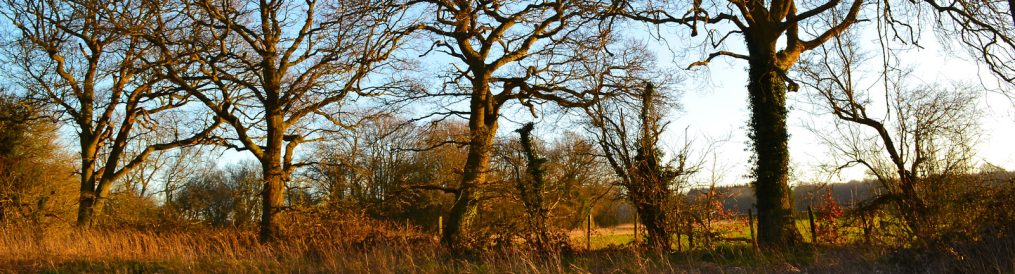
Close to the Cudham circular and Chevening walks, this magical spot (view from the gate: no entry into field) was not considered a contender until the judge happened to cycle past it on Sunday 5 May. This grassy field dotted with outstanding oaks, one of which appears damaged by lightning or storm, had never previously attracted the judge’s attention. The flowers appeared a very dense dark blue instead of rather milky blue of the previous two entrants, perhaps because of some trick of the light. There was some consideration that it should not qualify because it’s not strictly speaking on one of the walks, but this was overruled eventually, as cycle routes at KWNL also count.

Submissions from One Tree Hill, Lullingstone, Ide Hill, Hever and Oldbury were received too late to be considered unfortunately. They also breached the judge’s criteria of “not too much mud”.

I think there’s good bluebell viewing until around 13 May, but the beginnings of the end are already visible, so good luck!
See my cycle routes at Plot A Route

A Christmas trudge – then some fudge

A Christmas trudge – then some fudge

We chose Lullingstone for our Christmas morning walk. Well, I didn’t actually. It was the family choice, and a surprise one because I was, for once in my life, all for staying in and wrongly assumed my partner would be. I’m glad we did though: staying in all day and not walking anywhere is hardly ever the right choice, even with a turkey to roast and fudge to finish.

There’s no denying that in the mild, grey, mizzly, boring weather the Darent Valley landscape seemed to have lost a bit of its lustre. It felt as if we’d taken it by surprise – it’s usually ready for us and induces an inward gasp of delight as we get our first view of it. On Christmas Day it looked a bit bleak, a bit ‘meh’. It seemed to be saying, “oh it’s just them again – I can’t be bothered frankly.”

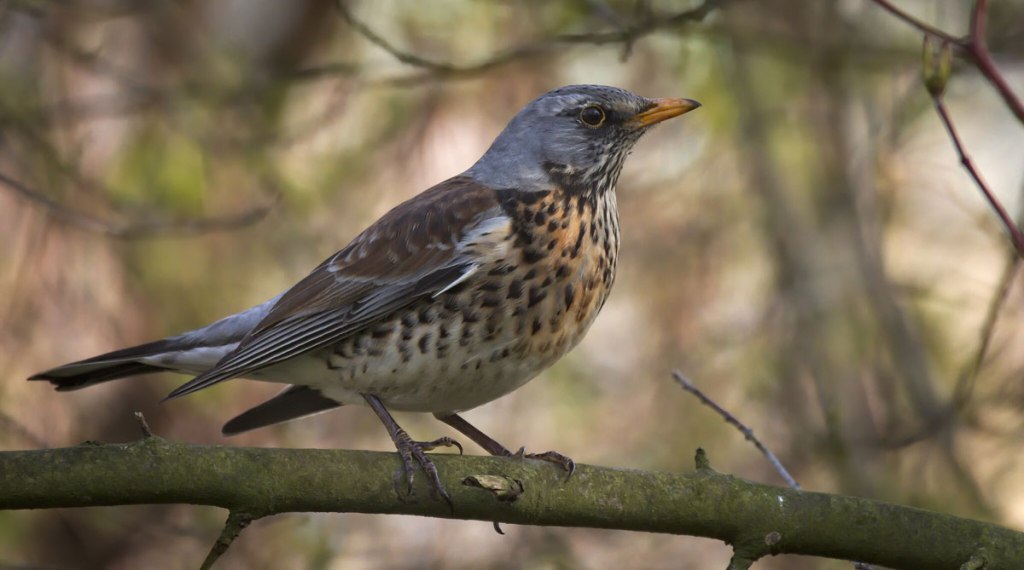
Fieldfare profusion

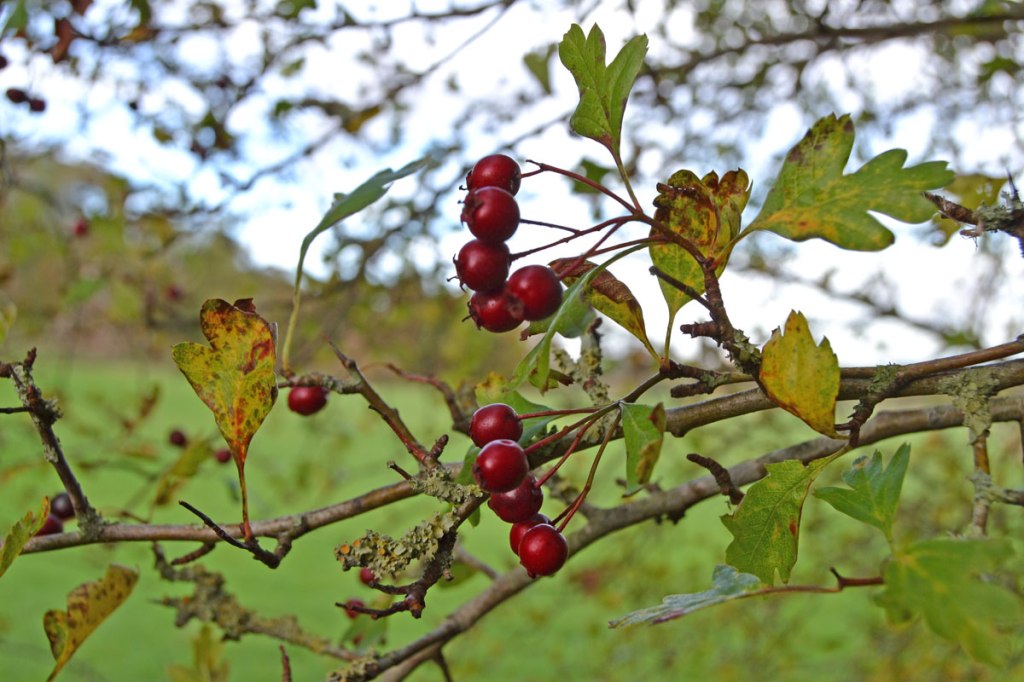
But on closer examination there was a lot to enjoy: huge groups of fieldfare (a winter thrush visitor from north-east Europe); a few chaffinch (relatively scarce nowadays in these parts) in brilliant winter plumage; loads of berries – haws, rosehips, elderberry in the main – and long-tailed tits flitting through open woodland. The profusion of berries was the attraction for the fieldfares. My regular Lullingstone kestrel did not appear, nor did the almost tame goldcrest I’ve encountered previously in Upper Beechen Wood. (Fieldfare photo: hedera.baltica/Wikimedia Commons)

Oh, that tree!

I’m often astonished at myself for not noticing things – I’ve been known to sit on sofas at home without realising they are brand new, turn on TVs that someone has just delivered and installed, and fail to remark on a room‘s entire renovation. I exaggerate, but it amazes me that I’ve walked past the extraordinary old oak at Lullingstone pictured below at least 200 times without really clocking it; a memory of it must have been lodged in my brain somewhere since childhood, but in the subliminal part. In a similar vein there’s an elegant art deco building opposite Brixton station that’s very familiar to me but it was only last week, on returning from the Ritzy, that I actually looked at it and saw it for what it was. I’ll never ignore it again, and the same goes for this incredible oak.

To be fair, there are several of these oaks at Lullingstone, mostly up towards the golf clubhouse in the west of the park (unlike this one). With some I’m not quite sure if they’re dead or alive. There’s one that you could actually hide inside. This one, which is maybe 300 years old, has a kind of elephant’s face embedded, is indicated on the map below. I’m going to try to keep eyes and brain a bit more joined up from now on. Probably means less daydreaming – let’s see!

Click on the link for a ‘live’, gpx version of this 4-mile Lullingstone route at OS Maps.

Hosed down after Hosey

Hosed down after Hosey

A beautiful dusk walk around Chartwell and Mariners Hill on the Hosey route, accompanied by a stunning full moon and the mew of a buzzard, hit the spot last Sunday afternoon. It’s not always the early bird that catches the worm, you know. The mud just before point 8, the ‘dramatic’ crossing of the infant River Darent, is hilariously sloshy and treacherous enough to defeat any footwear bar stilts fitted with spikes but can be avoided by walking parallel in the grassy field alongside and rejoining just before the log bridge. A satisfying hose down of boots after returning home was called for.

Trains, buses, walks around Keston and Whitstable

Trains, buses, walks around Keston and Whitstable

I’m trying to add more train/bus walks to the KWNL site; the traffic in SE London is a factor, as is the need to reduce car use and pollution. Then there’s the fact that lots of keen strollers don’t have cars anyway. I’ve got two new routes up my sleeve using public transport to access, but I haven’t quite got them finalised yet. One is Herne Bay to Whitstable (5 miles) which hardly needs a map… you just follow the coast path. Both stations are on the Ramsgate line from Bromley South. It’s quite expensive (£26 return) of course being a British train but definitely worth it. But I want to see if I can continue the walk to Faversham (doubling the length), which is also on the same line, using decent paths. I know you can but I haven’t done it yet. Also it means stretching the ‘Near London’ remit of this website somewhat, though the fastish train makes the trip fairly short in relation to distance and you arrive without feeling worn out by having to drive.

Closer to home would be a walk from Hayes station, the terminus of the London Bridge line via Catford Bridge, to Keston Ponds and then Downe (about 6 miles). From Hayes station you traverse Hayes Common, an attractive area of woods and heath to reach Keston. Behind the village is another woods from where you reach Keston Ponds. Looking at the OS map there is a ribbon of ponds from Keston and Hayes to Bromley Common. These are fed by springs and the Ravensbourne river, which rises at Keston Common.

Keston Common heathland

Beyond the two main ponds is an important area of heath then, after crossing the A233 you head through woodland to the Wilberforce Oak, where in May 1787 William Wilberforce talked with prime minister William Pitt the Younger (who lived at adjacent Holwood House, the Chequers of its time), about abolishing the slave trade. The spot is marked with a stone bench plonked there in 1862 and now behind the Holwood perimeter fence and a sign. There’s a dead oak still standing but that isn’t the Wilberforce oak. There are also bits of old oak lying about… maybe some of that is from the original. But there’s a nice healthy young oak anyway, planted about 30 years ago. There are also echoes of Roman and prehistoric settlements around this spot.

From here it’s pretty easy to walk all the way to Downe; cross the somewhat hairy Shire Lane, walk past the Holwood Farm Shop then take the footpath on the right which joins up with the Downe circular walk to bring you into the village from where you can get the 146 bus back to Hayes/Bromley South/Bromley North. One further appalling fact about the slave trade that only recently came to light: the descendants of slave owners in the UK were paid compensation for the loss of their ‘property’ from 1835 to, wait for it, 2015. Hard to believe isn’t it?

A suburban woody world

A suburban woody world

Petts Wood is brilliant for 2-3 mile walks combined with a cafe or restaurant visit to the town itself. The superb National Trust-maintained woodland has a multitude of paths, plenty of birdlife, some atmospheric heathery glades and a field with a nice view. There are little streams, a wonderful variety of trees from chestnut groves to scots pine, tulip trees, yew, holly and stout oaks, and lots of mud I’m afraid. I strongly advise travelling there by train if possible especially at the moment because the west side of town is gridlocked having been hit by petrol queues and major roadworks. It’s only a few minutes on the train out of Bromley South, on the Victoria-Orpington line; or 15 minutes from Hither Green/Lewisham on the Charing X-Sevenoaks route. The woods are a 10-minute walk to the north of the station, as is Jubilee Country Park. I’ve created a GPX map (revealing where you are on the route in real time) that ties in many of the more interesting parts of Petts Wood and its neighbour Hawkwood (see bottom of post for OS and All Trails versions).

Oh yes, by the way, there’s a major running event in the woods on Sunday October 10 so best avoid then.

Click here for Ordnance Survey GPX map to follow

Click here for All Trails GPX map with waypoints added.

Also, try this site’s Chislehurst Station to Petts Wood Station walk (3.5 miles)

Locked down but not locked in

Locked down but not locked in

Here we are again. Many of us will be looking on with horrified fascination at events in the US over the past few days thinking ‘wow, maybe it’s not so bad here in the UK after all right now’.

Well I don’t know. Things aren’t great here but they will get better in time. Reading books, learning to put the phone down, enjoying some quality drama and documentaries on TV will help, and of course checking out great music. But when it comes to getting out; it’s a little more complicated. Let’s not get too bogged describing the exact ‘rules’ right now, all readers on KWNL know to be sensible. Don’t go too far out, stick to social distancing and stay in your bubble. Some pubs are doing takeaway beverages, which might be handy. So, if you’re staying local here’s a few ideas to enjoy a jog or a walk that little bit more:

  • Really look at the trees in your street, neighbourhood and local park. Don’t take any tree for granted – there are some beauties in most streets that we just walk past without really looking and places like Beckenham Place Park (cafe still doing takeaway drinks and pictured below) have some absolutely brilliant arboreal gems. Use an app like Leaf Snap, Picture This or iNaturalist to record and identify trees. British Trees is also an excellent app which helps you identify species rather than just tell you. Remember we can only preserve beauty when we learn to appreciate beauty.
  • Learn a few common birdsongs and calls online and practise listening out for them. The best site I know is british-birdsongs.uk. It won’t make you a twitcher but it’s pretty cool to point without looking and tell your friend ‘song thrush in that oak tree’. Well, a bit cool. Maybe a bit uncool actually.
  • I’ve noticed that people are taking more interest in fungi these days and it’s the perfect time for looking out for toadstools and the like. The names are brilliant in themselves: “fly agaric” (the classic red with white spots), “lemon disco”, “stinkhorn”, “collared earthstar”, “jelly ear”, “scarlet elf cup”, etc. Snap them on your phone and try to match them to pictures online at sites like woodlandtrust.org. There are also apps, such as Picture Mushroom.
  • I don’t do this myself but maybe give some sketching a go. This article gives some good guidance I think.
  • If you have a bicycle take a trip into central London to in-between places like Bloomsbury and along the canals. It’s amazing the buildings and history you come across. And it’s such a rare opportunity to do this without much traffic. I’ve been working one day a week in central London and my route home takes me past St Paul’s Cathedral in the evening – it’s magical.

Anyway, stay safe, see you on the other side. And thanks to those who donate on this site. I’m building up to passing another bunch of not-so-filthy lucre to Kent Wildlife Trust and a local food bank.

Underriver and Budds, Sevenoaks: a scenic route

Underriver and Budds, Sevenoaks: a scenic route

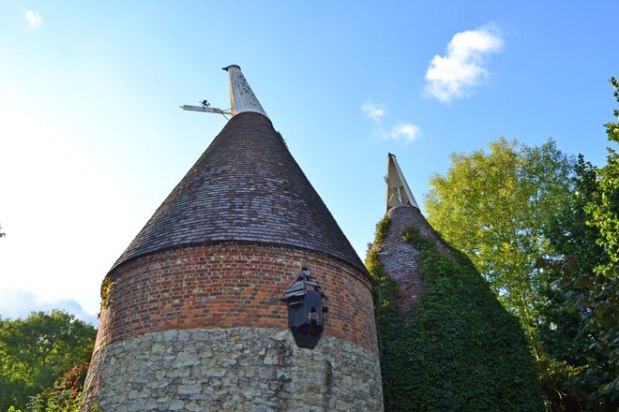
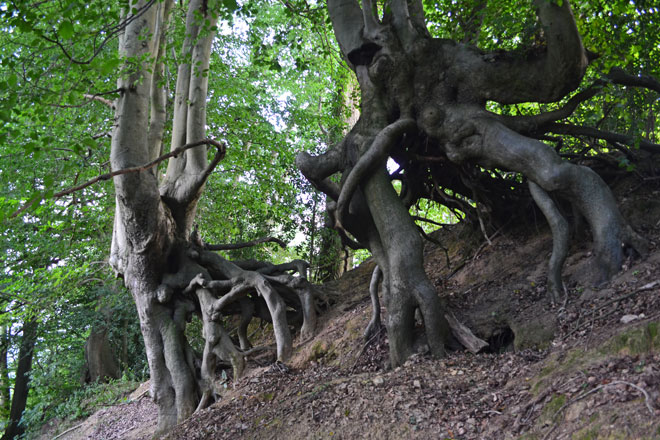
Another new route. Walk 26, Underriver and Budds, cobbles together the optional scenic extension to Walk 6 with the Wilmot to Budds path of Walk 7. It’s a brilliant walk with a superb hedgerow-lined path currently full of berries, a sunken trail with amazing trees growing out of its embankment, atmospheric oasthouses and far-flung views of the Weald. The woods at One Tree Hill are always a pleasure to walk in, especially the ‘tropical’-feeling bit east of Rooks Hill lane and there are myriad springs and little streams that trickle out of the sandstone ridge at various points – mostly around where the farms are, their positioning being no accident. It’s a two-hour round-trip hike starting and finishing at Underriver village.

For those who do these walks with younger children, I wonder if any of them find the appearance of oasthouses a bit disturbing; I certainly used to when I was small. I still find them fascinating and this walk takes you close to some of the best.

‘Walking’ beech trees on the sunken path near Underriver

The only blot on the landscape is the temporary (we hope) closure of the White Rock Inn, one of the nicest pubs on these walks.

The farms encountered have attractive old houses attached and pasture for horses, sheep and cattle, plus a few alpacas. However, around Budds, the fields are for cereals and can be quite barren depending on time of year. They lack wildlife/wildflower margins too – a slight blemish on what is a tremendous afternoon’s stroll. Check out the interractive map below and, as ever, on the walk’s page there are links to GPX (real time location) maps – including a nice short cut variation too.


Lullingstone’s wild garden is a match for its World Garden

Lullingstone’s wild garden is a match for its World Garden

I don’t publicise Lullingstone Country Park that much because it’s busy enough already and it’s easy to devise your own walk around its lush acres. The visitors’ centre car park is full to brimming by mid-morning of a sunny weekend and, just down the road, Castle Farm catches much of the overspill and is a lovely attraction in its own right with its lavender fields and local produce. And then there is the excellent World Garden at Lullingstone Castle. Throw in picnic tables, viewpoints, a cafe, the river path and there’s no mystery about its popularity.

Credit where it’s due; whoever looks after the place – I guess it’s Kent County Council – has done a wonderful job of rewilding areas of meadow and wildflower around the paths and fairways of the golf course. In spring it’s all about orchids, bugle, speedwell and cowslips but at this time of year the profusion of marjoram, thyme, fine grasses and wild carrot growing all over the place is spectacular. 

This slideshow requires JavaScript.

A walk around the park’s curvy contours and its superb ancient woodland (probably the quietest parts of the park) is a very civilised activity indeed. Those big North Downs skies are good for spotting birds of prey (I’ve seen all the major UK species here) and yellowhammers have made a comeback in the hawthorn/buckthorn thickets on the slopes. I’ve seen grass snakes here, too. Biggin Hill’s Spitfires often appear overhead on their joyriding flights … all in all it’s a real picture. Maybe visit later in the day on a fine weekend – they say the car parks are freed up a bit after 3pm. 

I think during the pandemic it’s best to avoid the river path, however. It gets a little too busy for my liking with myriad dogs confusing the issue. I’ve got two walks on here (3 and 12) that venture into the park from nearby Eynsford and Shoreham railway stations, but I’m considering adding another … perhaps starting at the public golf club entrance and taking in more of the woods. We’ll see.

Lullingstone CP’s Facebook page has all the latest news including whether or not the car park is rammed.

Sevenoaks wildlife reserve on the day of reckoning

Sevenoaks wildlife reserve on the day of reckoning

Ever been somewhere on your doorstep that you’d heard about but not hitherto bothered with, then been blown away by it? So after several decades of never going there I headed the way of Sevenoaks Wildlife Reserve, managed by Kent Wildlife Trust. I’d thought it was just a nondescript lake, a couple of bird hides and a few twitchery types in unfashionable knitwear dotted around. Instead, it was a veritable waterworld with one very large lake, four medium-sized ones, lots of bird hides, a large visitor centre, the River Darent, islands, ponds galore, reedbeds, loads of paths to explore and rich damp woodland of alder, birch and so on. I immediately saw lapwing, egret, pochard and curiously large number of long-tail tits. All in all, a more satisfying place to visit than Bough Beech, perhaps. When spring gets going it will be a real treat.

East Lake, Sevenoaks Wildlife Reserve

I shall return there; it’s a surprising place, rewilded after years of use as sand and gravel pits, and offers views of the Darent Valley from a perspective I hadn’t really seen before. There was a strange atmosphere though… the coronavirus suddenly felt as if it had got exponentially more serious on Saturday. I dropped by the local mega-Sainsbury’s on the way back; you could tell that the UK was trying to decide what kind of country it was – greedy and panicky, or stoic and rational. I think it’s still undecided.


Lullingstone – winter walking wonderland

Lullingstone – winter walking wonderland

The walks through Lullingstone country park (nos 3 and 12) take in superb chalk grassland, rewilded areas of scrub, wonderful beech woodland and long views of the Darent Valley. Walkers don’t truly need to follow the prescribed routes; you can take off in whatever direction you fancy, just don’t walk straight across a golf fairway if there are golfers visible. If you have time it’s great to wander in Beechen Wood, a site of special scientific interest, with 500-year-old oaks, hornbeams, towering beeches and ash.

The park is great for winter walks, not being quite as muddy as some of the routes on this site (One Tree Hill you have been warned) and dusk brings excellent sunset views. There’s adventure playground stuff dotted around too, if you have kids you want to bring. Buzzards and kestrels are usually seen at all times of the year and field birds such as yellowhammer, corn bunting and skylark are often spotted despite the decline in their numbers. And it’s easy to get there to on public transport: it’s just 20 minutes’ walk from Eynsford station with its trains to south-east London (Peckham Rye/Catford line). Throw in the terrific Roman Villa and Lullingstone Castle you have a great day out.

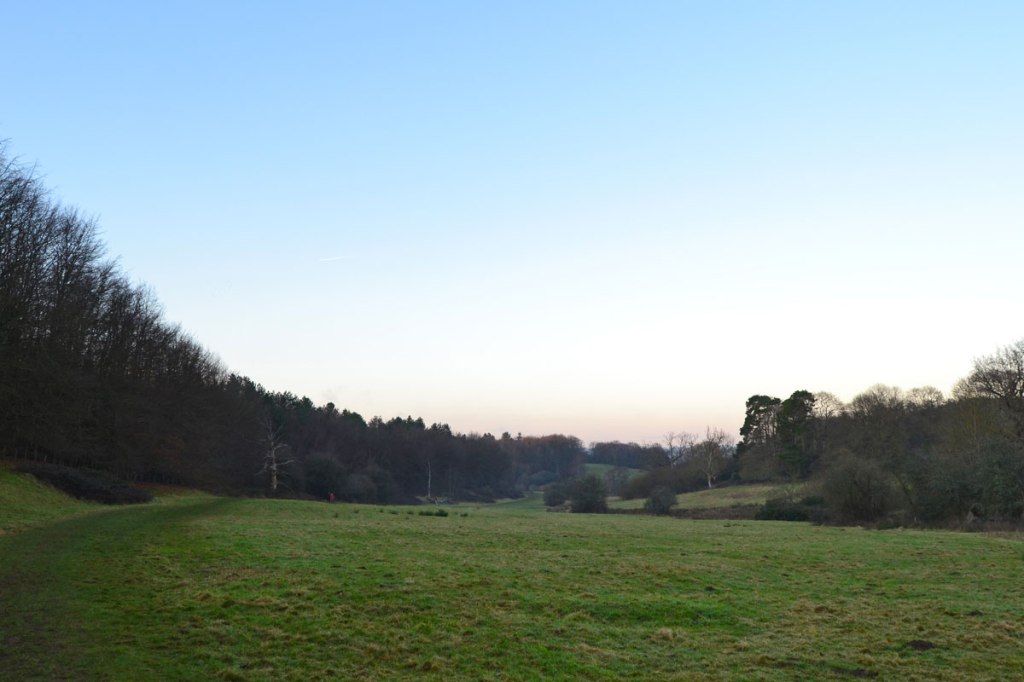
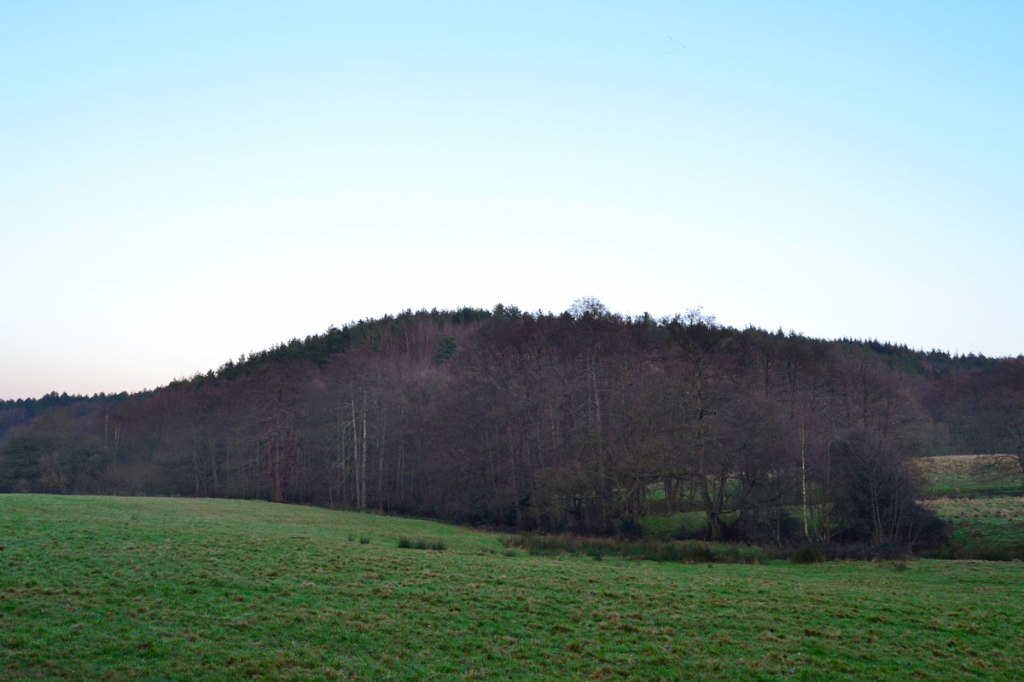
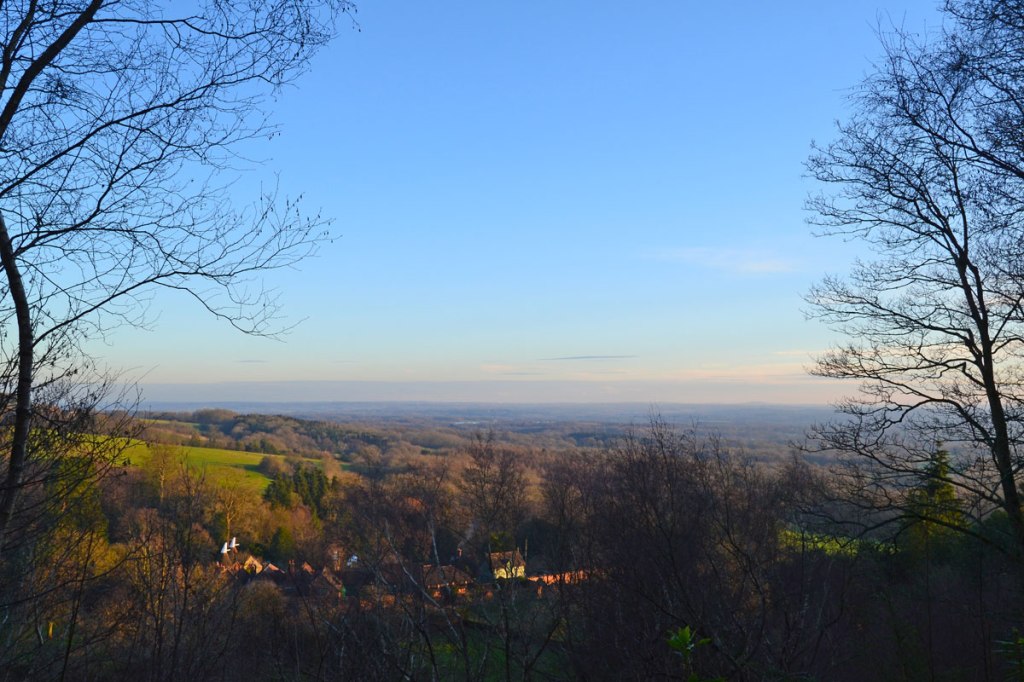
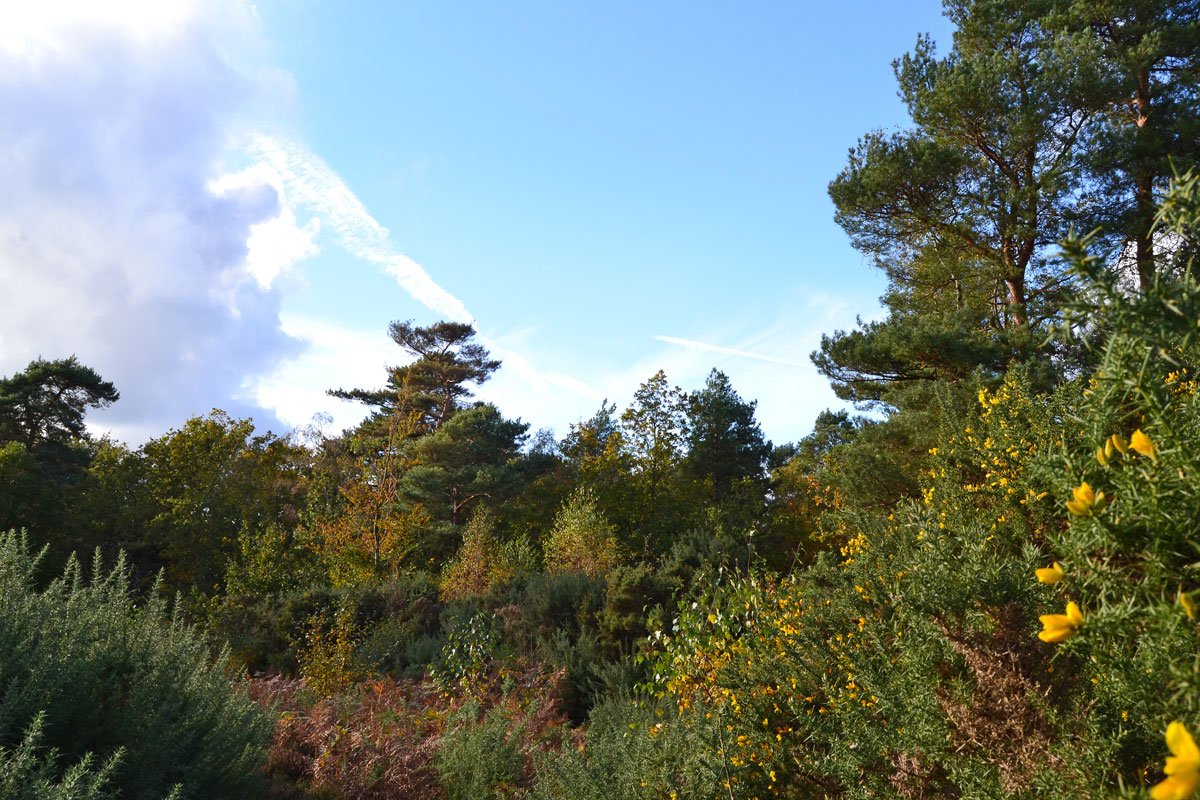
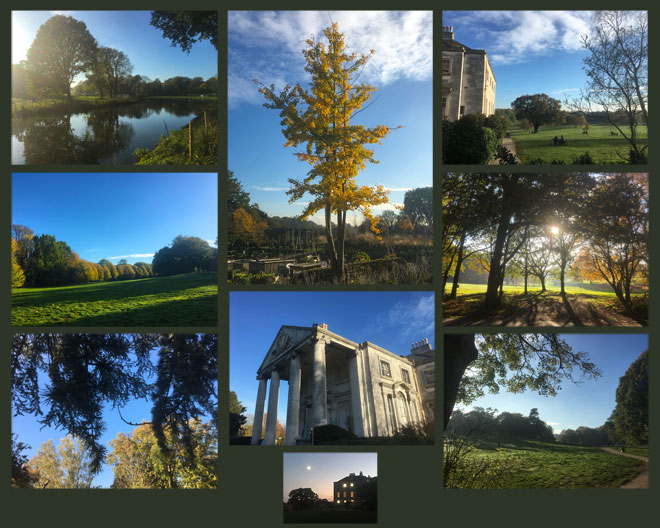
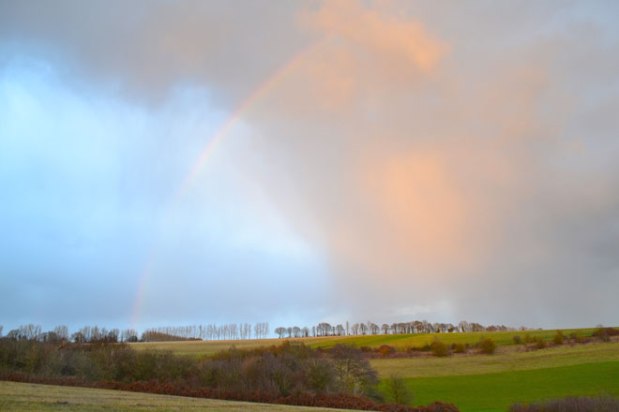
Here are some winter pix over the years, two from yesterday and a passing rain squall.

This slideshow requires JavaScript.