Lockdown loosening as spring unfurls

Lockdown loosening as spring unfurls

So from Wednesday it’s once again OK to drive into the countryside for a walk, but we are being urged to avoid using public transport to keep it safe for key workers. For the many without cars the walks will remain inaccessible but in the greater scheme of things, against the tragic current backdrop of lives and livelihoods lost, it’s not such a huge disaster. But it should be remembered that days spent out in the woods, fields and paths are hugely beneficial for mental health, I’d suggest in ways that the local park just can’t match. We also have to hope that the roads – and air – don’t become increasingly clogged as people jump in their vehicles for all purposes. Social distancing will need to be maintained, of course, and also take care around touching gates and fence posts – it would be a good idea to take wipes or hand sanitiser with you.

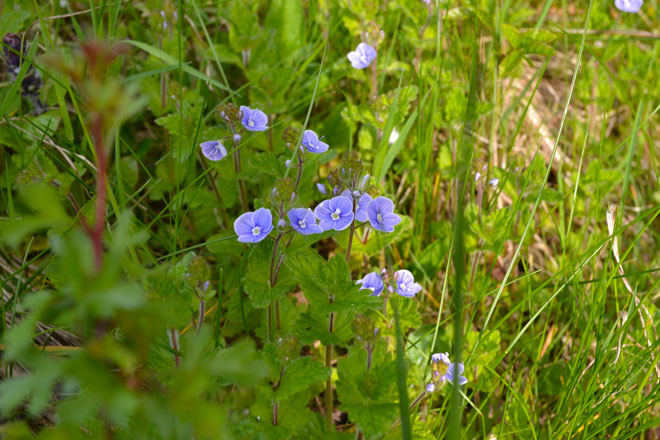
Speedwell.

Learning birdsong and wildflowers

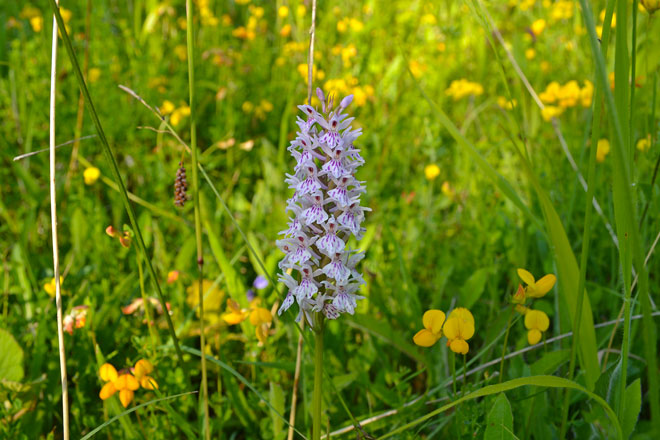
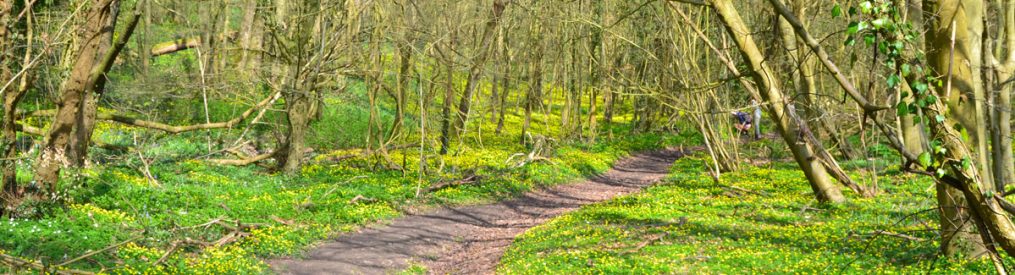
This spring’s bluebells will mostly be over but there will be plenty of other spring delights to witness. Cowslips, vetch, bugle, stitchwort, speedwell and buttercups are all flowering and soon orchids will push their way through grassy fringes and meadows along with ox-eye daisies. Warblers have arrived from Africa and are burbling, chiff-chaffing, and whistling away unseen in the woods and hedges. Precious few swallows, martins and swifts are around so far, I hear – a worry perhaps. I’m always astounded at the volume generated by tiny wrens at this time of year, so definitely worth listening out for them. A great bird to see is the spotted flycatcher. They have been seen on many walks on this site, most recently in Knole Park, not by me, but by experts. They disappear back to tropical Africa in August having only arrived this month so seeing one is a relatively big deal.

A really good website for learning birdsongs is this oneDon’t be fazed by the huge number of species to learn. Just learn the ones most relevant – for example, wood warblers aren’t present (much) in Kent woodlands but willow warblers are more numerous. Try to learn the basics – say, robin, blackbird, wren, great tit, goldfinch and chaffinch – and soon you’ll be adding others. Don’t be too frustrated if you can’t see the bird you can hear: it’s often incredibly difficult with the trees in full leaf, and many of us find it hard to exactly pinpoint where the bird song is coming from, not only in terms of direction but in terms of distance. Kent walks near London birdwatching correspondent Dave, of course, is a master of not only identifying song but working out where the sound is emanating from him – remarkable talent built on experience gleaned when a nipper no doubt.

This slideshow requires JavaScript.
Confined for now, but keep your eyes open

In my wildest dreams did I ever think when I set up this website that I’d be advising people not to take a walk. But current circumstances, like something from a disaster movie, dictate that really we shouldn’t go out into the countryside for our hiking fix. My last walk was in the Ashdown Forest (yes, I know, East Sussex… not Kent) on Sunday 22 March. And yes it was very busy with an atmosphere more of Easter holidays than a national crisis. It’s a beautiful place to be on a fine day but I kicked myself for suggesting it; there was always a high risk it’d be busy. So to reiterate the government’s advice:

  • Only go outside for food, health reasons or work (where this absolutely cannot be done from home)
  • Stay 2 metres (6ft) away from other people
  • Wash your hands as soon as you get home

People should not meet friends or family members who do not live with them. Gatherings of more than two people (excluding people who live together) will be banned.

Of course the word ‘absolutely’ is up for debate and ‘who do not live with them’ is not exactly clear either given the comings and goings of adulty ‘kids’. It’s difficult to stay two metres away in a shop too, especially when the brave shop staff decide to check your receipt. But we get the gist. The full government guidance on social distancing is here.

All our sympathy and concern must be directed at those who are elderly, frail, have underlying health conditions and mobility problems. And then there are the self-employed, from musicians, actors to carpenters and yoga instructors, who’ve seen their incomes disappear overnight and little mechanism in place to compensate them at least in the short term. Many have pointed to the plight of the homeless, those living in abusive relationships, in poor quality housing among others. These are tough times.

Garden and street birdwatching

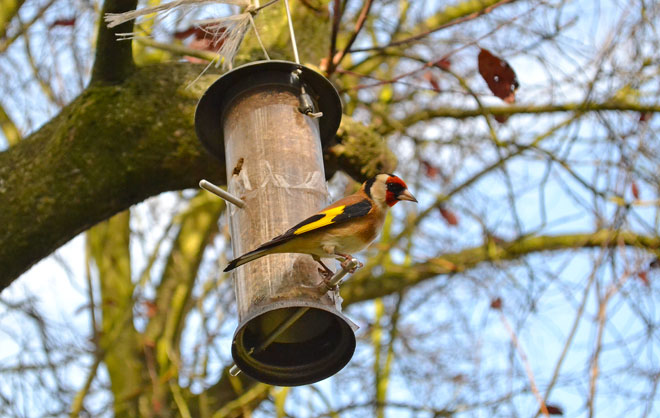
Goldfinch on my battered old seed feeder

Those of us lucky enough to have gardens might enjoy a spot of very local birdwatching: to that end, here’s my latest piece for Guardian Travel, which leans on the great experience, skill and knowledge of my friends Steve Gale and Dave, of these pages. Just prior to that I wrote a short piece on the Ightham Mote estate, also for Guardian Travel, as part of a round-up of National Trust gardens and parklands that at the time were remaining open. I guess the estate is still open seeing as it’s not fenced in but the NT has closed all its gardens now. Maybe this year the bluebells will only be enjoyed by true locals, not us more inner suburbanites.

If there’s any consolation to be had, it’s that local pollution levels have fallen markedly and we can hear birdsong now the whine of jets has disappeared. But I can’t wait for this to be over so we can all get out there (not all at once of course).

Update: Monday 6 April

In the past week I’ve written another piece for the Guardian around birds and wildlife, this time around watching webcams and using social media to deepen our understanding. An inspiration for this was the excellent Facebook (I know, I’m not a huge fan either) page and live show set up by Chris Packham and Meghan McCubbin called the Self Isolating Bird Club. In researching the piece I had a long chat with another Springwatch presenter, Michaela Strachan, who spoke to me from her house in South Africa, where she too is in lockdown. She was as delightful to talk to as you’d expect from her television appearances. The article is here.

Sevenoaks wildlife reserve on the day of reckoning

Sevenoaks wildlife reserve on the day of reckoning

Ever been somewhere on your doorstep that you’d heard about but not hitherto bothered with, then been blown away by it? So after several decades of never going there I headed the way of Sevenoaks Wildlife Reserve, managed by Kent Wildlife Trust. I’d thought it was just a nondescript lake, a couple of bird hides and a few twitchery types in unfashionable knitwear dotted around. Instead, it was a veritable waterworld with one very large lake, four medium-sized ones, lots of bird hides, a large visitor centre, the River Darent, islands, ponds galore, reedbeds, loads of paths to explore and rich damp woodland of alder, birch and so on. I immediately saw lapwing, egret, pochard and curiously large number of long-tail tits. All in all, a more satisfying place to visit than Bough Beech, perhaps. When spring gets going it will be a real treat.

East Lake, Sevenoaks Wildlife Reserve

I shall return there; it’s a surprising place, rewilded after years of use as sand and gravel pits, and offers views of the Darent Valley from a perspective I hadn’t really seen before. There was a strange atmosphere though… the coronavirus suddenly felt as if it had got exponentially more serious on Saturday. I dropped by the local mega-Sainsbury’s on the way back; you could tell that the UK was trying to decide what kind of country it was – greedy and panicky, or stoic and rational. I think it’s still undecided.


Sunshine and showers

Sunshine and showers

After the watery dip into the Ashdown Forest in midweek it was back to terra-not-so firma today with a squelchy trip to Lullingstone. Up the steps we went, past the Roman Villa to vast flint and chalk fields where several buzzards glided. It’s strange how wild birds of prey congregate near Eagle Heights; I guess they just want to peep at their captive exotic cousins. Storm clouds were fragmenting to the east having a deposited another ocean on our blighted county.

The river was extremely high and the water meadows living up to their billing with Eynsford’s small herd of highland cattle looking a bit hacked off as they nuzzled soggy hay bales and pondered their liquid domain.

On the way home we popped in on Eynsford Castle, basically a bunch of Norman ruins. The place was built within 20 years of the Battle of Hastings on the site of a Saxon tower by William de Eynsford I (for it is he) but was vandalised and left derelict 300 years later after an ownership dispute. Such a shame, it enjoyed a beautiful setting close to the river and would have contributed significantly to English Heritage or the National Trust if it had been maintained. Such a lack of foresight some of these medieval people.

This slideshow requires JavaScript.


A late winter walk in the Ashdown Forest

A late winter walk in the Ashdown Forest

A rare day off afforded me (us, actually) to venture somewhere during an afternoon when it didn’t rain continuously. We settled on the Ashdown Forest, an hour’s drive from my corner of south-east London, in East Sussex between Tunbridge Wells and East Grinstead. A perusal of the visitor centre’s maps online led us to choose Walk 11, Chelwood Gate, in the south-west of the Forest.

The area has got the lot: interesting geology, flora and fauna, views, history and literature, being the landscape for Winnie the Pooh’s capers with many recognisable spots. These include Eeyore’s Gloomy Place, Galleons Lap, the Heffalump trap, for example, all of which can be identified.

The walk was beautifully laid out in printable format, with lots of informative text. But it was very difficult to follow; a “narrow path” beside a ditch was actually a wide path that went through a huge puddle – that sort of thing, but we made it around thanks to careful map analysis. In fact, with a compass, a sense of direction and an Ordnance Survey sheet you can pretty much make it up as you go; there are many paths to choose from and the Forest’s inner Pale is open for exploration in a similar way to Knole Park, for example.

What was immediately apparent was just how much rain has fallen this winter; everywhere there were overflowing ponds, gushing streams, seas of mud. You’d think it was Scotland at times. But in fact the Forest, being easily the highest point of the Weald between the North and South Downs does attract far more rainfall than the lower surrounding areas and really does pep up the local rivers, eventually flowing into the Eden and Medway. The high heath and the Pale melds into wooded valley mires where the pines give way to alder and birch, and planks serve as bridges over vigorous streams, alongside some very old looking stone bridges.

This slideshow requires JavaScript.
 

I love how the Forest has its own vocabulary: there are ghylls, hatches, laps … And the names of the car parks are evocative too: Friends, King’s Standing, Roman Road, Goat, and of course Piglets and Pooh.

After we finished with Chelwood Gate (where medieval hero John of Gaunt used to enter for hunting and a home to Howard Macmillan, who once entertained JFK here) we drove a few miles east past Nutley and up onto the highest part of the Forest, to Gills Lap (Galleons Lap in Winnie the Pooh). Up there the views extend over bright yellow gorse for mile after mile in all directions. We walked down to the memorial to AA Milne and EH Shepherd. I felt quite moved, those stories have a real character and a sense of an innocent time that has been lost.

Our final port of call was the 15th-century Anchor Inn in the small village of Hartfield, a cosy labyrinth of a pub that serves two of the finest ales in all England: Harvey’s and Larkins. As we arrived at dusk a barn owl glided across the road in front of us. Then it was back to the smoke to plonk in front of the telly to watch Chelsea beat Liverpool … who would have credited that?

Getting there on public transport: Train to East Grinstead from East Croydon then the 261 or 270 bus seems to be the best option. At East Grinstead the brilliant Bluebell Railway takes day trippers by steam train down to Sheffield Park, south of the Forest. At the moment a landslip caused by rain means trains can’t reach East Grinstead, but there is a bus service from Lingfield. Boring though… so best wait ’til services are restored, hopefully in spring.
Getting there by car: Drive via Keston, Biggin Hill, Westerham, Edenbridge, Cowden and Hartfield on the rather pleasant B2026.

Tale of two orbs: a quiet evening awaiting Ciara

Tale of two orbs: a quiet evening awaiting Ciara

Saturday was a pleasant winter’s day so we ventured once again to the eastern Darent Valley watching the sunset and hoping for an early evening owl. We were rewarded instead by wonderful and close views of three juvenile buzzards hanging motionless above Fackenden Down calling to each other plaintively.

I haven’t got the lenses to capture wildlife unless it’s less than two feet away. My lack of super-duper equipment was also brought home to me by the rise of a huge moon behind Dunstall Farm; my camera could only represent it as a small white disc. Still there’s a bit of atmosphere in the shot, seen below. For starters, I love the pines that surround the secluded farmhouse, an attractive and venerable building with a hint of Normandy about it.

Today of course (Sunday, 9 February) I imagine nobody in their right mind went walking what with Ciara wreaking havoc across the land. (There is a shorter version of the Fackenden Down walk that’s quite handy for short winter days here – you can start it at Shoreham Station and walk up the track almost opposite to join the walk or park at the layby in Rowdown Lane as marked. It’s 2.6 miles but good exercise because quite up and down.)


This slideshow requires JavaScript.
Sunset from above the Darent Valley in the North Downs

Sunset from above the Darent Valley in the North Downs

I’ve felt watching sunsets was a bit of a cliche ever since visiting a club on the Greek island of Ios 30 years ago.

Scorpions, as the place was called I think, offered the chance to be spellbound as our golden orb sank below the Aegean – accompanied by a tequila cocktail costing 100 drachma (40p). For some reason the occasion made no impression on me whatsoever and I found the applause of the assembled horde hilarious in my then youthful arrogance.

However, I did see a terrific sunset rather more recently in Cornwall when the sun seemed to dissolve on contact with the surface of the sea coating it with a blazing trail … most peculiar. Perhaps it’s an age thing – one is drawn to sunsets on realising there aren’t all that many left.

Anyway, we were atop Fackenden Down doing a truncated version of the walk on these pages on Sunday (a clear day for once) at about 4pm when sunset happened. It was quite fun and there were a few people around to see it (actually seeing the sun at all is pretty rare these days after all). I took some frankly quite boring photos of it which I will now share as well as some hopefully atmospheric woodland shots (one with staring sheep) in the gathering winter dusk.

This slideshow requires JavaScript.


Winter dusk in the Kent downs

Winter dusk in the Kent downs

I followed my own advice and stuck to Knole and Lullingstone over the Christmas break, with the family. Christmas Day was a real beaut as were the past two days. When it’s clear, it’s fine to walk until 5pm, after sunset; you’ll be rewarded with vibrant sky colours, maybe drifting mist and even the silent flight of an owl. The next few days look fairly dull but the walks on here have great atmosphere in all conditions. Here are some pictures of Knole and Lullingstone from the past few days.

This slideshow requires JavaScript.
A pleasant walk at Clare, south-west Suffolk

A pleasant walk at Clare, south-west Suffolk

The Guardian Travel website and newspaper recently asked me to contribute to its ’10 of the best winter walks’ article, which was published on Saturday. I duly obliged but since Kent was already covered decided to head north to the Essex/Suffolk border, and a seven-mile circular walk between Clare and Cavendish taking in part of the River Stour long distance footpath. Both villages are lovely and the countryside quietly alluring. You can read my description here. Clare is two hours’ drive from south east London; sadly there is no train option, thanks to Beeching. There are other great walks in the area too, at this excellent website put together by local rambing enthusiast Derek.

This slideshow requires JavaScript.
 

Christmas and New Year’s walk choices

Christmas and New Year’s walk choices

Family walks are a fab tradition at this time of year. They often entail waiting for Grandpa to catch up and the kids to finish in the playground, dogs rolling in something unmentionable, and departing so late (because everyone’s trying to find suitable footwear) you arrive at the walk in time for dusk. No, of course, they are much more fun than that. But given all the rain and resultant mud it would be best not to go out in your festive season finery this week. A flask with some hot chocolate and perhaps a wee dram aren’t a bad idea either.

These are the walks I reckon are best for families this Christmas. My choice has been limited by all the rain – I’d love to recommend the Fackenden Down and One Tree Hill routes but the footpaths on the thin chalky soil of Fackenden could be treacherous and easily damaged, and One Tree Hill is a winter a mudbath for reasons not entirely clear to me. Anyway those walks have more strenuous sections not entirely appropriate or the ‘whole’ family. So my top five are:

1 Shoreham Circular (good pubs in Shoreham, not too muddy, one steep hill)
2 Lullingstone (visitors’ centre cafe, pubs in Eynsford, not too muddy; also can park at golf club or visitors’ centre for DIY walks – my route is just one of many variations)
3 Knole Park (best for lack of mud, cafe closed Christmas Day, shuttle available from Sevenoaks station Sunday 29th and 5th Jan) 
4 Downe short and long (a bit muddy in places but relatively good, one steepish hill stretch on the long version, two pubs in Downe) 
5 Otford and Shoreham (pubs in Otford and Shoreham; easy to make a good train walk with stations in both villages).

Another recommendation if you don’t want to travel out so far is Beckenham Place Park with its lovely new cafe, playgrounds, woodland, lake and gardens; it’s easy on the train too with three stations (Beckenham Junction, Beckenham Hill and Ravensbourne) on the doorstep. A little further out is Petts Wood (a bit muddier but beautiful woods), also easy by train (my route starts at Chislehurst station and finishes at Petts Wood station.

Of course it won’t be snowing but the picture above shows Knole in Sevenoaks on a particularly atmospheric winter’s day.