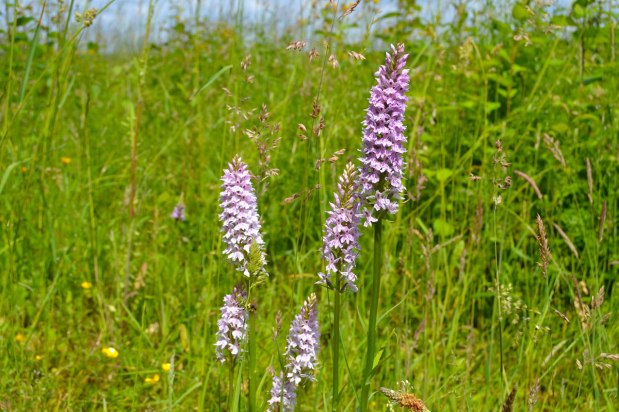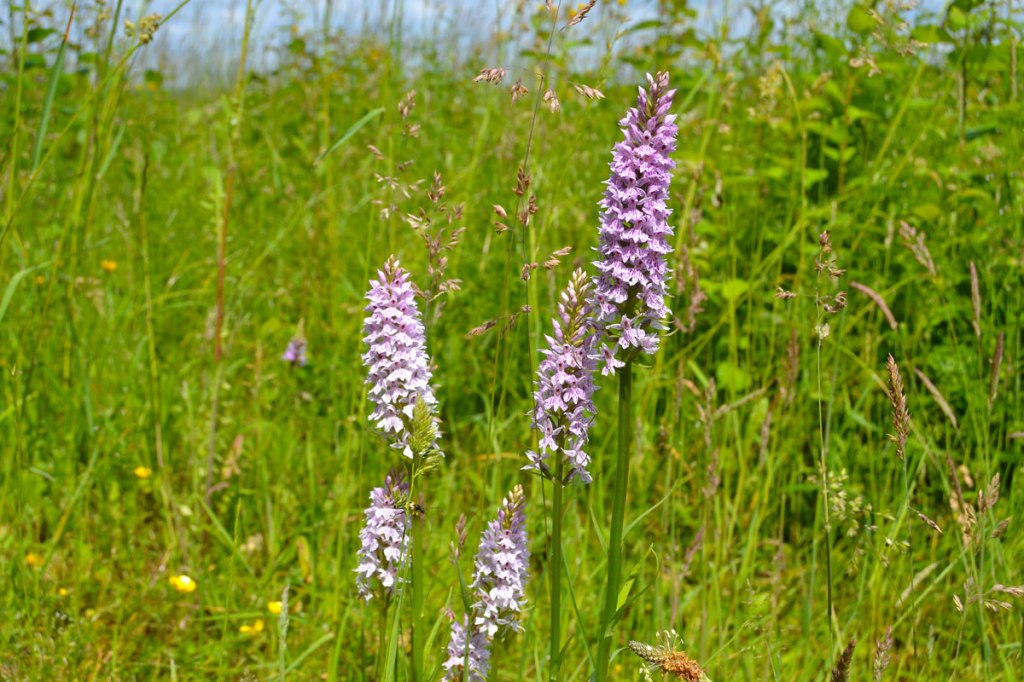
Orchids are in full flower across almost all the Kent Walks Near London. They particularly like the chalky North Downs routes, such as Heaverham, Chevening, Fackenden Down, Polhill, Lullingstone, Eastern Valleys etc (see list of walks above) but I’ve found great clusters at Hever and meadow fringes at Oldbury too, on the sandstone/clay of the weald and Holmesdale Vale. We unexpectedly came across the pictured common spotted orchids (the UK’s most often seen variety) on the Oldbury walk this week. This is one of the routes I’ve walked the least often; in fact I can count the times I’ve hiked the long and short versions on the fingers of one hand. I don’t know why, they are both brilliant strolls. The shorter version is mainly through woods and is one of the quietest walks on this website (apart from the bit near the A25). It takes in an enormous Iron Age fort, meadows facing the North Downs escarpment and a sandy trail past beautiful old fish ponds in rich woodland. I really recommend it – it’s got a special atmosphere, some might say even a bit spooky.
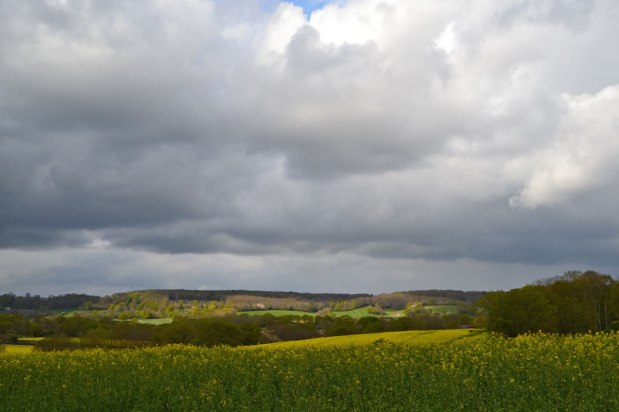
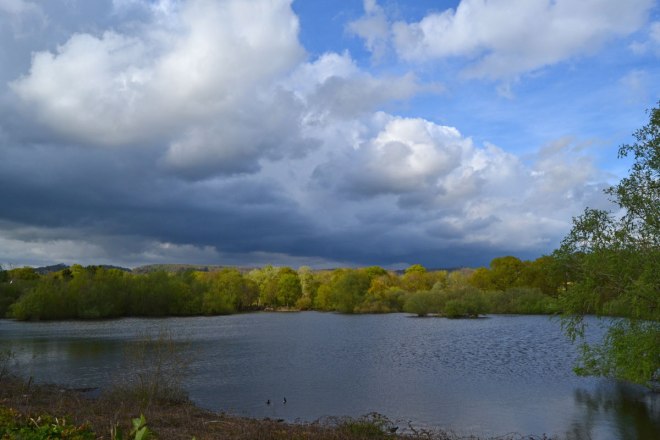
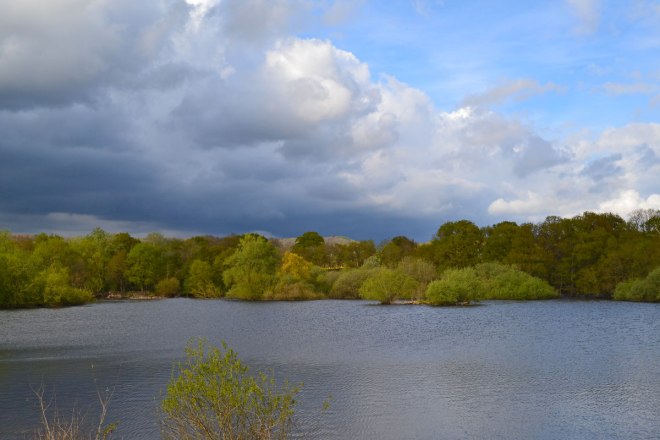
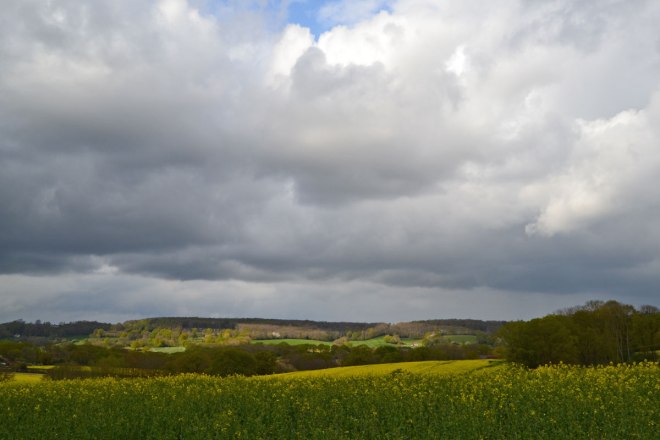
The little Bough Beech walk is one of those quiet ones: it doesn’t seem much but it creeps up on you and you realise you miss it if you haven’t done it for a while. The vast lake (described here) is a major spectacle at the beginning and end of the walk but doesn’t define the route; Bore Place, a delightfully hidden organic teaching farm and event venue, does. The walk is only two and a half miles (handy if you have a bad foot, as I do) to which you can add an hour‘s pop-in at the lovely nature reserve at the end, where there’s usually news of an interesting oiseaux or two keeping the friendly birders in the hide on their toes. Cuckoos (the star of this particular day), barn owls, kingfishers, migrating osprey are regularly seen here. On my recent walk here, as the fine pre-Easter weather started to break, interesting cloudscapes and shafts of sun reflected from the lake surface, while to the north the Greensand Ridge at Ide Hill and Goathurst Common were swept by very localised squalls. I was struck by how beautiful bluebells are when among cuckoo flowers; that was about as profound a thought I could muster while walking – which is how it should be. Back at home it was amazing to watch the simply incredible US Masters finale, though the football results did not bring me any comparable joy.
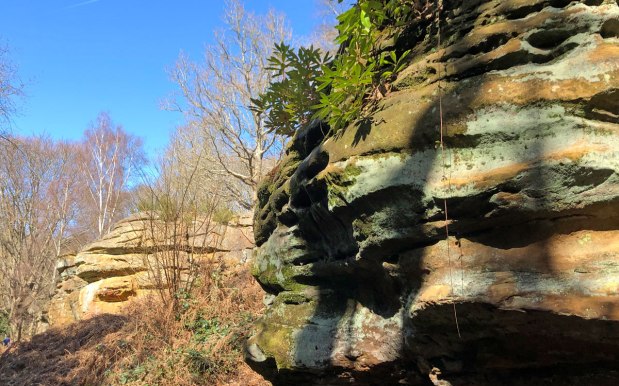
The sandstone outcrops in and around Tunbridge Wells on the Kent High Weald are little remarked on yet are the most climbed rock formations in the country, given their proximity to London. A great walk can be done from Tunbridge Wells station out past Wellington Rocks on the common, through Happy Valley as far as High Rocks, taking in all of these wonderful, alien-looking formations that appear strangely out of place within the smooth contours of south-east England. Perhaps come back via Rusthall Common, and its Toad Rock. A bit further away, at Groombridge are Harrison’s Rocks, perhaps the most striking of all and easily reached from Tunbridge Wells by taking the Spa Valley railway.
The sandstone here is Ardingly sandstone – a different type of rock to the greensand (glaucite) further north on the ridge south of Sevenoaks (see Ide Hill, Underriver, Oldbury and One Tree Hill walks). There are also outcrops, though much smaller, on the Hever and Chiddingstone walks. Our walk last week, in delightful weather (sadly not available this weekend) took in the Cheesewring rocks south of Rusthall Common.
The origins of these rocks, which gained their characteristic cracks during the ice ages, lie in sediment of the Wealden Lake. This covered much of what is now SE England and northern France 145 million years ago. I’ll add a walk at some point to cover these superb spots.
Meanwhile, grey clouds returned this Sunday but it was great to see the fantastic magnolias in full bloom in Scords Wood, as it melds into Emmetts Garden on the Ide Hill walk. The distant fields and even Bough Beech reservoir appeared white in the odd light. I’ve never seen that effect before. It was unsettling. But still, a lovely walk.
(Photographs: Cheeswringer, Tunbridge Wells; magnolia at Emmetts Garden. Adam McCulloch, iphone images so not the best!)
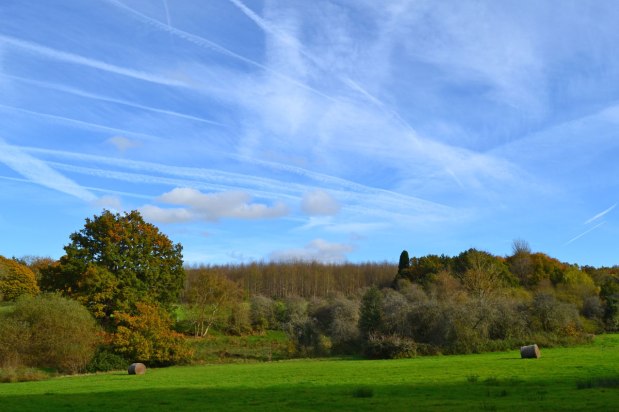
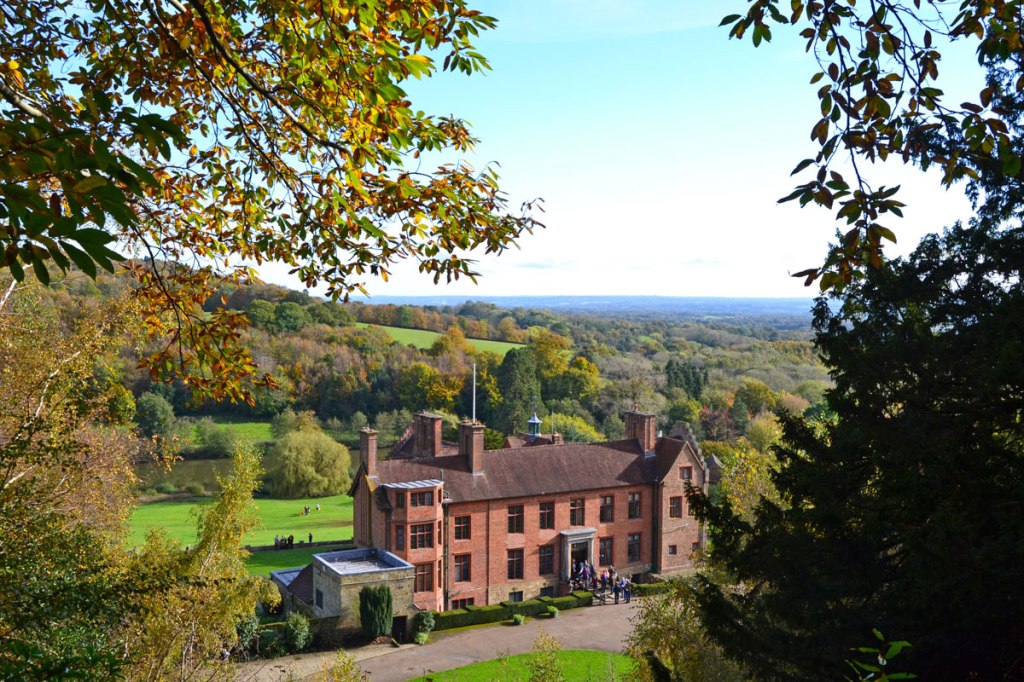
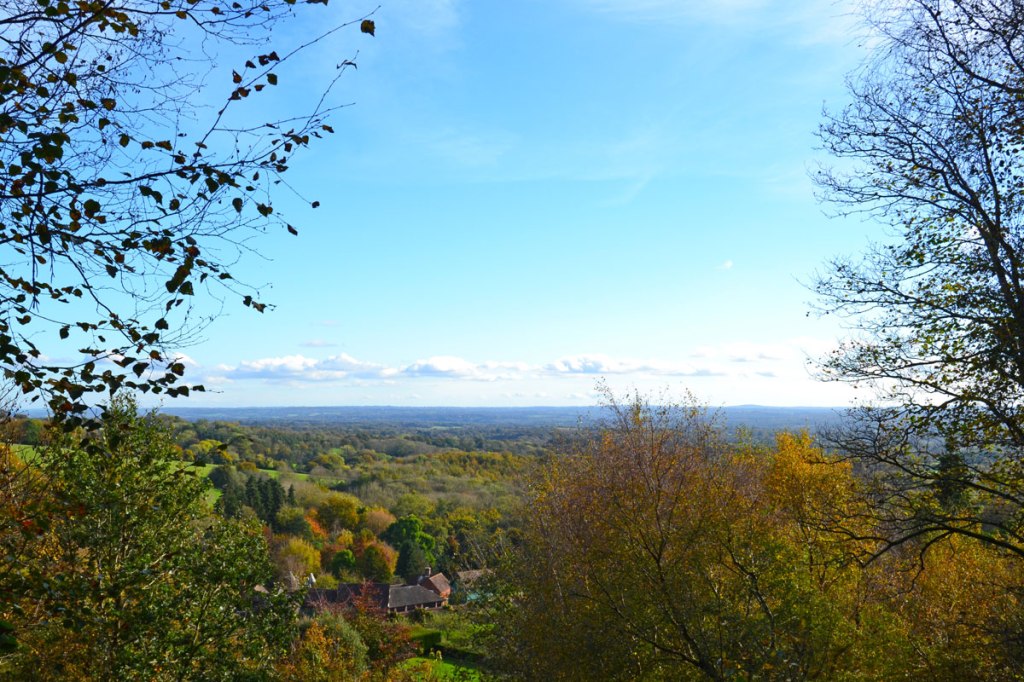
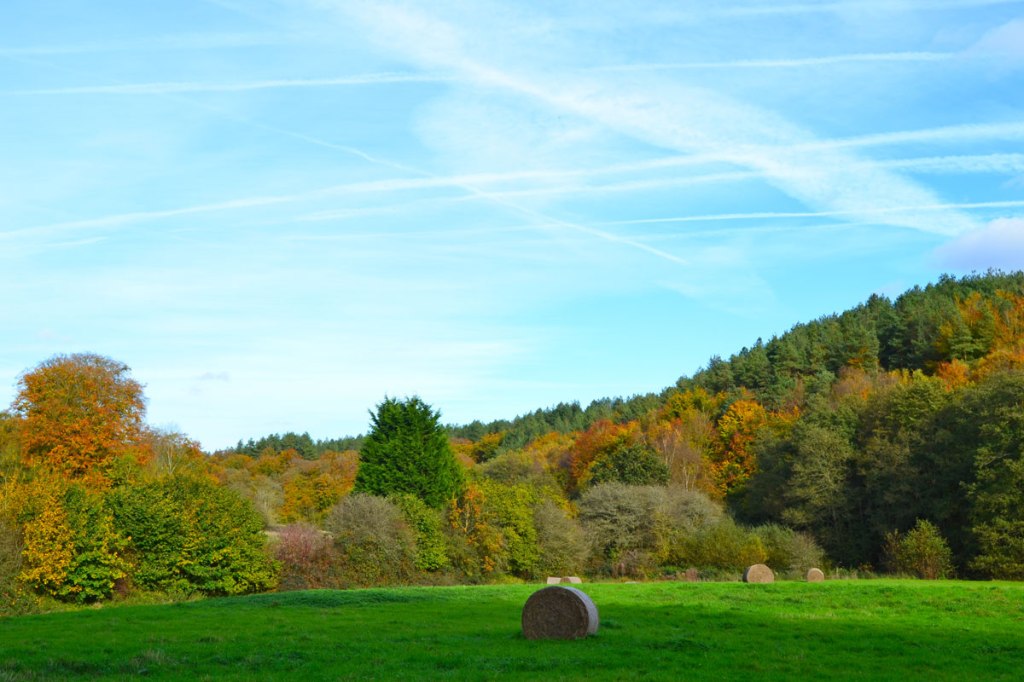
An El Classico of an autumn day. And about time too. We decided that the Hosey walk on the Greensand ridge route at Westerham was the one for us, given the foliage, and views of the Weald from Mariner’s Hill. This time last year the Heaverham circular walk at Kemsing provided something very similar but the warmth of that late October 2023 day seemed freakish at the time. Today was more normal, just a lovely day – neither warm nor cool. The leaf colours, especially in the little valley of the infant River Darent, were superb as hopefully the photos below show, and the vista across the roof of Churchill’s Chartwell gaff as magnificent as ever. I was expecting to see redwings recently arrived from the Netherlands and generally more birds flocking together. But nothing much happened on that front, although mistle thrush were heard and a large buzzard lifted off close to us in one meadow. A pint at the Westerham Brewery place on the way back was an outstanding finale. However, the effect wore off as my football team lost.
“When spring came, even the false spring, there were no problems except where to be happiest. The only thing that could spoil a day was people and if you could keep from making engagements, each day had no limits.”
That’s a fun quote from Hemingway. I take it to mean prioritise walks above socialising, now it’s a bit warmer (I reserve the right to be wrong about that) and to get out in the woods and downs, witness the transformation from grey and brown to green, blue and yellow. I say “witness” but it happens suddenly, overnight perhaps, when you’re not looking. Suddenly the air is soft, the countryside hues have changed and spirits have lifted.
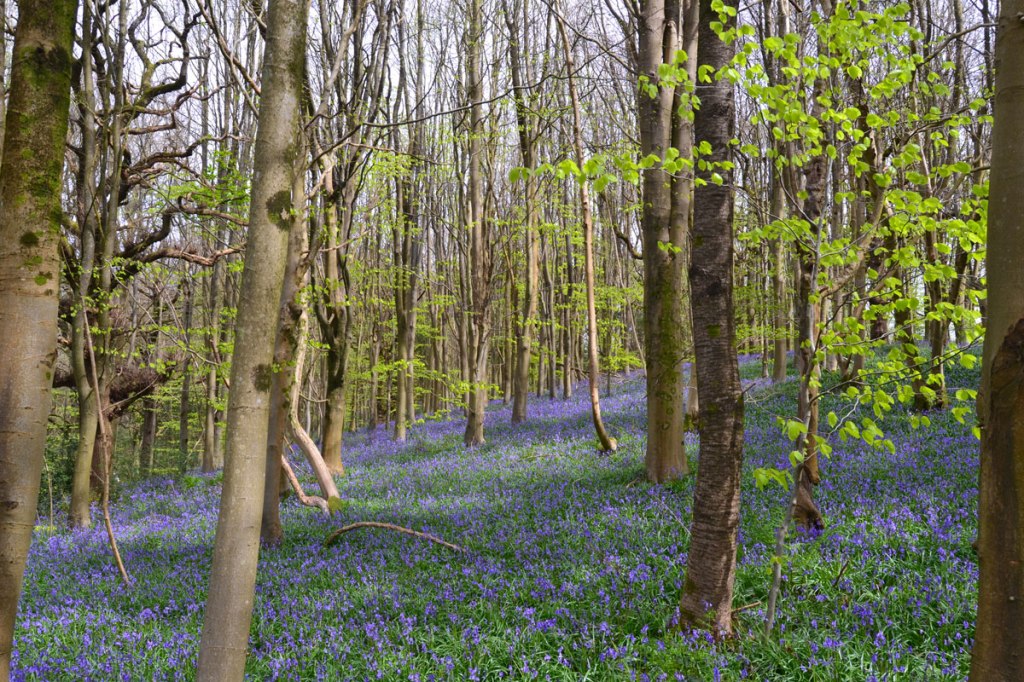
We chose the 3.5-mile Knockholt/Chevening North Downs route for late Saturday afternoon and a 4.5-mile stroll on the Greensand Ridge at Hosey for the following morning. On the Hosey route bluebells were two-thirds in bloom and were mixed beautifully with stitchwort and anemone. We heard coal tit, nuthatch, song thrush, chaffinch joining in the merry burble of song from great and blue tits, robins and wrens. A delightful pint of Westerham Brewery’s Light Ale ensued after the walk at Squerry’s Winery.
At Knockholt, along the escarpment, three red kites drifted overhead throughout the walk and a pair of buzzards hung in the air. These raptors love the updraft along the ridge and I think this walk is the most reliable route for seeing them on of all the walks here, though they can pop up on any. Please don’t think me callous but I rather hope the birds of prey feast on pheasants; there are too many of the latter human-introduced birds in these parts and they kill a large number of reptiles and amphibians.
Redwood tree above Chartwell, at Mariner’s Hill on the Hosey/Westerham route
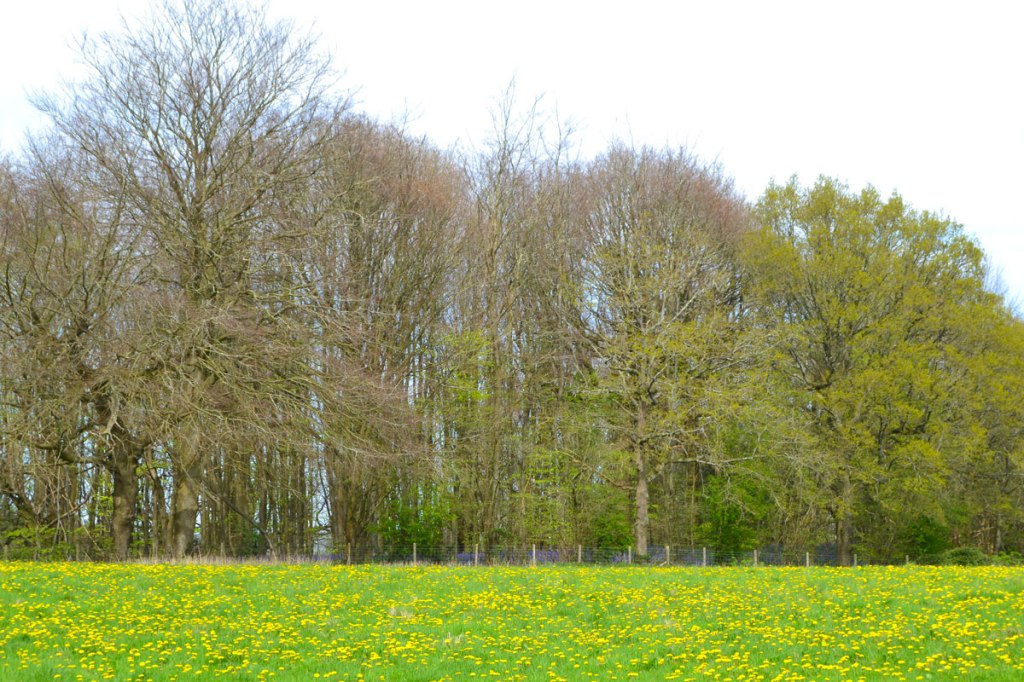
Dandelions on Mariner’s Hill, mid-April.
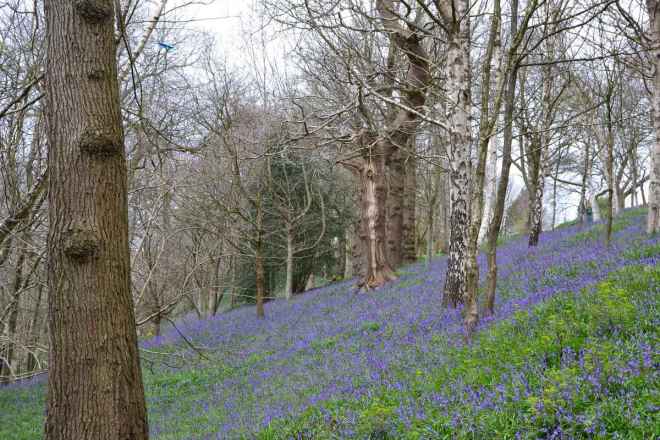
Bluebells on Mariner’s Hill on the Hosey/Westerham walk
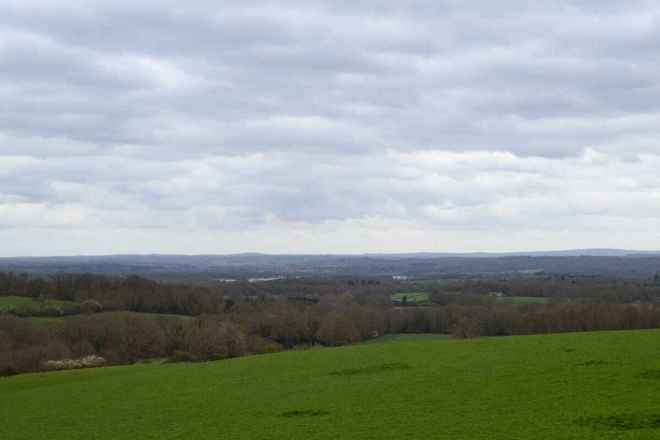
A view of Chevening House and the Vale of Holmesdale from the chalk escarpment near Knockholt Pound. The Hosey and Westerham walks are the Greensand Ridge in the distance
The cleft in the Downs on the Knockholt/Chevening shorter version
Marsh marigold by the infant Darent river, on the Hosey/Westerham routes
The chalk Knockholt/Chevening walk on the North Downs ridge is separated from the Hosey walk on the Greensand Ridge by the clay Vale of Holmesdale, an east to west valley that runs in parallel to the two lines of hills and which contains the M25 and M20 motorways. Holmesdale clay runs between the chalk and sandstone yet despite the starkly different geology in such a small distance the plants and tree species don’t superficially appear to differ that much – presumably the plants have adjusted to the contrasting soils over the millennia. But there are some differences – there are more likely to be orchids and expanses of grassland on the less densely wooded chalk hills; while on the greensand the woods seem a tad more extensive and are more likely to include stands of pine, which like the sandier soils. I’m no expert so I won’t go on. Bluebells like both; that’s the main thing and this week they are reaching their peak at sites like Meenfield Wood, Scords Wood, and Mariners Hill. Enjoy them, they’ll be gone within about four weeks.
Spirits have fallen almost as steadily as the rain as we slipped mildly and humidly from winter to spring . The Met Office have gloomily talked of precipitation records being broken, and a sense of oppressive drudgery has undeniably taken root as indoor life seems the only option. Still, I’ve been impressed by the amount of runners and cyclists still out in the lengthy downpours, clocking up the miles. Me, I’m a fair weather fitness fan. A lot of the rain has been too heavy for walks; I’m happy in drizzle but the stuff that stings your face definitely takes the pleasure away at this time of year, though can be fun in summer. But hey, spring is around the corner somewhere, the temperatures are mild, the crocuses are out in the park and the daffodils gaily wave in the breeze. I love to walk on the Greensand Ridge at this time of year, to see signs of spring seeping into the colours of the miles of countryside stretching before you as far as the Ashdown Forest. It’s muddy, sure, but there’s also optimism in the snowdrops, primroses and sudden uptick in birdlife among the skeletal trees. Toy’s Hill south of Westerham has been fertile ground for walking.
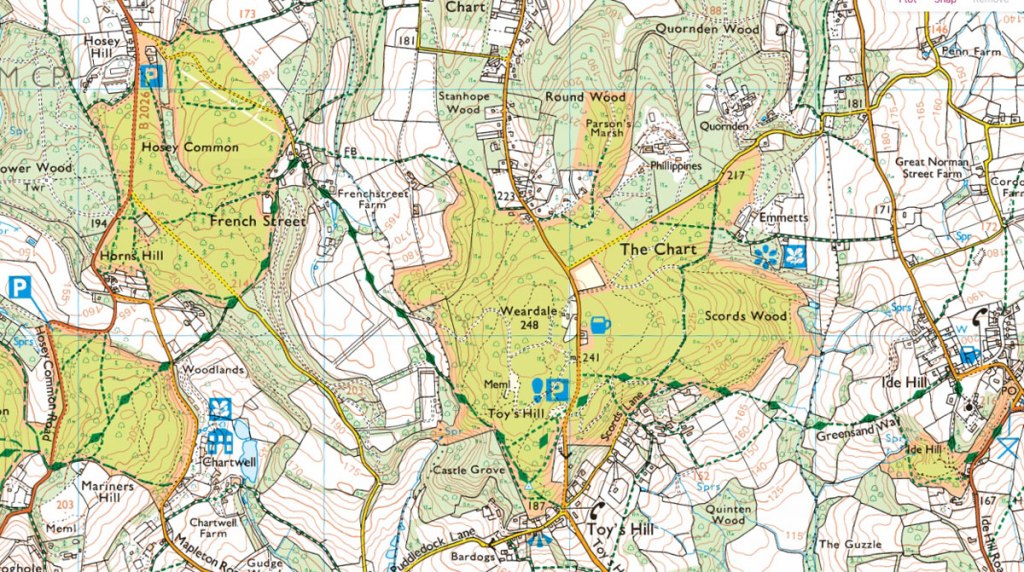
I haven’t got a Toy’s Hill walk on KWNL but there are several routes from the NT car park (the map above shows the car park, lower centre, and Toy’s Hill’s proximity to Hosey, Chartwell and Ide Hill) that are well signposted, such as the shortish Red Route, which will take you to Emmetts Garden and back. You can do my Ide Hill walk from Toy’s Hill easily enough, or even the Hosey Common route, but obviously you’ll be adding on a few miles. I really like the spot near the NT car park where the old mansion used to stand. From here you can see four counties including Leith Hill and even the South Downs on a fine day. The photos below were taken in early March; appearances change quickly at this time of year so expect less bleakness in the days ahead!
Four counties view from site of the demolished Weardale Manor, Toy’s Hill
Ram Pump pond below Emmetts Garden in Scords Wood, on the Toy’s Hill red route and the Ide Hill walk
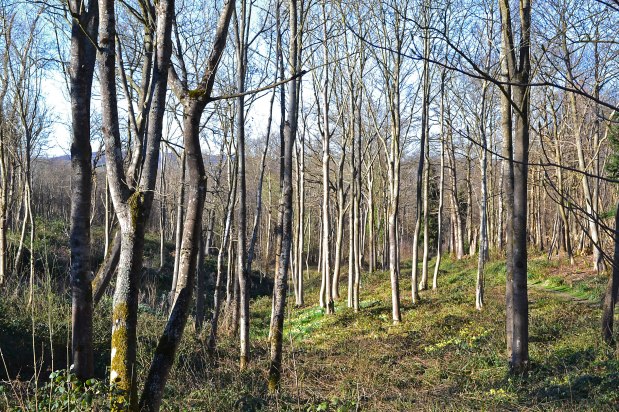
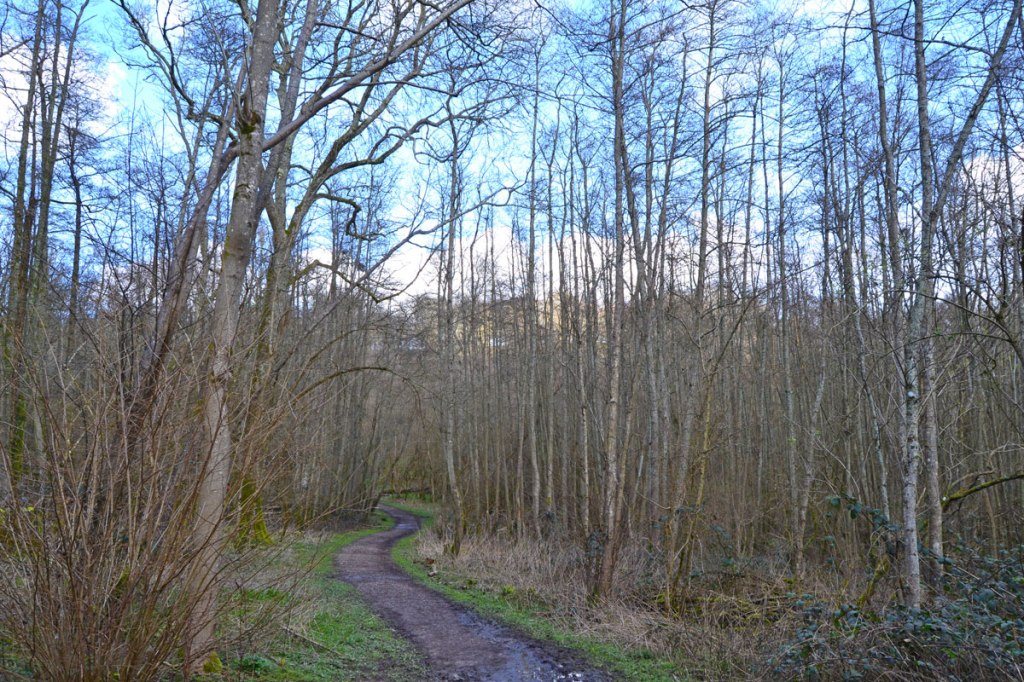
Scords Wood, awaiting signs of spring
This is the view south, to Bough Beech and Hever, from the point at which the Ide Hill walk joins the NT Toy’s Hill red route in Scords Wood
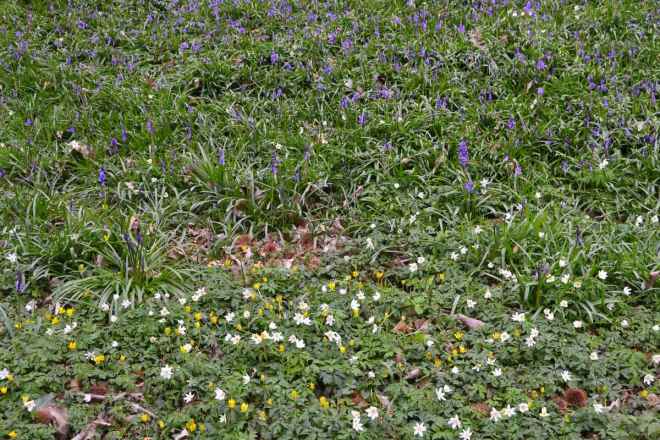
As for colour, look out for yellow lesser celandines, very spectacular at this time of year on the Fackenden Down walk in the woodland between the Down itself and Magpie Bottom. One of my favourite places for wildflowers in late March is on the Hever walk in the woods between Points 1 and 2, close to Hever Castle gardens (headline photograph). A yellow and white sheen seems to rise from the mossy forest carpet ushering in better days. But look if you want to keep your powder dry on the walking front, and not go out until mid-April and the blooming of the bluebells, that’s perfectly understandable.
What a wonderful walk today. The Oldbury-Ightham-Stone Street jaunt is a bit of an epic by KWNL standards at 6 miles, but every metre is worthwhile. I started badly, however, by telling a group of mountain bike riders they were wrongly cycling on a footpath. I was sure I was right but it turned out I was wrong. It was a bridlepath and they were fully entitled to ride on it. It wasn’t an unpleasant exchange and it was quite funny that I had to admit I was wrong after being shown the map. I ended up saying “Well I haven’t seen any horses, have you?” but I was trying not to laugh. I’m a country lane cyclist myself; I can’t understand cycling down paths and bumping over roots and being brushed by nettles. And I can’t understand cyclists steaming or wobbling down main roads with queues of nervous car drivers behind them. For me, the whole point is a bit of peace and quiet. But that’s me. Live and let live I say; each to their own.
I hadn’t done this walk since Covid. My friend Steve introduced me to it in July 2020. The lavender has been largely harvested but as a result, on that section of the walk I didn’t pass a soul. Interestingly the springs of the Greensand Ridge seemed to be unaffected by the dry and hot weather, so ponds were looking healthy-ish, and the little streams near Ightham tinkled beautifully.
One of the oddities of the walk is that despite being on the Greensand Ridge you don’t get the same extensive Weald of Kent views that you do further west, at One Tree Hill and around Ide Hill. There are just too many trees in the way! But I did get great views of the Spitfires from Biggin Hill on their joyride flights; they seem to use this area to break away from the accompanying photo plane.
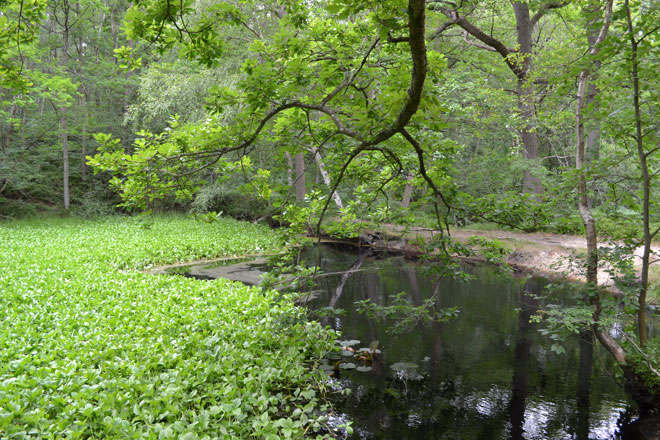
Pond at Point 1-2
Oldbury woods cover an iron age fort. It’s easy to see how this would have been a fortification in the centuries leading up to the Roman invasion but surely the Britons must have chopped down loads of trees to give themselves a field of view.
There is a similar feature at Keston, just south of the ponds. Navigation is not so straightforward at two points: between Stone Street hamlet and St Lawrence’s Church, and on Oldbury Hill itself, so check the GPX. Despite going slightly wrong twice (but quickly getting back on track thanks to the OS GPX) I was back home for the very enjoyable England v Germany football final – an excellent end to the afternoon. It’s a great walk, I really recommend it.
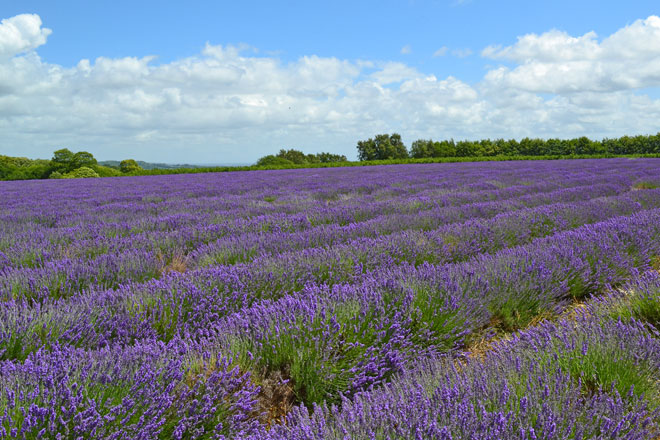
Mitchell and Peach lavender, point 3-4 pictured in early July 2020 – it’s harvested by August (earlier, if it’s been hot)
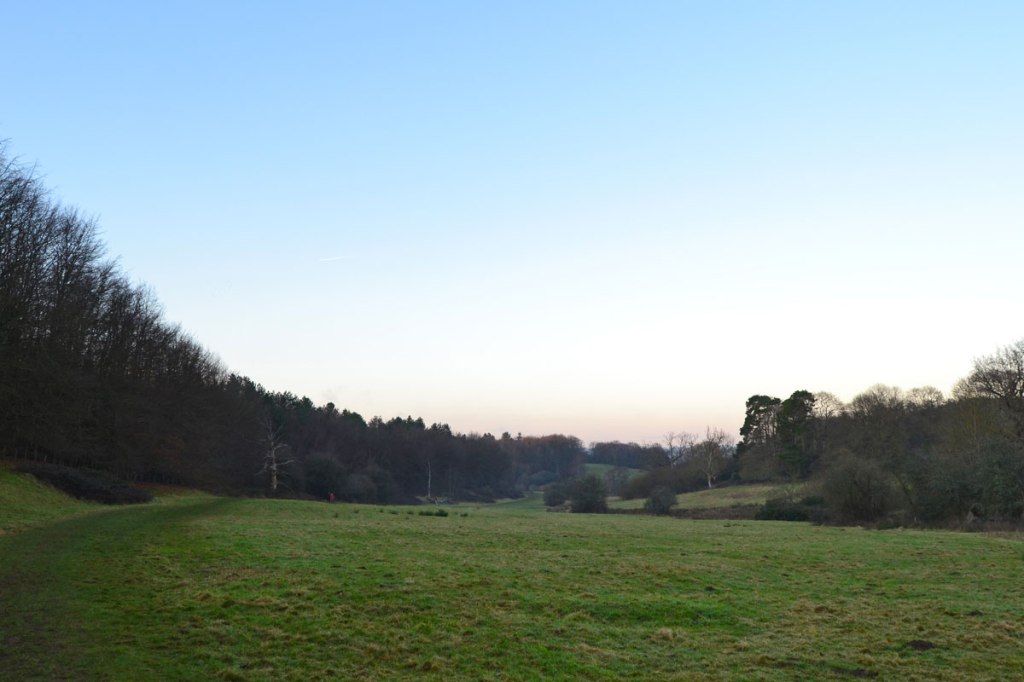
A beautiful dusk walk around Chartwell and Mariners Hill on the Hosey route, accompanied by a stunning full moon and the mew of a buzzard, hit the spot last Sunday afternoon. It’s not always the early bird that catches the worm, you know. The mud just before point 8, the ‘dramatic’ crossing of the infant River Darent, is hilariously sloshy and treacherous enough to defeat any footwear bar stilts fitted with spikes but can be avoided by walking parallel in the grassy field alongside and rejoining just before the log bridge. A satisfying hose down of boots after returning home was called for.
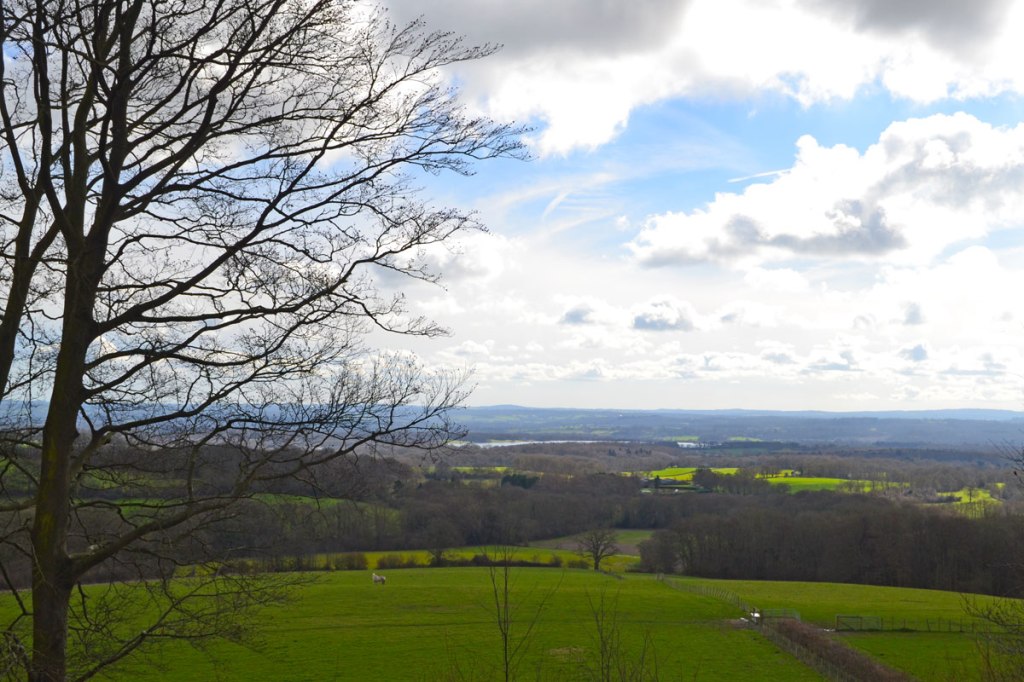
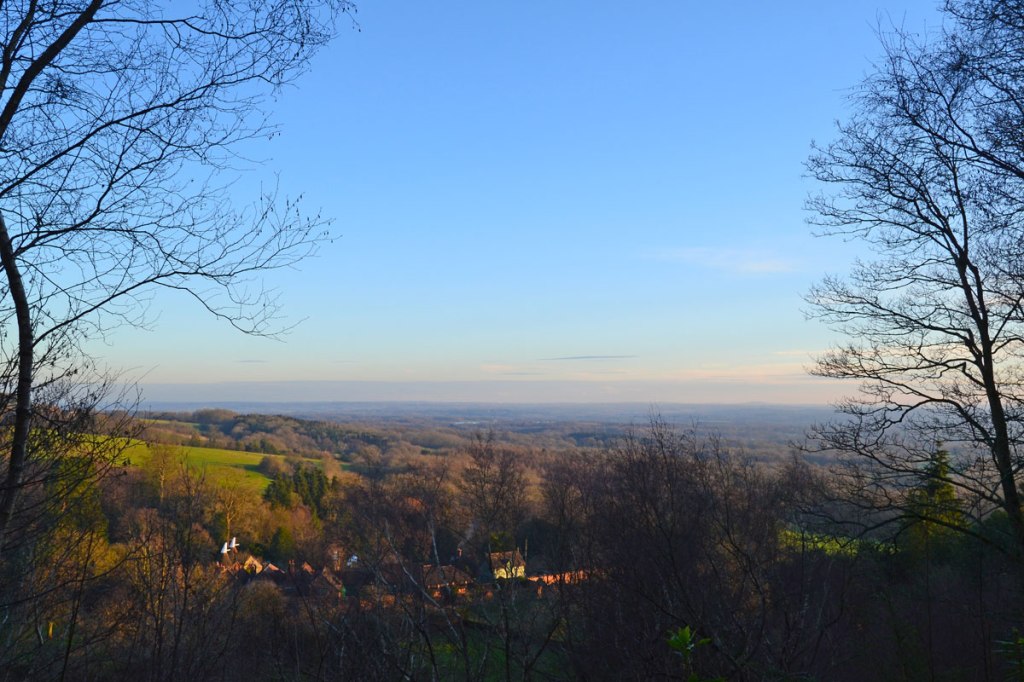
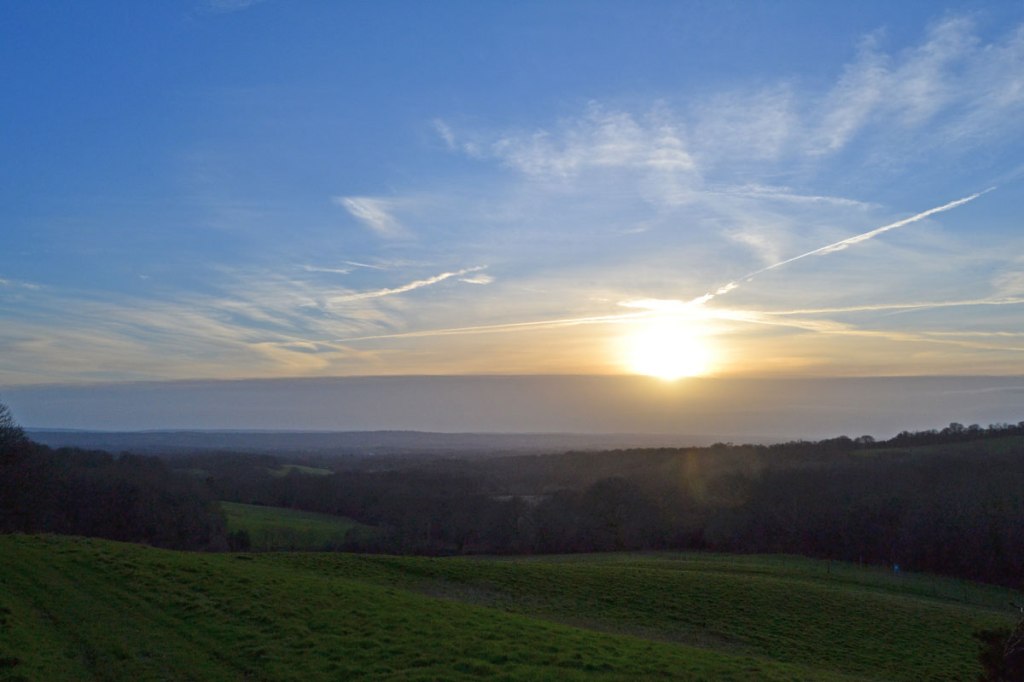
With Saturday a washout it was a real pleasure on Sunday to find time for the Ide Hill route (a three-hour round trip from SE London). For some reason I often take this Greensand Ridge walk while my chosen football team is playing so it’s rarely the relaxing stroll it ought to be. Fortunately, after initial tension, the goals came in a rush so by the halfway point all was well and I could enjoy the subdued January colours, stillness of the woods and occasional bird calls. A huge buzzard glided away from us soon after leaving Scord’s wood leaving a cacophony of jackdaw and carrion crow calls its wake. There were few other birds evident though, a few robins, wrens and a dunnock the only compensation for the finches I was hoping for. The tiny cricket pitch at point 5 seemed even more titchy with no one on it. We caught the sun as it slipped out of the blue sky into a solid-looking bank of cloud draped across the western horizon as far as the eye could see. This gave us a strangely false sunset, and an early dusk at odds with the sky overhead. But those weald views – fantastic as ever. A pint in the cosy Cock Inn was a perfect way to conclude proceedings. Oh, happy new year by the way.
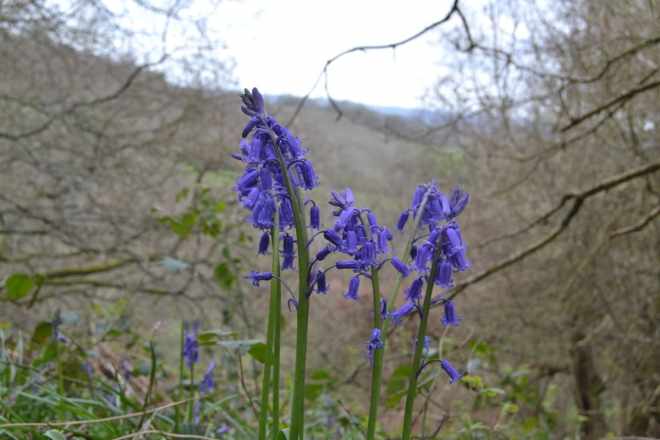
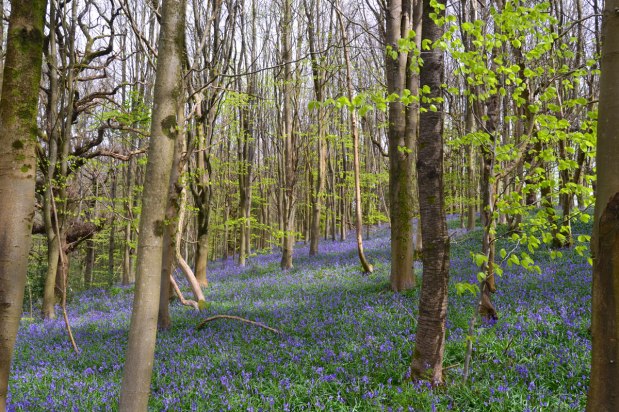
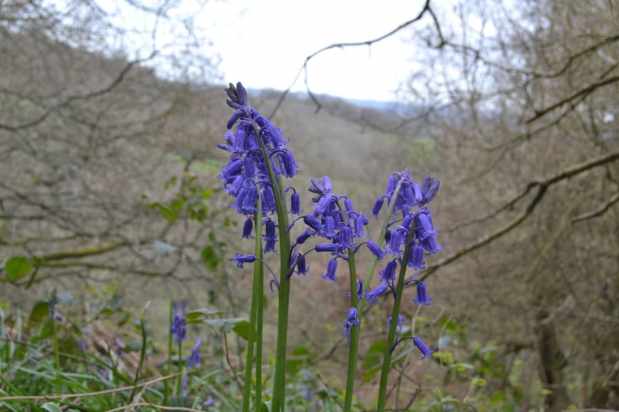
OK, for those going out this weekend expecting swathes of bluebells, you may be disappointed. They are late this year – particularly at One Tree Hill and Ide Hill, but not far off full bloom in Meenfield Wood. Probably a few too many cold nights of late has set them back. Next weekend will definitely be better. But there are other flowers to enjoy. Cuckooflowerclumps are great at this time of year and, like red campion, wood anenomes and celandine, get better the more you notice them. Primroses form eyecatching patches too, and soon cowslips will adorn the grassy slopes of the North Downs (with orchids and marjoram/oregano to follow). These all brightened up my walk from One Tree Hill to Ightham Mote then back up the hidden valley with the little stream yesterday (pictured below). Below are some recommendations of good places to see bluebells.
This slideshow requires JavaScript.
If you’re staying local, Beckenham Place Park has some good patches (or will have), although get ready to exercise emergency social distancing manoeuvres as oblivious joggers jag around, their ears full of choons. Oxleas Woods off Shooters Hill is another good local spot and I daresay Sydenham Hill Woods too. After that I think we’re talking Petts Wood and the adjoining Hawkwood and Little Heath Wood and Selsdon Wood south-west of Croydon. Of course, there are brilliant bluebells at Downe,Meenfield Wood, Ide Hill, One Tree Hill, Hosey Common and in woods east of Shoreham on this website’s walks, and the cobalt carpet reigns supreme in woods near Westerham and around Hever and Edenbridge.
They are uniquely adapted to suited the multispecies ancient woodlands of the UK
Low temperatures trigger their growth (but might delay their blooming if in April). Bluebell seeds germinate when the temperature drops below 10°C.
Bluebells predominantly convert sunlight into fructose allowing them to photosynthesise at low temperatures.
They are supreme competitors with other plants, allowing them to carpet woodland floors. But they get help in the form of mycorrhiza, a symbiotic fungi.
Almost half the world’s bluebells are found in the UK, they’re relatively rare in the rest of the world.
But please be careful never to tread on any; it takes bluebells years to recover from foot damage. Digging them up – surely no one visiting this site would consider such a thing – is illegal, and please don’t let dogs trample them either – keep them on the lead.