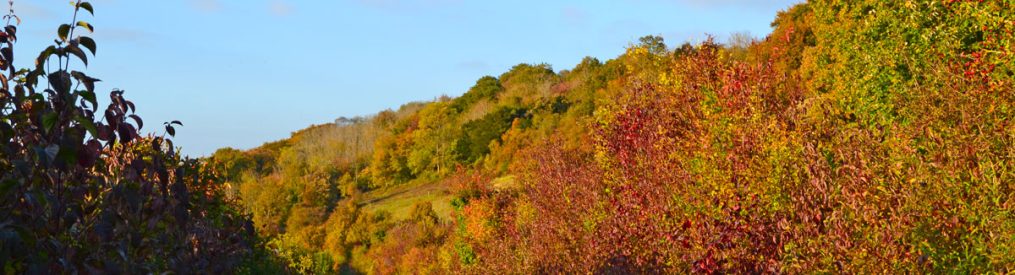
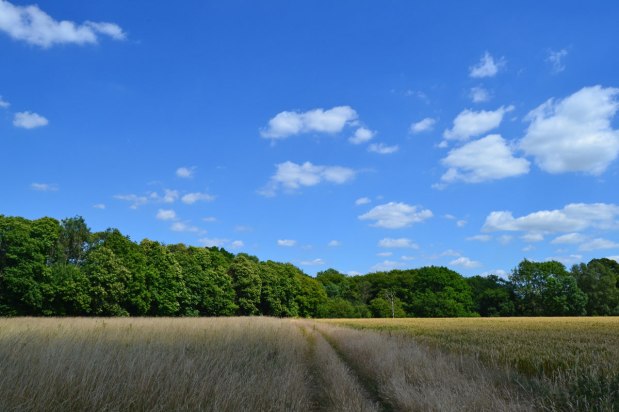
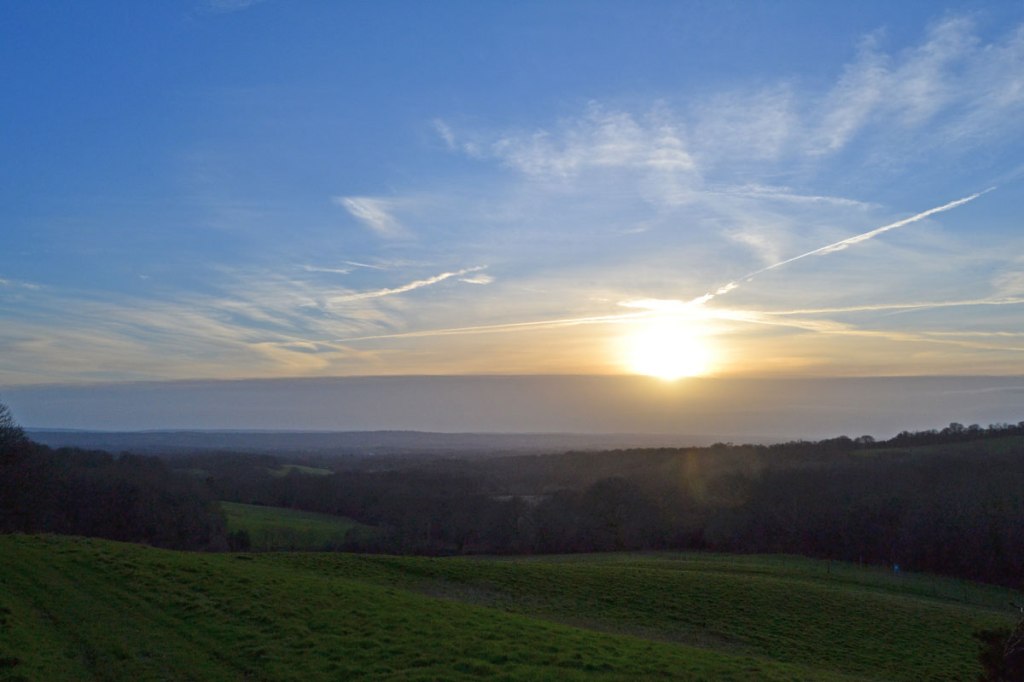
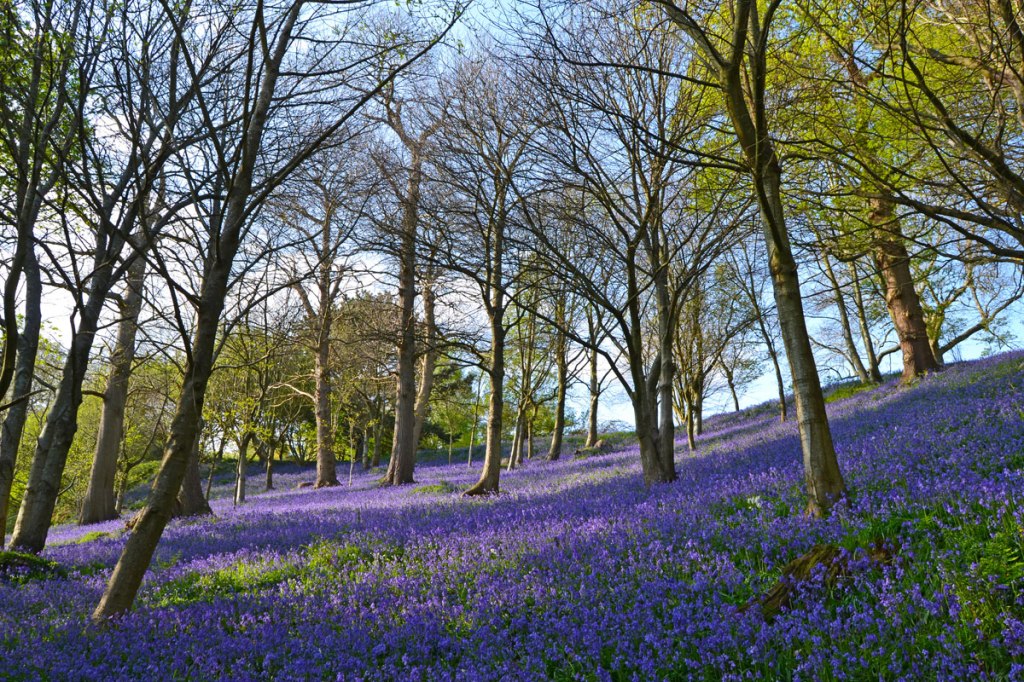
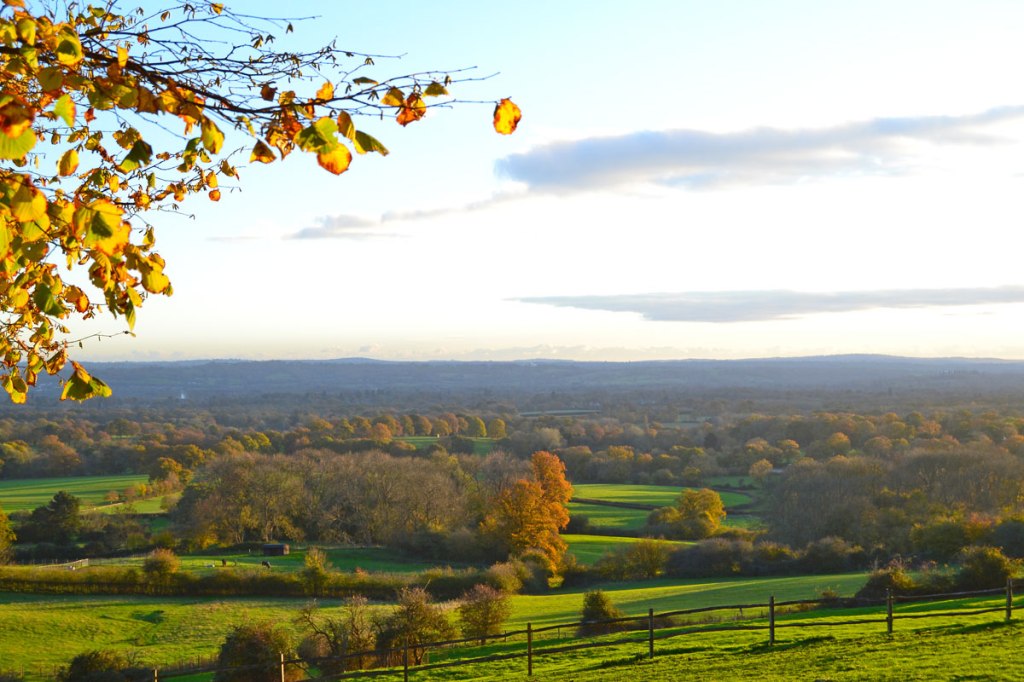
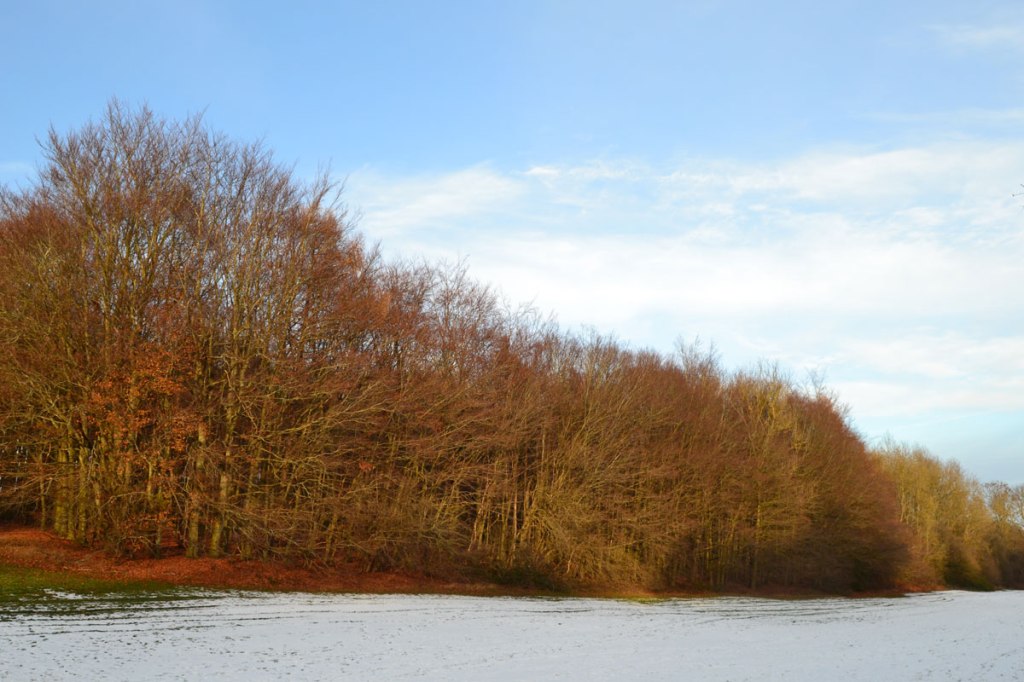
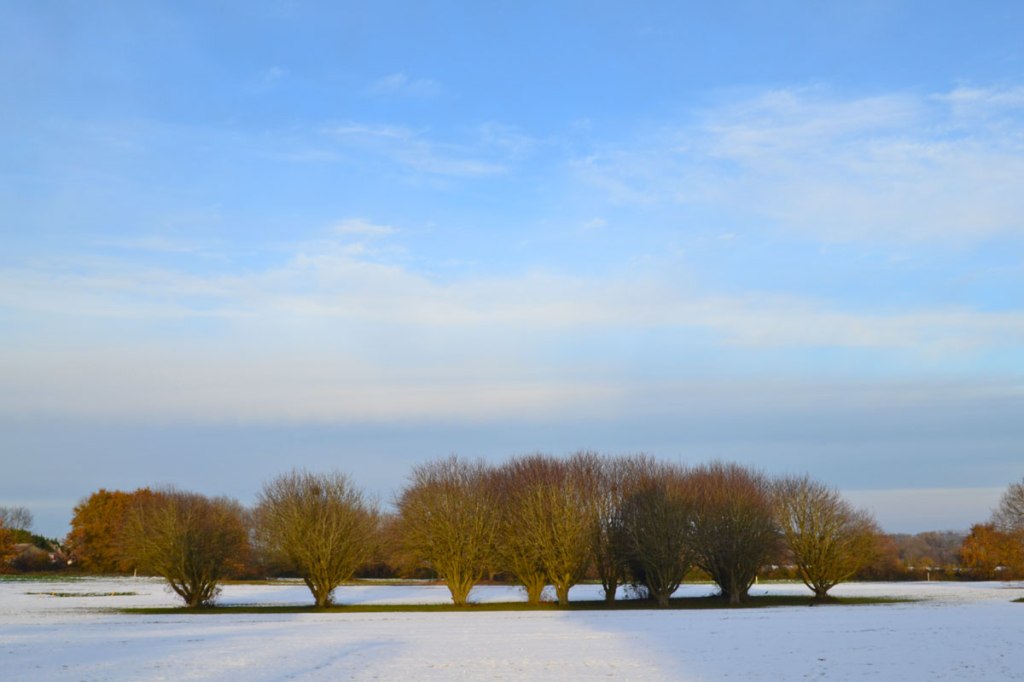
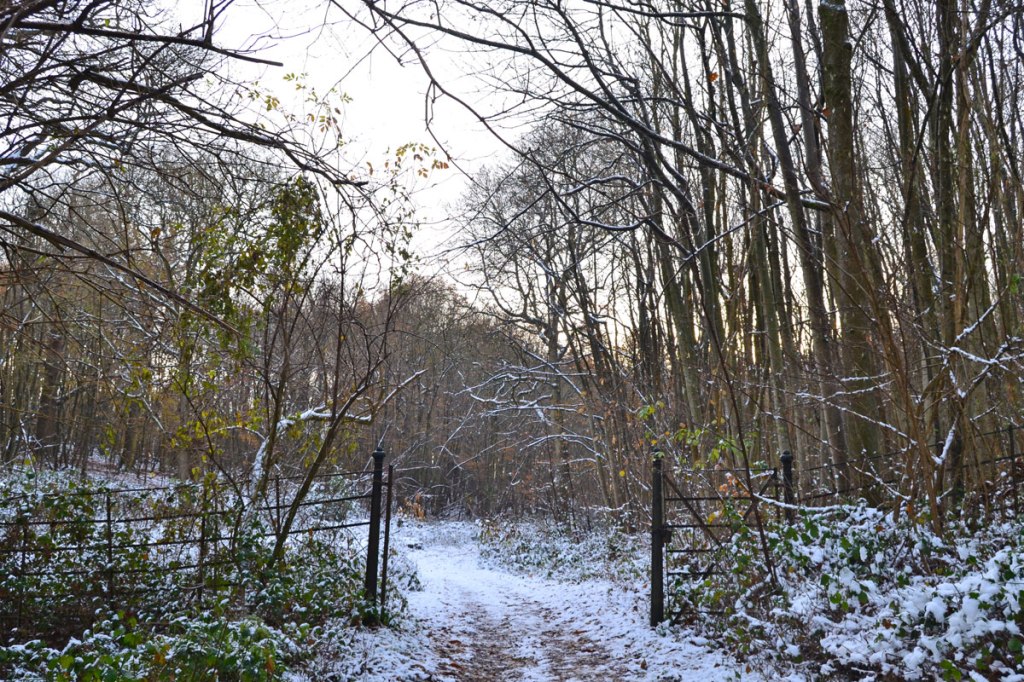
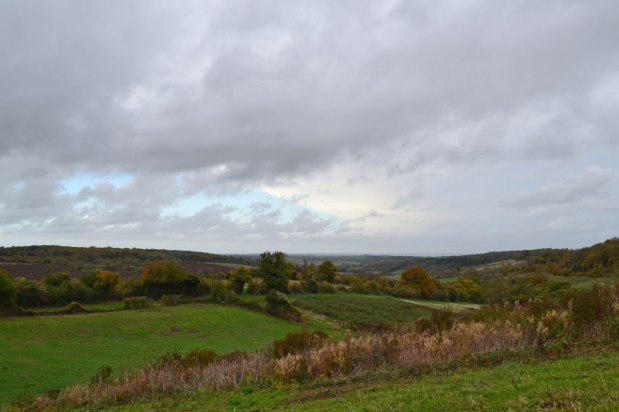
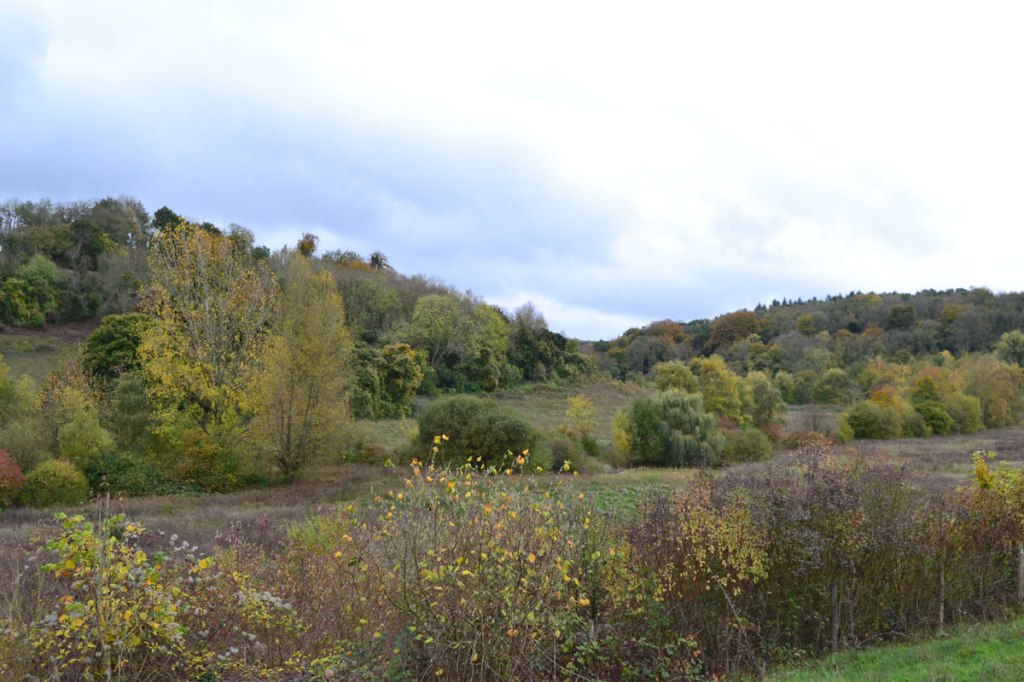
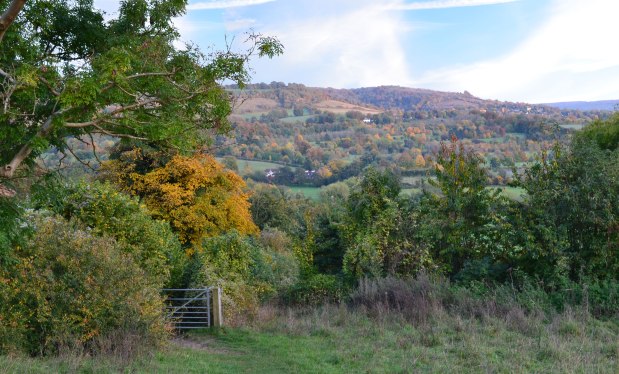
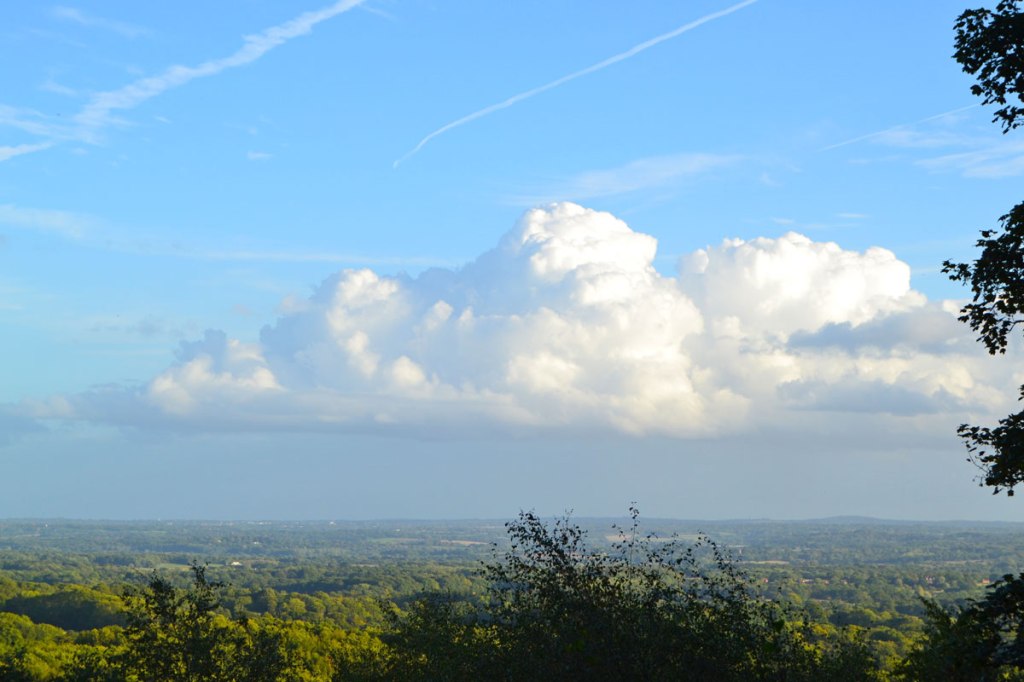
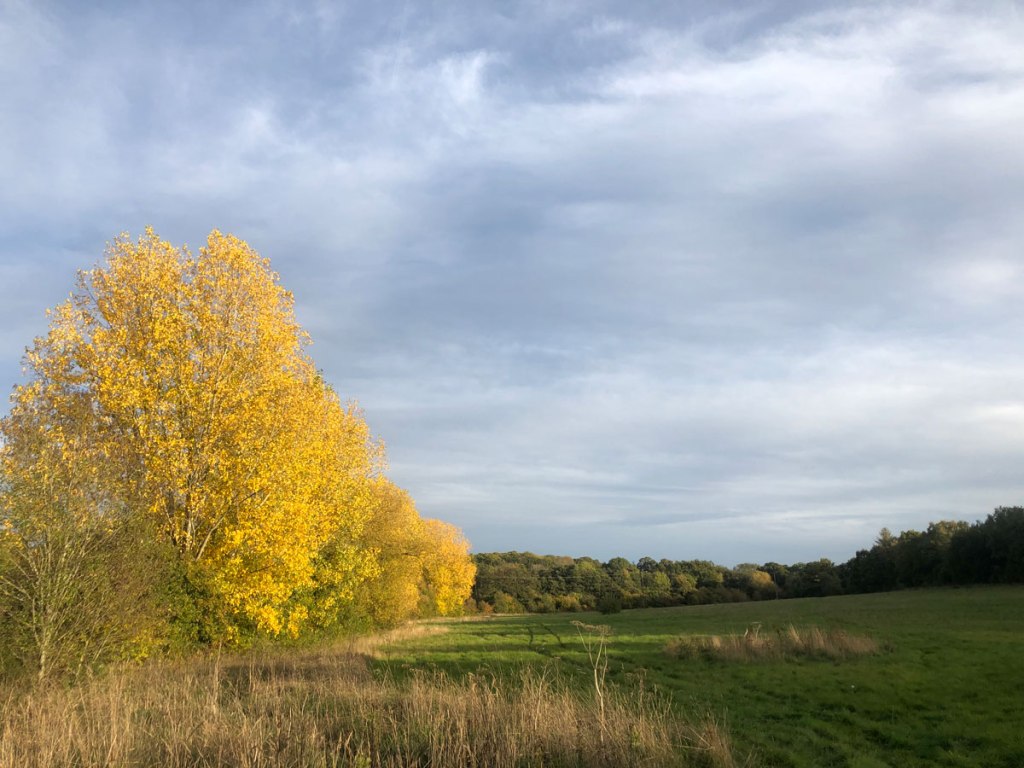
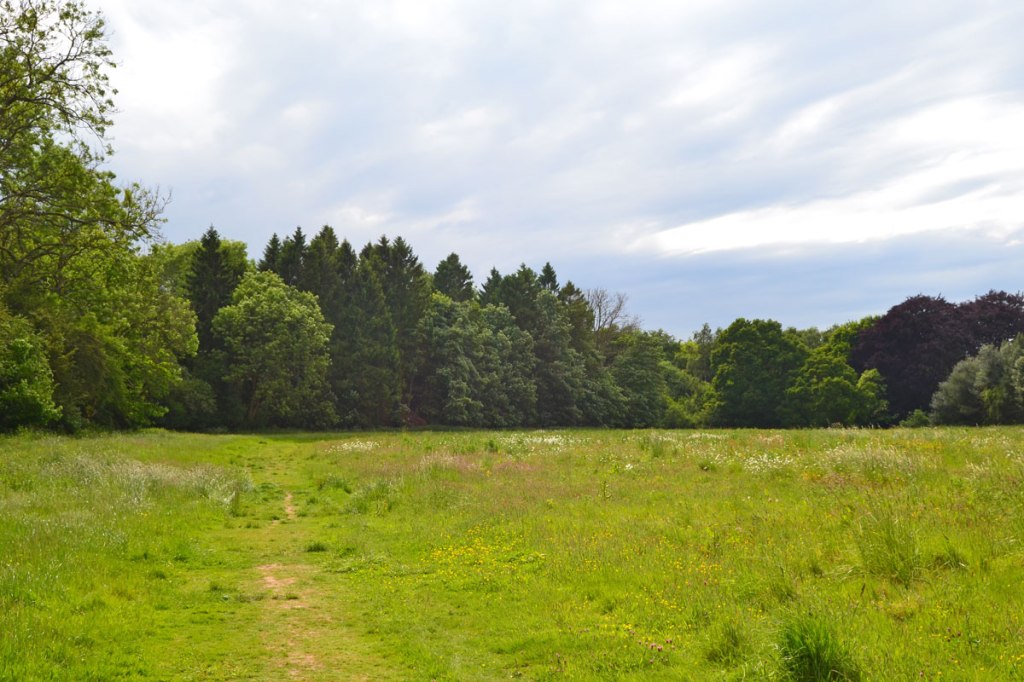
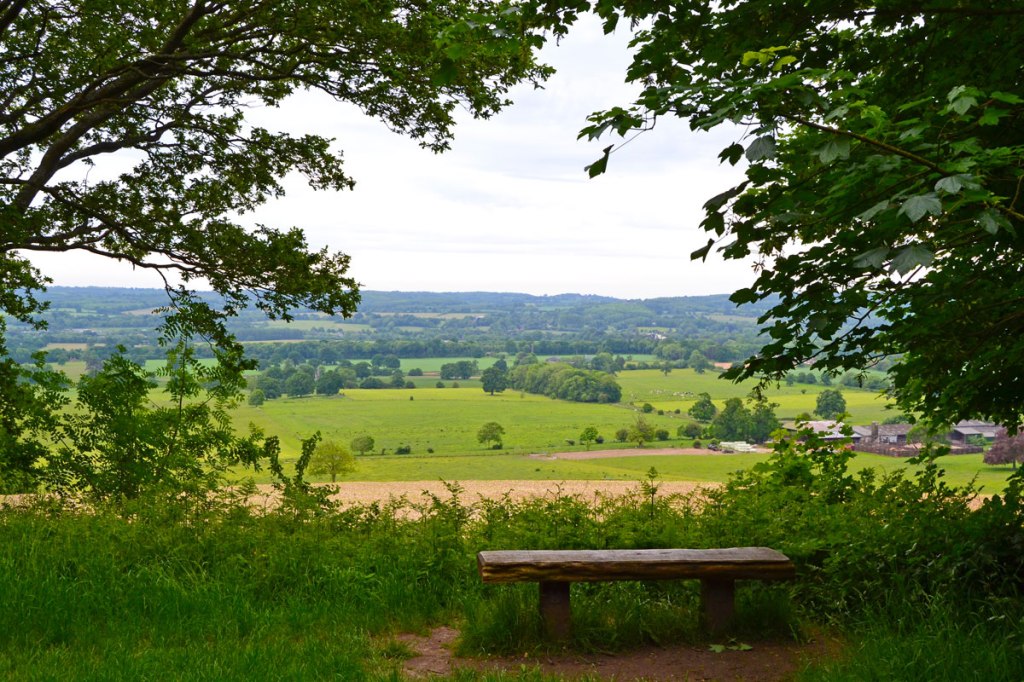
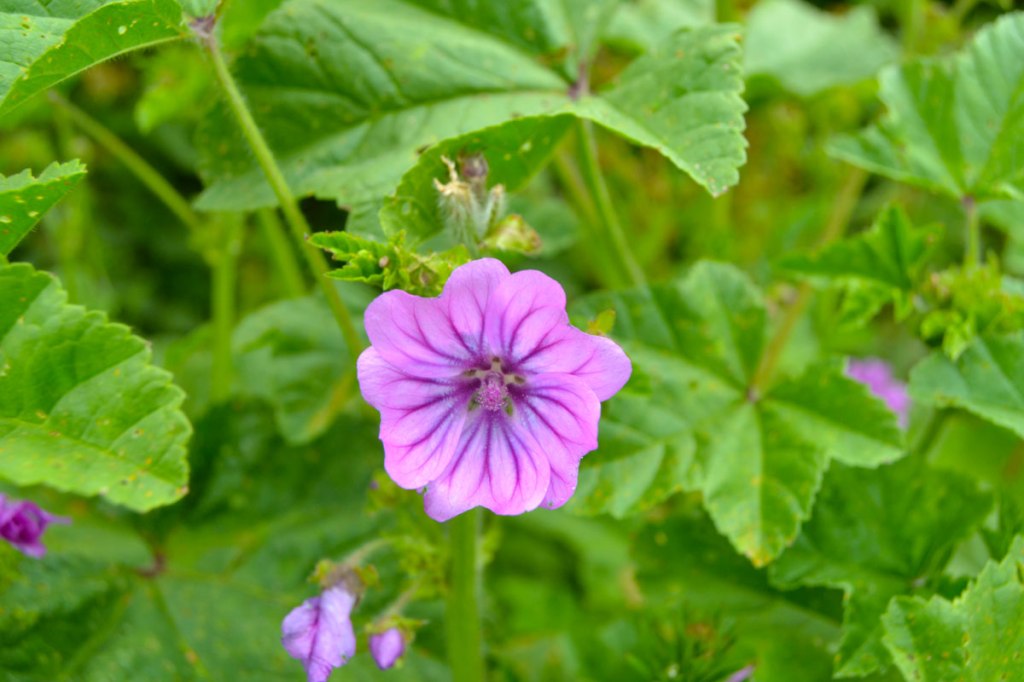
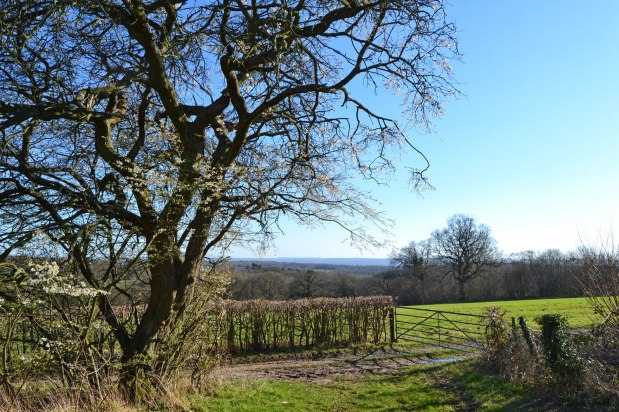
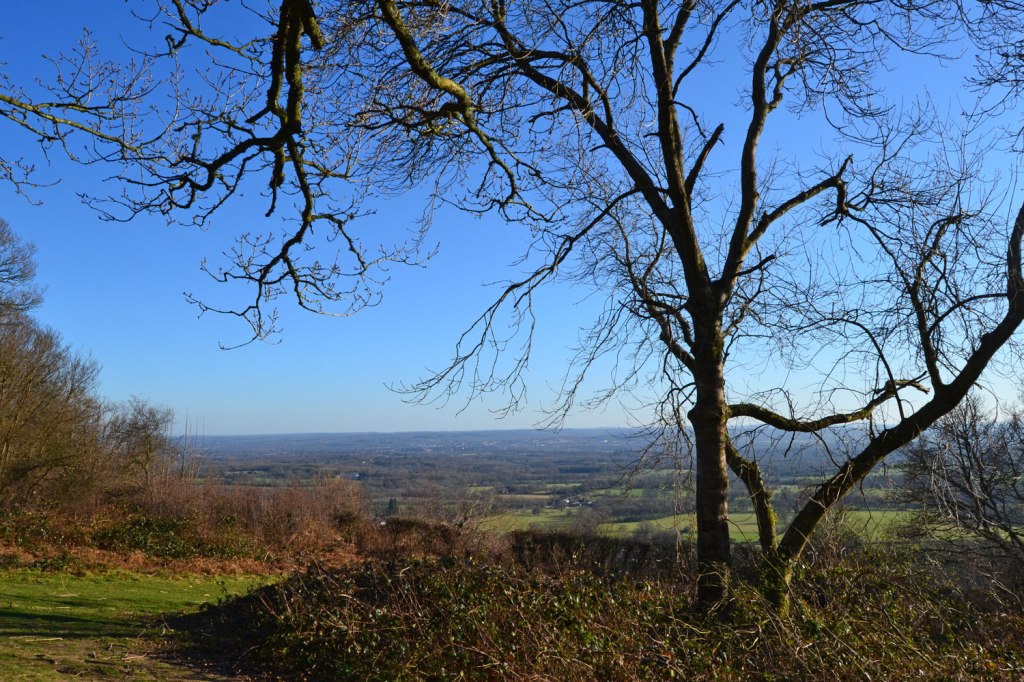
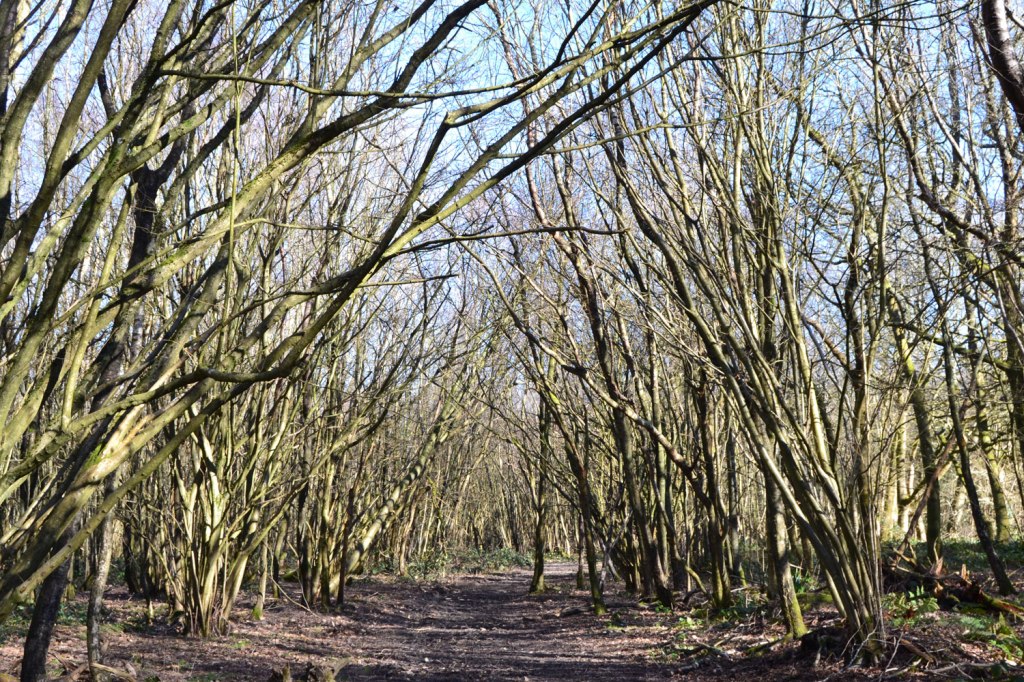
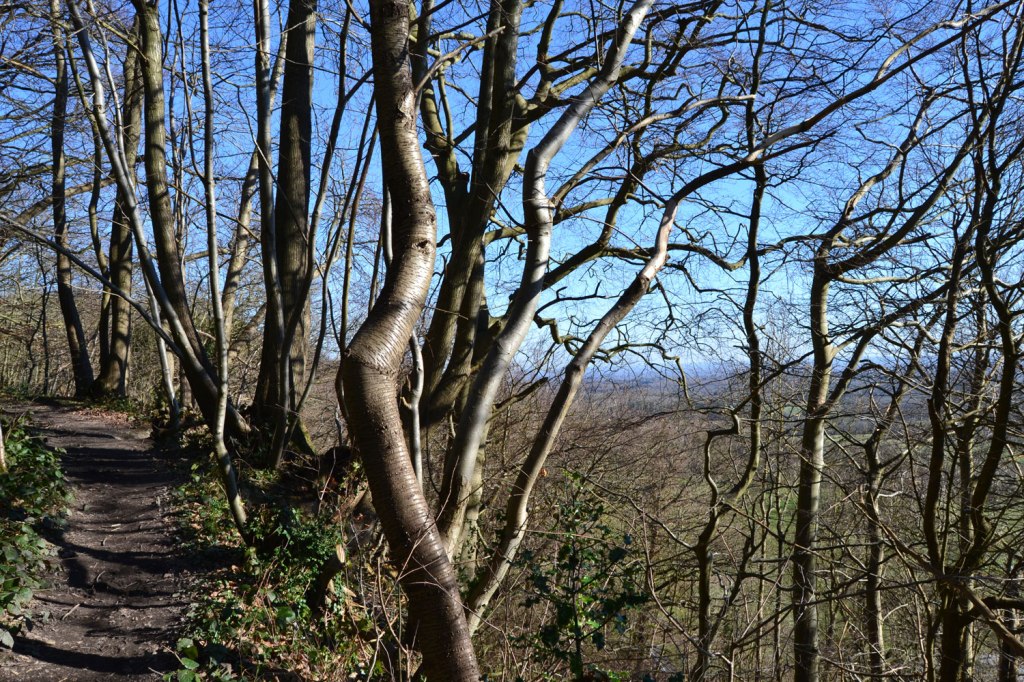
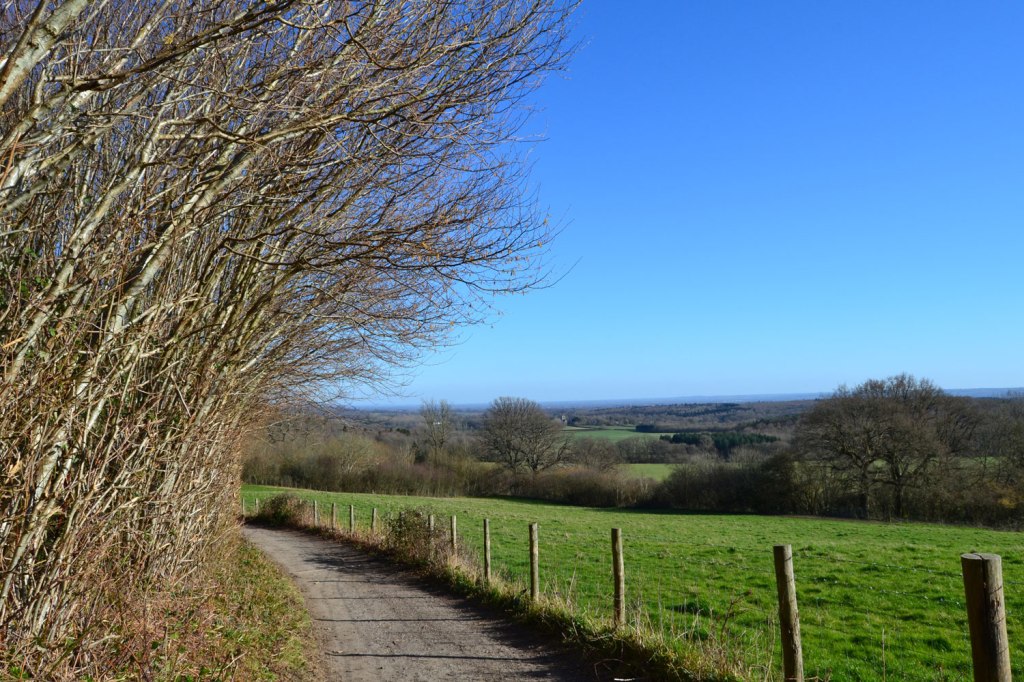
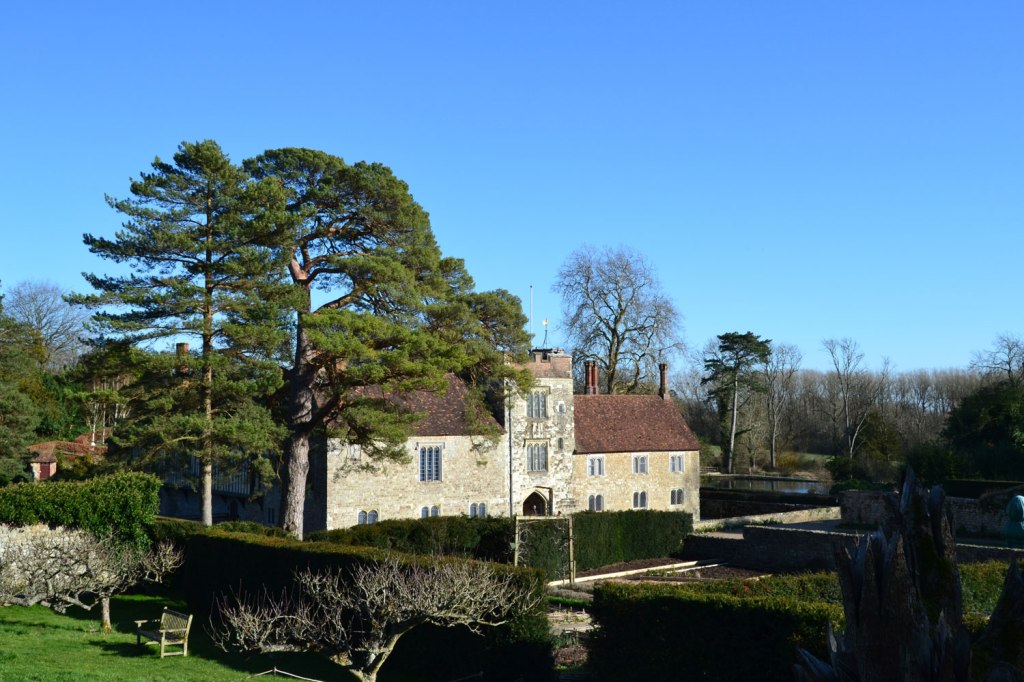
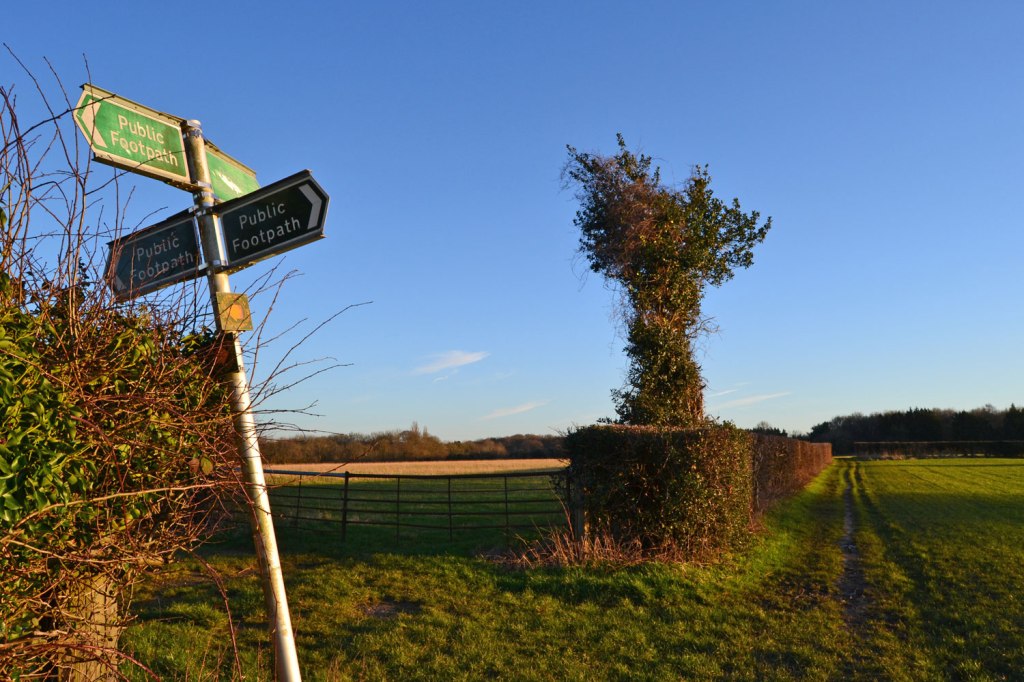
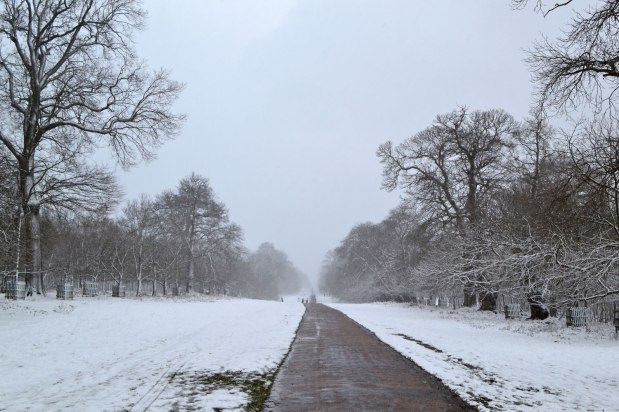
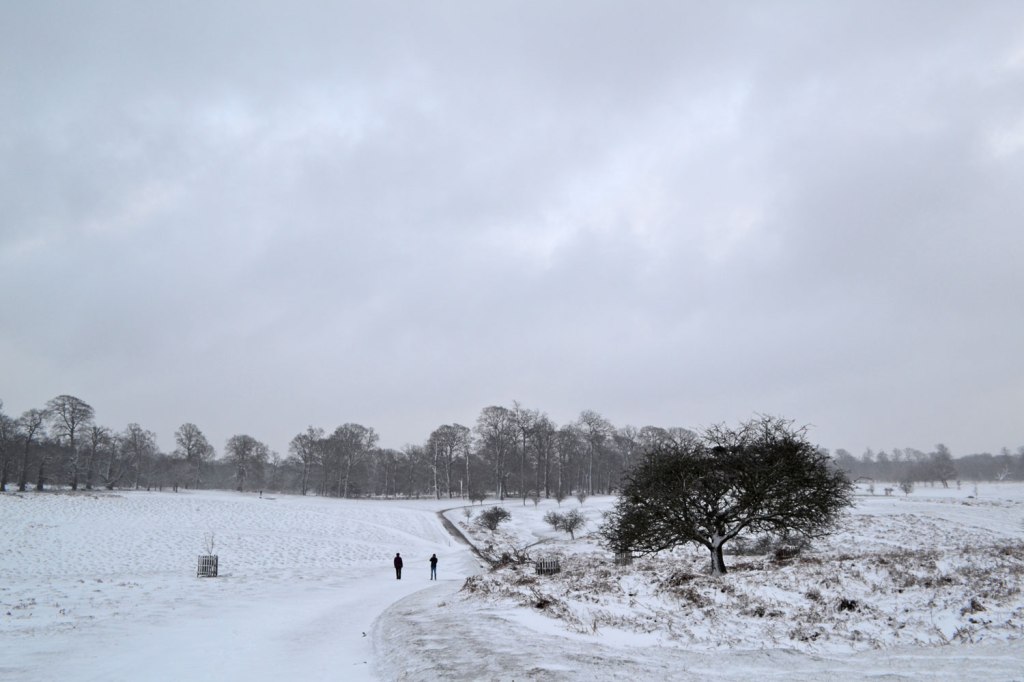
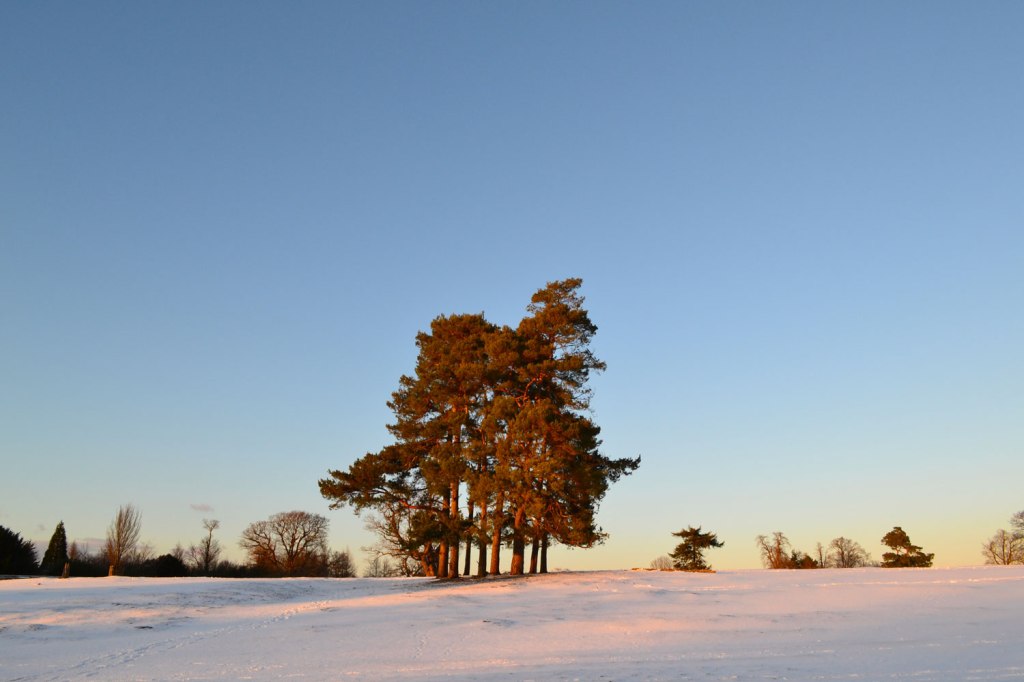
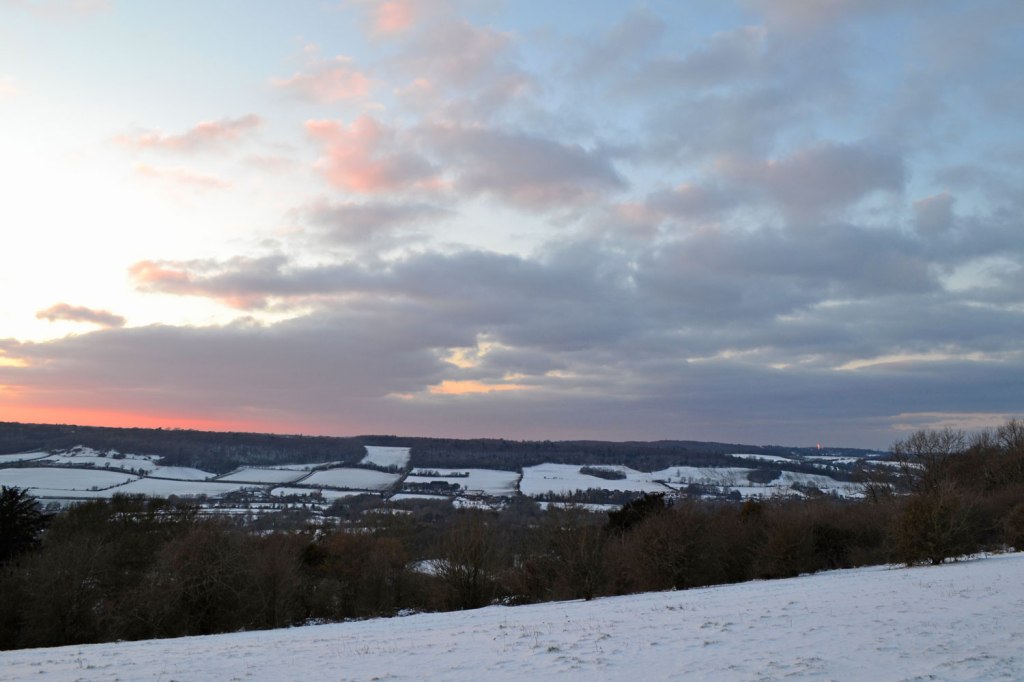
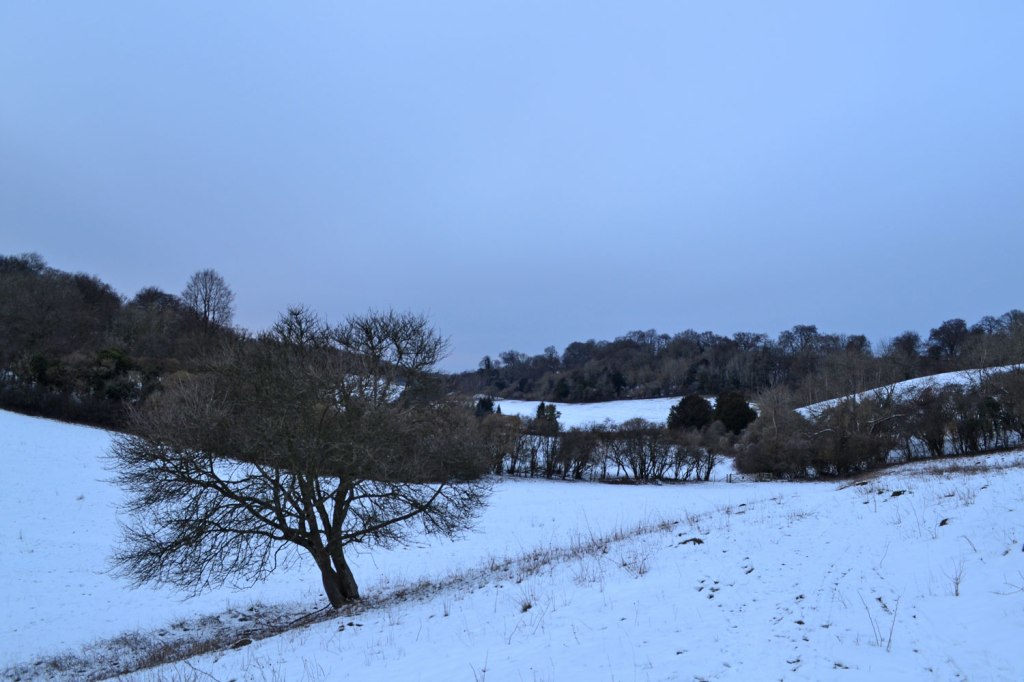
To mark the year’s passing I’ve picked one photo from each month looking back over the year so will hope to show the passage of the seasons. In some months I took few photos … which is why September’s picture is a bit “meh”. One photo is a complete cheat because it’s not from the walks here, but from north-west Scotland! I think my favourites are the final two of the year: Underriver view and Lullingstone in the snow, although the sharpness of that Cudham shot in remarkably clear July air does a lot for me.
I don’t rate myself as any kind of photographer, and I’m sure a true pro could do a lot better, but I do enjoy capturing an atmosphere or certain aesthetic. If others like them too, even better!
Happy Christmas to all who visit and use this website and best wishes for 2023.
A cloud layer produces a false sunset at Ide Hill, January
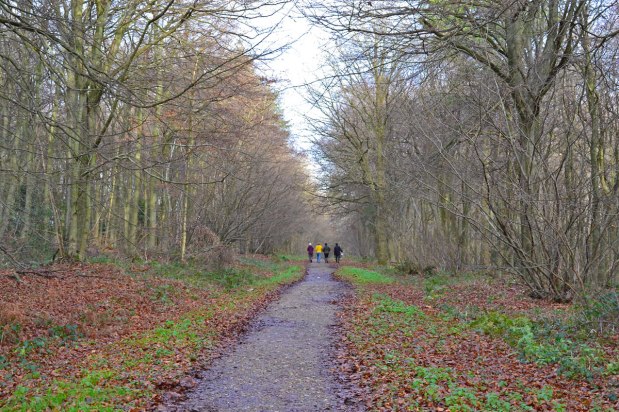
Downe walk, February
Flooded woods, Bough Beech, March
Bluebells in Emmetts Garden/Scord’s Wood, April 2022
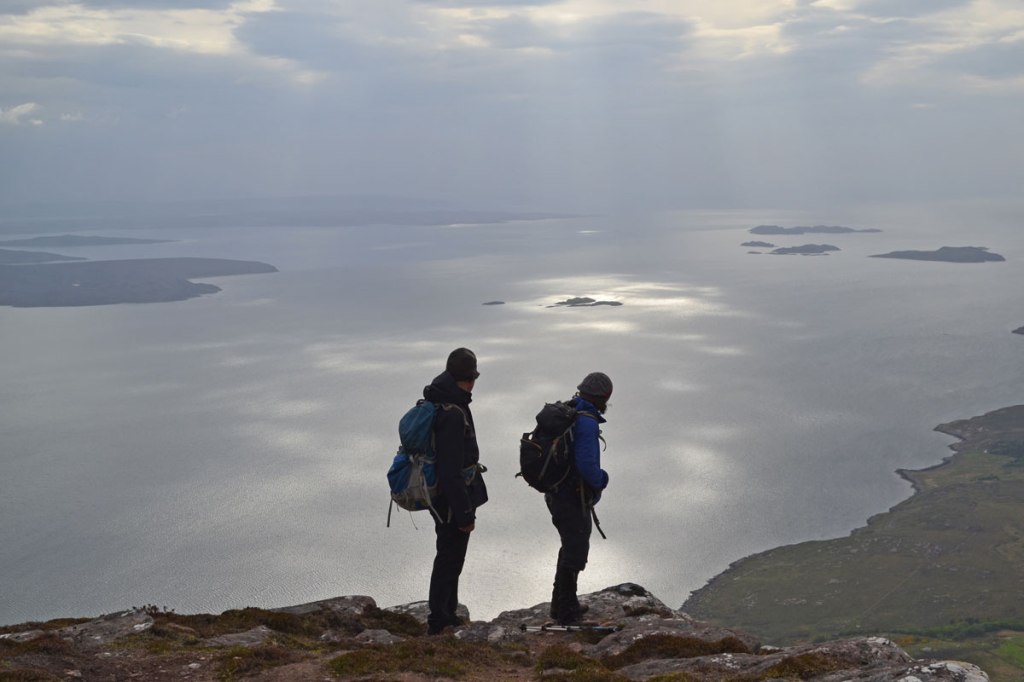
View over Summer Isles from Ben Mor Coigach, near Ullapool, May.
Pyramidal orchid in the Andrews Wood-Meenfield Wood gap, June
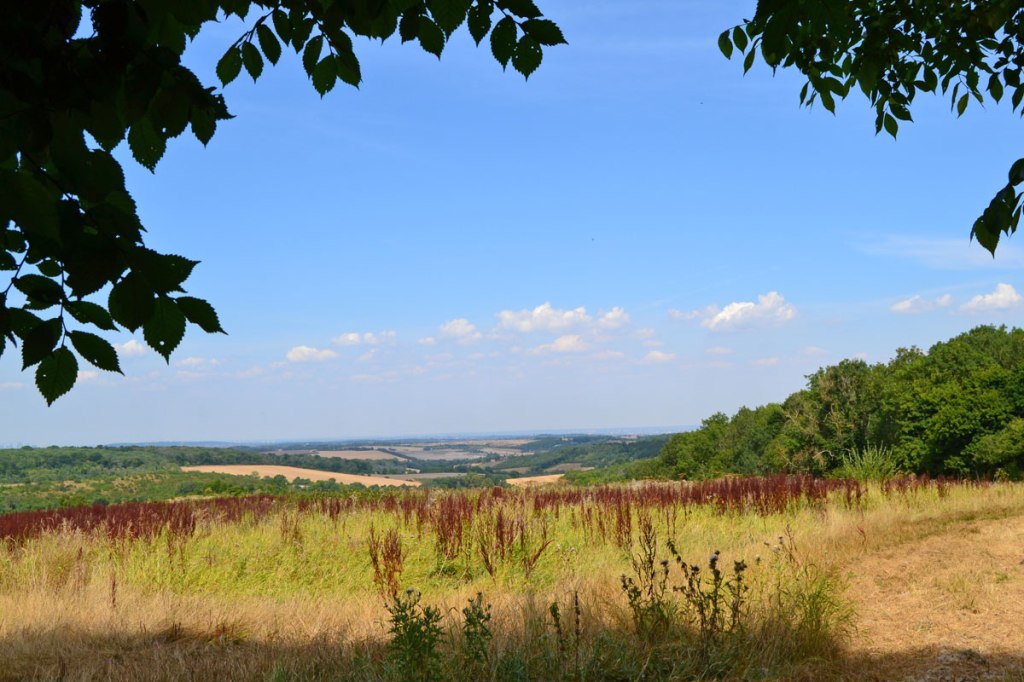
Cudham walk, July, between point 2 and 3, the field short cut
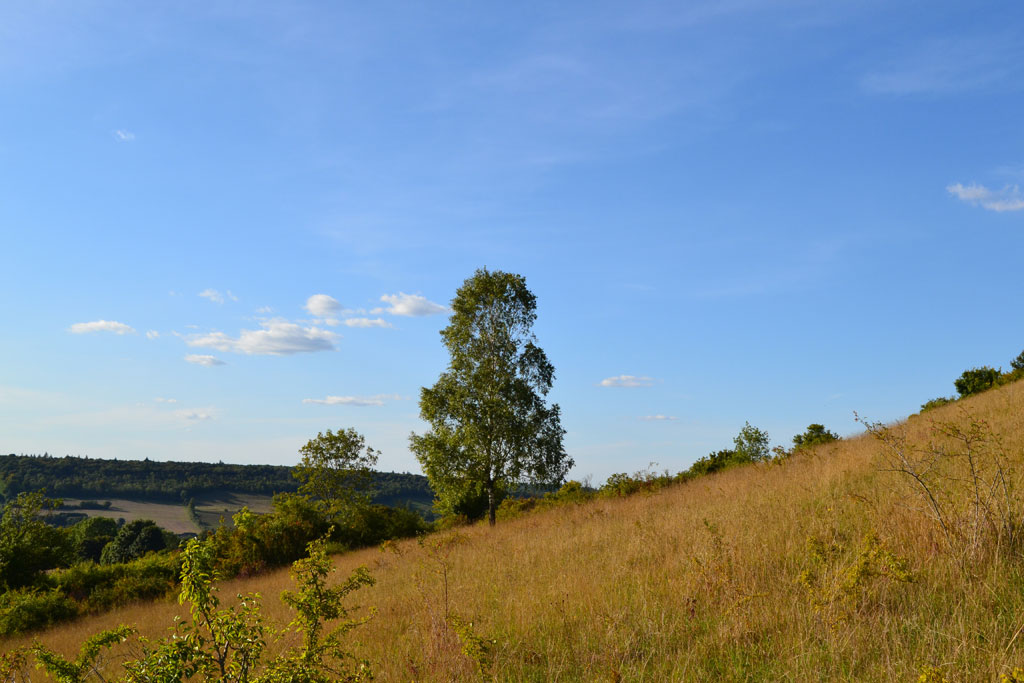
View from Romney Street, August, Fackenden Down walk
Lullingstone park is a great place to feel the winter vibes in the North Downs, with sweeping views of the Darent valley, big skies, mists swirling down by the river and a variety of terrain: from grassy expanses to rich beech and oak woods. Some walkers in Kent on Saturday saw a double sun – a trick of the light in which the sun seems to appear twice. It’s also called a sun dog, and is a type of halo. We weren’t so lucky, but the atmosphere was superb – wispy cloud, patches of cobalt sky, a low sun and a light mist. Small flocks of linnets were feeding in scrubby fields at the start of our route, up by the golf course entrance. It was the last day of this week of snow and freezing temperatures so we wanted to make the most of it, taking a 4-mile route around the park. A very deep frost had formed on top of the snow, producing some incredible branch-like crystal structures. It was a truly memorable stroll.
Exceptionally mild temperatures have lured bats out into the autumnal gloaming to catch late flying insects. I love watching these animals swoop, flutter and flit around and it’s a bonus to see them so late in the year. Usually you can only pick them out against the sky but at Downe and Keston on last weekend’s strolls I was buzzed by bats so closely I sensed rather than saw them zooming past. Yesterday at Polhill one or two emerged from the mist to pass close over our heads before vanishing into the gloom.
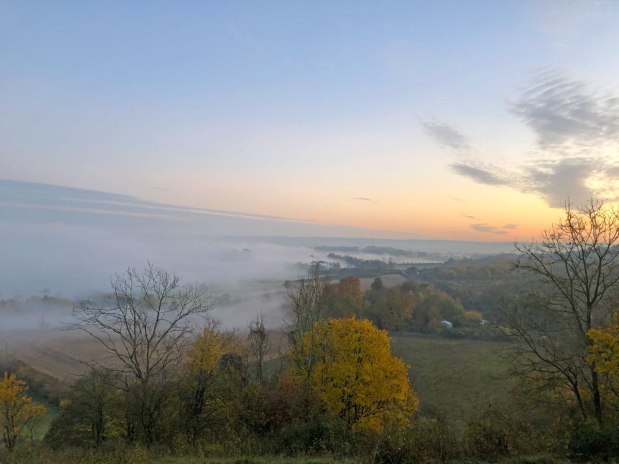
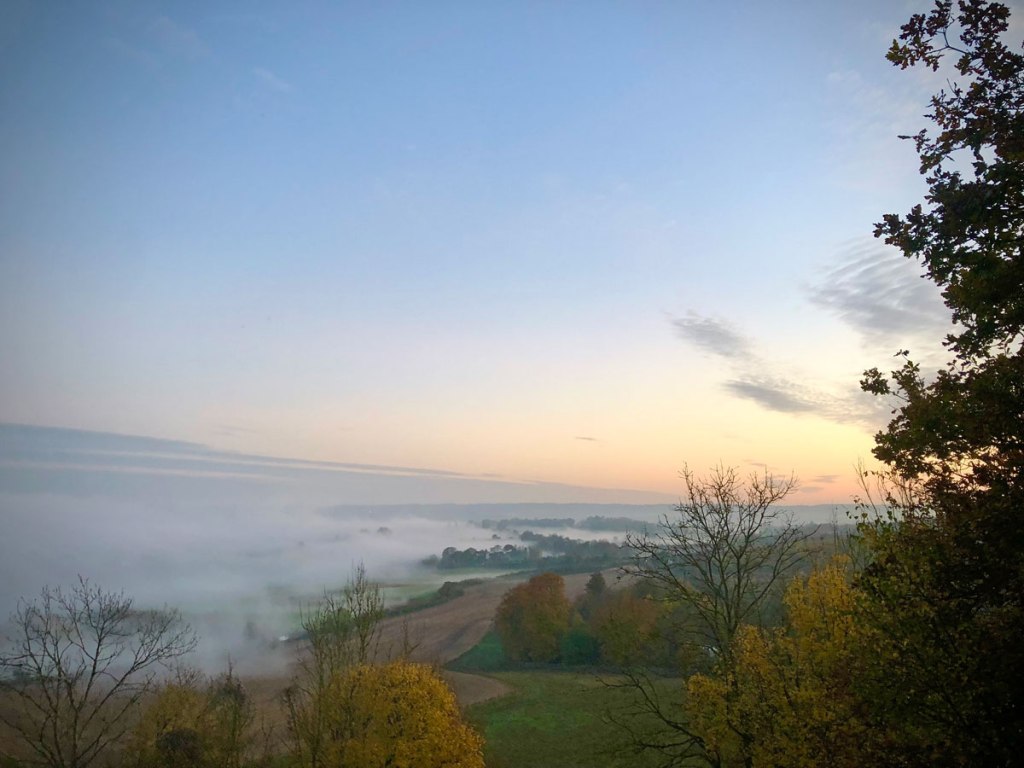
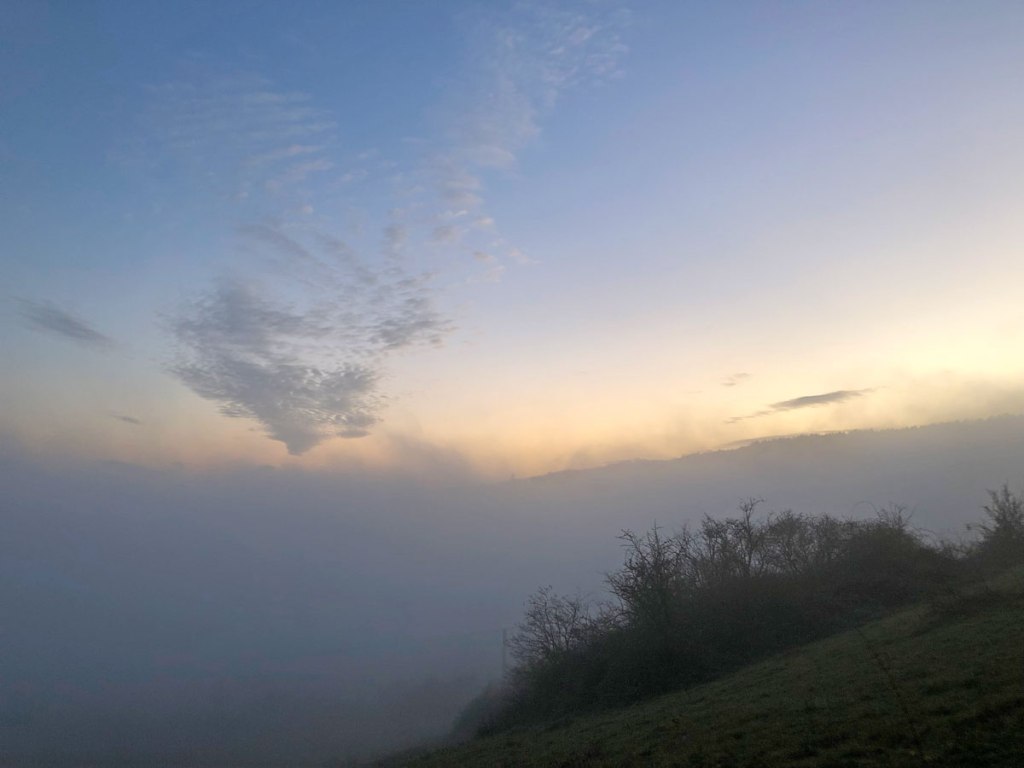
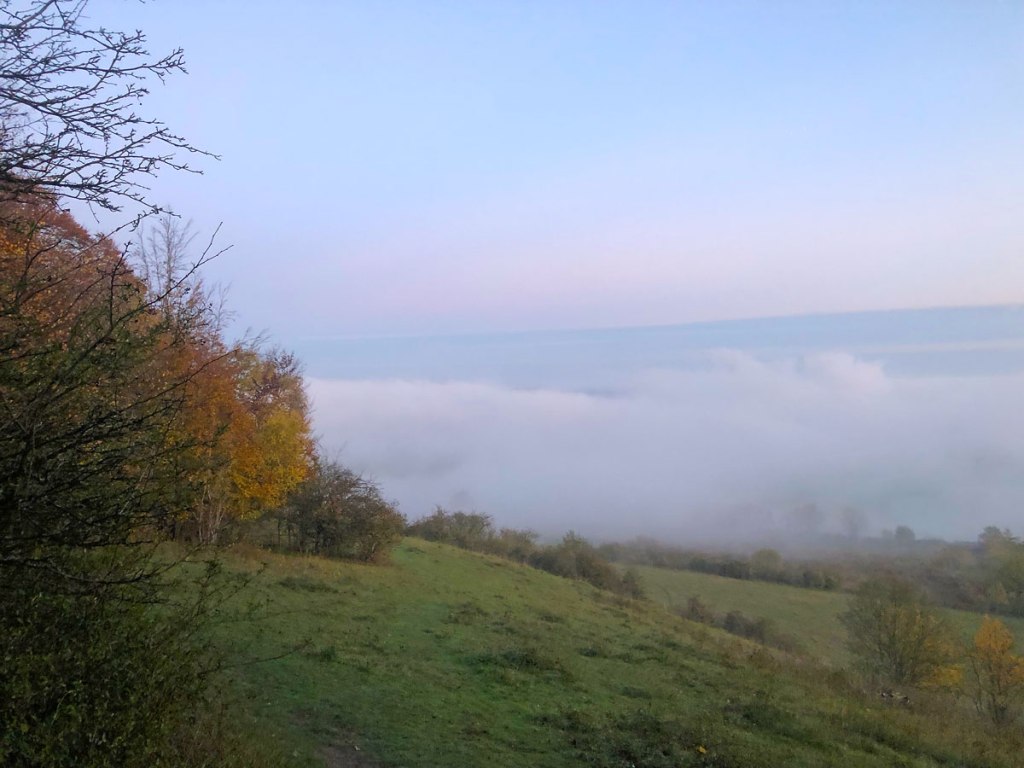
I’d thought we’d set off rather too late for a walk. Traffic was bad on the A21 slowing us further (the train is by far the best option for Shoreham walks) and low cloud had covered the sky. But by Locksbottom the skies cleared and we were bathed in a beautiful golden light. This was a false dawn: by the time we parked up by Meenfield Woods above Shoreham we were in quite dense fog. This magically cleared at Polhill, the walk’s halfway point, to give us unusual views before swirling back in as the sun set. With the mist below we had the feeling we were much higher above the valley than we were. I think this weather effect is called a temperature inversion, where warmer air passes over the relatively cold air on the valley floor, causing condensation.
By the time we finished the walk, visibility was down to about 50 metres and driving home the twisty, twiny country lanes needed total concentration if we were to avoid a close encounter with a hedgerow.
Mist obscures Sevenoaks, pictured from Polhill, November 2022
Mist at Polhill swirls in as the sun sets. Looking towards Knockholt and Chevening. November 2022
Mist at Polhill looking towards Otford, November 2022
I’m intrigued about how many of us look outside on a day like today – drab, cold, raining – and just think that curling up with a book or making a great meal or something would be a far better use of time than a walk. Who can blame those who decide such days are for doing stuff indoors? But judging by the views on this website there is a hardcore who come what may will not only brave the elements, they will relish them. I’m in this camp – although I do have a good book to read. Anyway, lovely autumn colour awaits those who make it out, all the more inspiring against the grey backdrop. Waterproof trousers and good boots will be handy though. Photos are from the Fackenden Down route last weekend on which the weather was actually fine as it turned out. Scroll through the photo gallery below right for autumn colour from all the walks.
What a superb walk on the Polhill route recently. Superb weather and the trees in their best autumn finery. The views across the Darent valley were at their very best with every little detail sharply visible: the church tower, the oasts, the route of the river … It was a view that would have inspired Samuel Palmer, the brilliant mystical romantic artist inspired by William Blake and Turner who roamed this locale with his equally arty mates ‘The Ancients’ in the late 1820s and early 30s. He was mainly based in a rundown cottage nicknamed Rat Abbey before joining his dad at the lovely Water House – still standing of course. Repros of his beautiful art can be seen in the Samuel Palmer pub. He fell in love with and married 19-year-old Hannah Linnell when in his early thirties while in Shoreham and went on a two-year honeymoon in Italy where his art developed further. But it’s his Shoreham works that seem to attract the most attention. Strangely, his surviving son Alfred (another son had tragically died at 19) in 1909 burned loads of his pieces after his death saying that they were a humiliation because no one could understand them, or something. Odd that.
View across Darent Valley toward Fackenden Downon Shoreham circular and Polhill walks. iphone pic
It’s interesting to reflect when gazing across these lovely pastoral valley, and at Palmer’s beautiful paintings, that all was not well in the countryside in the 1830s. Mechanisation was putting farmhands out of work leading to disturbances and the destruction of agricultural equipment, incidents collectively known as the Swing Riots. In 1830 more than a thousand protesters were transported to Australia or imprisoned while 19 people in Kent were hung for their part in the fire-setting and destruction.
Incidentally, the Samuel Palmer pub, formerly Ye Olde George, received unexpected visitors on 15 September 1940 when two very shaken pilots from a shot down German bomber were taken there for a stiff drink by the Home Guard. For some reason I had thought the pub they were taken to was the now defunct Fox and Hounds in Romney St, but the very friendly Shoreham Aircraft Museum custodian, Geoff Nutkins, tells me it was almost certainly the George. Geoff himself is an excellent artist; although what the mystic Palmer would have made of his depictions of Spitfires and Hurricanes boggles the mind.
Scenery changes rapidly at this time of year as greens meld into yellows, browns, reds and golds. So many species of tree seem to go their own way, diverging increasingly in colour until they lose their leaves. Ash turns red, birch gold, chestnuts almost yellow.
Weald view from Mariners Hill on the Hosey walk, in early autumn
Other recent walks have included Hosey Hill, Petts Wood and Cudham. Autumn colours are really becoming apparent now – it really is a great time to get out into our local countryside. Petts Wood was wonderful on Monday 17 October; what a gem that area is for a walk within suburbia.
Hawkwood Estate, Petts Wood in mid autumn. Birches along the Kyd Brook. iphone pic
The Westerham and Hosey walks are brilliant in autumn too, with huge views of the Kent Weald from Mariners Hill (near Chartwell) and a wealth of woodland, at times tangled and impenetrable and others spaced and stately.
Tower Hill, behind the infant River Darent, in early autumn 2022, on the Hosey and Westerham walks
Conditions underfoot remain pretty dry considering we’re past October’s mid-point, as rain remains an unusual event. It also continues to be very mild, thankfully, considering the energy crisis and on several walks lately I’ve felt overdressed. My next sorties will hopefully be further south, to Hever – well overdue – and then the Ashdown Forest.
Interesting to see the effect of normal weather on the colour of the landscape. The first picture was taken on 15 August on the Fackenden Down route with the summer drought at its peak; the second picture on 17 September. It had rained during the week of 4-11 September.
Parched ground near Dunstall Farm – the tree branch was dead years agoBack to normal after the early September rains – and, below, a silver birch tree on Fackenden Down photographed on the same days
Of all the walks on this site the one I’ve done the least is probably the Knockholt/Chevening circuit. I’ve not always been wildly effusive about it, even describing the early stages as dull. I was completely wrong it turns out. I strolled the route today and found it superb. The fields on the right of the North Downs Way in the early stages have been left fallow and look to be in a pretty advanced stage of rewilding – the flora is high enough to hide the odd lynx! As I hit Sundridge Hill the instantly recognisable and repetitive song of the yellowhammer burst from the hedgerows like some sort of alien morse code. A huge buzzard (what are they feeding them around here?) eyed me up from above. The views over Chevening House towards Ide Hill were delightful as I cleared the scarp face woodland. Chevening hamlet was as spooky as ever and the following climb back to Knockholt took in a broad vista of the Vale of Holmesdale under a moody sky with plenty of butterflies and wildflowers to admire. A red kite skidded and yawed above in the thermals and I startled a pair of greater spotted woodpeckers which suddenly took off from a fallen tree trunk a couple of metres ahead of me. I think my previous aversion to this walk was to do with the “private” signs around Chevening House, its association with some deeply unpleasant national figures, and the slightly creepy feel of the hamlet – it’s just so quiet, but it’s me, it’s not them – the road noise between points 4 and 5, and having to walk on the road for 100 metres by the farm at point 5. The truth is, there are great views, loads of wildflowers, wonderful trees and nothing much not to like.
As quite often happens in these parts the camera doesn’t capture the walk; slopes are flattened out so the scenery looks blander than it really is.
Kent walks near London scrub up well on crisp late winter days like … today! Here are views of the One Tree Hill walks and the Downe walk from recent sunny days.
The gloom of December and early January has lately given way to bright, often mild conditions. Great tits are blasting out their rhythmic calls optimistic that spring is around the corner and thrushes have been showing off at dusk with their varied, almost tropical-sounding tones. But this time last year all was silent: we were in the grip of a rare icy blast with heavy snow on the 7th and freezing conditions for the following week. If you’d stayed in south-east London you might have thought the snowfall was very light. But out in Kent, beyond the M25 and on the escarpments of the chalk North Downs and the Greensand ridge, the storm struck more powerfully. It seemed a good time to get out and get the feel of things, so here’s a photographic reminder of what real cold actually looks like. And believe me, the top of Fackenden Down on 12 February was bone-shakingly cold. Enjoy the photos! (Pictured are scenes from the Knole and Fackendon walks)
Personally I don’t mind ‘busy’ walks. Anyone who’s hiked the Samaria Gorge, climbed Snowdon or sauntered along the Amalfi coast’s spectacular ‘Walk of the Gods’ trail, will be familiar with routes’ long lines of dehydrated tourists in frankly inappropriate footwear. These Kent walks offer comparative splendid isolation and are undertaken by people who are generally dressed for the conditions. But if it really is solitude you are after you might find that the Shoreham circular isn’t the best choice on a sunny Sunday, and Petts Wood’s main paths are much frequented by families and dog walkers – unsurprisingly considering its suburban location. Lullingstone is particularly busy around the visitor’s centre and river and Knole around the house – but both are big enough country parks to escape the crowd. There were snaking queues of day trippers on the One Tree Hill routes before the winter mud arrived on sunny weekends. Personally I like to see everyone out and about; it’s great to see people of all ages enjoying the local countryside and greeting strangers as walkers do. But if you want a quieter walk the best routes are Shoreham’s eastern valleys, Otford to Kemsing, Hever, Otford circular and Fackenden Down. The Cudham and Knockholt walks aren’t exactly choc-a-bloc either usually. Don’t get me wrong, there are always people around on these walks – you won’t feel like Cheryl Strayed in Wild (as portrayed by Reese Witherspoon in the film). By the way, if you do choose a Shoreham route and happen to be hungry, the Mount Vineyard does great pizzas I’ve found recently – and it’s a great spot for a drink if you’re waiting for the train (the station’s an eight-minute walk up the road).