Thanks and best wishes to all readers… let’s get walking again

Thanks and best wishes to all readers… let’s get walking again

First of all, I wish all the best to Kent Walks near London readers as we all try to get through this period unscathed in terms of our health, your livelihoods and sense of wellbeing. To those who have had or still have Covid-19, many sympathies – it sounds horrendous in many cases. The countryside is slowly opening up, but we should all be mindful of social distancing and try to make way for each other on narrow paths. Let’s avoid overcrowding in good weather and take wipes for handling gates and stiles if possible.

Second thing, thanks to all those who have donated to this website… entirely voluntary so a heartfelt thanks from me. It’s only a small amount of course but it will help me produce more walks, better mapping and information and some will be going to charities too. There are adverts on the site too, you’ll see, but a niche page like this is never going to pull in the big bucks from the AdWords model so it’s little more than a token gesture towards commerciality. Maybe display ads from dedicated sources – outdoor retailers, pubs, or as you are about to read, apps – may be the way forward.

Oh, and please check out the Kent Wildlife Trust website. KWT manages some of the woods and sites on here (as does the Woodland Trust), helping maintain the paths and creating brilliant areas for flora and fauna. It deserves our full support (and donations right now).

’appy days with wildflower apps

Out and about for the first time in a while at the weekend made me reflect that May, June and July are probably the best times of year for trying to work out what kinds of wildflowers you hopefully aren’t trampling over.

Many wildflowers aren’t that spectacular compared with cultivated garden plants and we sort of take them for granted. But notice how, unlike some of our garden species, they don’t seem to suffer from the dry conditions so much.

Until recently I only knew obvious ones: cow parsley, buttercup, ox-eye daisy, buttercup, pyramidal orchid, etc. I was a blooming ignoramus you might say. But I started adding to my list by asking friends, looking at my dear departed mama’s old, faded book of illustrations (complete with samples turning to dust) and looking at websites. I half remembered things my mum told me as a kid, so pretty soon I could identify scabious, red campion and the like. And the more you keep an eye out and record, the more interesting the whole caboodle becomes. You start to appreciate the shy little flowers of the woods, meadows and margins, their colour and what they give to various creatures.
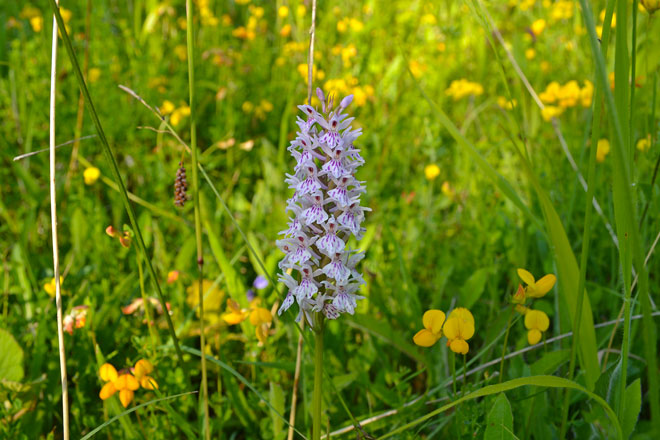
Common spotted orchid and trefoil, White Hill, Shoreham, on the Fackenden Down walk (in June 2019)

But by downloading the Picture This app on my phone (there are other similar tools too in the App Store, such as the excellent iNaturalist which I’ve also used) I’ve revolutionised my learning. The app compares your photos with its database pictures in seconds to tell you what you’re looking at. This has helped me identify stitchwort, bugle, white helleborine, yellow pimpernel, archangel, ground ivy, vetch, sainfoin, trefoil and milkwort, among others. It does tree leaves too. I’ve been quite oblivious to all this stuff for a long time, so please forgive my excitement.

Soon, an abundance of orchids will appear in places like Polhill Bank, Fackenden Down, Lullingstone, Magpie Bottom (see Walks on the menu above) and I can’t wait to get stuck into working out what’s what. The walks on this site are excellent for flora with chalky soils predominating on the North Downs; sandy soils on the Greensand Ridge and Weald routes.

I suppose flowery stuff is not the most useful information you’ll pick up in life but I find being able to identify wildflowers really does pique my interest and triggers curiosity about other things too… insects, birds and how our ancestors used these plants. It also makes up for the fact I am a pretty useless gardener.
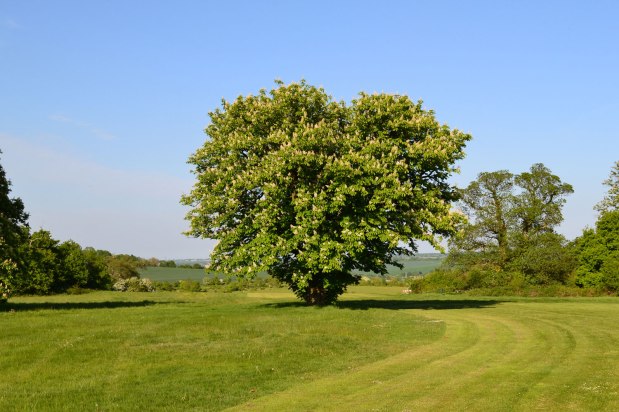
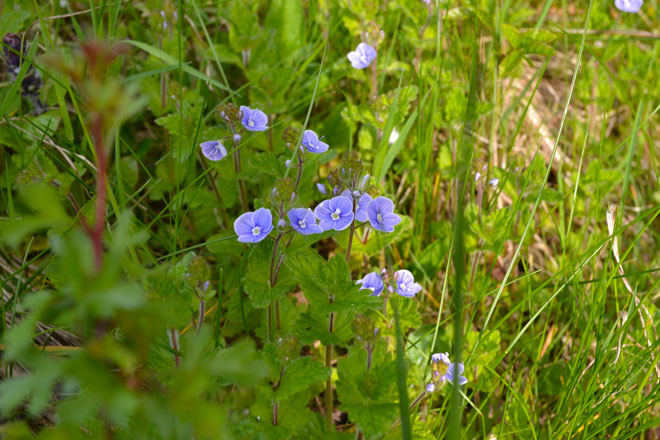
 

This slideshow requires JavaScript.

Lockdown loosening as spring unfurls

Lockdown loosening as spring unfurls

So from Wednesday it’s once again OK to drive into the countryside for a walk, but we are being urged to avoid using public transport to keep it safe for key workers. For the many without cars the walks will remain inaccessible but in the greater scheme of things, against the tragic current backdrop of lives and livelihoods lost, it’s not such a huge disaster. But it should be remembered that days spent out in the woods, fields and paths are hugely beneficial for mental health, I’d suggest in ways that the local park just can’t match. We also have to hope that the roads – and air – don’t become increasingly clogged as people jump in their vehicles for all purposes. Social distancing will need to be maintained, of course, and also take care around touching gates and fence posts – it would be a good idea to take wipes or hand sanitiser with you.

Speedwell.

Learning birdsong and wildflowers

This spring’s bluebells will mostly be over but there will be plenty of other spring delights to witness. Cowslips, vetch, bugle, stitchwort, speedwell and buttercups are all flowering and soon orchids will push their way through grassy fringes and meadows along with ox-eye daisies. Warblers have arrived from Africa and are burbling, chiff-chaffing, and whistling away unseen in the woods and hedges. Precious few swallows, martins and swifts are around so far, I hear – a worry perhaps. I’m always astounded at the volume generated by tiny wrens at this time of year, so definitely worth listening out for them. A great bird to see is the spotted flycatcher. They have been seen on many walks on this site, most recently in Knole Park, not by me, but by experts. They disappear back to tropical Africa in August having only arrived this month so seeing one is a relatively big deal.

A really good website for learning birdsongs is this oneDon’t be fazed by the huge number of species to learn. Just learn the ones most relevant – for example, wood warblers aren’t present (much) in Kent woodlands but willow warblers are more numerous. Try to learn the basics – say, robin, blackbird, wren, great tit, goldfinch and chaffinch – and soon you’ll be adding others. Don’t be too frustrated if you can’t see the bird you can hear: it’s often incredibly difficult with the trees in full leaf, and many of us find it hard to exactly pinpoint where the bird song is coming from, not only in terms of direction but in terms of distance. Kent walks near London birdwatching correspondent Dave, of course, is a master of not only identifying song but working out where the sound is emanating from him – remarkable talent built on experience gleaned when a nipper no doubt.

This slideshow requires JavaScript.

A late winter walk in the Ashdown Forest

A late winter walk in the Ashdown Forest

A rare day off afforded me (us, actually) to venture somewhere during an afternoon when it didn’t rain continuously. We settled on the Ashdown Forest, an hour’s drive from my corner of south-east London, in East Sussex between Tunbridge Wells and East Grinstead. A perusal of the visitor centre’s maps online led us to choose Walk 11, Chelwood Gate, in the south-west of the Forest.

The area has got the lot: interesting geology, flora and fauna, views, history and literature, being the landscape for Winnie the Pooh’s capers with many recognisable spots. These include Eeyore’s Gloomy Place, Galleons Lap, the Heffalump trap, for example, all of which can be identified.

The walk was beautifully laid out in printable format, with lots of informative text. But it was very difficult to follow; a “narrow path” beside a ditch was actually a wide path that went through a huge puddle – that sort of thing, but we made it around thanks to careful map analysis. In fact, with a compass, a sense of direction and an Ordnance Survey sheet you can pretty much make it up as you go; there are many paths to choose from and the Forest’s inner Pale is open for exploration in a similar way to Knole Park, for example.

What was immediately apparent was just how much rain has fallen this winter; everywhere there were overflowing ponds, gushing streams, seas of mud. You’d think it was Scotland at times. But in fact the Forest, being easily the highest point of the Weald between the North and South Downs does attract far more rainfall than the lower surrounding areas and really does pep up the local rivers, eventually flowing into the Eden and Medway. The high heath and the Pale melds into wooded valley mires where the pines give way to alder and birch, and planks serve as bridges over vigorous streams, alongside some very old looking stone bridges.

This slideshow requires JavaScript.


I love how the Forest has its own vocabulary: there are ghylls, hatches, laps … And the names of the car parks are evocative too: Friends, King’s Standing, Roman Road, Goat, and of course Piglets and Pooh.

After we finished with Chelwood Gate (where medieval hero John of Gaunt used to enter for hunting and a home to Howard Macmillan, who once entertained JFK here) we drove a few miles east past Nutley and up onto the highest part of the Forest, to Gills Lap (Galleons Lap in Winnie the Pooh). Up there the views extend over bright yellow gorse for mile after mile in all directions. We walked down to the memorial to AA Milne and EH Shepherd. I felt quite moved, those stories have a real character and a sense of an innocent time that has been lost.

Our final port of call was the 15th-century Anchor Inn in the small village of Hartfield, a cosy labyrinth of a pub that serves two of the finest ales in all England: Harvey’s and Larkins. As we arrived at dusk a barn owl glided across the road in front of us. Then it was back to the smoke to plonk in front of the telly to watch Chelsea beat Liverpool … who would have credited that?

Getting there on public transport: Train to East Grinstead from East Croydon then the 261 or 270 bus seems to be the best option. At East Grinstead the brilliant Bluebell Railway takes day trippers by steam train down to Sheffield Park, south of the Forest. At the moment a landslip caused by rain means trains can’t reach East Grinstead, but there is a bus service from Lingfield. Boring though… so best wait ’til services are restored, hopefully in spring.
Getting there by car: Drive via Keston, Biggin Hill, Westerham, Edenbridge, Cowden and Hartfield on the rather pleasant B2026.

A longer Downe route – my walk 20

A longer Downe route – my walk 20

Here’s a longer Downe route to follow; double the length of the existing Downe walk at 4.2 miles, so a pleasant 90-minute walk. See, download pdf or use GPX track from this page

It can be viewed on the GPSies site where a GPX track is available for you to download and follow on your smartphone (to get your real-time location tap the bottom-most button on the left of the screen).

The route starts and finishes at the same locations as the original Downe walk. The extension misses out on the lovely fields by Charles Darwin’s garden (although they are an easy detour away) and the Sandwalk but gains the superb ancient woods of Blackbush and Twenty Acre Shaw Woods with its superb April bluebells then orchids and gentians.

Last bluebells, Downe

Ancient woods: Blackbush and Twenty Acre Shaw

Yesterday the trees were rich with the calls of song thrush, chaffinch and wrens (so loud… and weird!). A sharp thundery looking storm slipped by to the south, on its way to Tonbridge and Sevenoaks (pictured). After the woods the walk joins the valley on the eastern border of the historic Biggin Hill airfield. Hedgerows, giant beeches and wild meadows make this a really rich looking habitat for flora and fauna; yesterday I saw nuthatches, greater spotted woodpeckers and a wonderful large tortoiseshell butterfly. Full description of walk here, but the GPX track should get you round easily enough. 

Next walk to be added to this site: Knockholt Pound/Chevening circular. By end of June.

Fabulous Fackenden

Fabulous Fackenden

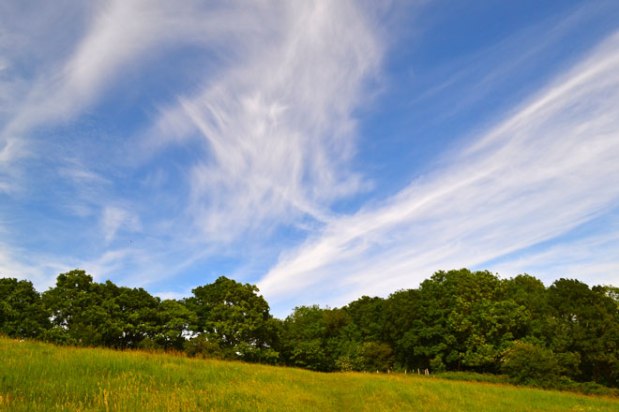
The Fackenden Down walk is such a winner at all times of year – and it’s so easy to get to from SE London, because it starts right outside Shoreham train station. In yesterday’s perfect weather wildflowers illuminated the hillsides and meadows; cirrus clouds offered a dramatic dreamscape high above and incessant birdsong filled the air. So many highlights on this walk: the bit when you leave the ancient beech wood and enter the timeless Magpie Bottom valley is my favourite. And the distant views of the City and the Shard from Romney Street are dramatic too. I was disappointed to see my team lose in the Champions League final later on (yet so thankful we got to the final) but the memories of the walk compensated. I created a GPX track of the walk too… so going off-route is now impossible (if you have a smartphone that is). The walk does have some steep sections though, so take it easy.

Interactive pdf of walk (to print or download on phone) is here.

This slideshow requires JavaScript.

Best bluebell walks in north-west Kent 2019

May 4: fading fast (Read 2020 bluebell piece here)

Just last weekend the bluebells were superb at Ide Hill, Meenfield Wood and Downe Bank but, while the odd patch lingers on spectacularly, time is already running out on the bluebell season. They peaked for only a short period this year it seems. I won’t claim any inside knowledge of why – maybe the lack of rain until the last day or so. But they are definitely already in obvious decline. Oh well … till next year then.

Last bluebells, Downe

Last bluebells, Downe. May 4, 2019

April 18: beginning to peak

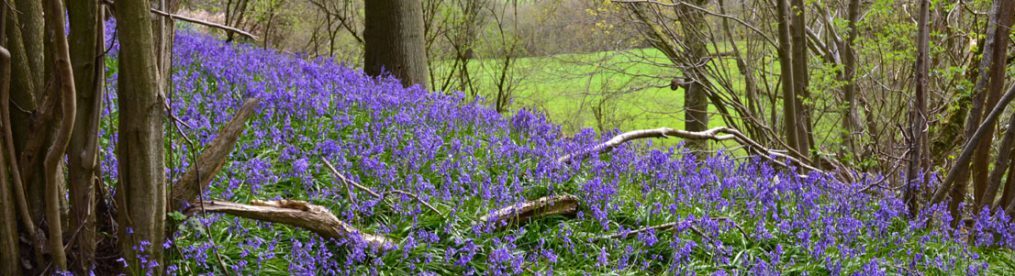
One of the most magical times of the year is when the woodland floor turns blue. From this weekend (April 19) onwards there should be a profusion of bluebells until the second week of May, so it will be worth heading for the woods. The best bluebell displays on the walks here are Ide Hill, One Tree Hill (walk 6 and 7), Polhill Bank/Meenfield Woods at Shoreham (walk 18), Hever, Petts Wood and Chislehurst, Westerham, Fackenden Down and Romney Street (19), and Downe (but only if you do the diversion down into the woods at Point 3 and continue to Berry’s Hill – marked on the map and the pdf). Eynsford/Lullingstone and Chiddingstone/Penshurst probably aren’t the best bluebell walks, although on the latter there are rich concentrations at one or two points.

Meenfield Wood bluebells

Early bluebells at Meenfield Wood, near Shoreham, Kent. 2019, April 13. © Adam McCulloch

In many of the woods you’ll be walking with the pervasive aroma of wild garlic (which you can use to make pesto sauce etc) and alongside plenty of cheeky little wild flowers – primroses, wood anemone, common dog violet, arum, red campion, wood-sorrel (oxalis), yellow archangel and orchids (Downe Bank, Lullingstone up from the visitors’ centre, Bough Beech’s Bore Place meadows particularly good for the latter). A highlight not to be missed is the profusion of daffodils at Ightam Mote (One Tree Hill walks) where you should also see buzzards wheeling and soaring in the thermals and yellowy/greeny brimstone butterflies floating around clearings and copses. Emmett Garden’s tulip ‘plantation’ on the Ide Hill walk is also wonderful. Look out for migrant bird species arriving, particularly the following warblers: chiffchaffs newly arrived from southern Europe and north Africa can be heard in all the woodland on these walks, and it’s worth learning and listening for the song of blackcaps and common and lesser whitethroats. The latter two, which arrive from as far away as sub-Saharan Africa, migrate at night and are a favourite of the birdwatching fraternity.

That reminds me, the One Tree Hill routes are very good for butterflies – where the path goes through the lee of the Greensand Ridge amid boulders and rich vegetation the insect world gets particularly busy and peacocks, orange-tips and brimstones proliferate on a bright day. This coming weekend (April 20), forecast to be warm, should be a good time to see them.

This slideshow requires JavaScript.

Easter Sunday silence

A very memorable walk on Easter Sunday. It was after 6pm when we set off for Downe, having waved friends off. We took the normal route, veering off at point 3 to see the bluebells. There was an extraordinary silence. No Heathrow or Gatwick aircraft in the stack and precious little activity at Biggin Hill; just one executive jet took off in the course of the hour.

For some reason there was no traffic at all, although the pubs in the village were reasonably busy. I don’t think I’ve ever walked in this corner of the world with so little background sound, just birdsong. On that subject we distinctly heard the call of stonechats at point 5-6 from nearby undergrowth (a sound like two stones being knocked together). This was odd because stonechats are usually a bird of heathland. Anyway, a lovely sunset added to the tranquil, timeless scene and there wasn’t a cloud in the sky.

A special stroll.

This slideshow requires JavaScript.

The North Sea comes to the North Downs

South-east London’s first April weekend was a dullard; very disappointing at a time of year when colour is returning to parks, gardens and countryside. A breeze from the North Sea – not a particularly cold one – brought thick stratus, drizzly outbreaks and, on Saturday, a gloom that made it hard to distinguish 3pm from 7pm. Headlights were on, people hurried past, huddled, on the pavements. On the North Downs escarpment the cloud barely scraped over the hills and the drizzle intensified; but there was a snug softness in the air and sudden increases in brightness as the sun attempted to break through before being smothered by the North Sea murk once again.

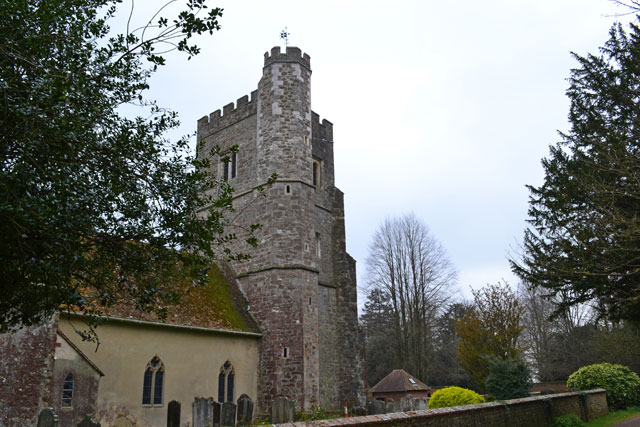
Chevening church, Kent

Chevening church, St Botolph’s © Adam McCulloch

Chevening

Near Chevening, beneath the scarp, on a murky day in spring © Adam McCulloch

Sunday was marginally better, but the Spitfires and light aircraft of Biggin Hill were still well and truly grounded – so none of the flybys accompanied by the growl of piston aero engines you usually get in these parts. We did two walks at Knockholt Pound, taking in Chevening hamlet: one to the west that loops back on to the North Downs Way via Sundridge Hill; the other to the east, heading down by Star Hill Lane then swinging right past messy farmyards to Chevening’s ancient St Botolph’s Church. The first bluebells are out and other wildflowers punctuated the grey proceedings along with myriad ultra-busy birds. A bullfinch was spotted, a buzzard (always a buzzard or two at Chevening) and more pheasants than I’ve ever seen.

I may well add the combined walk to this site next week, but I’m not totally satisfied with it; some good views and points of interest but there’s one bit where there’s too many farm tracks and rubbish heaps and I’m not even sure if you’re allowed to walk there. Also, the woods seem a bit too managed – logging, and probably something to do with all the pheasants.

Dungeness dallying

Not that near London…

That weird peninsula in ultra south-east Kent has a particular allure for many. Strange but wonderful light, mystical buildings from down the ages – all clashing; the delightful miniature railway that goes for miles, a lovely pub and interesting flora and fauna – particularly birdlife.

Fishermen often land cod, plaice, bass and mackerel off the shingle close to the power station and twitchers delight in the migrant species that drop by. Historic structures abound and very trendy modern architecture peppers the shoreline among the fishing hulks, converted old railway wagons, coast guard and lifeboat buildings, nuclear power station and two-and-a-bit lighthouses. Local residents probably get a bit hacked off at the sightseers trampling noisily in the shingle around their homes (especially whoever lives in Derek Jarman’s old gaff these days) but that’s the price of living in a nice place.

This slideshow requires JavaScript.

Well, ‘nice’ isn’t really the right word. It’s ‘different’, not nice.

We went hoping for some sun but got little last Thursday. We were really taken by the fish’n’chips at The Britannia pub though, and the cool nautical decor (best pub loos ever). The Brexit Phonebox installation was quite striking too. I forgot my binoculars so relied only on mk1 eyeball to spot marsh harrier, a curlew, a hobby (I think) and a few wheatears. Probably wouldn’t have helped much anyway; my binox are rubbish. We popped in at the RSPB reserve later where there was a plethora of digging bees; an apparently rare sub species (More on Dungeness at North Downs and Beyond.)

One thing, if driving down (not the only way; you could get a train/bus/Dymchurch Railway combination from London) I’d avoid the M20… because of well publicised reasons (too depressing/boring to go into here), but also the lorry-up-your-arse thing. Instead, leave early take a leisurely and really scenic drive down the A21, turn off to Hawkhurst, Northiam then past Rye and Camber.

This slideshow requires JavaScript.