Thanks and best wishes to all readers… let’s get walking again

Thanks and best wishes to all readers… let’s get walking again

First of all, I wish all the best to Kent Walks near London readers as we all try to get through this period unscathed in terms of our health, your livelihoods and sense of wellbeing. To those who have had or still have Covid-19, many sympathies – it sounds horrendous in many cases. The countryside is slowly opening up, but we should all be mindful of social distancing and try to make way for each other on narrow paths. Let’s avoid overcrowding in good weather and take wipes for handling gates and stiles if possible.

Second thing, thanks to all those who have donated to this website… entirely voluntary so a heartfelt thanks from me. It’s only a small amount of course but it will help me produce more walks, better mapping and information and some will be going to charities too. There are adverts on the site too, you’ll see, but a niche page like this is never going to pull in the big bucks from the AdWords model so it’s little more than a token gesture towards commerciality. Maybe display ads from dedicated sources – outdoor retailers, pubs, or as you are about to read, apps – may be the way forward.

Oh, and please check out the Kent Wildlife Trust website. KWT manages some of the woods and sites on here (as does the Woodland Trust), helping maintain the paths and creating brilliant areas for flora and fauna. It deserves our full support (and donations right now).

’appy days with wildflower apps

Out and about for the first time in a while at the weekend made me reflect that May, June and July are probably the best times of year for trying to work out what kinds of wildflowers you hopefully aren’t trampling over.

Many wildflowers aren’t that spectacular compared with cultivated garden plants and we sort of take them for granted. But notice how, unlike some of our garden species, they don’t seem to suffer from the dry conditions so much.

Until recently I only knew obvious ones: cow parsley, buttercup, ox-eye daisy, buttercup, pyramidal orchid, etc. I was a blooming ignoramus you might say. But I started adding to my list by asking friends, looking at my dear departed mama’s old, faded book of illustrations (complete with samples turning to dust) and looking at websites. I half remembered things my mum told me as a kid, so pretty soon I could identify scabious, red campion and the like. And the more you keep an eye out and record, the more interesting the whole caboodle becomes. You start to appreciate the shy little flowers of the woods, meadows and margins, their colour and what they give to various creatures.
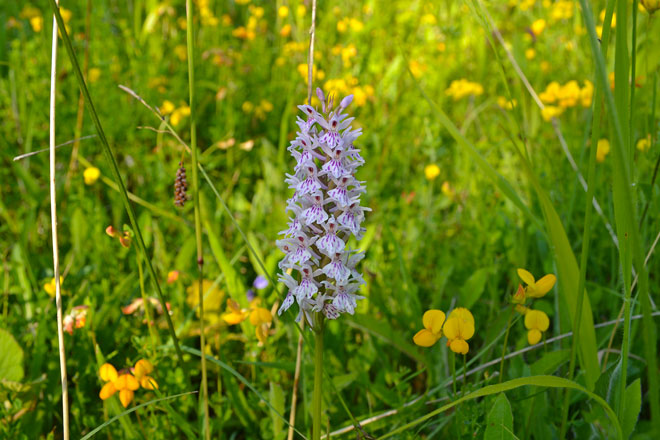
Common spotted orchid and trefoil, White Hill, Shoreham, on the Fackenden Down walk (in June 2019)

But by downloading the Picture This app on my phone (there are other similar tools too in the App Store, such as the excellent iNaturalist which I’ve also used) I’ve revolutionised my learning. The app compares your photos with its database pictures in seconds to tell you what you’re looking at. This has helped me identify stitchwort, bugle, white helleborine, yellow pimpernel, archangel, ground ivy, vetch, sainfoin, trefoil and milkwort, among others. It does tree leaves too. I’ve been quite oblivious to all this stuff for a long time, so please forgive my excitement.

Soon, an abundance of orchids will appear in places like Polhill Bank, Fackenden Down, Lullingstone, Magpie Bottom (see Walks on the menu above) and I can’t wait to get stuck into working out what’s what. The walks on this site are excellent for flora with chalky soils predominating on the North Downs; sandy soils on the Greensand Ridge and Weald routes.

I suppose flowery stuff is not the most useful information you’ll pick up in life but I find being able to identify wildflowers really does pique my interest and triggers curiosity about other things too… insects, birds and how our ancestors used these plants. It also makes up for the fact I am a pretty useless gardener.
 

This slideshow requires JavaScript.

Awesome orchid wonderland

Awesome orchid wonderland

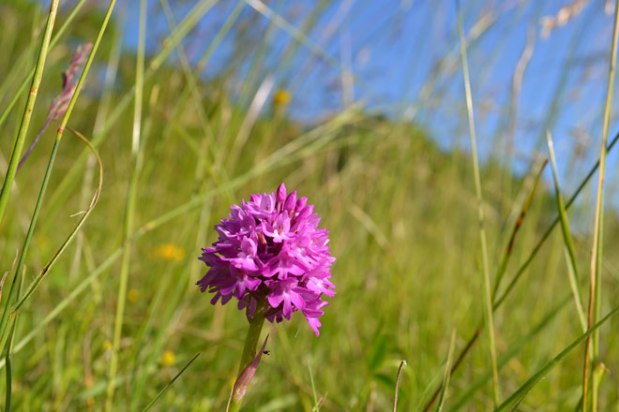
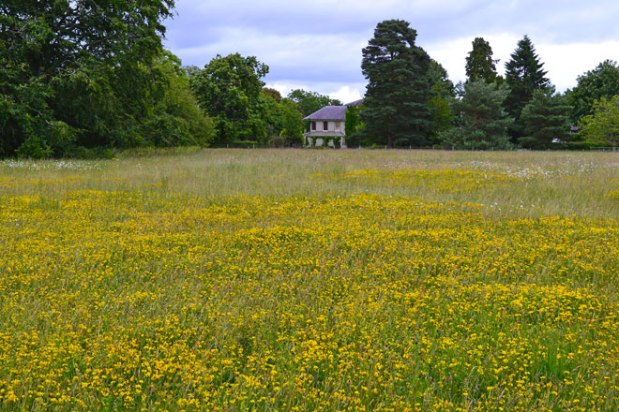
I was bowled over by the wildflowers on the Fackenden Down walk yesterday. I’ve never seen so many orchids; with yellow trefoil and tall ox-eye daisies blazing away as a background some of the meadows were mesmerising. Full credit to those managing the sites of special scientific interest at Magpie Bottom, Austin Spring and Fackenden Down along to White Hill (Kent Wildlife Trust in conjunction with local landowners?). Their hard work has produced a superb return. I’m not good at identifying orchids beyond the pyramidal variety, but I’ll give it a shot for the photos.

To strike a more negative note, I got the feeling there should still be more insects enjoying this abundance; there were plenty of bees around but not a lot else (a few marbled white butterflies, the odd peacock butterfly and red admiral notwithstanding). There was a distinct lack of swallows, martins and swifts, too. These species haven’t made it to these shores in great numbers this year it seems and that could be because of the effect of insecticides. But anyway, a beautiful and memorable walk.

And remember, this wonderland is only 50 minutes direct on the train from Peckham Rye, with the walk starting opposite Shoreham station.

This slideshow requires JavaScript.

Downe Downe deeper Downe

Downe Downe deeper Downe

I’ve always liked that Status Quo song ever since I was a young teenager. I’m no headbanger but it’s got energy and drive – which Kent walkers have in abundance of course.

GPX dodgy and iffy instructions

I did both Downe walks this weekend. The weather was distinctly iffy so I couldn’t be bothered to go far. So I did the new longer Downe walk on Saturday and the usual shorter one on Sunday with my wife. She was not too impressed by my instructions; “too wordy” she said in a slightly irritated fashion after about 50 yards. My attention was somewhat distracted by a B-17 Flying Fortress flying low overhead, but then she pointed out I had omitted to mention any stiles and gates and thought my ‘line of trees’ was really a wood. It made me realise that we all see things a bit differently and that I’m so familiar with the walk that I was imagining rather than actually seeing. That’s quite a phenomenon – try describing your walk to the station or to the office… it’s so obvious to you but you suddenly realise that you’ve completely misdescribed a house or a shop.

Compounding the unclear directions is the uncomfortable fact that the GPX tracks I’m pointing people to on the website are distinctly dodgy. On Saturday it was only right 50% of the time; often the blue dot marking your ‘live’ location would linger unhappily in a nearby road or layby. No idea why. Could be a signal thing or a sign you are running out of data, a position I’m very familiar with. Today, on the short Downe walk, the GPX was inaccurate the whole time. I’ll have to redo the track, maybe using a different website but then there might just be something about Downe, deeper Downe.

Here’s the pdf for the new instructions for Walk 1 Downe Circular. Gratitude to my wife for opening my eyes and apologies to anyone I’ve misled. And here is, hopefully, a more reliable GPX track.

By the way, I’ve learnt a new wildflower name and I’m going to use it. Birds-foot-trefoil. It’s small and yellow and spectacular at Downe, particularly in the meadows close to Darwin’s house (of course!). Apparently the plant is a staple in the diet of caterpillars of common blue, silver-studded blue and wood white butterflies. There are also pyramidal orchids at the moment in the the hillside fields that end the walk.

Hillside field point 7-8, Downe

A longer Downe route – my walk 20

A longer Downe route – my walk 20

Here’s a longer Downe route to follow; double the length of the existing Downe walk at 4.2 miles, so a pleasant 90-minute walk. See, download pdf or use GPX track from this page

It can be viewed on the GPSies site where a GPX track is available for you to download and follow on your smartphone (to get your real-time location tap the bottom-most button on the left of the screen).

The route starts and finishes at the same locations as the original Downe walk. The extension misses out on the lovely fields by Charles Darwin’s garden (although they are an easy detour away) and the Sandwalk but gains the superb ancient woods of Blackbush and Twenty Acre Shaw Woods with its superb April bluebells then orchids and gentians.

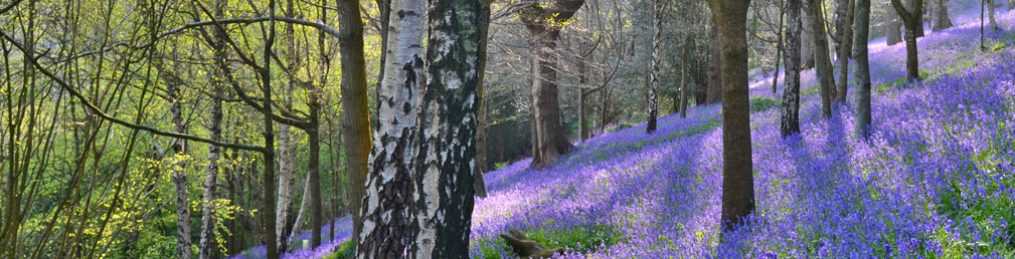
Last bluebells, Downe

Ancient woods: Blackbush and Twenty Acre Shaw

Yesterday the trees were rich with the calls of song thrush, chaffinch and wrens (so loud… and weird!). A sharp thundery looking storm slipped by to the south, on its way to Tonbridge and Sevenoaks (pictured). After the woods the walk joins the valley on the eastern border of the historic Biggin Hill airfield. Hedgerows, giant beeches and wild meadows make this a really rich looking habitat for flora and fauna; yesterday I saw nuthatches, greater spotted woodpeckers and a wonderful large tortoiseshell butterfly. Full description of walk here, but the GPX track should get you round easily enough. 

Next walk to be added to this site: Knockholt Pound/Chevening circular. By end of June.

Fabulous Fackenden

Fabulous Fackenden

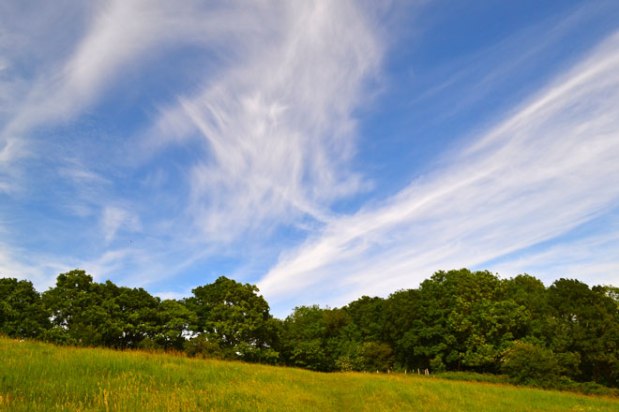
The Fackenden Down walk is such a winner at all times of year – and it’s so easy to get to from SE London, because it starts right outside Shoreham train station. In yesterday’s perfect weather wildflowers illuminated the hillsides and meadows; cirrus clouds offered a dramatic dreamscape high above and incessant birdsong filled the air. So many highlights on this walk: the bit when you leave the ancient beech wood and enter the timeless Magpie Bottom valley is my favourite. And the distant views of the City and the Shard from Romney Street are dramatic too. I was disappointed to see my team lose in the Champions League final later on (yet so thankful we got to the final) but the memories of the walk compensated. I created a GPX track of the walk too… so going off-route is now impossible (if you have a smartphone that is). The walk does have some steep sections though, so take it easy.

Interactive pdf of walk (to print or download on phone) is here.

This slideshow requires JavaScript.

The austere beauty of the Kent Downs in winter

Winter has arrived but it remains mild; with more rainfall the mud has churned up on the most of the walks so it’s time for wellies. But take care: the chalky Darent Valley hillside paths can be a bit slippery at this time of year, particularly where the paths are worn and the chalk is close to the surface. But the austere beauty of the North Downs in winter is now evident, especially on the eastern side of the valley – walks 5, 14 and 19 – and on the Eynsford routes: walks 3 and 12. If the temperature drops a bit take a flask out with some hot chocolate and maybe a shot of something stronger – really works out here in an easterly wind!

Each of the walks on this site have their own character. There’s definitely a split between the southern routes, such as Chiddingstone, Ide Hill and at Hever, which are more wooded and somehow bucolic, and the more hilly, more grassy northern routes of the Darent Valley where the ridgelines are the highest points for an easterly winds for hundreds of miles. It’s all very atmospheric; when walking I often imagine what life was like for Saxons, Romans, Britons and Vikings who settled these parts and picture them on their long, painstaking journeys.

So, here’s a useful way of choosing a walk near SE London … enlarge the map, then just click on the labels and lines to find a walk that suits you. You’ll see there’s quite a spaghetti junction of walks around Shoreham, you can combine them all and stay out all week if you like! My tip this week is Walk 19: Fackenden Down. It’s on the eastern side of the Darent Valley – straight out of Shoreham train station and the views are terrific. The walks are also on the menu at the top. Enjoy…

My walks

Download Walk 1: Downe circular (near Bromley, 2.6 miles) View on your phone/desktop
Download Walk 2: Shoreham circular (3.5 miles) View
Download Walk 3: Shoreham to Eynsford (4.2 miles) View

Download Walk 4: Ide Hill circular (3 miles) View
Download Walk 5: Otford circular via Romney St (5.5 miles) View

Download Walk 6: One Tree Hill circular (near Sevenoaks, 5.5 miles) View
Download Walk 7: One Tree Hill figure of eight (near Sevenoaks, 5 miles) View
Download Walk 8: Shoreham/Otford circular (5 miles) View
Download Walk 9: Hever circular (4.5 miles) View
 Download Walk 10: Chiddingstone/Penshurst circular (4 miles) View
Download Walk 11: Knole Park’s Wild Side (3.5 miles) View
 Download Walk 12: Eynsford/Lullingstone circular (4 miles) View
 Download Walk 13: Chislehurst station to Petts Wood station (3.7 miles) View
Download Walk 14: Shorehams mystery eastern valleys (5 miles) View
Download Walk 15: Westerham/Chartwell (5.5 miles)
View
Download Walk 16: Shoreham circular mk2 (3.5 miles) View
• Download Walk 17: Bough Beech/Bore Place (2.5 miles) View
Download Walk 18: Shoreham/Polhill Bank (4 miles) View
Downland Walk 19: Fackenden Down (4 miles) View
Download Walk 20: Downe circular mk2 (4 miles) View

An online version of the Ordnance Survey map 147 can be found here but strangely some public footpaths are not included. I’m gradually working on making GPX files for the walks so they can be followed ‘live’ on smartphone, but, ahem, slow progress is being made!

September. A glorious month for walking

There’s still a couple of months before mud sets in, and with fine weather, hedgerows fully laden with berries and insects, trees still in full leaf and birdlife on the move, this is a great time to hit the paths. And I daresay some will prefer the mild temperatures we’re having now, compared with the scorchio stuff that enveloped us in July.

This slideshow requires JavaScript.


One Tree Hill figure-of-eight walk, in the light of August

A beautiful stroll on Sunday in 32C sunshine at One Tree Hill, Sevenoaks. We did a version of the figure-of-eight walk, past Ightam Mote, skirting Shipbourne then on to the hamlet of Budds before climbing back up the green sandstone ridge at Wilmots Hill. We passed hardly a soul but nor did we see many birds. Everything was still, waiting for evening coolness as the last of the daytrippers sidled contentedly away from Ightam Mote, smiling and clutching bags containing goodies from the National Trust shop. The hushed reverential mood of the day was only heightened by the sudden appearance of one of the Biggin Hill Spitfires glistening in the sun, banking hard towards Plaxtol and briefly getting into formation with a slow twin-engine passenger plane (maybe a photo sortie?) before dashing off west. A thrilling sight.

This slideshow requires JavaScript.

Quieter Shoreham walks

For anyone who’s enjoyed the Shoreham Circular walk really should give the Shoreham Circular Mk2 a go. It goes along the ridge on the eastern side of the valley before dropping down and eventually joining the Mk1 route by the Darenth golf course. It’s a lovely quiet stroll starting in ancient woods (slow worms, buzzards, woodpeckers), ascending to the top of the hill eventually with great views and wild chalk meadows which teem with butterflies. It all ends by the George pub…

It’s pretty decent for public transport too… Shoreham station is opposite the start of the walk and can be reached by direct train from Blackfriars on the Catford loop line via Nunhead etc (check first, the Thameslink network is chaotic – there’s also the option of a train to Sevenoaks on the London Bridge-Orpington line, then changing). Give it a go this weekend, all is set fair.

If you fancy something longer, ending up in the same place, then the mysterious eastern valleys walk from Shoreham station or the Romney St/Otford/Shoreham circle (from Otford station) will fit the bill.

Glorious meadows and woods of Chiddingstone, but few birds…

Whenever I do the Chiddingstone walk it seems to be fantastic weather. Sunday was a real beauty, clear skies, bright sunshine, a whisper of cool breeze. Our resident anonymous birdwatcher Dave came along and straightaway I heard and saw far more species than usual; cuckoo, song thrush, skylark, goldfinch, and best of all, marsh tit in the swampy woods near the start of the walk. The latter is rare enough to be worth recording with the Kent Ornithological Society, which Dave duly did.

The cuckoo we later saw flying between oaks. For a moment I thought it was a kestrel, with its rapid flap, but Dave pointed out that the wings stayed too low for that to be the case.

Odd though that we didn’t see buzzards or kestrels. And there were only a few swallows, despite the many fantastic meadows left untamed and absolutely buzzing with insect life including mayflies. No swifts at all or house martins. Dave said this was troubling and representative of the mass decline in bird numbers (and, actually, insect numbers) in Europe as a probable result of farms’ use of neonicotinoid insecticides, now being somewhat tardily restricted by the EU.

However, one insect we did see several examples of was the european hornet (Vespa crabro). There’s clearly a nest in the village somewhere, but we also spotted some individuals at the Penshurst side of the walk. These are native hornets and are less troublesome than wasps in many ways; they don’t seem to be such suckers for sweet things for one thing. We certainly enjoyed a swift Larkins at the Castle Inn without being troubled by those we saw zooming around nearby. Of course, when they sting, they hurt. Like hell.

An awesome walk and so much to enjoy.

This slideshow requires JavaScript.