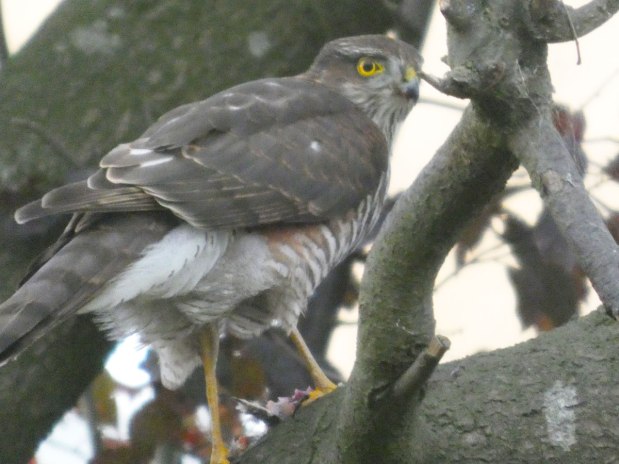
Working from home has its benefits. A glance out of the kitchen window one grey Thursday recently brought rich dividends. There in the cherry plum tree was a bird. Usually it would be a pigeon, a robin, a great tit or goldfinch. This was larger and was clearly eating something it had pinned to a branch. It was a sight I’ve never seen before – almost a bucketlist scenario in fact, a sparrowhawk in my garden. I’ve had the odd sparrowhawk encounter in my pocket of south-east London before – soaring over Cator park, racing down Perry Vale, zipping low through Mayow Park and most vividly nearly taking my ear off while chasing sparrows in Bell Green. Yes, Bell Green, that hitherto unnoticed wildlife haven. I’ve seen one try to eat a pigeon at Beckenham Cricket Club while out running. It was chased away by crows and the pigeon flew off unimpressed by its brief ordeal.
Male sparrowhawk notices a crow eyeballing it from across the garden. Not bothered.
Don’t look too closely if you’re squeamish. Nature is red in claw …
What a privilege to receive a visit from this superb bird
But this was new to me. A sparrowhawk having lunch (a poor little long-tailed tit I believe) for about 10 minutes, unhindered, just a few feet from me. I had to take photos through the kitchen window so as not to disturb him (it was def a male) so the quality isn’t great but beggars can’t be choosers. I’m still rather excited by the whole thing truth be told.
It was great to hear that Kent Wildlife Trust made it to their £196k target to buy an extra 26 acres to extend their Polhill Bank reserve, which features on a couple of KWNL routes – Pluto and Meenfield Woods. I headed out there earlier today, sacrificing the first set of the French Open tennis final. I had a subsidiary mission – to buy a shrub. I was actually planning to go to Coolings for this purpose, near Knockholt, but the traffic was so horrendous on the pertinent routes past Bromley and Hayes that I diverted to Polhill Nursery so I could return to SE London via the Orpington bypass road, up through Chislehurst. I had a good look at Polhill Bank. The first pyramidal orchids were showing, along with loads of milkwort, speedwell and all the June usuals. My expertise does not extend to plants beyond the common species. There were few birds around: I heard a cuckoo briefly, which is something, a whitethroat and eventually a yellowhammer. Buzzards soared, a swift swooped around; there were no swallows or martins disappointingly. However, for the first time I saw a lizard at this reserve. I’ve long wanted to see one here because KWT’s website proclaims their presence on these sunny slopes. So I was delighted. I really had to look and just caught it in the corner of my eye in a gap between vegetation. I stayed on the path and was determined not to disturb it in any way as it was sunning itself on a piece of wood. As a result my photos are rubbish. But that is less important to me than the fact I documented it and didn’t tread on anything I shouldn’t have – and left it in peace.
Common lizard at Polhill
Heavy rainfall has formed pond just beyond Polhill
Mysterious birder Dave has emerged once again from his Kent weald lair! This was great news on this gusty, mild, cloudy day with a walk at Knole planned. Dave’s presence would ensure that I would observe or hear (rarely both) species I wouldn’t usually encounter when walking alone. Arriving at Knole late thanks to an unforeseen ambush cunningly laid by temporary traffic lights on the A21, I spotted Dave already staking out the territory in Knole’s south eastern corner. “There’s nothing here,” he said, greeting me with breezy optimism. But it wasn’t entirely true. By standing still amid the beeches and oaks in the open woodland of that area of the park it seemed the birds started to come to us. First a troop of chaffinches (but not as far as we could tell the hoped for brambling), then coal tit, song thrush, nuthatch, greater spotted woodpecker and goldcrest. As we entered the south eastern conifer plantation we heard siskin (pictured header) – or rather Dave did.
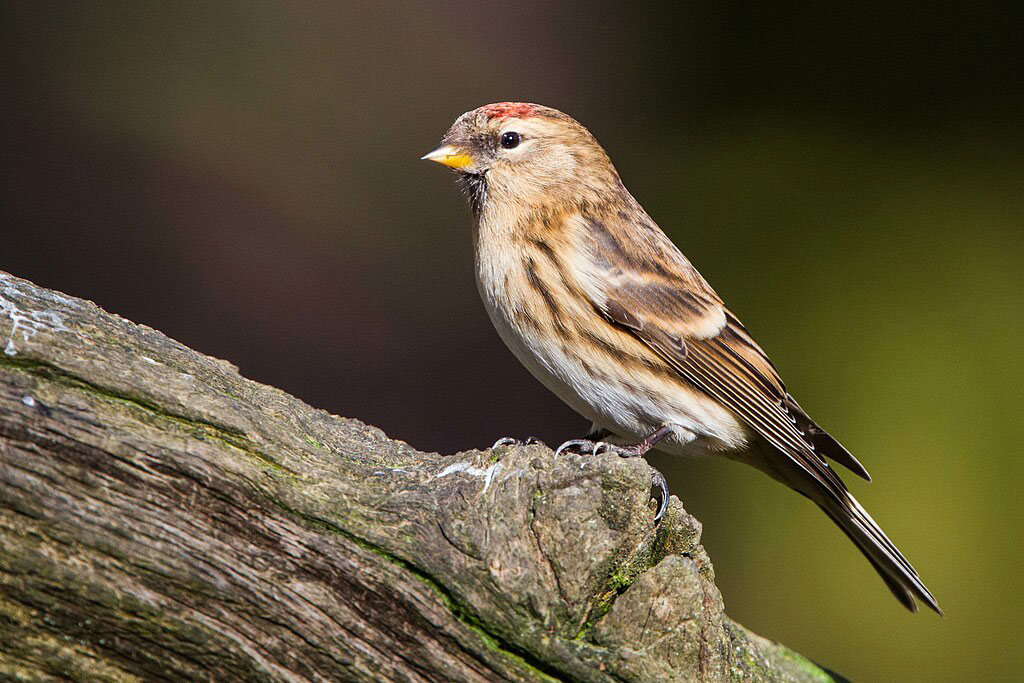
Lesser redpoll. Photo by Ron Knight/Wikimedia Commons
Later a lesser redpoll (pictured above) flew over, a very delicate little finch type thing. Two greenfinches – not at all common these days – were spotted at the top of a tree, while more predictably, a buzzard wheeled above. Mistle thrush was then heard and a flock of redwings streamed across the field on the Godden Green side of the wall on the eastern fringe, where there’s a lovely view of Fackenden to Kemsing downs and of the Darent Valley opening. Finally, a fetching pair of stonechat, a male and a female, alighted in grass just ahead of us as we started to walk up to the house. As we got close they hopped into the bracken tops, disturbing a roosting wren.
It’s definitely worth walking with Dave – you become aware of far more birds than you would normally see. I had to bite my lip though when checking the football scores – West Ham were playing at Man Utd and it wasn’t going well … sorry Dave.
Walking on the path through the scabious, ragwort, marjoram, yew trees and grasses on the chalky west-facing slopes of White Hill/Fackenden Down last Saturday I spotted a wasp spider – a creature I’d never seen personally. It’s a spectacular arachnid, one that has been increasing its numbers in the south-east over the past 15 years. I guess a powerful orb weaver like this will be snaffling up drowsy late summer insects in the coming weeks. The walk itself was as beautiful as ever but quite bereft of bird life, which isn’t unusual for late August just prior to the large migrations. Only a solitary buzzard and a charm of goldfinches being of note, though we weren’t being particularly observant. Oddly, not a single swallow was noted – unlike during the walk at Cudham the following day, where a red kite was also seen. My friend Teri took the spider photos.
The Polhill/Pluto walk was a delight this week; a chance encounter with a brown argus butterfly (pictured below by sort-of-accident while focusing on scabious flowers) on the Polhill Kent Wildlife Trust patch a highlight. The Andrew’s Wood segment of Shoreham Woods was full of great willowherb, marjoram and wild parsnip – a colourful brew. On the Darent Valley floor itself the sunflowers at Filston Farm were a treat and there were still some wild verbascum flowers in bloom at Sepham Farm. Very few birds were seen which is quite normal for this time of year although a hobby, a buzzard and a suspected corn bunting at Filston Farm were notable spots, while swallows were beginning to gather for their big goodbye. Yellowhammer were heard but not seen at the foot of Polhill.
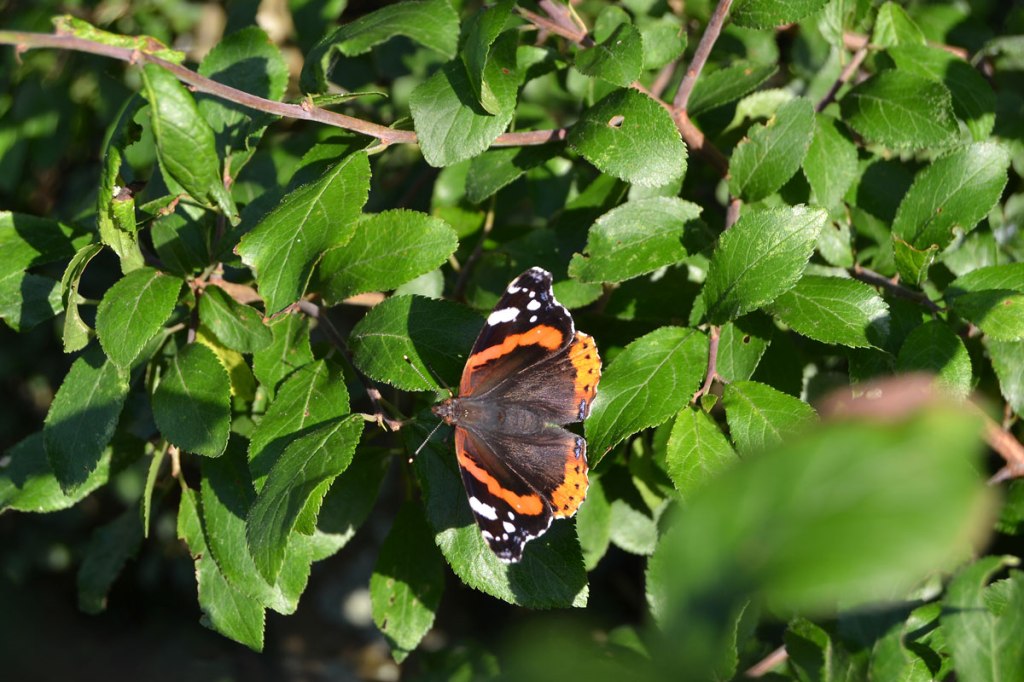
Late July, early August: it’s a slightly torporous time, and in most summers the countryside becomes gradually a bit tired and frazzled looking – rather like the Australian cricket team currently trying to play out the Ashes (now there’s a hostage to fortune). But this year, thanks to recent regular rain, there’s still a freshness about things. I particularly love the long grasses this year, so full of wildflowers – and such a contrast to last summer’s scorched earth. We’ve been lucky in 2023 in that respect, as other parts of Europe have literally burned. Nearly all the walks on this site feature beautiful grassy meadows at one point or another, the best being on the chalk North Downs at Downe, Shoreham (Eastern Valleys, Pluto, and Fackenden in particular, Knockholt and Cudham. Wild marjoram, wild carrot, ragwort, trefoil, knapweed, pyramidal orchids (still flowering) are among the common wildflowers all flourishing amid the grasses, creating a fetching spangle of purples, yellows, pinks, reds and creams among the greens. Anecdotally, butterflies have shown well this summer despite the mixed weather. At the moment it seems to me species such as comma, red admiral, marbled white and large white are the most commonly seen. In April and May, brimstones were a common sight, then peacock butterflies. I haven’t seen any silver fritillaries this year and hardly any orange tips or small tortoisehells, I’ve just been unlucky – others have seen them. Pictured below: red admiral butterfly, scarp view, knapweed in Chevening churchyard, a cleft in the North Downs scarp, a comma butterfly, the escarpment, a lonely path, all from Knockholt/Chevening short walk on a near-cloudless late July early evening.
I’ve long wanted to visit the Knepp Estate in West Sussex, about a 90-minute drive from Sydenham, so welcomed an opportunity to join one of my brothers in a perusal.
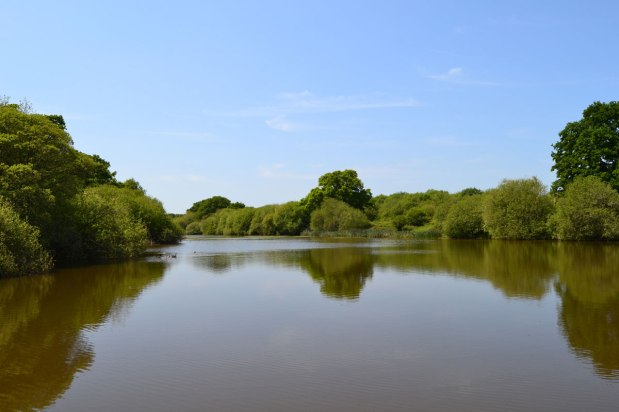
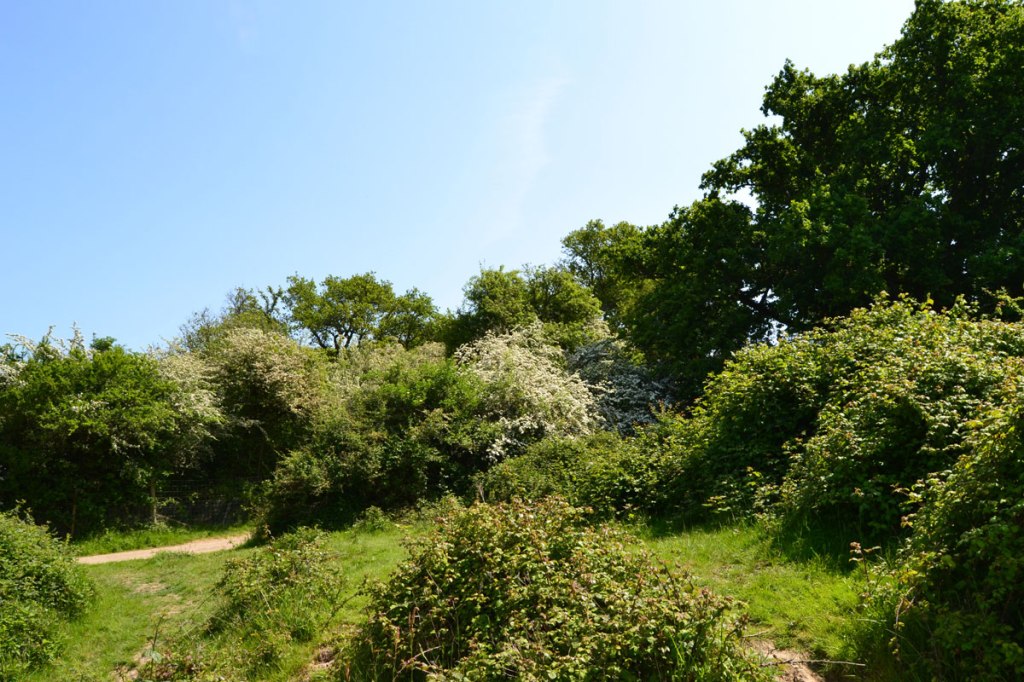
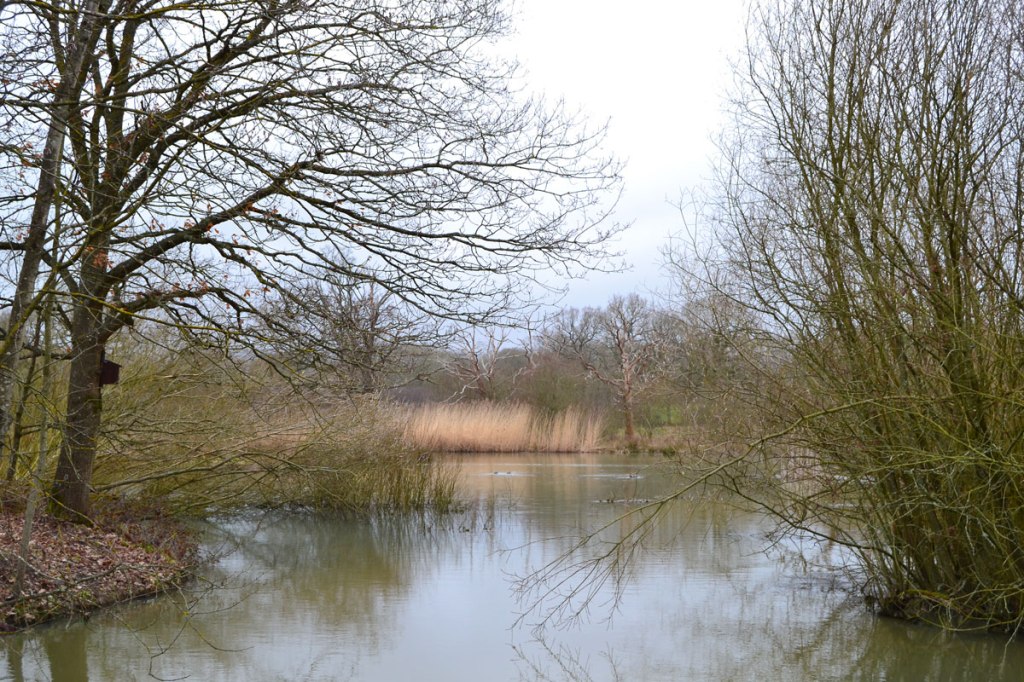
Knepp isn’t necessarily a photogenic place; there are no hills and valleys or stunning vistas. But its scrubby terrain, streams, ponds and pasture felt properly authentic and rural as if time had stood still for centuries. I was astonished by the abundance of hawthorn and blackthorn (pictured above) which underlined to me just how central these bushes and small trees are to our countryside. Soon after entering we came across several score whitethroats along with other warblers, heard a turtle dove, cuckoos, woodpeckers, yellowhammers and corn buntings. At a large pond (below) a kingfisher darted hither and thither. So the rewilding has clearly worked! We came across longhorn cattle, Tamworth pigs and red deer, each species of which contribute to keeping things in order and encouraging insects and birdlife. The pigs, an ancient species, are a substitute for wild boar.
But there was one beef I had: the local dog walkers. Sorry guys, but letting your dogs off the lead in such a place as Knepp is absolutely not on. I know it’s within the rules technically (the signs only specify ‘keep dogs under control’) but we saw three dogs clearly not under any control. One dog briefly went after the Tamworth pig family, causing the huge sow to go into full attack mode. Luckily, the gormless owners were able to grab their hound before any harm was done (to the dog) but in doing so they’d put themselves in some danger. I was seething at their stupidity! What’s odd is that I’ve never seen dogs so poorly managed on any of the Kent walks – so how can it be that a famous rewilding estate with such rare nature can attract such behaviour? The equivalent would be seeing dogs chasing deer in Knole Park – something I’ve never seen.
Of all the seasons-within-seasons, the end of winter, or springter, is one of the least enjoyable for walking I find. That doesn’t mean I don’t enjoy getting out into the countryside; it just means that when I do, I look around and think “meh” quite a bit. There’s still a lot to look out for in early March: old man’s beard (clematis vitalba), hazel and alder catkins, blossoming blackthorn, the vigorous growth of bluebell shoots, redwings and fieldfares flocking to migrate east, small birds breaking into song, the passage of gulls at high level etc, but the predominant colours are grey and brown, the air is still harsh and raw, mud clings to your boots and you slip on steep paths.
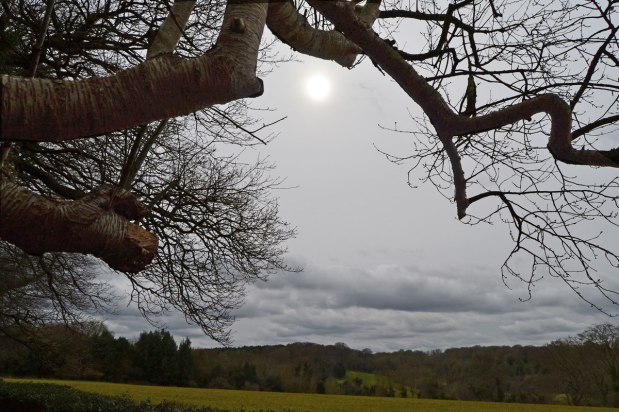
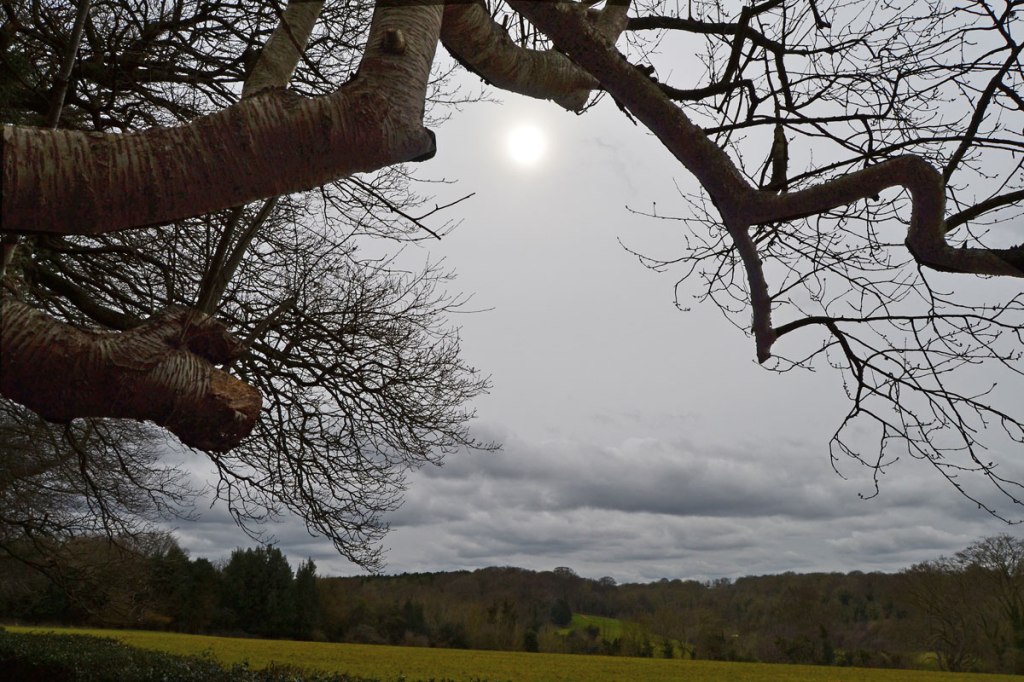
On recent walks to Hosey, Fackenden Down, Bough Beechand Downe, I found plenty to like but not much to inspire. This was partly because, apart from at Fackenden where there was an eyecatching sunset, the sky was unyielding and grey. Drama is needed in the sky at times like these, and springter often provides it as great air masses come into conflict, showering us with rain, hail, snow and sleet and producing fascinating aerial vistas. But at Hosey, all was monotone, at Bough Beech a thin Sunday drizzle dampened down any sense of vitality and at Downe, the morning brightness was consumed by a blanket of altostratus – the precursor to an approaching front – which had stealthily taken over the day as I was en route. But everyday is different if you look closely enough and the sun, a white ball behind the veil, did its best to make the stroll memorable.
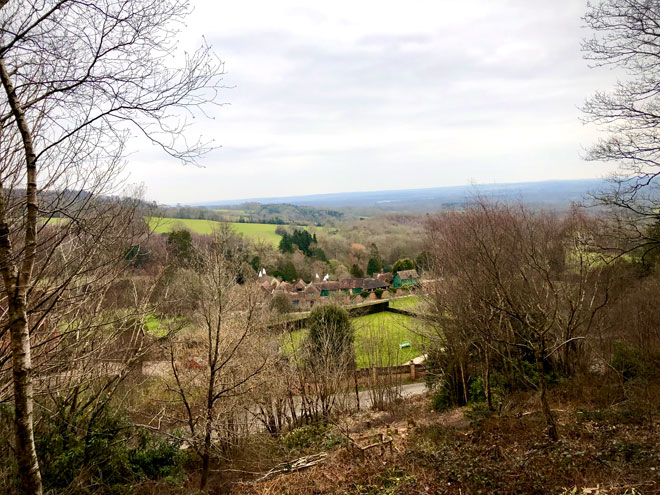
View over Chartwell, Hosey walk
Bough Beech nature reserve
View over Bough Beech reservoir from the Bore Place chair
Downe walk under altostratus cloud
View from Fackenden Down, March 2023
That terrific birder Dave accompanied me at Bough Beech, educating me as we went on the courtships of goldcrests, the behaviour of gadwall – a much underappreciated duck, he said – West Ham’s unsatisfactory season, the calls of marsh tit and treecreeper (I’d forgotten, again), and the distribution of local chaffinch populations. Although we made it to 39 species we saw no snipe, barn owl, brambling, kestrel or even buzzard as we hoped. The bird of prey fraternity was represented only by a solo red kite who lazily loitered above the low weald landscape for nearly half the walk, sometimes close, sometimes distant – an almost spectral presence so unfettered was it by the subdued, squelchy land below.
Thinking back to that red kite (which by the way would have been an extraordinarily rare sight in this part of the world until about 10 years ago) my springter moans and groans appear misplaced; these grey walks were brilliant.
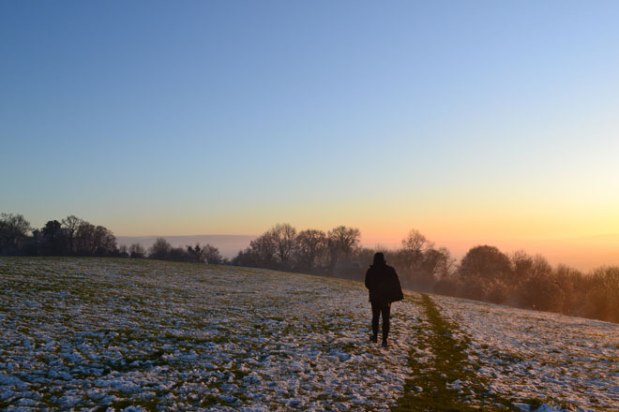
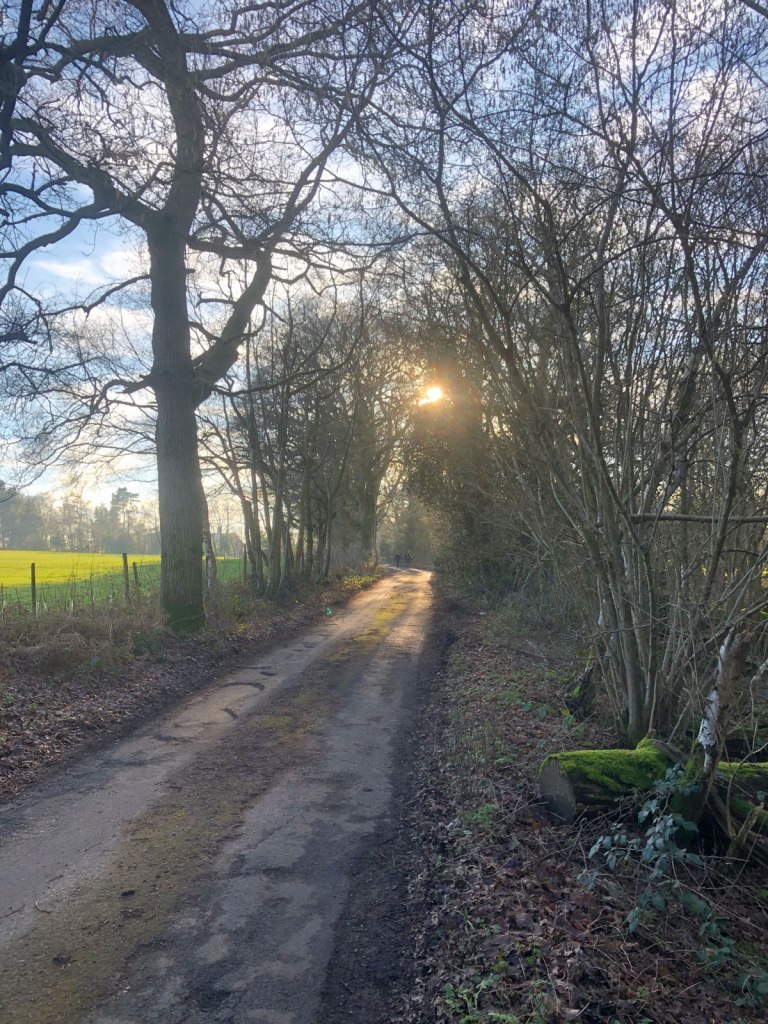
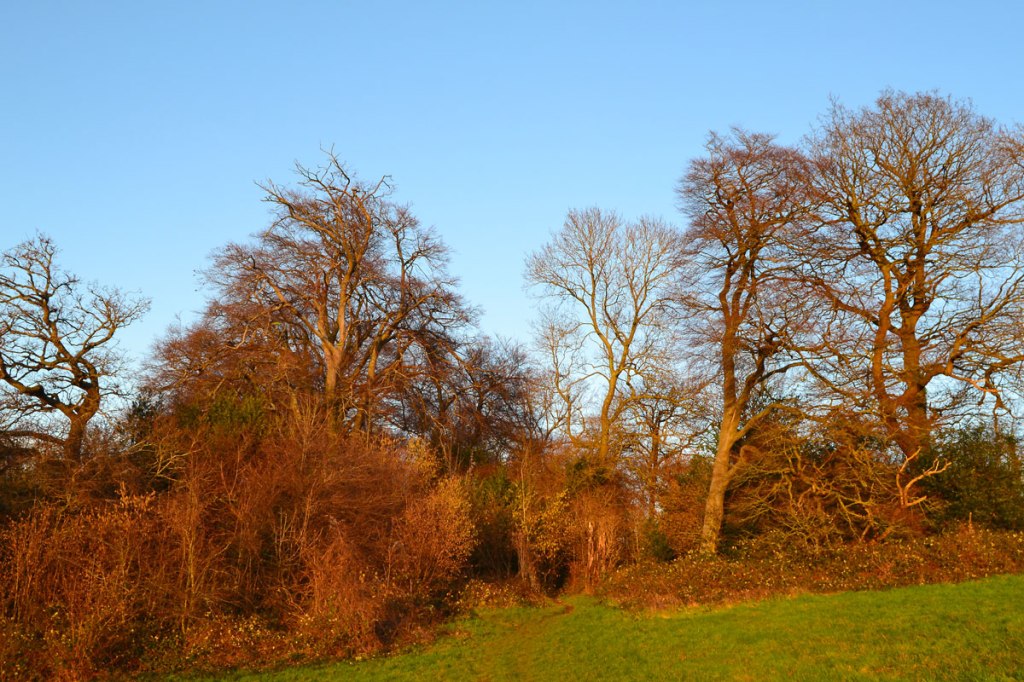
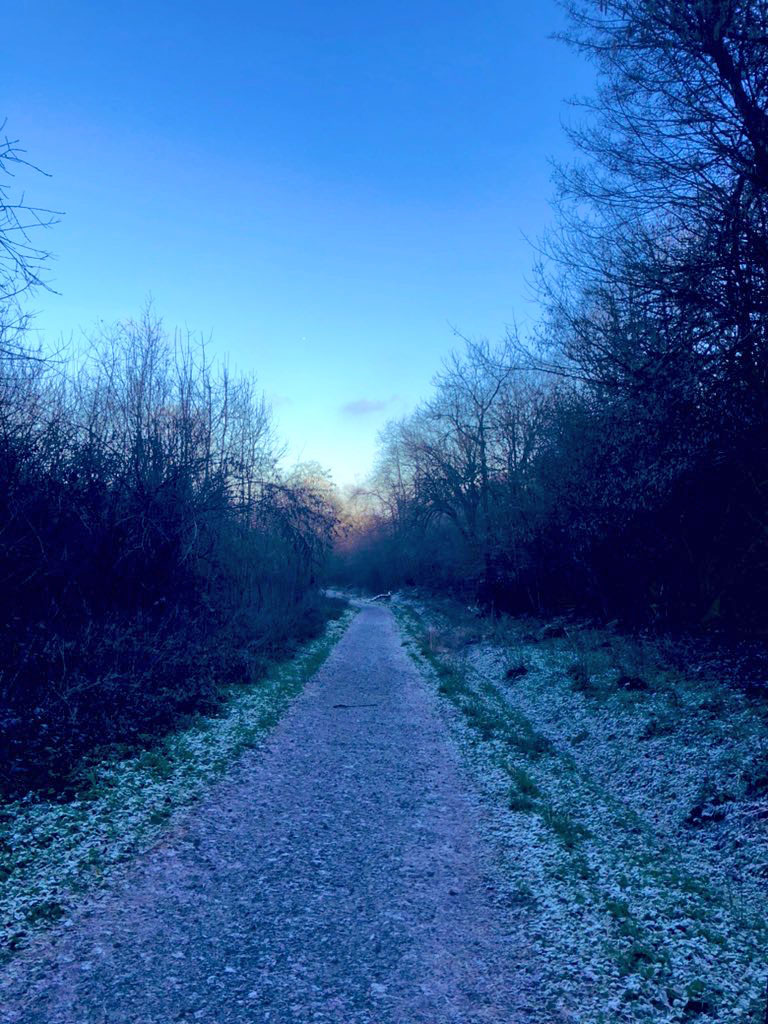
January walks are all about timing. Things can appear dreary, muddy, dank and generally unappealing but with the right weather conditions the quality of the light can make everything right. Clear, bright, frosty days are definitely the best for a Kent hike at this time of year and despite all the low cloud and rain this month, there have been quite a few such days falling at the weekend. Well, a couple anyway. We’ve tried to make the most of it and walks at Cudham, One Tree Hill, Ide Hill, Hosey, Downe (despite the new fences) and Petts Wood have come up trumps. With a hard frost, like the one we found at One Tree Hill last Sunday, a lot of the mud freezes, which helps considerably. Such days can be good for a spot of casual birdwatching too with small birds often so keen to feed that they care less for human presence – I’ve enjoyed up-close views of goldcrest, nuthatch, coal tit and brambling this winter. But it’s a mysterious affair; sometimes there are no birds at all.
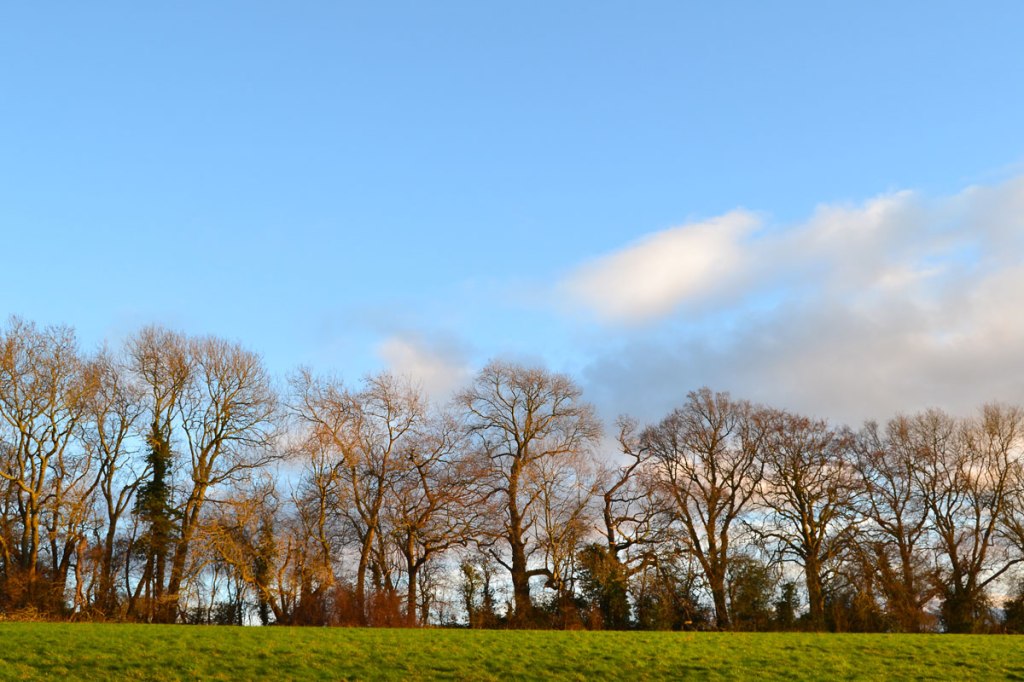
Beech trees catch the late afternoon sun, Downe
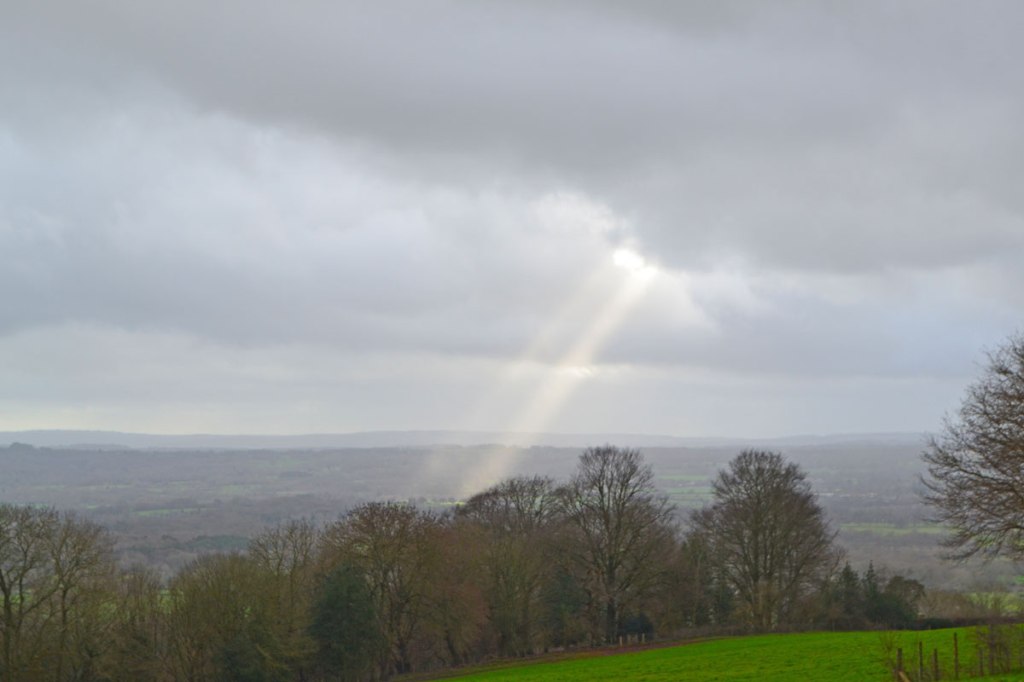
Sunbeam at Mariners Hill over the low weald of Kent.
Rooks Hill Lane on the One Tree Hill, Ightham Mote walk at Bitchet Green (iphone photo)
Sunshine on beech trees, Downe, January
Hidden valley, Ightham Mote in deep frost. iPhone photo.
Most of the time the wildlife on these walks is pretty elusive, the small birds skulk in the undergrowth, lizards and amphibians dart away as you approach. Badgers are asleep. But every now and then something odd happens. They forget about us and say ‘I want to bask in the sunshine, I can’t be bothered with all this hiding’. Clearly, this grass snake spotted by the legend that is Birder Dave (and photo courtesy of Dave) near the River Medway at Tonbridge, wasn’t too bothered about the prospect of a bird of prey swooping down or a fox pouncing. But then it was rather big and may have learned not to worry so much – Kent’s very own anaconda.
Grass snakes often hang out close to water; they are good swimmers and have a liking for amphibians among other things. I’ve only seen them once; at Lullingstone where there were at least two similarly long ones slithering in and out of grass cuttings. Adders are all also present on the walks but are even more rarely seen. Lizards are a wee bit less elusive – I’ve seen them on the Knole, Ightham Mote and Fackenden walks.













 Kent walks near London