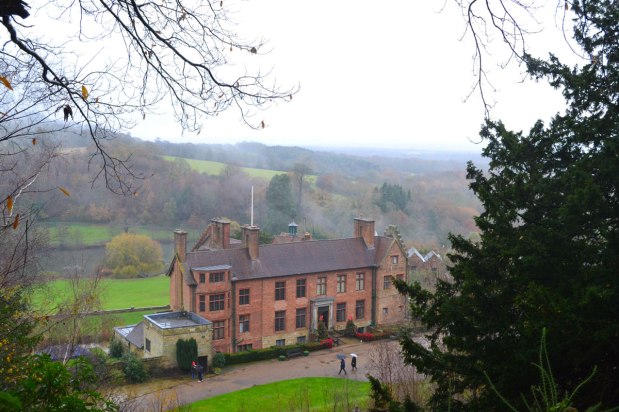
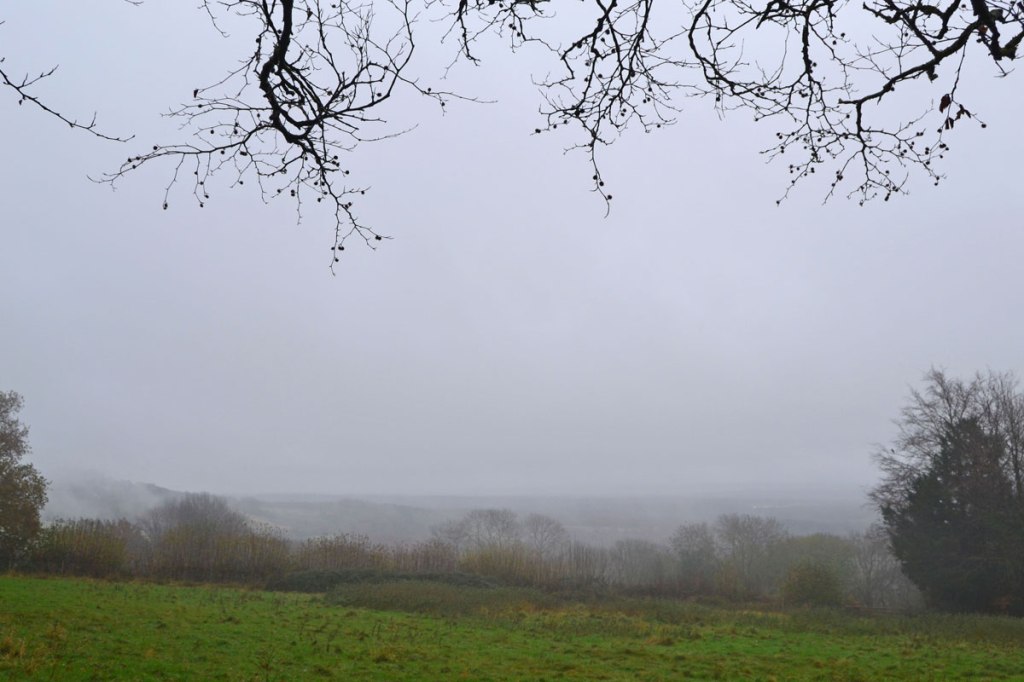
I love to walk the Hosey and Westerham routes in late autumn because of the views of the Low Weald woods from Mariner’s Hill and the hues of the trees on the lower slopes of Tower Hill along the infant River Darent. I missed out on those treats this year but last Sunday we took the Hosey route despite persistent rain and cloud so low it scudded into the hollows of the Greensand Ridge and draped itself over NT attractions such as Chartwell and nearby Emmett’s Garden. We did the walk in reverse, which made life a little less predictable but also disoriented us on a couple of occasions. Even the familiar can confuse when approached from a different direction (wise words indeed ha ha). Despite the rain and mud it was a lovely atmospheric stroll and further proof that, as the great walker Alfred Wainwright said, “there is no such thing as bad weather only the wrong clothing”. I can’t say I had the right clothing, given the fact that my jeans were covered in mud by halfway through and the skin on my bare hands had shrivelled, but these minor discomforts were dwarfed by the pleasure of being out in the countryside. Small birds, including three bullfinch – a rare sight – flittered in many of the hedgerows, a sign that recent frosts have softened and sweetened the berries enough to be gulped down. (Pictured below: Mariner’s Hill views in cloud and rain; water meadow of infant River Darent – a good spot for bullfinch. Above: Chartwell)
There’s a real pleasure to walking in very cold conditions and not only because you’ve bought some hot chocolate with you with a shot of rum in it. The light, the clouds, the wonder of winter and the sudden dusk all bring an edge of adventure. It’s a great time for a walk. Often the mud is hardened by frost too so you can stride without getting bogged down. We don’t often get snow in these parts but remember that if there’s a hint of the white stuff in south east London there’s a good chance there’s a lot more of it on the North Downs. So if you have children pining for snow larks, there’s always a chance that by heading to say Fackenden Down, Polhill or Knockholt you might have a bit of luck. It’s worked for me over the years. I particularly love the atmosphere of Knole in winter – the frosty hollows and rich (ish) bird life coupled with that huge medieval home that is lit so beautifully by the setting sun and from within as twilight comes on, are an essential part of my mid-winter wanders. This little cold snap will be over by tomorrow evening but there’ll be more to come.
In my most recent newsletter there was a glaring omission. I listed the best walks on this site for mud avoidance but forgot to mention Knole. This was particularly remiss of me because not only does it deserve a place in any list of non-muddy winter walks it should actually be top of the list.
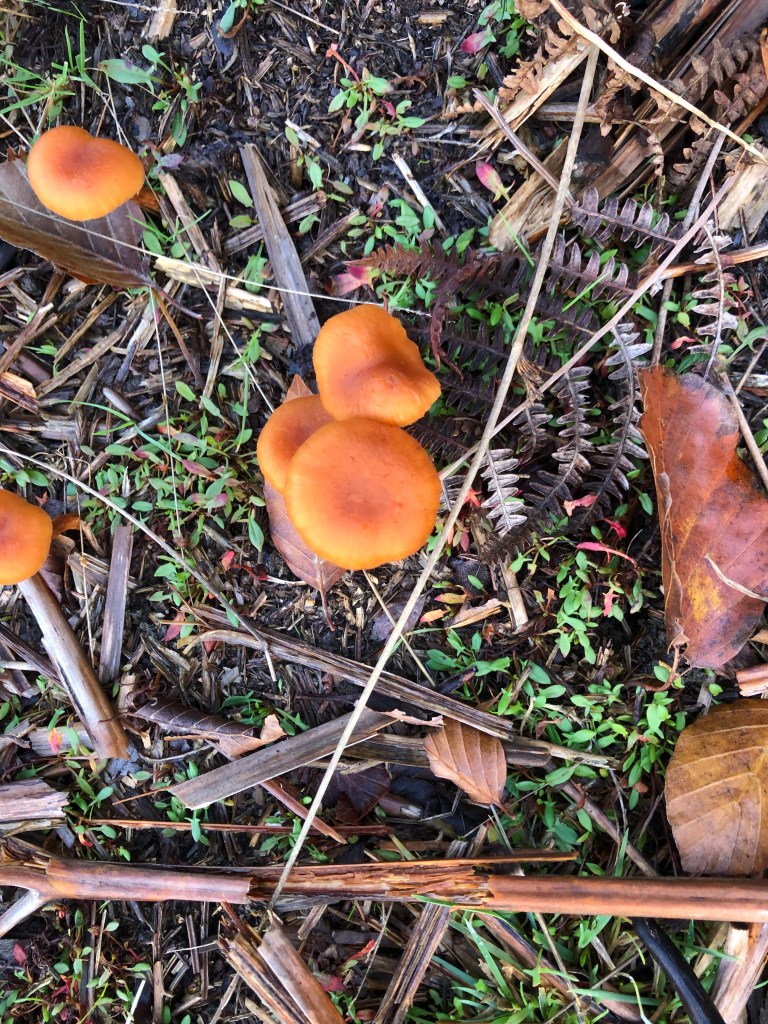
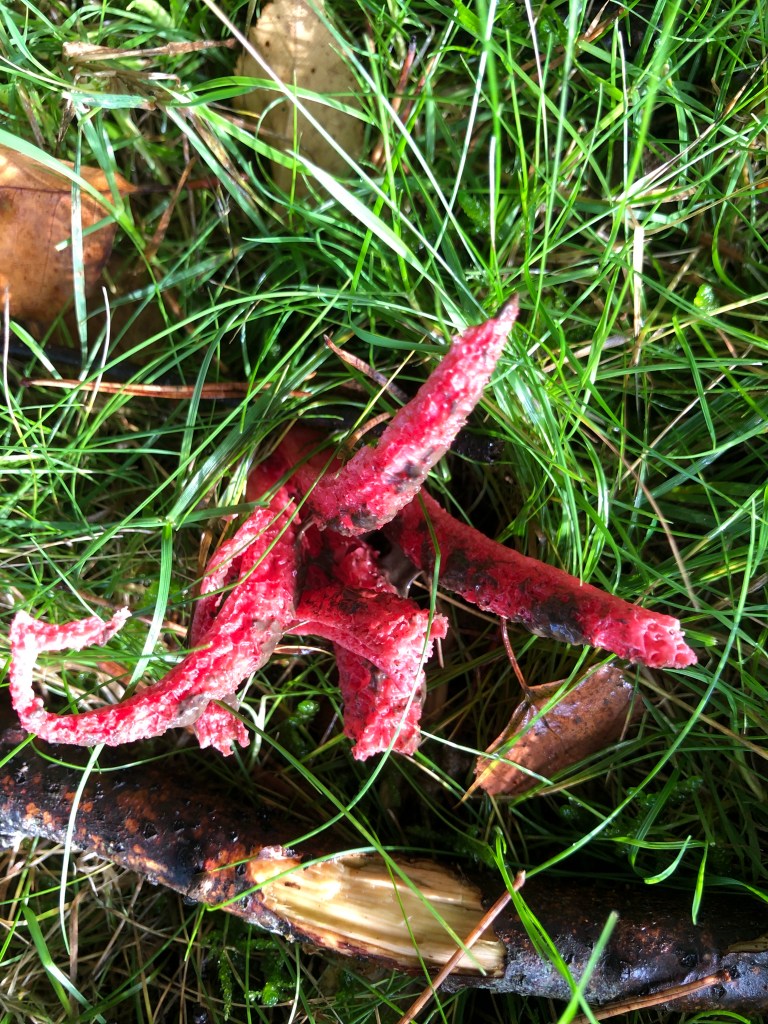
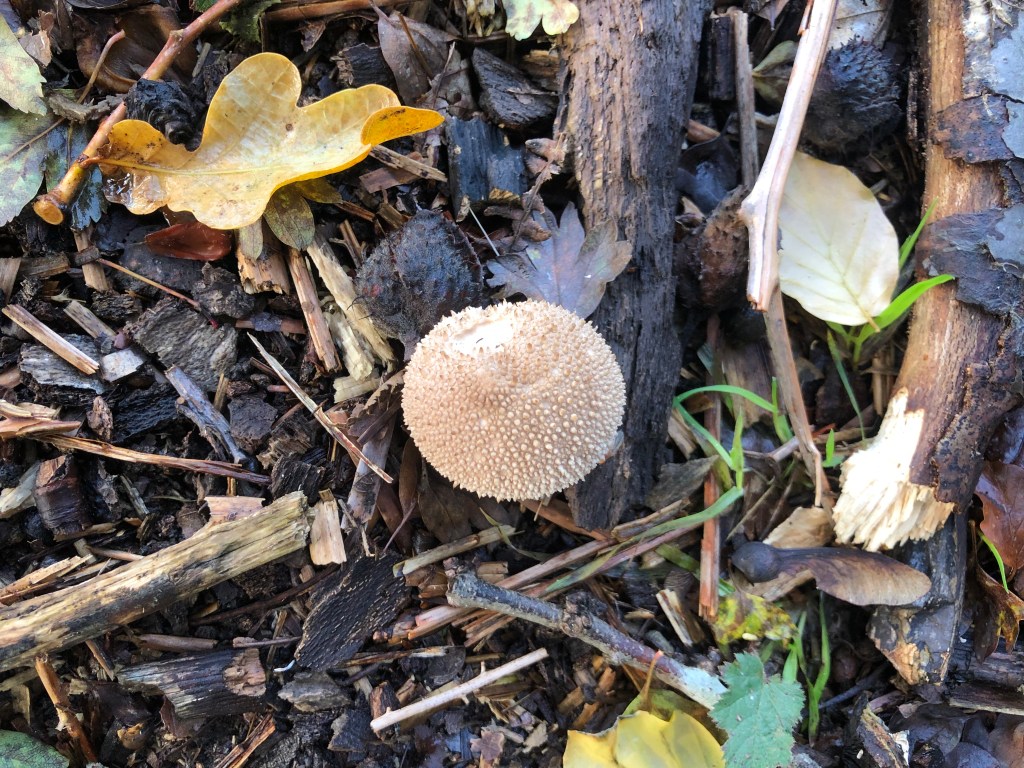
A walk there last week revealed only one properly muddy bit, in the conifer woods in the south east of the park near the beginning of the route as you cross the little stream. The park is brilliant at all times of year but I particularly love it in late autumn as small flocks of migratory birds hide in hawthorn shrubs, buzzards float high above and the deer develop enormous antlers. Fungi is also better here than on any other of the walks I think. I’m no expert, but the amethyst deceiver is among the most colourful, and there are other great species here such as saffrondrop bonnets and fairy fingers. We saw devil’s fingers on our most recent walk, very weird looking stuff.
Knole in autumn, honey fungii, parasol, puffball, devils finger
Knole (click here for National Trust description) is quite a rare terrain: it sits just behind the Greensand Ridge and is mainly composed of acid grassland (click for Kent Wildlife Trust in-depth). In fact it contains about 35% of all the acid grassland in Kent, a terrain that provides habitat for lots of wildflowers and rare fauna including lizards and adders, and invertebrates such as deadwood beetles. The little hillocks in the grass are the nests of yellow meadow ants, and in turn their presence helps support a good green woodpecker population.
Knole House
Back to mud: I’d say the best routes for mud avoidance are:
5 Ide Hill (now that the paths have been relaid – but can still get bad at points)
By and large the walks on the North Downs chalk are better for avoiding mud as water seeps through the thin soil into the porous walk quicker. Yet, to contradict this, Knole is sandstone and the worst spot for mud at KWNL is on the chalk Andrew’s Wood hillside on the way to Meenfield woods and Polhill/Pluto.
Mud, frost and snow at One Tree Hill, February 2021
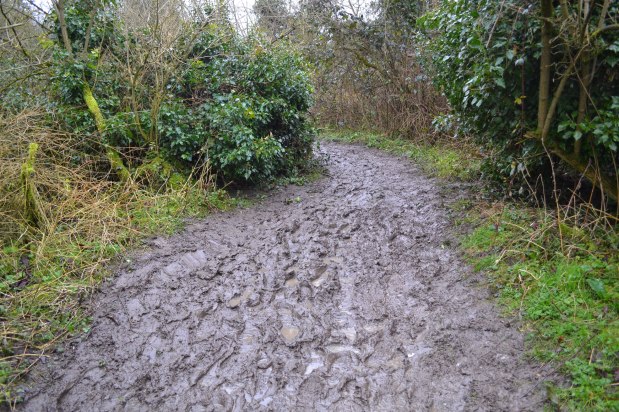
Mostly, a pair of wellies and overtrousers will sort you out where things get really squelchy but I’ll be mostly avoiding Underriver (Ramshed Farm in particular), and the Low Weald walks at Hever and Chiddingstone for now. Where paths are hemmed in a bit and popular with walkers things also get very squelchy (like the path up into Lullingstone from the Roman Villa pictured in the leading image, for example). So ‘natural causes’ are not always responsible for mud, though I suspect the water table and a layer of clay might be responsible for Andrews Wood hillside. One Tree Hill is surprising to me – it’s not a place you’d think would get so bad. It could be footfall, or perhaps some water table-related reason is the reason. Another morass is on the popular Downe walk just before you re-emerge into the village right at the end. The popular Shoreham Circular is OK, though footfall on the path through the golf course can lead to horrendously swampy conditions!
So, worst for mud are:
One Tree Hill (at the top of the hill near the car park is horrendous if wet)
Underriver (aforementioned farm and waterlogged low weald fields)
Polhill/Pluto – Andrews Wood hillside and Polhill slope itself (too slippery in winter)
Hever – hemmed in paths create WW1-type conditions
This route, no 28, is similar to walk 27, but is better for people walking on Sundays, when there is no train service. You can start it from the lovely Chequers Inn, Heaverham (if you buy a drink/meal); Kemsing village car park; or Mon-Sat from Kemsing station. Rather like the Chevening/Knockholt walk it’s another chalk escarpment route that drops down into the Vale of Holmesdale, and uses short stretches of the North Downs Way. The link below includes the usual Google map and the more useful OS map, plus written directions. PDF to download will follow in a few days!
This is a shorter version of a really great woodland autumnal route. The Oldbury walk comes in at around seven miles once you wander around a bit. That may be a bit offputting for some, who prefer a 90-minute-2-hour stroll, no more, no less. So click here for a clipped version (Ordnance Survey GPX map). On this shorter 4.2-mile version you miss out on Ightham Mote and its secret valley but other walks on this site include these superb spots, such as the two One Tree HIll walks (walk 6 and 7). So, starting in the Styants Bottom Rd car park the new walk sets off east and around the Iron Age Fort of Oldbury Hill. On the fort’s northern side there are great views to Kemsing Down and the St Clere estate at Heaverham if you walk along the field edge. Then it’s back into the woods, crossing the A25 at Crown Point and walking up towards St Lawrence church above Stone Street. Just before reaching the church turn sharp left and follow the path along a cliff edge set back from the main greensand ridge before turning left down giant steps and following the sand path north through mysterious Fishpond Wood back to the A25 then on to the car park.
Holloway on north west slope of Oldbury Hill Fort
A log looking like the remains of a prehistoric creature (eye and mouth front right)
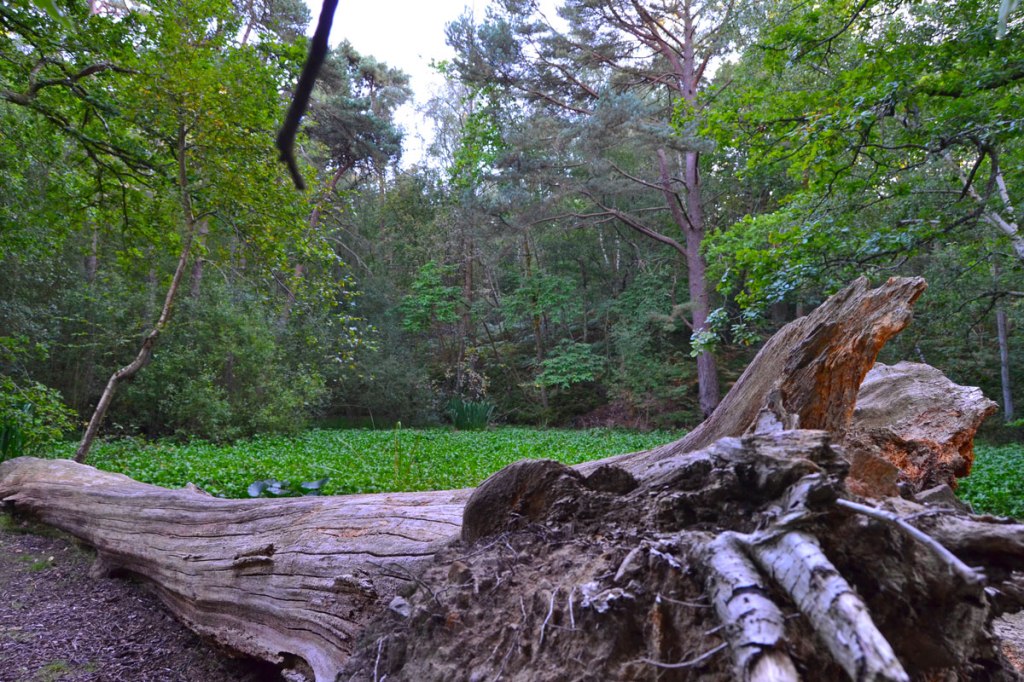
Fallen tree by one of the fish ponds, almost dry in early September
Sand path through Fishpond Woods, Oldbury
Church, Stone Street, on Oldbury walk, July
I’ve added some waypoints to the GPX map mentioned above to help you navigate. Some have labels (church, for example) others have Ordnance Survey grid references (TQ 5764 5613 etc) to help you pinpoint location on your smarphone (if you have one). I recommend using the GPX map because being mostly in woods it’s hard, otherwise, to know what path you’re on; however, walking around a bloody great lump in the form of south-east England’s largest iron age fort should help! Here’s the NT page, and here’s more about the history of the place here.
One more thing about this walk: it’s a bit spooky. The woods, the ancient fort, the hidden cliff, the mysterious ponds in the woods. It’s … atmospheric let’s say.
The Underriver walk was a picture last weekend, two unseasonably warm days that probably represented the last knockings of summer. It felt like summer and looked like summer with foliage mostly green and few birds flocking apart from some buzzards and jackdaws in a high altitude spiral. It’s another walk I now do in reverse to the sequence described on this site. One of the reasons for this is to avoid the sharp uphill section in the holloway by the “dancing beeches” just past the oasthouses at point 3. Coming downhill here then enjoying the route past Romshed farm seems a bit more civilised now I’ve done it a few times. At One Tree Hill the National Trust has trimmed the hedgerows and blackthorn clumps back to enlarge the panoramic view – and very effectively so. I’ve walked past that spot since childhood, though much more often these days, and that timeless view across the Low Weald to the Ashdown Forest and as far as the Surrey Hills in the west still grabs my attention. It’s a popular spot, as you can see in the picture below.
Walks this weekend will have a different flavour. The ground will be wetter with plenty of freshly fallen leaves. The temperature will be a lot crisper than last week, perhaps by nearly 10C, but with blue skies forecast it should be a beautiful couple of days for a stroll. And a first proper taste of autumn.
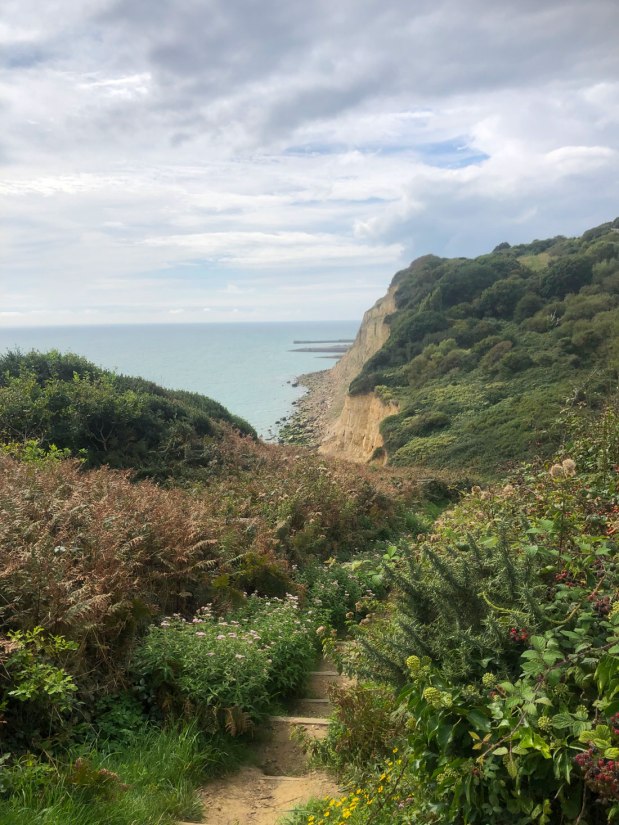
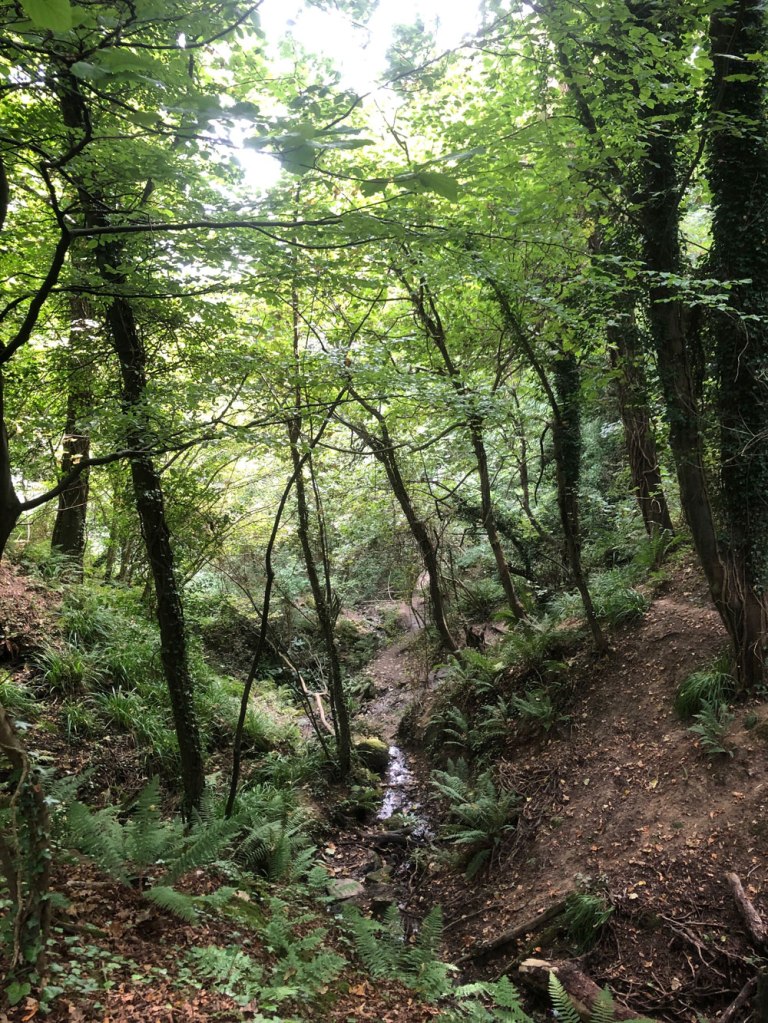
It has been known for me to make an occasional foray outside Kent to far flung parts. East Sussex is one such place. This week I ticked off a bucket list item (having once seen a TV programme extolling the nature around Fairlight Cove) by doing a long walk in Hastings country park. It’s a superb sandstone landscape of cliffs and steep ravines through which flow vigorous little streams. These ravines are called glens – Ecclestone Glen and Fairlight Glen are the most impressive – and have lots of sessile oaks (like the short, twisty oaks of Welsh valleys) and exotic-looking ferns. The glens are heat and humidity traps, so have a kind of tropical feel.
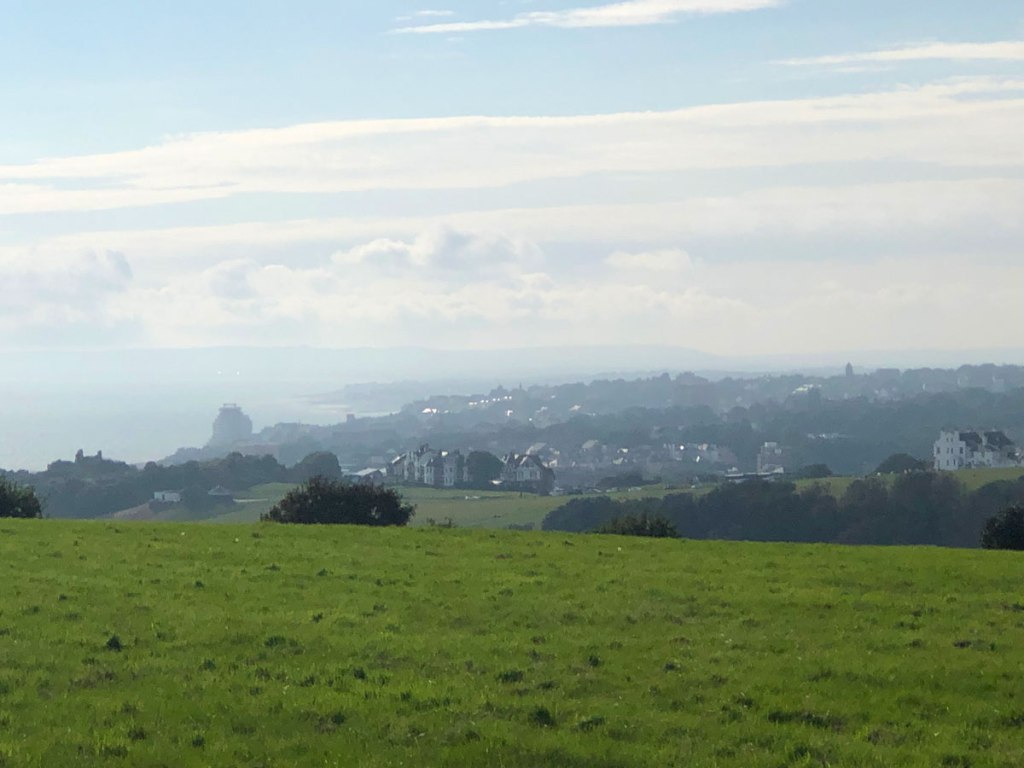
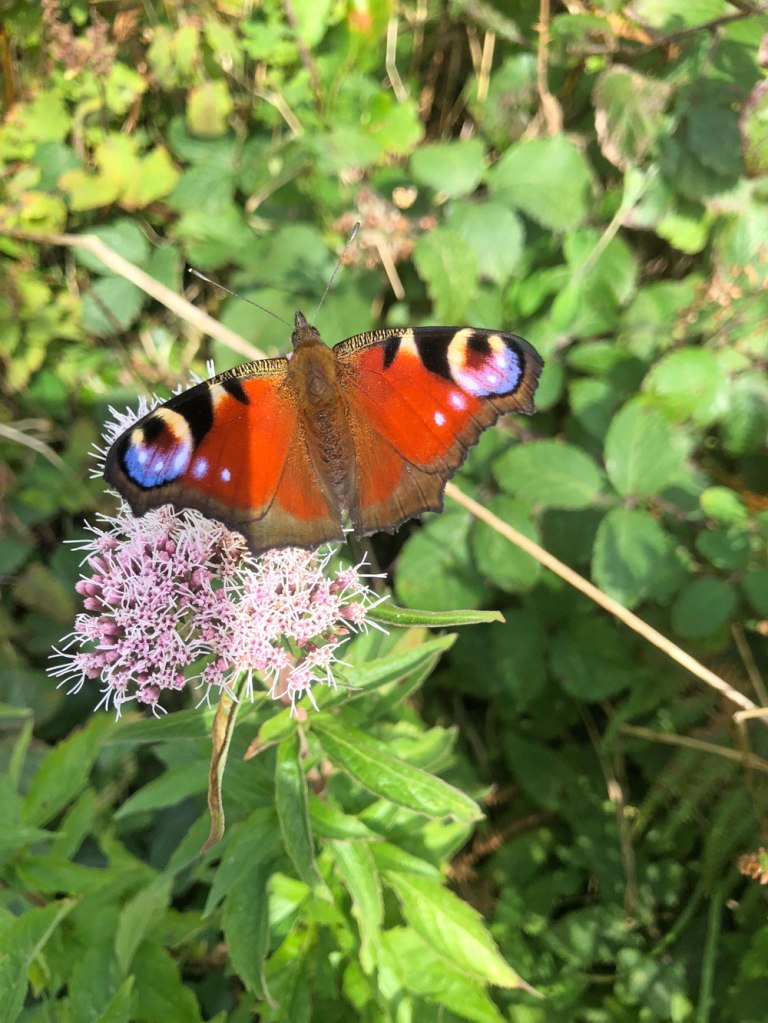
Clockwise: view of Hastings from East Hill; view of Winchelsea Beach and Camber from Firehills; a glen reaches the sea; the clifftop path; newly emerged peacock butterfly feasting on hemp-agrimony; Fairlight Glen
The trees are small because the steep slopes and sandy soil will not support any great weight. The crumbly slopes and thick scrub (superb blackberries) reminded me very much of the undercliff between Axmouth and Lyme Regis in east Devon/west Dorset. My walk started at East Hill next to Hastings Old Town and finished at Firehills, where I enjoyed a superb view over Pett Levels, Winchelsea Beach, Camber Sands to Dungeness. Later I visited beautiful Winchelsea village for the first time, swam by Hastings harbour arm and enjoyed a superb gig by Corrie Dick’s Sun Swells band hosted by Jazz Hastings at the wonderful Sea Angling Association venue overlooking the English Channel. My kind of day trip. Further explorations to exotic locations included a trip to Canterbury to see old friends and an enjoyable walk in the chalk downs at Bekesbourne.
Click here to see an OS Maps rendering of my Hastings route (with GPX navigation). You can see from the map that it would be possible to extend the walk all the way to Rye and beyond very easily; there are buses to take you back to Hastings or take the Rye train to either Hastings or Ashford to connect with a London service.
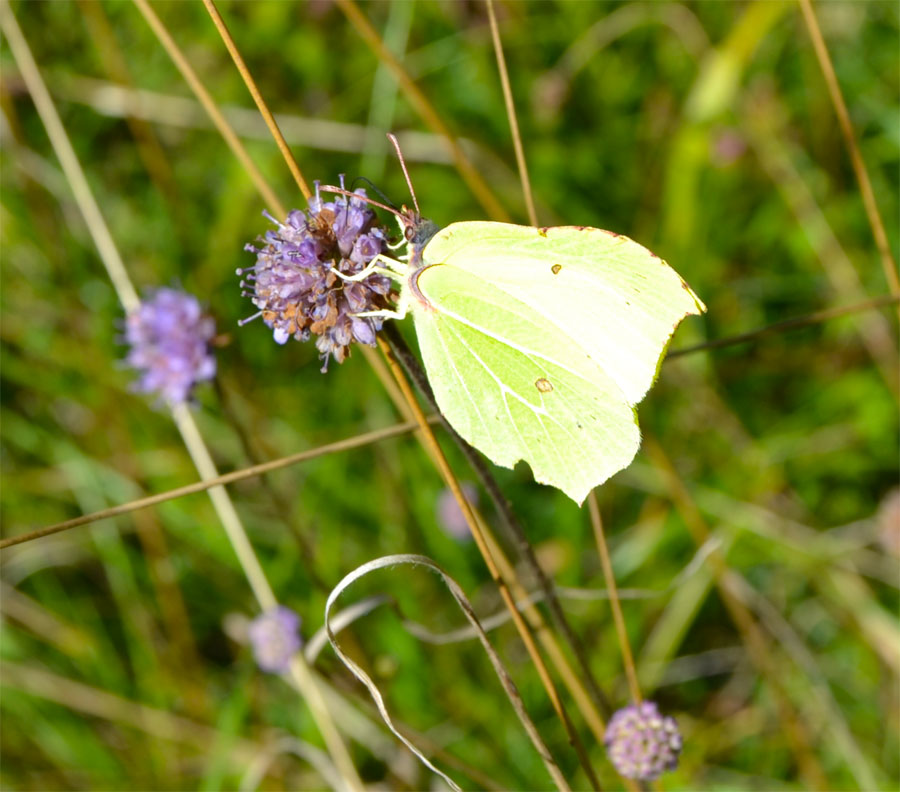
The hot sunny weather – this September has been pronounced already as one of the hottest on record in the UK – has been good news for butterflies. The Fackenden walk is particularly good for viewing them; the first few sections after the right turn on White Hill were awash with chalkhill blues, red admirals, large whites, meadow browns and gatekeepers this week. I was particularly intrigued by the numbers of brimstones flying during my sultry stroll there last Monday. These beauties are the offspring of the butterflies that emerged from hibernation in April and May. With so many scabious and devil’s-bit scabious still flowering along with the likes of fading marjoram, valerian, wild carrot and trefoil, there is plenty of foodstuff still around. That wonderful ‘garden’ running halfway up between White Hill and Fackenden Down is great for other creatures too: it’s clearly good habitat for reptiles and birds, though I’ve never personally seen much there, not even a whitethroat, blackcap or yellowhammer this summer – just a few goldfinches (a beautiful but common bird), red kite, buzzards and green woodpeckers after the many ants on these slopes. I did spot a rapidly disappearing common lizard though, after hearing a rustle in the leaf litter. Earlier in the walk, at Austin Spring I was delighted by a view of a hobby (a smallish, fast-flying falcon) hurtling straight towards me, presumably chasing dragonflies.
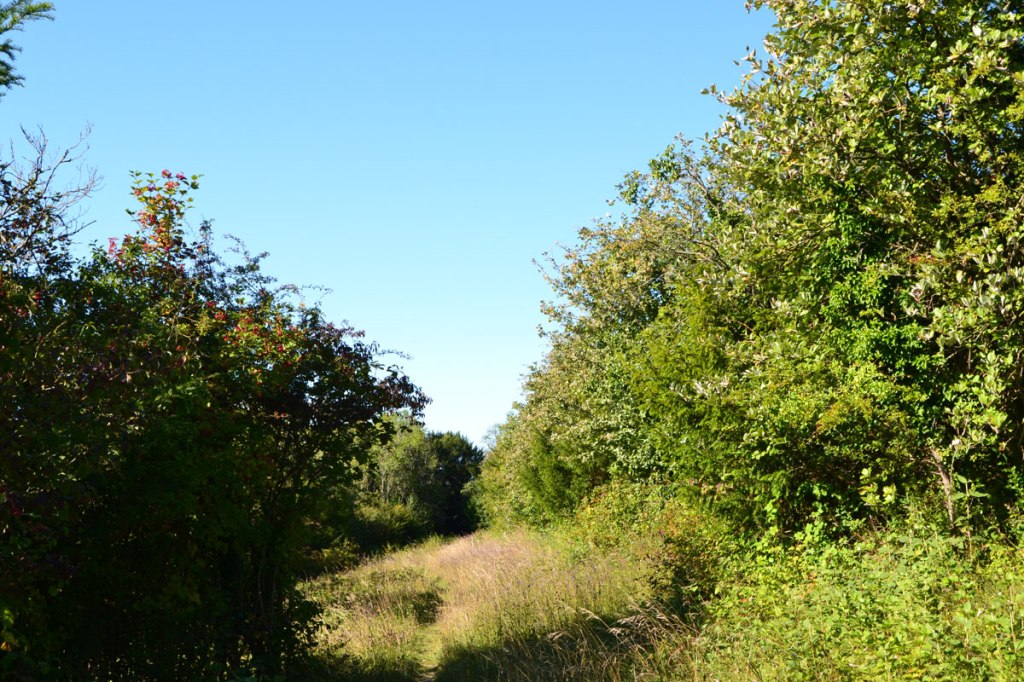
I’ve taken to doing the Fackenden route the ‘wrong’ way round these days: so I take the path on the left up White Hill that culminates in the steps, then across the Dunstall Farm fields to Austin Spring and Romney Street, Magpie Bottom (also great for flowers and insects) and eventually to Fackenden Down. Either way is great, I suppose I just want to save that ‘garden’ with its kaleidoscopic haze of grasses, scabious and insects until last. (Pictured: red admiral, brimstone, red admiral, the path linking White Hill and Fackenden Down looking north, a scabious flower and, below, a male chalkhill blue.)
Walking on the path through the scabious, ragwort, marjoram, yew trees and grasses on the chalky west-facing slopes of White Hill/Fackenden Down last Saturday I spotted a wasp spider – a creature I’d never seen personally. It’s a spectacular arachnid, one that has been increasing its numbers in the south-east over the past 15 years. I guess a powerful orb weaver like this will be snaffling up drowsy late summer insects in the coming weeks. The walk itself was as beautiful as ever but quite bereft of bird life, which isn’t unusual for late August just prior to the large migrations. Only a solitary buzzard and a charm of goldfinches being of note, though we weren’t being particularly observant. Oddly, not a single swallow was noted – unlike during the walk at Cudham the following day, where a red kite was also seen. My friend Teri took the spider photos.
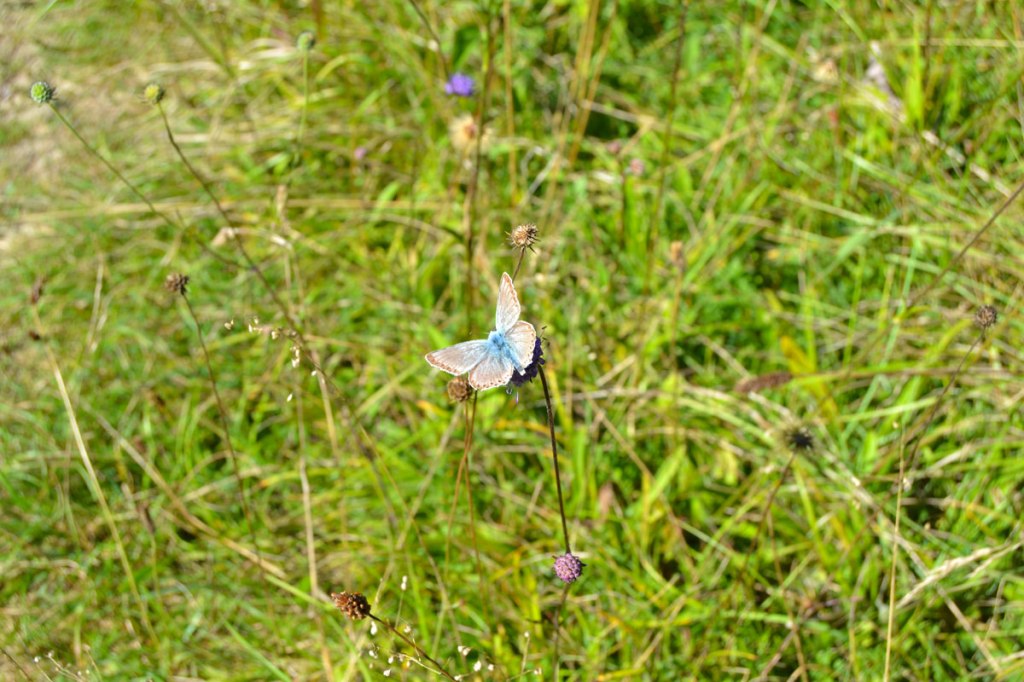
The Polhill/Pluto walk was a delight this week; a chance encounter with a brown argus butterfly (pictured below by sort-of-accident while focusing on scabious flowers) on the Polhill Kent Wildlife Trust patch a highlight. The Andrew’s Wood segment of Shoreham Woods was full of great willowherb, marjoram and wild parsnip – a colourful brew. On the Darent Valley floor itself the sunflowers at Filston Farm were a treat and there were still some wild verbascum flowers in bloom at Sepham Farm. Very few birds were seen which is quite normal for this time of year although a hobby, a buzzard and a suspected corn bunting at Filston Farm were notable spots, while swallows were beginning to gather for their big goodbye. Yellowhammer were heard but not seen at the foot of Polhill.


























 Kent walks near London